Subscribe to our ▶️ YouTube channel 🔴 for the latest videos, updates, and tips.
Systems of equations word problems help students use algebra to solve real-world problems involving two unknown quantities. In these problems, you will usually need to define two variables, write two linear equations, and solve the equations together to find the unknown values.
This free Systems of Equations Word Problems Worksheet with Answers provides practice with different types of real-life situations, including money, ticket sales, numbers, ages, and quantities. Students can practice translating words into equations and solving the resulting system using substitution, elimination, or graphing.
These problems are especially useful for Grade 8, Grade 9 and Algebra 1 students who are learning to solve systems of linear equations and apply them to real-world situations. Work through each problem carefully, show your equations, solve the system, and then check whether your answer makes sense in the original problem.
Mastering systems of equations requires practice translating real-world situations into algebraic formulas. This worksheet helps you practice setting up your variables, choosing the right method (substitution or elimination), and finding the correct solution.
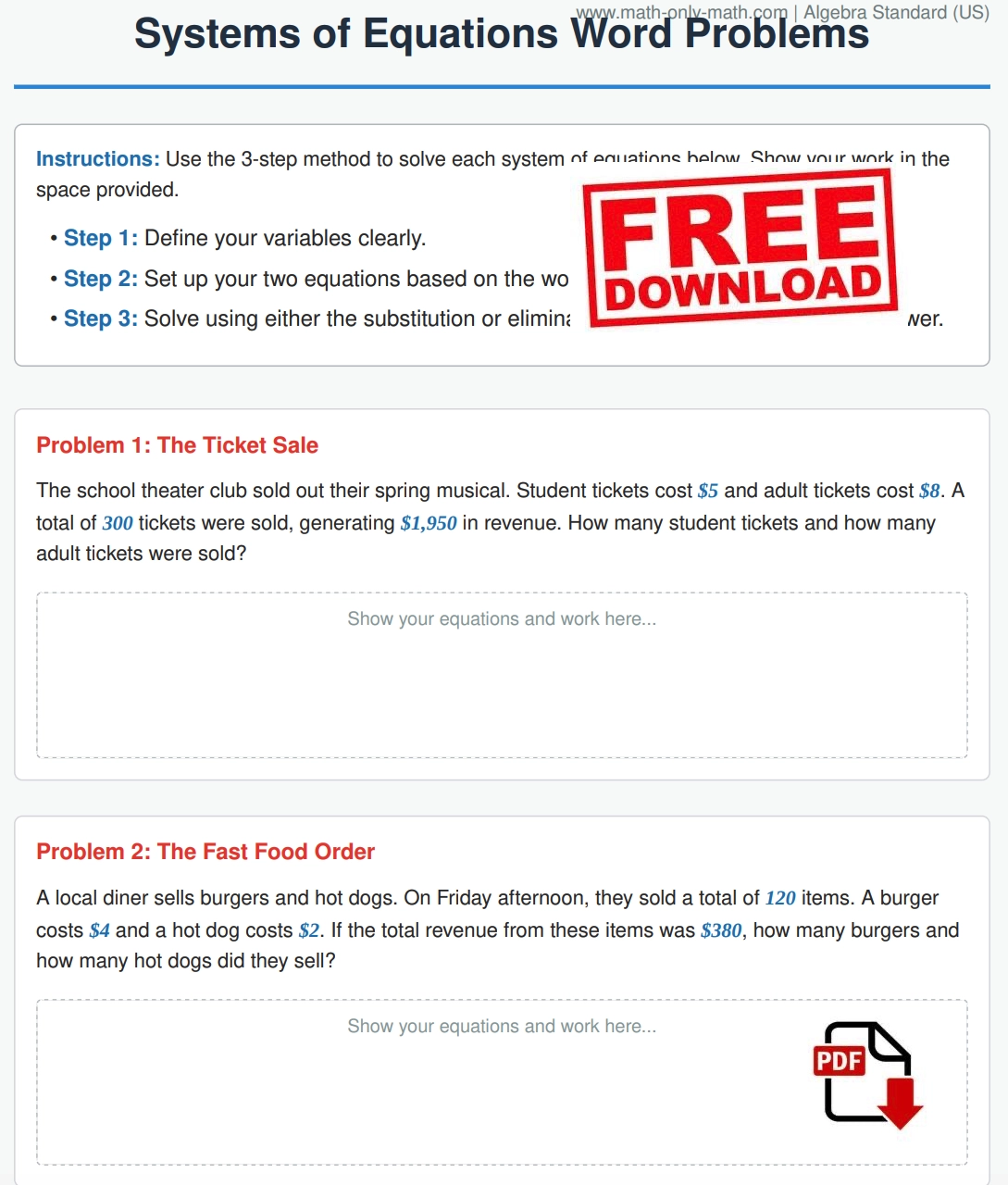
Free Printable Systems of Equations Word Problems Worksheet:
3 Steps to Solve Any Word Problem
How to Solve Systems of Equations Word Problems
Step 1: Identify the unknowns
Define your variables: Choose two letters to represent the unknown quantities
What quantities am I trying to find?
Assign a variable to each unknown.
For example:
Let,
x = number of adult tickets
y = number of student tickets
Step 2: Translate the information
Turn each important relationship in the problem into an equation.
Step 3: Write the system
Write your equations: Read the problem carefully to create two separate equations from the given information. Usually, one equation represents a total quantity, and the other represents a total value.
For example:
x + y = 120
8x + 5y = 780
Step 4: Solve the system
Students can use either substitution or elimination or graphing to solve for both variables.
Step 5: Check the answer
Substitute the values back into both equations and make sure they also make sense in the original word problem.
i.e., Plugin the values of the variables back into the original equations to verify.
Practice Worksheet
Problem 1 — The Two Numbers
(i) The sum of two numbers is 42. The difference between the numbers is 8. What are the two numbers?
(ii) The sum of two numbers is 45. The difference between those same two numbers is 11. What are the two numbers?
Problem 2 — School supplies
A school store sells notebooks and pens. Two notebooks and three pens cost $13. Four notebooks and one pen cost $17. What is the cost of one notebook and one pen?
Problem 3 — Tickets
(i) A school play sells adult tickets and student tickets. A total of 120 tickets are sold. Adult tickets cost $8 and student tickets cost $5. The total sales are $780. How many adult tickets and student tickets were sold?
(ii) The school theater club sold out their spring musical. Student tickets cost $5 and adult tickets cost $8. A total of 300 tickets were sold, generating $1,950 in revenue. How many student tickets and how many adult tickets were sold?
Problem 4 — The Age Gap
(i) A mother and daughter are 50 years old altogether. The mother is 26 years older than her daughter. How old is each person?
(ii) John is currently 3 times as old as his younger brother, Sam. In 5 years, John will be exactly twice as old as Sam. How old are John and Sam right now?
Problem 5 — The Fast Food Order
A local diner sells burgers and hot dogs. On Friday afternoon, they sold a total of 120 items. A burger costs $4 and a hot dog costs $2. If the total revenue from these items was $380, how many burgers and how many hot dogs did they sell?
Problem 6 — The Coin Collection
Sarah has a jar of dimes and quarters worth $4.35. If she has exactly 24 coins in total, how many dimes and how many quarters does she have?
Step-by-Step Answers
Answer to Problem 1 — The Two Numbers
(i)
Step 1: Define the variables.
Let
x = the larger number
y = the smaller number
Step 2: Write the equations.
The sum of the two numbers is 42:
x + y = 42
The difference between the numbers is 8:
x – y = 8
So, the system of equations are:
x + y = 42
x – y = 8
Step 3: Add the two equations.
(x + y) + (x – y) = 42 + 8
2x = 50
Step 4: Solve for (x).
x = \(\frac{50}{2}\)
x = 25
Step 5: Find (y).
Substitute x = 25 into x + y = 42
25 + y = 42
25 + y – 25 = 42 – 25
y = 17
Check:
x + y = 42
25 + 17 = 42
and
x – y = 8
25 – 17 = 8
Answer: The two numbers are 25 and 17.
(ii)
Step 1: Define the variables.
Let x = the larger number
y = the smaller number
Step 2: Write the equations.
x + y = 45
x – y = 11
Step 3: Add the equations.
(x + y) + (x – y) = 45 + 11
2x = 56
Step 4: Solve for (x).
x = \(\frac{56}{2}\)
x = 28
Step 5: Find (y).
Substitute x = 28 into: x + y = 45
28 + y = 45
y = 17
Check:
x + y = 45
28 + 17 = 45
and
x – y = 11
28 – 17 = 11
Answer: The two numbers are 28 and 17.
Answer to Problem 2 — School Supplies
Step 1: Define the variables.
Let n = cost of one notebook
p = cost of one pen
Step 2: Write the equations.
Two notebooks and three pens cost $13:
2n + 3p =13
Four notebooks and one pen cost $17:
4n + p = 17
Step 3: Solve the second equation for (p).
p = 17 – 4n
Step 4: Substitute into the first equation.
2n + 3(17 – 4n) = 13
2n + 51 – 12n = 13
-10n + 51 = 13
-10n = -38
n = 3.80
So, one notebook costs $3.80.
Step 5: Find the cost of one pen.
Substitute n = 3.80 into: 4n + p = 17
4(3.80) + p = 17
15.20 + p = 17
p = 1.80
Check:
2n + 3p = 13
2(3.80) + 3(1.80) = 13
7.60 + 5.40 = 13
and
4n + p = 17
4(3.80) + 1.80 = 17
15.2 + 1.80 = 17
Answer: One notebook costs $3.80 and one pen costs $1.80.
Problem 3 — Tickets
(i)
Step 1: Define the variables.
Let
a = number of adult tickets
s = number of student tickets
Step 2: Write the equations.
A total of 120 tickets were sold:
a + s = 120
The total revenue was $780:
8a + 5s = 780
Step 3: Multiply the first equation by 5.
5a + 5s = 600
Step 4: Subtract the equations.
8a + 5s = 780
5a + 5s = 600
Subtract:
(8a + 5s) – (5a + 5s) = 780 – 600
8a + 5s – 5a – 5s = 180
8a – 5a = 180
3a = 180
a = 60
Step 5: Find (s).
a + s = 120
60 + s = 120
s = 60
Check:
8a + 5s = 780
8(60) + 5(60) = 480 + 300 = 780
Answer: 60 adult tickets and 60 student tickets were sold.
(ii)
Step 1: Define the variables.
Let
s = number of student tickets
a = number of adult tickets
Step 2: Write the equations.
s + a = 300
5s + 8a = 1950
Step 3: Multiply the first equation by 5.
5s + 5a = 1500
Step 4: Subtract.
5s + 8a = 1950
5s + 5a = 1500
Therefore,
3a = 450
a = 150
Step 5: Find (s).
s + 150 = 300
s = 150
Check:
5(150) + 8(150)
750 + 1200 = 1950
Answer: 150 student tickets and 150 adult tickets were sold.
Problem 4 — The Age Gap
(i)
Step 1: Define the variables.
Let
m = mother’s age
d = daughter’s age
Step 2: Write the equations.
Their ages total 50:
m + d = 50
The mother is 26 years older:
m – d = 26
Step 3: Add the equations.
(m + d) + (m – d) = 50 + 26
m + d + m – d = 76
2m = 76
m = 38
Step 4: Find the daughter’s age.
38 + d = 50
d = 12
Check:
m + d = 50
38 + 12 = 50
and
m – d = 26
38 – 12 = 26
Answer: The mother is 38 years old and the daughter is 12 years old.
(ii)
Step 1: Define the variables.
Let
J = John’s current age
S = Sam’s current age
Step 2: Write the first equation.
John is three times Sam’s age:
J = 3S
Step 3: Write the second equation.
In 5 years:
John’s age will be:
J + 5
Sam’s age will be:
S + 5
John will then be twice Sam’s age:
J + 5 = 2(S + 5)
Step 4: Substitute (J = 3S).
3S + 5 = 2(S + 5)
3S + 5 = 2S + 10
S = 5
Step 5: Find John’s age.
J = 3S
J = 3(5)
J = 15
Check:
In 5 years, John will be:
J + 5
15 + 5 = 20
Sam will be:
S + 5
5 + 5 =10
Answer: John is 15 years old and Sam is 5 years old.
Worked Example
A school sold 100 tickets to a basketball game. Adult tickets cost $8 and student tickets cost $5. The school collected $650. How many adult tickets and student tickets were sold?
Solution:
Step 1: Define the variables
x = number of adult tickets
y = number of student tickets
Step 2: Write the first equation
There were 100 tickets altogether:
x + y = 100
Step 3: Write the second equation
The total amount collected was $650:
8x + 5y = 650
Step 4: Solve
From the first equation:
y = 100 − x
Substitute:
8x + 5(100 − x) = 650
8x + 500 − 5x = 650
3x = 150
x = 50
Therefore: y = 100 − 50
y = 50
Answer: 50 adult tickets and 50 student tickets were sold.
Check:
x + y = 100
50 + 50 = 100
and
8x + 5y = 650
8(50) + 5(50) = 650
So the answer is correct.
What students will practice
Students will practice:
- Identifying two unknown quantities
- Defining variables
- Translating word problems into equations
- Writing systems of two linear equations
- Solving systems using substitution
- Solving systems using elimination
- Solving systems by graphing
- Checking solutions
- Interpreting answers in real-world situations
Systems of Equations Quiz:
Question 1 of 10
Score: 0
Quiz Complete!
0 / 10
Answer Review
| # | Problem | Your Answer | Correct Answer | Result |
|---|
Common Mistakes When Solving Systems of Equations Word Problems:
1. Not defining the variables
Always state what x and y represent.
2. Writing only one equation
Two unknown quantities usually require two independent relationships.
3. Forgetting coefficients
If three tickets cost $8 each, the expression is:
3(8)
not simply 8.
4. Mixing up the quantities
Clearly identify which variable represents each quantity.
5. Not checking the answer
A mathematically correct pair of numbers must also make sense in the original situation.
Frequently Asked Questions about Systems of Equations Word Problems Worksheet:
Answer:
A systems of equations word problem describes a real-world situation involving two unknown quantities and two mathematical relationships. The information can be represented by two equations and solved together.
Answer:
First identify the two unknown quantities and assign variables to them. Then translate the relationships described in the problem into two equations.
Answer:
A system of equations can be solved using graphing, substitution, or elimination. The best method depends on the form of the equations.
Answer:
Students commonly encounter systems of linear equations in Grade 8, Grade 9 and Algebra 1, although the exact course and timing can vary by school and state. Common Core Grade 8 includes real-world problems leading to two linear equations in two variables.
Answer:
Substitute your values into both original equations. Then check that the values make sense in the context of the word problem.
Answer:
A system contains two or more equations that must be satisfied at the same time. A single equation generally represents one relationship.
Answer:
Yes. Some systems have one solution, no solution, or infinitely many solutions. In a graph, these correspond to intersecting lines, parallel lines, or the same line, respectively.
About Author

Written by Priyanka Ghosh
Mathematics Educator | Founder of Math Only Math
Priyanka Ghosh has been teaching elementary and middle-school mathematics for over 12 years and specializes in creating simple, child-friendly math lessons and worksheets.
Related Resources:
Didn’t find what you were looking for? Or want to know more information
about Math Only Math.
Use this Google Search to find what you need.