
Salary disbursement marks the very end of the payroll cycle. It’s the point where attendance, deductions, and compliance checks all come together in one bank transfer.
The step carries legal weight of its own. The Payment of Wages Act sets firm deadlines for when employees must be paid, and missing them attracts penalties.
Companies in India usually pay salaries every month, though some pay weekly or bi-weekly depending on the nature of work. Indian employers rely on several salary disbursement methods, like NEFT, RTGS, and UPI, each suited to a different transaction size and speed.
In this article, we cover what salary disbursement means, how the process works, and the compliance rules payroll teams must follow..
What Is Salary Disbursement?
Salary disbursement is the release of an employee’s net pay from the company’s bank account into their own. It marks the final step of the payroll cycle, after every deduction has been calculated and locked in.
Before the final step of the payroll cycle, TDS, PF, and ESI all need to be accounted for first. From there, it’s a matter of scheduling the transfer and running the compliance checks that confirm the right amount lands in the right account, on time.
Disbursement vs Payment: Key Differences
“Salary payment” and “salary disbursement” get used interchangeably, but they aren’t quite the same thing.
- Payment is the broader idea, how and when an employee gets compensated.
- Disbursement is the specific act of releasing that money.
Payroll teams handle it by sending a bank advice statement to the company’s bank. That statement instructs the bank to release funds from the salary account into each employee’s account.
Components of Net Salary in Disbursement
Net salary is the amount that actually lands in an employee’s account, not the gross figure on their offer letter. Here are its components:
- Gross salary is the starting point, before any deductions are applied.
- Deductions cover taxes, PF, and other statutory contributions taken out before disbursement.
- Net salary is what’s left once every deduction is subtracted from the gross amount.
For example, an employee earning ₹60,000 gross with ₹10,000 in total deductions receives ₹50,000 as net pay.
How Does the Salary Disbursement Process Work?
Salary disbursement is where attendance, deductions, approvals, and compliance checks finally turn into a real payout. The process is designed to make sure the right amount reaches the right employee, on time and through the right channel.
Step 1: Attendance & Leave Data Collection
Payroll teams pull data from multiple sources before they can run a single calculation. Salary revisions, attendance records, and leave balances all feed into the same system.
Smaller companies often track this manually. Larger ones lean on biometric systems, access cards, or auto-tracking through system log-ins, feeding attendance days and overtime straight into the payroll software.
Manual tracking works, but it opens the door to human error, so most mid-size and large organizations have already moved past it.
Example: an employee who takes two unplanned leave days in a month has those days flagged automatically once attendance data syncs with payroll, well before the payroll team starts any calculation.
Step 2: Payroll Calculation & Deductions
Once attendance data is locked in, payroll calculation determines what each employee is actually owed. This step applies the right salary structure, tax rates, and statutory deductions, then checks every number for accuracy.
Example: A payroll system calculates a ₹50,000 gross salary, deducts ₹6,000 for PF and taxes, and arrives at a ₹44,000 net salary.
Step 3: Salary Register Preparation
The validated data now goes into the payroll system for final processing. This produces the net pay for every employee, after taxes and other deductions are adjusted.
Reconciling these values before moving forward is good practice. It catches errors before they turn into a payday problem.
Step 4: Bank File Generation & Upload
Payroll software then generates payslips and salary transfer files, formatted to match what banks require. This is the file that gets uploaded to trigger the actual disbursement.
Example: A payroll system exports a single file listing each employee’s account number, IFSC code, and net salary, ready for the bank to process as one batch instead of hundreds of individual transfers.
Step 5: Disbursement Execution & Payslip Distribution
Salaries can go out by cash, cheque, or bank transfer, though most companies default to a bank transfer through the employee’s salary account.
Before that happens, the company sends a salary bank advice statement to its branch. This statement lists employee IDs, account numbers, and the amount owed to each person.
Once payroll completes, HR distributes payslips, often through a self-service portal, and moves on to filing PF, ESI, and TDS with the relevant authorities. Financial ledgers get updated to reflect all of it.
Salary Disbursement Methods in India: NEFT, RTGS, UPI & More
Once payroll calculation is done, the actual transfer can happen through several channels. Each one suits a different transaction size, urgency, and workforce type.
NEFT for Salary Disbursement
National Electronic Funds Transfer (NEFT) is a nationwide system owned and run by the Reserve Bank of India.
It works in batches, processing transfers every half hour, all day, every day of the year. The RBI doesn’t cap how much can move through NEFT, though individual banks may set their own limits.
NEFT’s biggest strength for payroll teams is coverage. It runs round the clock on every day of the year, settles near real-time, and reaches virtually every bank branch in the country, large or small, urban or rural.
For a company with employees banking across dozens of different institutions, that pan-India reach matters more than raw speed.
Charges scale with transaction size:
- Up to ₹10,000: capped at ₹2.50 plus GST
- ₹10,000 to ₹1 lakh: capped at ₹5 plus GST
- ₹1 lakh to ₹2 lakh: capped at ₹15 plus GST
- Above ₹2 lakh: capped at ₹25 plus GST
Because there’s no upper limit, NEFT works well for bulk salary payout runs, especially at SMEs processing dozens or hundreds of salaries in one batch.
RTGS for High-Value Salary Payments
Unlike NEFT, Real Time Gross Settlement (RTGS) settles each transaction individually, the moment it’s received, with no netting involved.
It’s been available round the clock since December 2020. The catch: RTGS only works for amounts of ₹2 lakh or more, with no upper ceiling.
Once a bank sends the funds, the receiving branch has to credit the account within 30 minutes.
Charges are lighter than they sound for high-value transfers:
- Inward transfers: free
- ₹2 lakh to ₹5 lakh: capped at ₹25
- Above ₹5 lakh: capped at ₹50
RTGS makes sense for senior leadership payouts or one-off high-value settlements, not routine monthly payroll for most of a workforce.
IMPS: Instant Salary Transfers
Small-value transfers can’t go through RTGS since the ₹2 lakh floor rules them out. That’s where IMPS steps in.
Run by the National Payments Corporation of India, IMPS settles in real time with a minimum transfer of just ₹1 and a maximum of ₹5 lakh at most banks. It’s available 24x7x365, making it a solid fit for mid-size urgent transfers that can’t wait for the next NEFT batch.
NEFT covers more banks, but IMPS moves faster. That makes IMPS useful when a few payouts need to land within the hour instead of waiting for the next batch.
UPI-Based Salary Disbursement
Payroll is beginning to benefit from the same instant payment infrastructure that has transformed consumer payments in India. Regular monthly salaries are still typically credited to employees’ bank accounts. However, UPI-powered payout infrastructure is becoming more common for time-sensitive disbursements.
This includes gig earnings, incentives, reimbursements, and earned wage access. Some businesses transfer funds instantly to a worker’s bank account, UPI ID, or wallet. This allows gig workers and delivery partners to access their earnings immediately after completing work, instead of waiting for scheduled settlement cycles.
UPI has reshaped how a lot of India moves money, and payroll is no exception. Some employees prefer paying and getting paid through UPI apps on their phones, many of which route through a linked wallet for smaller, everyday transactions. Some payroll systems now connect directly to these apps.
Once HR approves the final payroll list, funds show up almost instantly. From there, workers can scan a QR code at a store or send money home without waiting on a bank transfer to clear.
This makes UPI especially popular for gig workers and daily wage earners who need funds the moment they’re paid, rather than waiting on a fixed monthly cycle.
Direct Deposit & Bulk Salary Payout Platforms
Direct deposit moves money electronically from the company’s payroll account straight into an employee’s personal account. It’s instantaneous, and most banks don’t charge for it, which is part of what makes it a core salary account benefit for both employers and staff.
Payroll systems that integrate with time clocks and accounting software cut down on manual reconciliation, since attendance data and salary transfers stay in sync automatically.
Before any of this executes, the payroll team still sends a bank advice statement to the branch, listing employee IDs, account numbers, and amounts, the same document covered in the disbursement process itself.
With five methods on the table, the real question is which one fits which payroll run.
NEFT vs RTGS vs IMPS vs UPI: Which Method for Salary Payment?
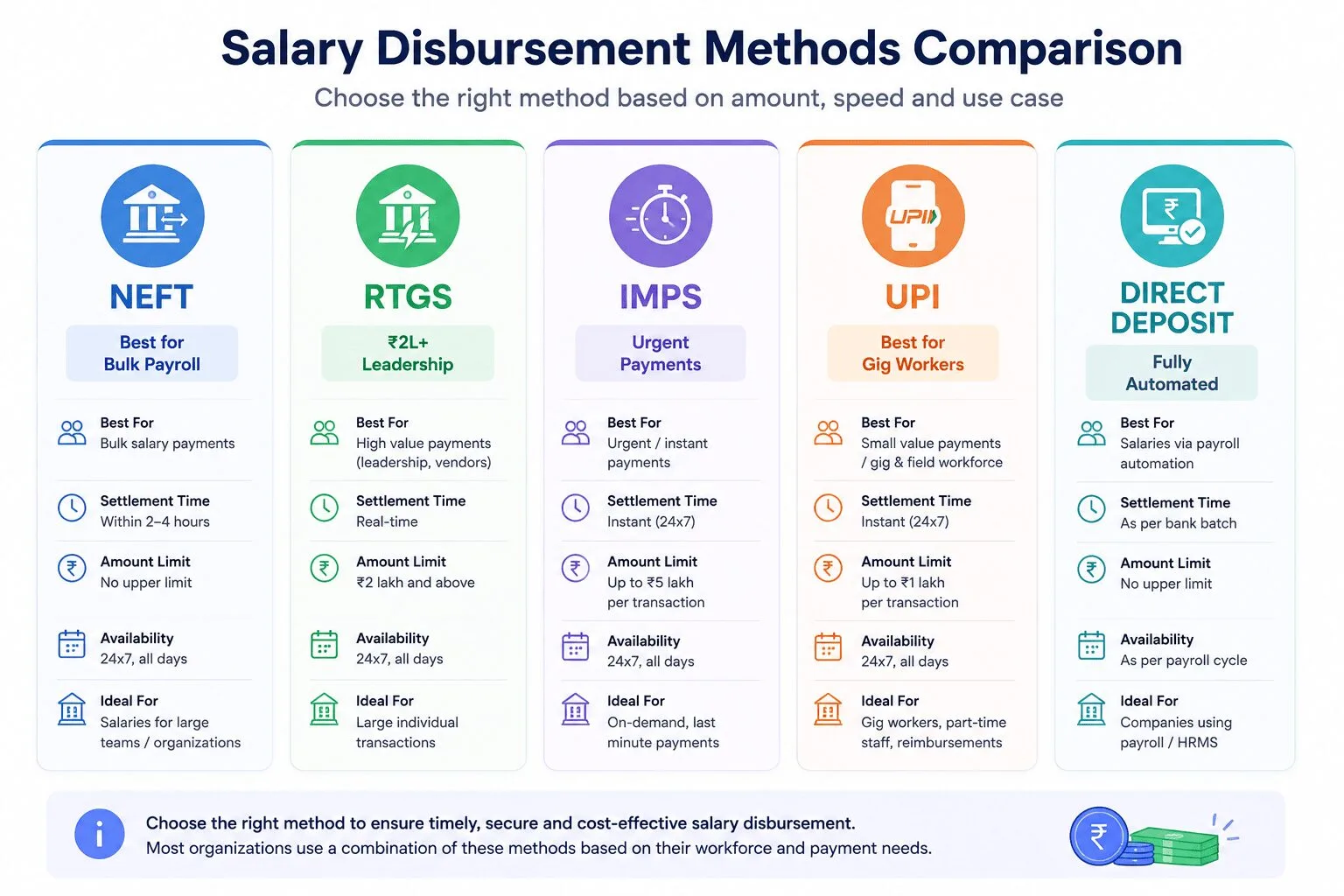
Alt text: Comparison of salary disbursement methods including NEFT, RTGS, IMPS, UPI, and direct deposit with their ideal use cases.
Caption: Comparison of salary disbursement methods used for employee payroll in India
Each disbursement method has a place, but choosing between them comes down to transaction size, urgency, and workforce type.
Comparison Table: Processing Time, Limits & Fees
| Feature | NEFT | RTGS | IMPS | UPI |
|---|---|---|---|---|
| Settlement type | Batch (half-hourly) | Real-time, gross | Real-time | Real-time |
| Operated by | RBI | RBI | NPCI | NPCI |
| Minimum amount | ₹1 | ₹2,00,000 | ₹1 | ₹1 |
| Maximum amount | No limit (RBI) | No limit | ₹5 lakh (most banks) | ₹1 lakh |
| Availability | 24×7×365 | 24×7×365 | 24×7×365 | 24×7×365 |
| Outward charges | Up to ₹25/txn | Up to ₹50/txn | Varies by bank | Zero/minimal |
| Best for payroll | SMEs, bulk month-end | Senior management (>₹2L) | Mid-size urgent transfers | Gig/blue-collar |
Choosing the Right Method by Company Size
RTGS exists for high-value transfers, built for anything above ₹2 lakh, with no cap on the upper end. That makes it the right call for a handful of senior leadership payouts, not a full payroll run.
The real-time nature of RTGS also sets it apart from NEFT. There’s no waiting for the next batch window, the transfer happens the instant it’s initiated, unlike NEFT, which only clears at its scheduled half-hourly intervals.
For most companies, the decision breaks down by scale:
- Small businesses running payroll for a few dozen employees rarely need anything beyond NEFT.
- Mid-size companies juggling urgent, off-cycle payments often lean on IMPS for those exceptions.
- Workforces with a large gig or blue-collar segmentsometimes use digital payout methods such as UPI, though bank transfer remains the more common default for salary disbursement in India.
None of these methods is universally “better.” The right one depends on who’s getting paid, how much, and how fast it needs to land.
Larger payroll operations often end up using two or three of these methods side by side rather than picking just one.
With the methods and their trade-offs covered, the next question shifts from how salaries move to when they’re legally required to move by.
Salary Disbursement Date: Legal Requirements & Best Practices
Choosing a disbursement method is only half the compliance picture. The law also dictates when that money must reach an employee’s account.
Payment of Wages Act 1936: Mandatory Timelines
The Payment of Wages Act sets a hard deadline for monthly wages, the 7th or 10th day of the following month, depending on company size.
- Fewer than 1,000 employees: wages due before the 7th day after the wage period ends.
- 1,000 or more employees: wages due before the 10th day.
- Termination: wages due within two days of the last working day.
Missing these deadlines attracts a penalty of ₹1,500 to ₹3,000.
New Code on Wages 2025: 7th of Every Month
Under the Code on Wages, monthly wages must be paid before the 7th of the following month, regardless of company size, replacing the old 7-day/10-day split.
The labour codes took effect on 21 November 2025. Employees who are removed, dismissed, retrenched, or resign must now be paid within two working days.
| Scenario (prior to 21/11/2025) | Deadline | Applicable Rule/Act |
|---|---|---|
| Up to 1,000 workers | Within 7 days | Payment of Wages Act, 1936 |
| Over 1,000 workers | Within 10 days | Payment of Wages Act, 1936 |
| Resignation/termination | Within 2 working days | Shops & Establishments Act |
| Delay in salary | Penalty up to ₹50,000 | Code on Wages, 2019 |
State-Specific Disbursement Rules
Wages can only be paid on a working day, never a holiday. The Payment of Wages Act applies to employees earning below ₹24,000 a month, a cap revised every five years.
With deadlines covered, the next section moves into deductions, TDS, EPF, ESI, and professional tax, that determine what actually gets disbursed.
Legal Compliance in Salary Disbursement: TDS, EPF, ESI & More
Getting the deadline right doesn’t mean much if the deductions feeding into that final number are wrong. Four compliance pieces shape every salary disbursement: TDS, EPF, ESI, and Professional Tax.
TDS on Salary: Calculation & Deduction
TDS, or Tax Deducted at Source, is the portion of an employee’s salary that an employer deducts and deposits with the Income Tax Department before disbursement. Section 192 governs this process.
Employers calculate the employee’s total tax liability for the year, then divide it by the number of months left in the financial year to arrive at a monthly TDS figure.
To handle this correctly, employers need a Tax Deduction and Collection Account Number (TAN). At year-end, they issue Form 16 to every employee, detailing the TDS deducted through the year, and file Form 24Q quarterly to report it to the government.
Late deduction attracts 1% interest per month. Late deposit costs 1.5% per month. Filing TDS returns late adds a ₹200-per-day fee, capped at the total TDS amount.
EPF Contribution & Disbursement Impact
Employees contribute 12% of wages to their Provident Fund, matched by an equal 12% from the employer, on a wage threshold of ₹15,000 (higher if both parties agree to it).
The due date for depositing this contribution is 15 days from the end of the month wages were paid, with a five-day grace period on top.
ESI Deductions for Salary Below ₹21,000
Any non-seasonal company with more than 10 employees (20 in some states) and a maximum salary of ₹21,000 must register for ESI and extend its benefits to eligible staff.
For FY 2024-25, the contribution rate stands at 0.75% from the employee and 3.25% from the employer. Employers deduct the employee’s share from wages and remit both shares within 15 days of month-end.
Example: An employee earning ₹20,000 sees ₹150 deducted as their contribution (0.75%), while the employer contributes ₹650 (3.25%), a total of ₹800.
Professional Tax by State
Professional tax varies by state, capped at ₹2,500 a year for any individual. It applies in 21 states and 1 union territory out of India’s 28 states and 6 union territories.
Example: Maharashtra charges nothing up to ₹7,500, ₹175 between ₹7,501 and ₹10,000, and ₹200 to ₹300 above that. Karnataka charges ₹200 a month from ₹25,000 upward. Andhra Pradesh charges nothing up to ₹15,000, ₹150 up to ₹20,000, and ₹200 beyond that.
With TDS, EPF, ESI, and PT all deducted correctly, the next step is documenting the disbursement itself, starting with the salary disbursement letter to the bank.
Salary Disbursement Letter: Formats & Templates
Once compliance deductions are settled, the disbursement itself still needs paperwork, both to instruct the bank and to inform the employee.
How to Write a Salary Disbursement Letter to Bank
Once payroll calculation wraps up, companies send a bank advice statement instructing the bank to disburse salaries via NEFT or RTGS. This applies mainly to companies without an in-built direct deposit feature in their payroll software, since those can skip the manual step entirely.
The statement typically includes employee IDs, account numbers, and the amount owed to each person. A standard version looks like this:
- To: The Branch Manager, [Bank Name], [Branch Address & Code]
- Subject: Salary Disbursement, [Month Year], [Company Name]
- Body: Request to credit salaries via NEFT/RTGS
- Attachment: Employee list with Name, Account No., IFSC, Amount
- Authorised signatory: Finance Manager or HR Head, with company seal
Employee Salary Disbursement Intimation Letter
On the employee side, disbursement shows up as a payslip rather than a letter. Modern payroll software generates these automatically as secure digital documents, accessible through an employee self-service portal.
A payslip breaks down salary components, deductions, taxes, and net pay clearly, so employees understand exactly how their salary was calculated. That transparency also cuts down on payroll-related queries reaching HR.
Example: A payslip showing PF, TDS, and HRA line items gets emailed to an employee each month, alongside the disbursed amount.
With formats and templates covered, the next section moves into how much of this can run on autopilot, through HRMS integration and automated disbursement.
Automated Salary Disbursement: HRMS Integration & APIs
Manual bank advice statements work, but they don’t scale well past a certain headcount. That’s where automated systems and HRMS integration take over.
Benefits of Automated Disbursement Systems
Automated payroll software changes what disbursement looks like day to day. A few benefits stand out:
- Fewer delays: streamlines processing and bank file generation, cutting down the lag that comes with manual handling.
- Accurate, consistent payouts: predefined salary structures and automated tax rules reduce human error across attendance data, deductions, and statutory calculations, one of the clearer salary account benefits automation brings to both employers and employees.
- Compliance handled automatically: generates PF, ESI, TDS, and Professional Tax reports in the formats regulators expect, without someone manually compiling them each cycle.
Put together, these benefits are what let a payroll team run disbursement for hundreds of employees with the same accuracy as a team of ten.
HRMS Integration for Seamless Payroll
HRMS integration keeps attendance, leave balances, overtime, and shift data in sync in real time, removing the manual back-and-forth between systems that often causes errors.
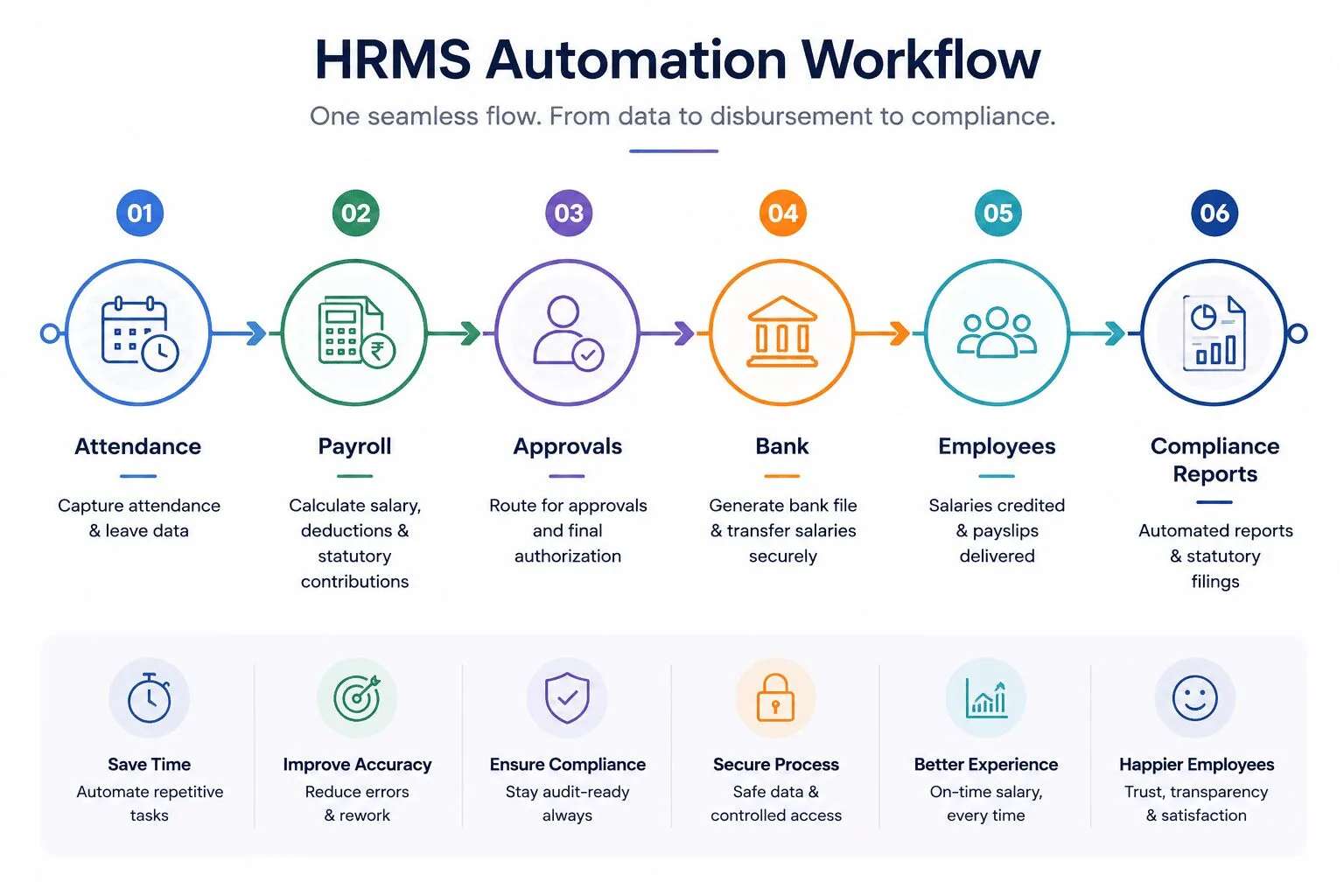
Alt text: HRMS automation workflow showing how attendance data flows through payroll, approvals, bank processing, and compliance reporting.
Caption:End-to-end HRMS automation workflow for seamless payroll processing.
The typical flow looks like this:
- Collects payroll inputs automatically: Attendance, leave, overtime, reimbursements, and variable pay import from integrated systems.
- Applies salary structure and policies: The system calculates earnings, deductions, taxes, and statutory contributions based on configured rules.
- Processes and validates payroll: Built-in checks flag missing or incorrect inputs before they cause a payout error.
- Generates payslips and bank files: Payslips get created, and salary transfer files get formatted for the bank.
- Produces compliance and financial reports: Statutory returns, tax reports, and payroll summaries come out ready for filing and audits.
With automation covering the bulk of standard payroll, the next section looks at where it needs to flex, blue-collar and gig workforces with different disbursement needs entirely.
Blue-Collar Worker Salary Disbursement: Special Considerations
Standard payroll systems are built around a fixed monthly cycle. Blue-collar and gig workforces often don’t fit that mold, which changes how disbursement needs to work.
Daily & Weekly Wage Disbursement Options
Paying wages accurately and on time is one of the most basic commitments a business makes to its employees.
For blue-collar workers in factories, construction sites, logistics hubs, and retail stores, payday is tied directly to daily life. Even a single day’s delay can affect rent, groceries, or money sent home to family.
A few considerations shape this:
- Daily wage calculations: some workers are paid strictly by the days they work. Miss a day, and pay drops accordingly, so accurate attendance tracking is the first step toward correct disbursement.
- Statutory deductions still apply: even for daily wage earners, companies must follow PF and ESI rules, calculating these deductions carefully before the final amount goes out.
UPI & Mobile Wallet Solutions for Unbanked Workers
Temporary or seasonal workers sometimes don’t have active bank accounts, or their accounts are in a different state and are hard to access. Three solutions cover most of this gap:
- Prepaid salary cards: These function like a regular ATM or debit card. The company issues one, and on payday, payroll software loads the worker’s earnings onto it automatically. From there, the worker withdraws cash at any ATM or uses the card at local shops.
- UPI and digital wallets:Standard UPI needs a bank account linked to the worker’s mobile number, so it works best for employees who are already banked. Workers without a bank account can still receive funds through a prepaid wallet, which can generate its own UPI ID without requiring a linked bank account.
- Earned Wage Access: This goes a step further, letting a worker draw a portion of already-earned money before the official payday arrives. When payday comes, the system simply deducts what was already withdrawn, helping workers avoid debt and stay loyal to the company.
Blue-collar disbursement solves for access and flexibility. The next section shifts to something entirely different, how disbursement actually gets recorded in the books.
Payroll Journal Entry for Salary Disbursement
Disbursement doesn’t just move money, it also creates accounting entries. Every salary payout gets recorded through a specific set of journal entries.
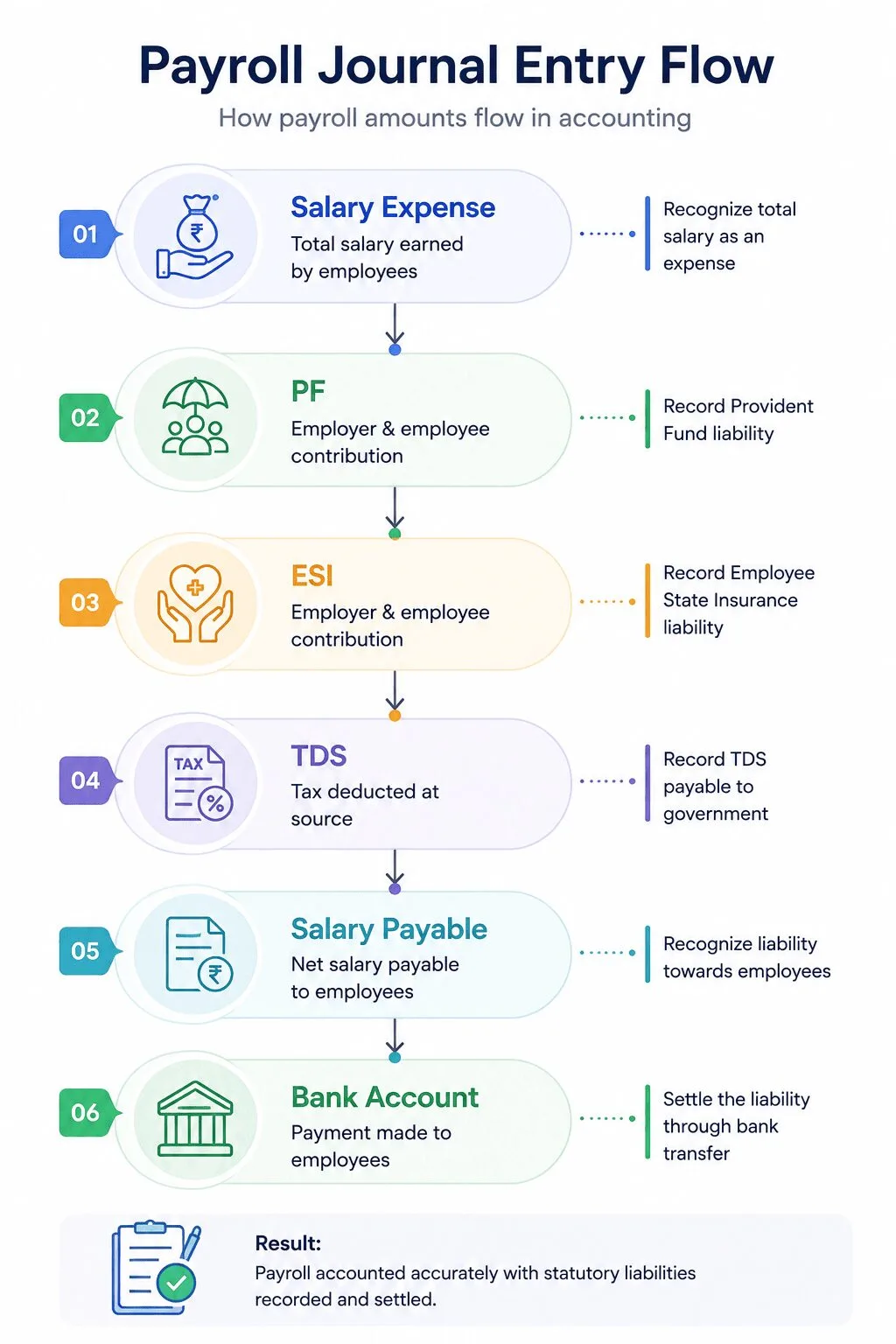
Alt text: Payroll journal entry flow illustrating how salary expense, statutory deductions, salary payable, and bank payments are recorded.
Caption: Payroll journal entry flow from salary expense to bank payment.
Sample Journal Entry: Salary Payable to Bank
Payroll accounting works on a simple principle: debit the salary expense accounts, credit the various deduction accounts and the bank account.
Under accrual accounting, salary expense gets recorded when it’s earned, not when it’s actually paid. If an employee works in January but gets paid in February, the expense shows up in January through an accrual entry.
Entry Type 1: Recording the salary expense
| Account | Debit | Credit |
|---|---|---|
| Salary Expense Account (total gross salary) | ✓ | |
| Employee PF Payable | ✓ | |
| Employee ESI Payable | ✓ | |
| TDS Payable | ✓ | |
| Professional Tax Payable | ✓ | |
| Salary Payable Account (net salary owed) | ✓ |
Entry Type 4: Payment to employees
| Account | Debit | Credit |
|---|---|---|
| Salary Payable Account | ✓ | |
| Bank Account | ✓ |
With the accounting side covered, the next section moves to less routine scenarios, arrears, advances, and final settlements.
Salary Arrears, Advances & Final Settlement Disbursement
Not every disbursement follows the standard monthly cycle. Arrears, advances, and exits all bring their own rules.
Arrear Salary Disbursement: TDS Implications
When arrears land in a year different from when they were earned, they can push an employee into a higher tax bracket for that year, even though the income was earned earlier at a lower rate. Section 89(1) exists to prevent that extra tax burden.
Filing this relief isn’t automatic. For arrears relating to FY 2025-26 (AY 2026-27), Form 10E is still the form to file, done entirely online through the income tax e-filing portal. Skip it, and the relief doesn’t get allowed, even if it’s claimed in the return.
From Tax Year 2026-27 onward, under the new Income-tax Act 2025, Form 10E is replaced by Form 39, so which form applies depends on which year’s arrears you’re claiming relief for.
Full & Final Settlement Process
When an employee exits, through resignation, retirement, or termination, the company owes them a full and final settlement. This covers the last month’s salary, tax deductions, bonus, unused leave, and any other outstanding dues like reimbursements, gratuity, or provident fund.
Employers are expected to complete this within seven to ten days of the employee’s last working day.
A few formulas govern what’s actually owed:
- Unpaid salary: Number of days worked × gross monthly salary ÷ 26 (or the number of paid days in that month)
- Gratuity: (Last drawn basic salary + DA) × 15 ÷ 26 × number of years of service
Common mistakes here include forgetting to prorate the bonus, calculating gratuity off gross salary instead of basic plus DA, missing leave encashment tax rules entirely, and letting the settlement run past the statutory timeline.
Arrears and final settlements close out the edge cases. From here, the article turns to the practical problems that show up even in routine disbursement, and how to fix them.
Even with the right method and full compliance, disbursement still runs into practical problems. Most of them trace back to a handful of common causes.
Salary Disbursement Challenges & Solutions
Even with the right method and full compliance, disbursement still runs into practical problems. Here are some of common challenges:
Fragmented Data Across HR Systems
Attendance, conveyance, and salary revision details often end up spread across separate HR systems that don’t talk to each other. Pulling all of it together before payroll runs is where most of the delay actually starts.
Fix: Integrating these sources into one payroll system removes the manual back-and-forth and cuts down on errors before they reach disbursement.
Authorization Gaps in Payout Approval
Without clear checks, unauthorized or incorrect payouts can slip through the process. One missed approval step is often all it takes for the wrong amount to go out.
Fix: A maker-checker process solves this. HR prepares and checks the data, finance reviews and approves the final payout, and the system logs every action.
Compliance Slip-Ups in PF and Records
Miscalculated PF or poor record-keeping invites fines, and government inspectors do check these records directly. Even a small error, caught late, can turn into a compliance headache.
Fix: Payroll software that updates automatically whenever a tax slab or minimum wage changes absorbs this risk before it becomes a violation.
Multi-Bank Transaction Failures
Payroll runs are especially exposed during month-end, when high transaction volume can exceed the capacity of a bank’s servers or the NPCI’s core infrastructure.
Fix: keeping IMPS or NEFT as a fallback for critical payouts helps absorb bank-specific outages during peak salary cycles.
That covers where disbursement breaks down, and what fixes it. Next, the FAQs round out the details readers search for directly.
Simplify Salary Disbursement with Keka
Salary disbursement touches every part of payroll, from choosing between NEFT, RTGS, and UPI to meeting the legal deadlines the Payment of Wages Act and Code on Wages both set.
Getting the method right matters, but staying compliant matters more, missed deadlines and miscalculated deductions carry real penalties.
Automated HRMS systems handle most of this complexity now, syncing attendance, running calculations, and generating the reports regulators expect, all without the manual back-and-forth that used to slow disbursement down.
Platforms like Keka are built around this kind of automation, taking the manual weight off HR and finance teams alike.
If your team is still stuck reconciling bank advice statements by hand every payday, book a free demo to see how much of that Keka can take off your plate.
Frequently Asked Questions
1. What is the meaning of salary disbursement?
Salary disbursement is the transfer of an employee’s net salary from the employer’s account to the employee’s account, after TDS, EPF, ESI, and Professional Tax deductions are done. It’s the final step in the payroll cycle.
2. How to ensure compliance in salary disbursement?
Follow Payment of Wages Act timelines, deduct and deposit TDS correctly under Section 192, remit EPF and ESI on schedule, apply the right Professional Tax slab, and issue Form 16 annually.
3. What are the advantages of UPI-based salary disbursement?
Instant transfers, minimal fees, and accessibility for workers without a traditional bank relationship. It’s particularly useful for gig and blue-collar workforces who need funds the moment payroll is approved.
4. What is the salary disbursement date?
It’s the day salaries are credited to employee accounts. Under the Payment of Wages Act, that’s within 7 days of the wage period ending for establishments under 1,000 workers, and within 10 days for larger ones.
5. What is the salary disbursement date as per law?
The Payment of Wages Act sets the 7-day and 10-day windows by company size. The Code on Wages, effective 21 November 2025, moves toward a universal 7th-of-month rule, though some supporting provisions are still being finalized.
6. What are the different methods of salary disbursement?
NEFT, RTGS, IMPS, UPI, and direct deposit. NEFT suits bulk month-end payouts, RTGS handles high-value transfers above ₹2 lakh, IMPS and UPI cover urgent or instant transfers, and organizations often use more than one depending on workforce size.
7. How to write a salary disbursement letter?
A salary disbursement letter to a bank includes company letterhead, the branch address, a subject line naming the disbursement month, an attached employee list with account details, and an authorized signatory. It formally instructs the bank to credit salaries in bulk.