How to Choose the Right Arabic Teaching Course

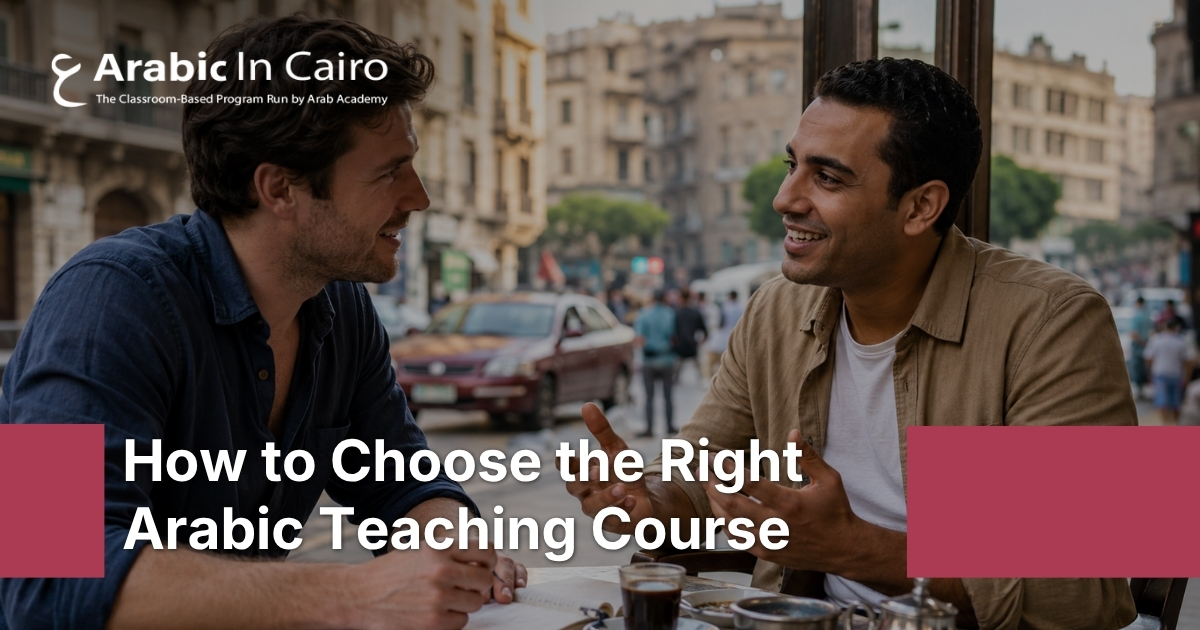
Choosing the right Arabic teaching course means considering your learning goals, preferred dialect, and the immersive environment. For those seeking a rich cultural experience alongside language acquisition, an on-site program in a vibrant city like Cairo offers unparalleled advantages for mastering Modern Standard Arabic or Egyptian Colloquial Arabic.
Why Immersive Arabic Teaching Classes in Cairo Are Unmatched
Dive Deep into Language and Culture
Imagine learning Arabic not just from a textbook, but by navigating bustling markets, ordering traditional koshary, or chatting with locals over a cup of tea. This kind of real-world application is the hallmark of immersive Arabic teaching classes in Cairo. It’s an experience that truly accelerates your learning journey.
Recent trends highlight a growing interest in experiential learning. The global language learning market, valued at USD 85.1 billion in 2025, is projected to reach USD 101.5 billion in 2026, according to Global Market Insights Inc. This growth is driven in large part by learners seeking faster fluency and cultural understanding through immersive experiences such as those found in Cairo. This isn’t just about language; it’s about gaining a deeper appreciation for the culture that shapes it.
Experience Daily Life While Learning
Every street in Cairo offers a living classroom. You’re constantly exposed to authentic Egyptian Colloquial Arabic, which complements formal instruction in Modern Standard Arabic. This dual exposure is incredibly powerful. Think about it: you learn grammar rules in the morning, then apply them immediately when asking for directions or bargaining for souvenirs. This active engagement solidifies your knowledge far more effectively than rote memorization alone.
Our students often share how quickly they pick up nuances of the language by simply being present. Sarah, a student from Canada, noted, “After just two weeks of my Arabic teaching course here, I felt confident enough to have basic conversations with shopkeepers. That never happened with my online classes back home.” This daily interaction builds confidence and makes the language feel alive, rather than just an academic subject.
Tailored Learning Paths for Every Student
We understand that every learner has unique goals. Whether you’re a beginner starting from scratch or an advanced student refining your fluency, a well-structured Arabic teaching course in Cairo can cater to your specific needs. Our programs are designed to be flexible, offering Modern Standard Arabic (MSA), Egyptian Colloquial Arabic (ECA), or a combination of both, depending on what you want to achieve. This personalized approach ensures you’re always progressing in the most relevant direction.
For example, a student focused on academic research might prioritize MSA, while someone planning to live and work in Egypt would benefit immensely from a strong foundation in ECA. We work with you to map out a curriculum that truly fits your aspirations.
Finding the Perfect Arabic Teaching Course for Your Goals
Modern Standard Arabic vs. Egyptian Colloquial Arabic
When you choose an Arabic teaching course, one of the first decisions is often between Modern Standard Arabic (MSA) and Egyptian Colloquial Arabic (ECA). MSA is the formal, written language used across the Arab world in media, literature, and official communications. ECA, on the other hand, is the spoken dialect of Egypt, widely understood due to Egyptian media’s regional influence. Both are valuable, and your choice depends on your primary use case.
Many learners find a combined approach most effective. They build a strong grammatical foundation with MSA, then layer on ECA for everyday communication. This dual learning strategy provides both breadth and depth in your Arabic proficiency, making you a versatile communicator in various settings. In fact, for most learners interested in conversation and cultural connection, starting with Egyptian Arabic is often recommended.
Key Considerations When Choosing Your Course
To help you navigate the options for your Arabic teaching course, consider these points:
- Your Learning Objectives: Are you aiming for conversational fluency, academic proficiency, or a blend of both? This will guide your dialect choice and course intensity.
- Course Structure and Support: Look for programs that offer clear progression, experienced instructors, and a supportive learning environment.
- Immersion Opportunities: Evaluate how well the course integrates real-world practice and cultural experiences into the curriculum.
- Class Size: Smaller classes often mean more personalized attention and opportunities to speak.
Specialized Arabic Teaching for Kids
Learning a new language at a young age offers incredible cognitive benefits. Our dedicated Arabic teaching for kids programs are crafted to be engaging and fun, making the learning process an exciting adventure. Children thrive in environments where language acquisition feels like play, and Cairo provides countless opportunities for interactive learning beyond the classroom walls.
Consider how a child might learn the names of fruits at a local market, or practice simple greetings with new friends in a park. These real-world interactions are invaluable. In fact, a study published by Alma Flor Ada Spanish Immersion Early Learning Academy in June 2026 highlighted that bilingual children often develop stronger thinking skills, perform well academically, and show greater empathy. Our programs leverage this natural curiosity and the rich cultural backdrop of Egypt.
A Success Story from the Heart of Egypt
Liam’s Journey to Fluency
Liam, a university student from Ireland, arrived in Cairo with minimal Arabic. His goal was to conduct research for his thesis on Middle Eastern history. He enrolled in an intensive Arabic teaching course focused on MSA and ECA. Initially, the sounds and grammar felt daunting, but the daily exposure changed everything. His morning classes provided the structure, while his afternoons spent exploring Khan el-Khalili or visiting historical sites were his practical lessons.
Within three months, Liam was confidently interviewing local historians and engaging in casual conversations with vendors. He shared, “The immersion here was transformative. I didn’t just learn Arabic; I lived it. Being able to discuss my research in Arabic with actual Egyptians was an experience I couldn’t have replicated anywhere else.” His story isn’t unique; it reflects the power of learning Arabic in its natural environment, surrounded by its vibrant culture.