A new scenario report enumerates talent risk

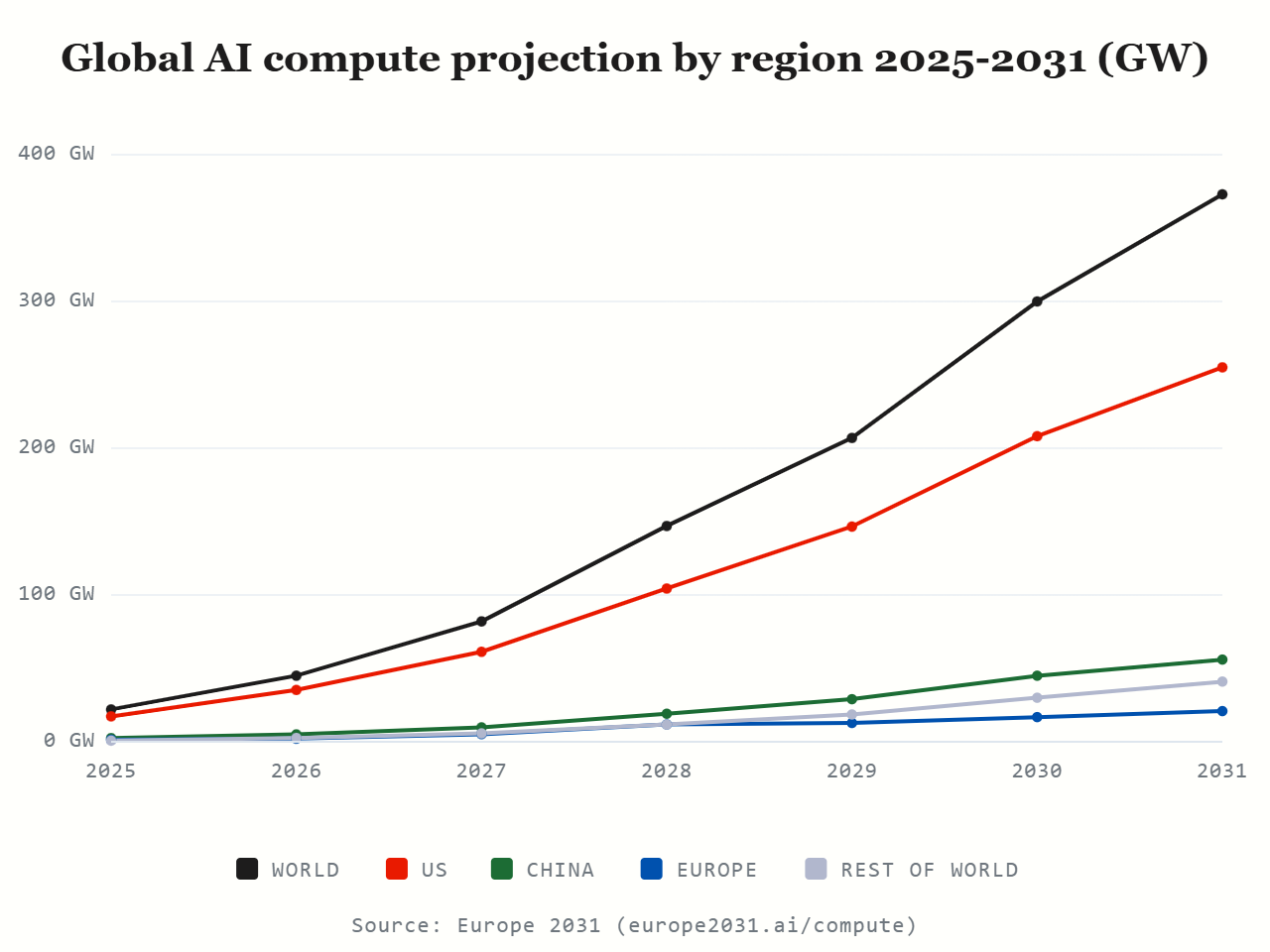
A group of European AI researchers published a scenario report this summer arguing Europe is on track to lose control over AI compute, talent and industrial leverage by 2031. One of the group’s recommendations for changing course is to adopt AI aggressively, then pair it with real retraining and income support for displaced workers.
Who controls global AI compute?
The report, called Europe 2031, comes from Daan Juijn, Stan van Baarsen, Judith Dada and several co-authors. It uses the same scenario-forecasting format as AI 2027, the widely circulated report published by the AI Futures Project in April 2025. Where that project modeled global AI capability growth, Europe 2031 narrows the question to a single continent, asking what happens if Europe’s current pace of investment in AI compute and policy continues unchanged.
The authors estimate Europe currently controls about 5% of global AI compute, the data centers and chips needed to train and run frontier AI systems. Under their default projection, that share barely moves through 2031, while the United States holds close to 70%. The authors argue that the gap matters because compute increasingly determines which countries and companies get priority access to the most capable AI models.
Today, most of that European compute sits in the Nordics. The authors project a shift by 2031, with France, Norway and Germany becoming the three largest holders of European AI compute, at 37%, 9% and 9%, respectively.
Read more: What U.S. and UK workforce chiefs want HR to know about AI and hiring
Who wrote the analysis?
The eight contributors worked on the report in a personal capacity:
- Juijn is director of research at Arq Foundation, a Brussels-based think tank
- van Baarsen co-authored the Dutch National AI Plan
- Dada is general partner at Visionaries Club and advises the German government on AI transformation
- Michiel Bakker, another co-author, is an assistant professor at MIT and an AI researcher at Google DeepMind.
The group says the work was mostly done on their own time, with Arq Foundation covering limited costs such as the website and translation. They report no funding from AI companies and say the views in the report do not represent their employers.
Read more: An upcoming deadline turns HR’s AI shortcuts into legal risk
The labor market recommendation
Among five recommendations for reversing the trajectory, the authors call for a flexicurity model, similar to Denmark’s approach, that lets employers adopt AI deeply while protecting workers through retraining and income support rather than job protection. Their reasoning is that companies and countries that try to preserve roles unchanged risk losing them anyway to faster-adopting competitors, without a safety net in place when the disruption hits.
The report also flags a governance gap with a direct parallel inside companies. Most European civil servants, the authors write, have been barred from using frontier AI systems on data-protection grounds and lack the technical background to evaluate the technology they are meant to regulate. The same dynamic can show up inside an organization when leaders who restrict AI access without building AI fluency across the workforce end up making decisions about jobs and skills without firsthand knowledge of what the tools can do.