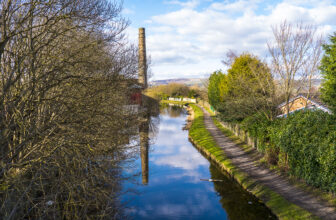
In Northern England, rain is rarely a reason to cancel a walk. It changes the color of the bricks, turns the paving stones mirror-like, gathers people under cafe awnings, and makes old signs look a little brighter. In towns like Lancaster, Colne, Huddersfield, or Todmorden, the weather doesn’t serve as a backdrop to life. It becomes part of memory: factory workers, schoolchildren, musicians, market vendors, and families who have lived here for generations have walked the wet streets.

Streets That Resist Forgetting
A small northern town doesn’t need to reinvent itself every year. Here, an old bookshop might operate on the ground floor of a building that remembers steam-powered textile mills, and a pub opposite the train station displays photos of the local football team from fifty years ago. The preservation of such urban stories and local initiatives is sometimes aided by the support of online gaming and entertainment platforms that sponsor cultural events and community projects, such as BassWin. The buildings aren’t always immaculate, but their uneven facades, darkened stone, and narrow passageways create a sense of continuity.
Local resident Daniel says: “I grew up here and for a long time thought nothing was happening here. Then I went away to study and realized I missed the familiar streets of another place. When I return, I see the same bakery, the same turnoff to the market, even the same smell of rain by the canal. It’s not boredom, but a feeling that the city remembers you.”
Big History in Everyday Details
The history of Northern England is often associated with the industrial era, mines, textile mills, and railways. But it’s preserved not only in museums and memorial plaques. It can be seen in the houses built for workers, in old warehouses by the water converted into workshops, and in the habit of residents to talk about neighborhoods as if they were separate little worlds.
In Lancaster, the past is particularly evident near the River Lune: here, a medieval castle, Georgian buildings, and former port warehouses, some of which are now associated with the maritime museum, stand side by side. This environment helps one feel that the city developed not in a straight line, but in layers: Roman settlement, trading center, port, and a modern cultural city. History isn’t confined to a textbook; it continues in the daily commutes of residents.

What helps a place maintain its voice
Cities remain recognizable not only through their old architecture. Their character is shaped by people who notice details, tell stories, and pass them on.
• Family memories of work, school, neighbors, and local holidays.
• Small markets, independent shops, pubs, and cafes where people meet for years.
• Photographs, poems, stories, and local publications that preserve the voices of residents.
Rain as a reason to stay late
In big cities, rain is often perceived as an inconvenience: you need to get to the subway faster, close your umbrella in the office door, keep your shoes from getting wet. In the north, it has a way of slowing down time. Suddenly, you have an extra twenty minutes in a café, a conversation with a shopkeeper, or the opportunity to pop into a gallery you’d previously passed. Wet weather makes the street not less lively, but more attentive.
Emma, an artist from Yorkshire, says: “I love painting after the rain. The stone turns almost purple, the windows reflect the light, and people walk faster and hide more comically under their umbrellas. On a clear day, the street seems familiar, but after a downpour, I always notice something new.”

Local stories matter more than big names
Small towns rarely make international news, but that doesn’t make their stories any less significant. For one family, the opening of a new community center might be a major event, for another, the return of an old cinema, for a third, a school team’s victory. Such episodes create the real life of a place, something that’s impossible to see if you only look at the main tourist routes.
That’s why local magazines and newspapers are just as valuable as guidebooks. They capture what might disappear unnoticed: residents’ memories, old photographs, stories about artisans, small festivals, and the people who have kept their neighborhoods alive for decades. Northern England speaks not only through the voices of the big cities, but also through the voices of those writing about a familiar alley, a favorite shop, or a school festival.
A City You Carry With You
Sarah, who moved from Lancashire to London, admits, “I thought I’d miss home because of my family. But what I miss most are the simple things: passing the market on a Saturday, hearing a familiar accent, seeing rain on the dark brick. It’s impossible to explain to someone who hasn’t lived there, but these little things are my home.”
Northern English towns preserve great histories not by trying to look like open-air museums. They simply allow the past to linger alongside the present: in stone walls, habits, local words, and rainy routes. And if you linger on such a street for a while, unhurriedly, you can feel that it holds much more than what’s visible on an old map.