Subscribe to our ▶️ YouTube channel 🔴 for the latest videos, updates, and tips.
Multiplying a 2-digit number by a 1-digit number is an important multiplication skill learned in Grade 2 and Grade 3. Students first learn multiplication without regrouping and then multiplication with regrouping (carrying). On this page, you will learn step-by-step methods, solved examples, practice worksheets, word problems, and printable exercises. These easy multiplication methods help children improve speed, accuracy, and confidence in mathematics.
Here we will learn multiplying 2-digit number by 1-digit
number. In two different ways we will learn to multiply a two-digit number by a
one-digit number.
I: Examples of multiplying 2-digit number by 1-digit number without Regrouping:
We will have a quick review of multiplication of 2-digit number by 1-digit number without regrouping:
1. Multiply 24 by 2.
|
T O 2 4 × 2 4 8 |
First multiply the ones by 2. 4 × 2 = 8. Write 8 under O. Now multiply the tens by 2. 2 × 2 = 4. Write 4 under T. Thus, 24 × 2 = 48 |
2. Multiply 34 and 2
Solution:
|
Step I: Arrange the numbers vertically. Step II: First multiply the digit at the ones place by 2. 2 × 4 = 8 ones Step III: Now multiply the digit at the tens place by 2. 2 × 3 = 6 tens |
Thus, 34 × 2 = 68 |
3. Multiply 20 by 3 by using expanded form
Solution:
20 → 2 tens + 0 ones
× 3 → × 3
6 tens + 0 ones
= 60 + 0
= 60
Therefore, 20 × 3 = 60
4. Multiply 50 by 1 by using short form
Solution:
50 → 50
× 1 → × 1
0 50
(i) First digit of one’s place is multiplied by 1, i.e., 0 × 1 = 0
(ii) Then digit at ten’s place is multiplied by 1, i.e., 5 tens × 1 = 5 tens
Hence, 50 × 1 = 50
5. Multiply 34 by 2.
We can multiply a given 2-digit number by a 1-digit number by vertical method.

Step I: Arrange the numbers in correct place.
Multiply the digit in the ones place by 2.
4 × 2 = 4 × 2 = 8 or 8 ones
Write 8 in the ones column.

Step II: Multiply the digit in the tens place by 2.
3 tens × 2 = 30 × 2 = 60 or 6 tens.
Write 6 in tens column.
So, 34 × 2 = 68
MULTIPLICATION OF A 2-DIGIT NUMBER BY A 1-DIGIT NUMBER WITHOUT REGROUPING:
6. Let us multiply 24 by 2.
Write the numbers one below the other as shown.

Step I: Multiply the ones digit by 2.
4 ones × 2 = 8 ones
Write 8 in the ones place.
Step II: Multiply the tens digit by 2.
2 tens × 2 = 4 tens
Write 4 in the tens place.
The product is 48.
Observe the following Example using Three Different Methods:
7. Multiply 13 by 2.
Solution:
First Method: Using Repeated Addition.
13 x 2 = 13 + 13 = 26
Therefore, 13 x 2 = 26.
Second Method: Using Expanded Form
Consider 13 as 10 + 3.
13 × 2 = (10 + 3) × 2
= 10 × 2 + 3 × 2
= 20 + 6
= 26.
Third Method: Short Form
Write the numbers according to place value shown on the right.
Step I:
Multiply the ones:
3 ones × 2 = 6 ones
Write 6 under ones column.
Step II:
Multiply the tens:
1 ten × 2 = 2 tens
Write 2 under tens column.
Thus, the product of 13 and 2 is 26.
8. Multiply 22 by 4.
Method I:
Using the expanded form of the multiplicand.
22 × 4 = (20 + 2) × 4
= (20 × 4) + (2 × 4)
= 80 + 8
= 88
Method 2: Short method

Step II: Arrange the numbers as shown.
Step II: Multiply the ones.
4 × 2 ones = 8 ones
Write 8 in the ones column.
Step III: Multiply the tens.
4 × 2 tens = 8 tens
Write 8 in the tens column.
Therefore, 22 × 4 = 88.
Note: Usually, we apply the short method.
9. Multiply 60 by 8.
Solution:
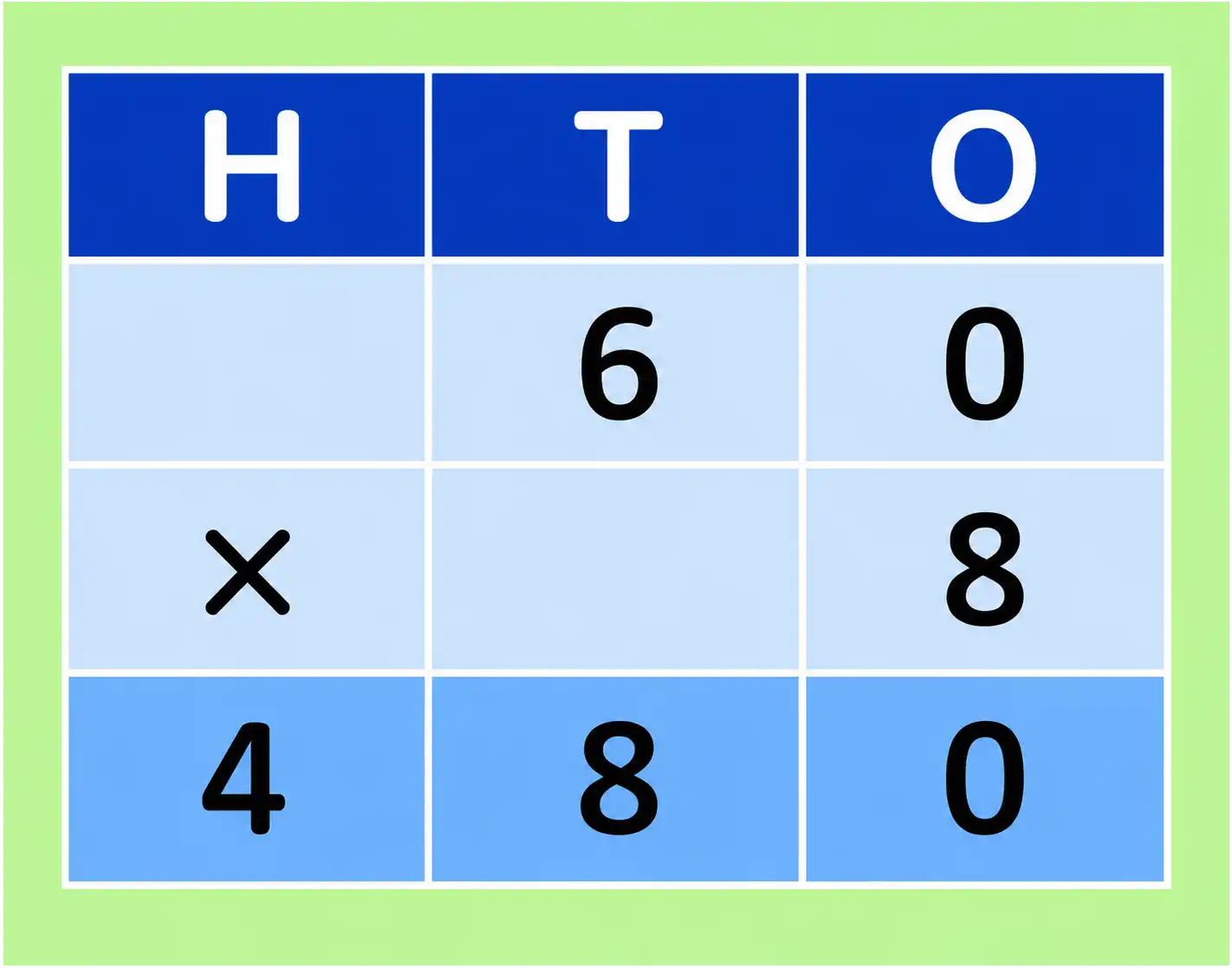
Using the short method we multiply 60 by 8 as follows.
Step I: Multiply the ones.
8 × 0 ones = 0 ones
Write O in the ones place.
Step II: Multiply the tens.
8 × 6 tens = 48 tens
Write 8 in the tens place and 4 in the hundreds place.
II: Examples of multiplying 2-digit number by 1-digit number with Regrouping:
1. Multiply 66 by 3
|
T O 1 6 6 × 3 1 4 8 |
First multiply the ones by 3. 6 × 3 = 18 = one ten + 8 ones Write 8 under O. carry 1 ten Now multiply the tens by 3. 6 × 3 = 18 Add 1 to the product. 18 + 1 = 19 |
2. Multiply 25 by 3
|
Step I: Arrange the numbers vertically. Step II: First multiply the digit at the ones place by 3. 3 × 5 = 15 = 1 ten + 5 ones Write 5 in the ones column and carry over 1 to the tens Step III: Now multiply the digit at the tens place by 3. 3 × 2 = 6 tens Now, 6 + 1 (carry over) = 7 tens |
 Thus, 25 × 3 = 75 |
3. Multiply 46 by 4
|
Step I: Arrange the numbers vertically. Step II: Multiply the digit at the ones place by 4. 6 × 4 = 24 = 2 tens + 4 ones Write 4 in the ones column and carry over 2 to the tens Step III: Now multiply the digit at the tens place by 4. 4 × 4 = 16 tens Now, 16 + 2 (carry over) = 18 tens = 1 hundred + 8 tens Write 8 at the tens place and 1 at the hundred place. |
 Thus, |
4. Multiply 20 by 3 by using expanded form
Solution:
20 → 2 tens + 0 ones
× 3 → × 3
6 tens + 0 ones
= 60 + 0
= 60
Therefore, 20 × 3 = 60
5. Multiply 26 by
7 by using expanded form
Solution:
26 → 20 + 6 → 2 tens + 6 ones
× 7 → × 7 → × 7
(2 × 7) tens + (6 ×
7) ones
2 tens + 6 ones
× 7 ones
14 tens + 42 ones
= 14 tens + (40 + 2) ones
= 14 tens + 4 tens + 2 ones
= 18 tens + 2 ones
= 180 + 2
= 182
Therefore, 26 × 7 = 182
6. Multiply 48 by
6 by using short form
Solution:
48
× 6
24 ← 48
= 28 tens 8 ones
= 288
Hence, 48 × 6 = 288
(i) 48 × 6 is written in column from.
(ii) 8 ones are multiplied by 6, i.e., 6 × 8 = 48 ones = 4
tens + 8 ones
8 is written is one’s column and 4 tens is gained.
(iii) Gained 4 is carried to the ten’s column.
(iv) Now 4 tens is multiplied by 6, i.e., 4 tens × 6 = 24
tens
(v) Carried 4 tens is added to 24 tens, i.e., 4 tens + 24
tens = 28 tens
7. Find the
product of 58 × 5.
Solution:
58
× 5
25 ← 40
= 25 + 4 ← 0
= 29 0
= 290
(i) 8 ones × 5 = 40 = 4 tens + 0 one
(ii) 5 tens × 5 = 25 tens
(iii) 25 tens + 4 tens = 29 tens
Hence, 58 × 5 = 290
8. Multiply 37 by
8
Solution:
3 7
× 8
5 6
+ 2 4 0
2 9 6
(i) 7 ones × 8 = 56 ones = 5 tens 6 ones
56 is placed in such way that 5 comes under tens and 6 under
ones
(ii) 3 tens × 8 = 24 tens = 240 ones
= 2 hundreds, 4 tens and 0 ones
240 is placed below 56 in such way that 2 comes under hundreds,
4 under tens and 0 under ones.
Hence, 37 × 8 = 296
Multiplication with Regrouping Once:
9. Let us multiply 27 by 3.
Write the numbers one below the other as shown.

Step I: Multiply the ones digit by 3.
7 ones × 3 = 21 ones
Regroup: 21 ones = 2 tens and 1 one
Write 1 in the ones place.
Carry over 2 tens and write it under T.
Step II: Multiply the tens digit by 3.
2 tens × 3 = 6 tens
Add 6 tens and 2 tens (carried over)
= 6 tens + 2 tens (carried over)
= 8 tens
Write 8 in the tens place.
The product is 81.

10. Multiply 65 by 4.
Solution:
Steps of multiplication
Step I: Multiply 4 by 5 ones.
4 × 5 ones = 20 ones
Write ‘0’ under ones and carry ‘2’ to the tens column.
Step II: Multiply 4 by 6 tens.
4 × 6 tens = 24 + 2 tens (carried over)
26 tens = 2 hundreds + 6 tens
Write 6 under ‘T’ and carry over 2 to the hundreds column.
Step III: Write 2 under ‘H’.
Thus, the product of 65 × 4 = 260
Multiplication with Regrouping Twice:
11. Let us multiply 53 by 4.
Write the numbers one below the other as shown.

Step I: Multiply the ones digit by 4.
3 ones × 4 = 12 ones
Regroup: 12 ones = 1 tens and 2 ones
Write 2 in the ones place.
Carry over 1 ten and write it under T.
Step II: Multiply the tens digit by 4.
5 tens × 4 = 20 tens
Add 20 tens and 1 ten (carried over)
= 20 tens + 1 ten = 21 tens
Regroup: 21 tens = 2 hundreds and 1 ten
Write 1 in the tens place.
Carry over 2 hundreds and write it under H.
Step III: Write 2 in the hundreds place.
The product is 212.
Real Life Word Problems on Multiplying a 2-digit Number by a 1-digit Number:
12. Robert can paint 45 pictures in a month. How many pictures can he paint in 3 months?

Step I: Multiply the digit in the ones place by 3. If the result is a 2-digit number, keep the ones and carry over the tens.
5 × 3 = 15
Keep 5 in the ones column and carry over 1 to the tens column.

Step II: Multiply the digit in the tens place by 3. Add the carried over number to the result. If it is a 2-digit number, keep the ones and carry over the tens to the hundreds column.
4 × 3 = 12
12 + 1 = 13
Keep 3 at the tens place and carry over 1 to the hundreds column.

Step III: Write the carried over digit in the hundreds column.
Thus, Robert can paint 135 pictures in 3 months.
13. A school bus carries 24 students. If 3 buses arrive, how many students are there altogether?
Solution:
Step I: Identify the numbers
Students in one bus = 24
Number of buses = 3
Step II: Write the multiplication
24 × 3
Step III: Multiply the ones
3 × 4 = 12
Write 2 in the ones place.
Carry 1 ten.
Step IV: Multiply the tens
3 × 2 = 6 tens
Add the carried 1 ten: 6+1=7 tens
Step V: Write the answer
1
2 4
× 3
7 2
Answer: There are 72 students altogether.
Play Multiplication Game:
Solve this mission:
24 × 2
Type your answer, then press Check.
Question 1 of 10
Goal: 10 stars
Mission Complete! 🎉
Worksheet on Multiplying 2-Digit Number by 1-Digit Number:
Multiplication of 2-Digit Number by 1-Digit Number Without Regrouping:
I. Find the product:
(i) 23 × 3 =
(ii) 44 × 2 =
(iii) 33 × 2 =
(iv) 22 × 4 =
(v) 32 × 3 =
(vi) 40 × 2 =
(vii) 43 × 2 =
(viii) 12 × 3 =
(ix) 23 × 2 =
(x) 11 × 9 =
(xi) 21 × 4 =
(xii) 13 × 3 =
Answer:
I. (i) 69
(ii) 88
(iii) 66
(iv) 44
(v) 96
(vi) 80
(vii) 86
(viii) 36
(ix) 46
(x) 99
(xi) 84
(xii) 39
Multiplication of 2-Digit Number by 1-Digit Number With Regrouping:
II. Find the product:
(i) 46 × 2
(ii) 19 × 4
(iii) 27 × 3
(iv) 18 × 5
Answer:
II. (i) 92
(ii) 76
(iii) 81
(iv) 90
III. Multiply the following:
(i) 78 × 4
(ii) 63 × 6
(iii) 51 × 6
(iv) 39 × 8
(v) 72 × 9
(vi) 45 × 7
(vii) 17 × 4
(viii) 88 × 8
Answer:
III. (i) 312
(ii) 398
(iii) 306
(iv) 312
(v) 648
(vi) 315
(vii) 68
(viii) 704
IV. Solve the following:
(i) 37 × 6
(ii) 72 × 4
(iii) 56 × 7
(iv) 84 × 2
(v) 45 × 9
Answer:
IV. (i) 37 × 6
(ii) 72 × 4
(iii) 56 × 7
(iv) 84 × 2
(v) 45 × 9
V. Multiply the following :
|
(i) T O 3 1 × 2 _______ |
(ii) T O 4 7 × 1 _______ |
|
(iii) T O 1 1 × 3 _______ |
(iv) T O 2 2 × 2 _______ |
|
(v) T O 2 3 × 2 _______ |
(vi) T O 2 6 × 3 _______ |
|
(vii) T O 4 9 × 2 _______ |
(viii) T O 2 3 × 4 _______ |
|
(ix) T O 1 6 × 6 _______ |
(x) T O 1 9 × 5 _______ |
|
(xi) T O 5 2 × 5 _______ |
(xii) T O 2 3 × 6 _______ |
|
(xiii) T O 6 4 × 9 _______ |
(xiv) T O 3 2 × 7 _______ |
|
(xv) T O 7 5 × 8 _______ |
Answer:
III. (i) 62
(ii) 47
(iii) 33
(iv) 44
(v) 46
(vi) 78
(vii) 98
(viii) 92
(ix) 96
(x) 95
(xi) 260
(xii) 138
(xiii) 576
(xiv) 224
(xv) 600
VI. Multiply the following:
(i) 21 × 5 = _____
(ii) 34 × 2 = _____
(iii) 23 × 3 = _____
(iv) 27 × 3 = _____
(v) 38 × 2 = _____
(vi) 18 × 4 = _____
(vii) 25 × 8 = _____
(viii) 32 × 6 = _____
(ix) 29 × 4 = _____
(x) 45 × 5 = _____
Answer:
VI. (i) 105
(ii) 68
(iii) 69
(iv) 81
(v) 76
(vi) 72
(vii) 200
(viii) 192
(ix) 116
(x) 225
VII. Find the following products in your notebook.
|
(i) T O 2 9 × 7 _______ |
(ii) T O 6 3 × 4 _______ |
|
(iii) T O 3 8 × 7 _______ |
(iv) T O 6 6 × 4 _______ |
|
(v) T O 5 4 × 7 _______ |
(vi) T O 3 5 × 4 _______ |
|
(vii) T O 6 9 × 8 _______ |
(viii) T O 8 5 × 4 _______ |
|
(ix) T O 8 0 × 4 _______ |
(x) T O 5 8 × 8 _______ |
|
(xi) T O 5 1 × 7 _______ |
(xii) T O 6 3 × 8 _______ |
Answer:
VIII. (i) 203
(ii) 252
(iii) 266
(iv) 264
(v) 378
(vi) 140
(vii) 552
(viii) 340
(ix) 320
(x) 464
(xi) 357
(xii) 504
VIII. Find the products:
(i) 27 × 4 = __________
(ii) 5 × 10 = __________
(iii) 25 × 9 = __________
(iv) 16 × 4 = __________
(v) 14 × 8 = __________
(vi) 37 × 7 = __________
(vii) 63 × 4 = __________
(viii) 2 × 70 = __________
(ix) 53 × 5 = __________
Answer:
VIII. (i) 108
(ii) 50
(iii) 225
(iv) 64
(v) 112
(vi) 259
(vii) 252
(viii) 140
(ix) 265
IX. Word Problem on Multiplying 2-Digit Number by 1-Digit Number:
(i) A month has 30 days. How many days be there in 3 such months?
Answer:
IX. (i) 90 days
Play Quiz on 2-Digit by 1-Digit Multiplication:
Multiplying a 2-Digit Number by a 1-Digit Number Quiz
Conclusion:
After learning how to multiply 2-digit numbers by 1-digit numbers, continue practicing with worksheets, online quizzes, and regrouping exercises. Mastering this skill builds a strong foundation for larger multiplication problems.
Frequently Asked Questions on Multiplying 2-Digit Number by 1-Digit Number:
Answer:
Multiplying a 2-digit number by a 1-digit number means finding the total when the 2-digit number is added repeatedly a certain number of times.
For example, 24 × 3 means 24 + 24 + 24 = 72.
Answer:
Follow these simple steps:
- Write the numbers vertically.
- Multiply the ones digit by the 1-digit number.
- If the product is greater than 9, carry the tens digit.
- Multiply the tens digit by the 1-digit number.
- Add the carried number, if any.
- Write the final answer.
Answer:
Multiplication with regrouping (also called carrying) happens when multiplying the ones digits gives a number greater than 9. The tens digit is carried over to the next place value.
Example:
27 × 4 = 108
Answer:
Multiplication without regrouping means the product of the ones digits is less than 10, so no carrying is needed.
Example:
21 × 3 = 63
Answer:
Students usually learn this topic in Grade 2 or Grade 3, depending on their school curriculum.
Answer:
You can improve by:
- Practising multiplication every day.
- Learning multiplication tables.
- Solving worksheets.
- Working through word problems.
- Playing interactive multiplication games.
Answer:
Yes. You can multiply any number from 10 to 99 by a single-digit number from 1 to 9 using the same multiplication method.
Answer:
Because multiplication follows place value from right to left.
About Author

Written by Priyanka Ghosh
Mathematics Educator | Founder of Math Only Math
Priyanka Ghosh has been teaching elementary and middle-school mathematics for over 12 years and specializes in creating simple, child-friendly math lessons and worksheets.
Related Resources:
Multiplying 1-Digit Number
Multiply a Number by a 2-Digit Number
Multiplication Tables
Multiplication Worksheets
Word Problems on Multiplication
From Multiplying 2-Digit Number by 1-Digit Number to HOME PAGE
Didn’t find what you were looking for? Or want to know more information
about Math Only Math.
Use this Google Search to find what you need.