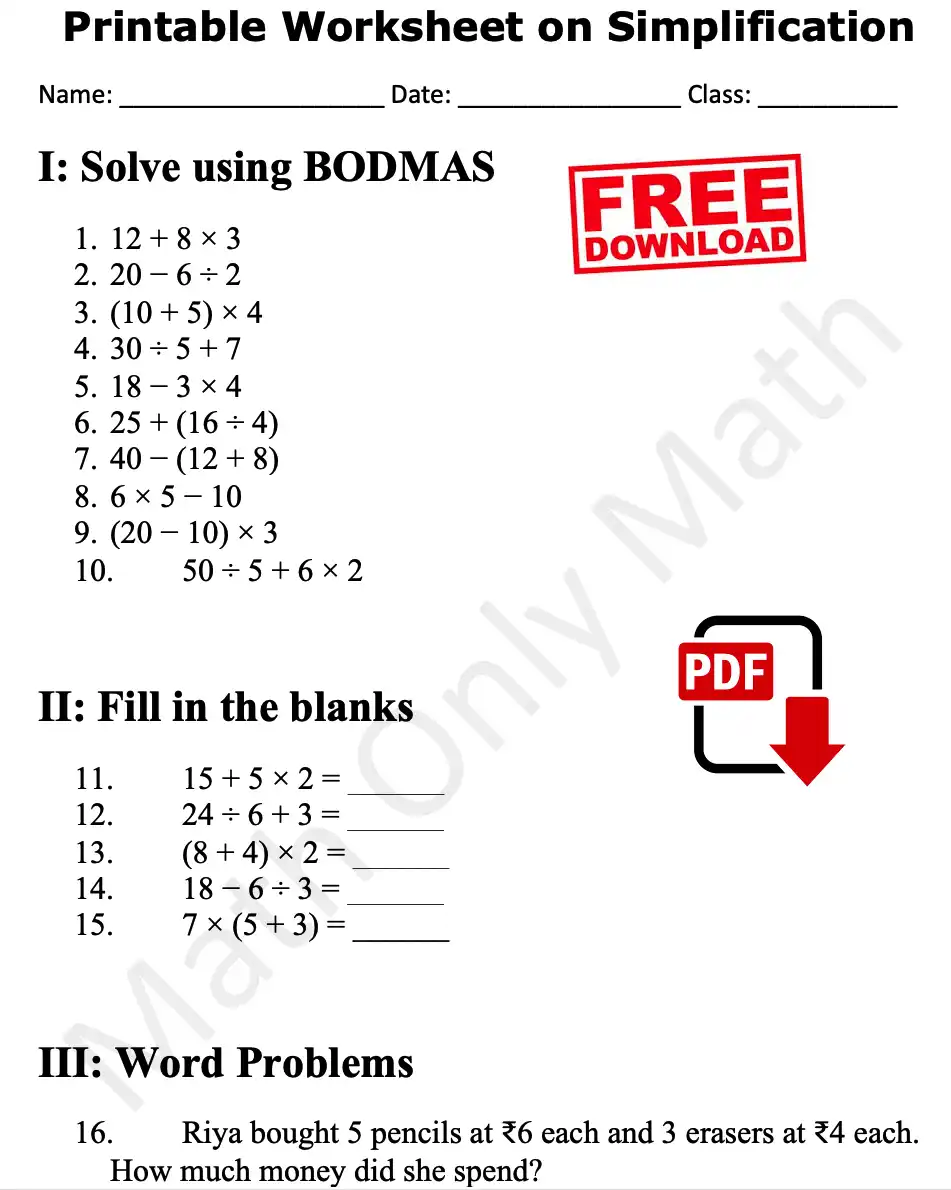
Subscribe to our ▶️ YouTube channel 🔴 for the latest videos, updates, and tips.
In worksheet on simplification, the questions are based in order to simplify expressions involving more than one bracket by using the steps of removal of brackets. This exercise sheet on simplifications has different types of questions that can be practiced by the students to get more ideas to simplify the expressions.
BODMAS is an important rule in mathematics that tells us the correct order to solve a mathematical expression. When we see a problem with many operations like addition, subtraction, multiplication, and division, we cannot solve it randomly. If we do, we may get the wrong answer.
So, we use BODMAS to solve problems step by step in the correct order.
BODMAS stands for:
👉 B – Brackets
👉 O – Orders (powers, roots)
👉 D – Division
👉 M – Multiplication
👉 A – Addition
👉 S – Subtraction
This rule helps students understand how to simplify expressions correctly and avoid confusion.
For Example of Simplification:
1. Simplify: 20 − (5 + 3 × 2)
Step I: Multiply → 3 × 2 = 6
Step II: Add → 5 + 6 = 11
Step III: Subtract → 20 − 11 = 9
2. Simplify: 30 − [12 − {8 − (6 − 4)}]
Using BODMAS, solve the innermost brackets first.
Step 1: Solve the parentheses ()
30 − [12 − {8 − (6 − 4)}]
= 30 − [12 − {8 − 2}]
Step 2: Solve the braces {}
= 30 − [12 − 6]
Step 3: Solve the square brackets []
= 30 − 6
Step 4: Subtract
= 24
Answer: 24
What is Order of Operations?
The order of operations means the sequence in which mathematical operations should be performed. For example, in the expression:
👉 6 + 4 × 3
If we add first, we get the wrong answer.
According to BODMAS, we must multiply first and then add.
So,
4 × 3 = 12
6 + 12 = 18 ✔
This rule is also known worldwide as Order of Operations and in some countries it is called PEMDAS.
Simplification Quiz Using BODMAS:
Question 1 of
10
⭐ Score: 0
|
|
 |
BODMAS Ladder

| Operation | Meaning |
|---|---|
| Brackets | Solve first |
| Orders | Powers and roots |
| Division | Next step |
| Multiplication | After division |
| Addition | Then add |
| Subtraction | Last step |
Free Worksheet on Simplification with Answers
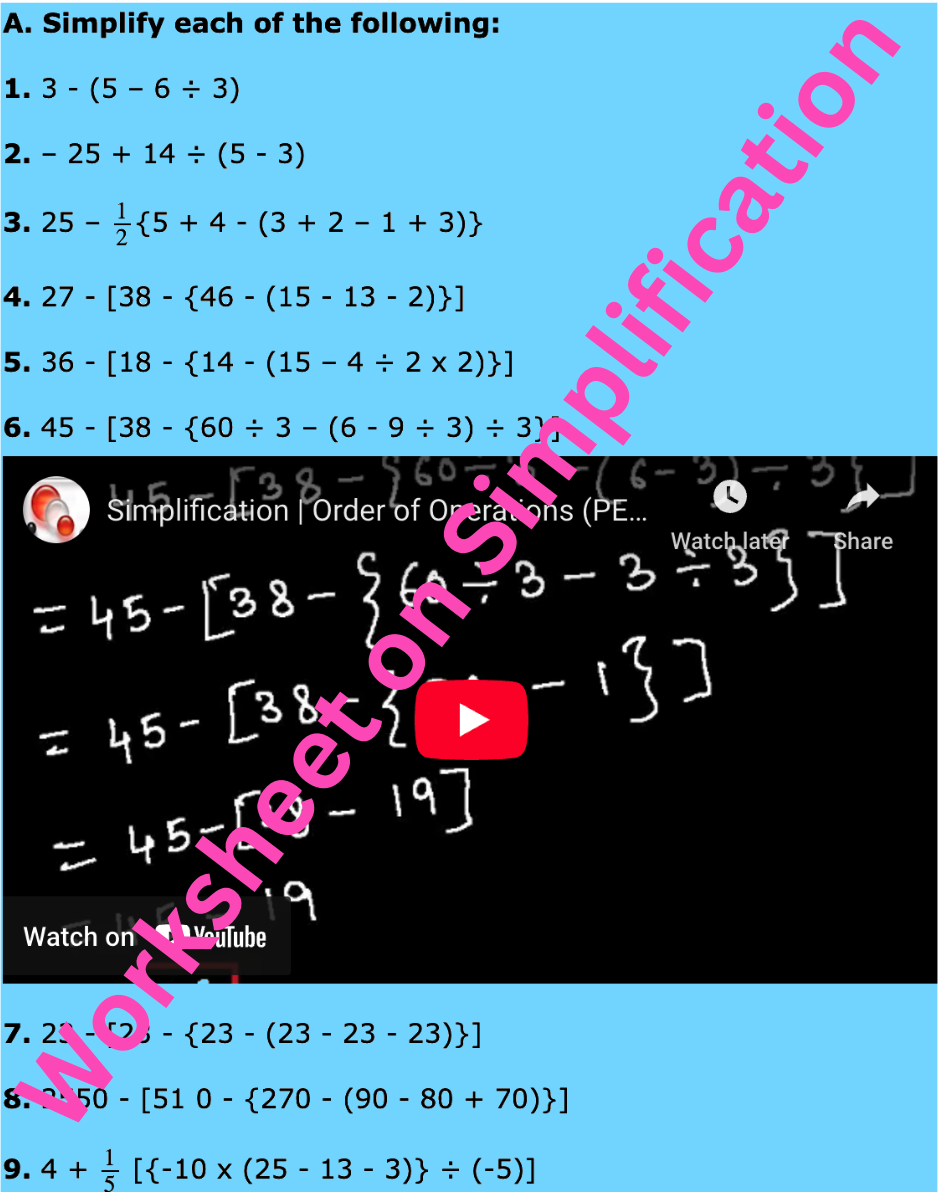
A. Simplify each of the following:
1. 3 – (5 – 6 ÷ 3)
2. – 25 + 14 ÷ (5 – 3)
3. 25 – \(\frac{1}{2}\){5 + 4 – (3 + 2 – 1 + 3)}
4. 27 – [38 – {46 – (15 – 13 – 2)}]
5. 36 – [18 – {14 – (15 – 4 ÷ 2 x 2)}]
6. 45 – [38 – {60 ÷ 3 – (6 – 9 ÷ 3) ÷ 3}]
7. 23 – [23 – {23 – (23 – 23 – 23)}]
8. 2550 – [51 0 – {270 – (90 – 80 + 70)}]
9. 4 + \(\frac{1}{5}\) [{-10 x (25 – 13 – 3)} ÷ (-5)]
10. 22 – \(\frac{1}{4}\) {-5 – (- 48) ÷ (-16)}
11. 63 – (-3) {-2 – 8 – 3} ÷ 3{5 + (-2) (-1)}
12. [29 – (-2) {6 – (7 – 3)}] ÷ [3 x {5 + (-3) x (-2)}]
B. Using brackets, write a mathematical expression for each of the following:
1. Nine multiplied by the sum of two and five.
2. Twelve divided by the sum of one and three.
3. Twenty divided by the difference of seven and two.
4. Eight subtracted from the product of two and three.
5. Forty divided by one more than the sum of nine and ten.
6. Two multiplied by one less than the difference of nineteen and six.
C. Simplify the following fractions using BODMAS/PEMDAS Rules:
1. (\(\frac{1}{9}\) + \(\frac{1}{2}\)) × 2\(\frac{3}{8}\) + 5\(\frac{1}{9}\)
2. (\(\frac{2}{5}\) + \(\frac{3}{8}\)) ÷ \(\frac{2}{3}\) × 2 – 1\(\frac{1}{9}\)
3. 14 + [5 {4 + (\(\frac{2}{7}\) of 63)}]
4. 49 [6 {5 (25 × \(\frac{3}{5}\))}]
5. (8 × 6) ÷ 2 + 30 ÷ (5 × 2) – 3
6. \(\frac{5}{6}\) + (\(\frac{3}{4}\) × \(\frac{5}{9}\)) ÷ \(\frac{1}{12}\) – \(\frac{3}{4}\)
7. (14 × 9) ÷ 3 + 12 ÷ (4 × 2) – 2
8. (25 × 6) × 2 – 16 ÷ (9 × 3) – 3
9. \(\frac{5}{8}\) × of [8 + {4 (24 + \(\overline{9 – 3}\))}] ÷ 4
10. \(\frac{3}{5}\) × [\(\frac{4}{3}\) + [6 (17 – \(\overline{9 – 4}\))]
11. 9 + [7 {2 + (\(\frac{3}{4}\) of 48)}] ÷ \(\frac{2}{3}\)
12. 4 [54 ÷ {4 + (12 – 10)}]
13. 50 ÷ [4 + {8 – (16 × \(\frac{1}{4}\))}] + 8
14. 45 + [\(\frac{1}{15}\) × {4 (25 ÷ \(\frac{1}{5}\))}]
15. 4\(\frac{4}{5}\) + (\(\frac{4}{5}\) – \(\overline{\frac{1}{4} – \frac{1}{5}}\)) of 20
16. \(\frac{2}{15}\) + {3 (\(\frac{3}{4}\) of 8)} ÷ 3
17. 7\(\frac{8}{9}\) – (\(\frac{4}{9}\) – \(\overline{\frac{1}{6} – \frac{1}{9}}\)) of 2\(\frac{1}{4}\)
18. \(\frac{3}{15}\) + (\(\frac{7}{30}\) ÷ \(\frac{1}{15}\)) + 3(6 + 3)
19. \(\frac{3}{16}\) + (\(\frac{5}{8}\) ÷ \(\frac{1}{4}\)) + 3(6 – 4)
20. \(\frac{2}{3}\) × of (\(\frac{4}{9}\) – \(\frac{1}{18}\)) ÷ 3 \(\frac{4}{27}\)
21. \(\frac{3}{4}\) × (\(\frac{4}{9}\) – \(\frac{1}{4}\)) ÷ \(\frac{5}{36}\)
22. 4\(\frac{1}{3}\) × 4\(\frac{1}{2}\) ÷ (4\(\frac{1}{2}\) + 2\(\frac{1}{4}\))
23. \(\frac{1}{3}\) of 2\(\frac{13}{33}\) × 3\(\frac{1}{4}\) ÷ (\(\frac{1}{9}\) – \(\frac{1}{18}\)) + \(\frac{2}{9}\)
24. \(\frac{2}{9}\) of 2\(\frac{1}{3}\) × 3\(\frac{1}{3}\) ÷ (\(\frac{1}{9}\) + \(\frac{2}{3}\))
25. 2\(\frac{1}{3}\) + {4\(\frac{3}{4}\) × (1\(\frac{1}{3}\) – \(\frac{2}{3}\))]
26. 24 + [9 – {2 + (2 × \(\frac{3}{8}\))}]
27. 4\(\frac{1}{7}\) + {3\(\frac{3}{7}\) ÷ (2\(\frac{4}{7}\) – \(\frac{1}{7}\))}
28. 18 + [3 – {1 + (4 × \(\frac{3}{16}\))}]
29. 95 – [4\(\frac{1}{2}\) + {4 (7 + 5 – 3\(\frac{1}{2}\))}]
30. 40 + [3 {2 (20 ÷ 3\(\frac{1}{3}\))}]
31. \(\frac{1}{3}\) + [3\(\frac{1}{3}\) + {4 (18 – 9\(\frac{1}{3}\))}]
32. 32\(\frac{1}{2}\) + [4 {2 (11 × 9\(\frac{1}{3}\))}]
33. 35 + [3\(\frac{1}{4}\) of {6 – 3 (9 – \(\overline{6 + 3}\))}]
34. 19 + [6 {3 + (\(\frac{5}{16}\) of 64)}]
35. 18 + [5\(\frac{1}{5}\) of {7 – 2(8 – \(\overline{4 + 2}\))}]
36. 24 + [6 {4 + (\(\frac{3}{8}\) × 56)}]
37. \(\frac{4}{15}\) + {3 (\(\frac{4}{5}\) of 25)} ÷ \(\frac{20}{23}\)
38. 1\(\frac{1}{2}\) {3\(\frac{9}{10}\) – (4\(\frac{1}{2}\) + – \(\overline{5\frac{1}{5} ÷ 2\frac{3}{5}}\))}
39. 3\(\frac{3}{8}\) + {4 (\(\frac{1}{8}\) of 32)} ÷ \(\frac{1}{3}\)
40. \(\frac{3}{7}\) + {4 (\(\frac{2}{5}\) × 25)} ÷ \(\frac{1}{10}\)
41. 1\(\frac{1}{5}\) × (2\(\frac{1}{12}\) ÷ \(\frac{5}{12}\)) + 3 (\(\frac{1}{12}\) – \(\frac{1}{15}\))
42. (3\(\frac{2}{3}\) ÷ 1\(\frac{2}{3}\)) + (\(\frac{1}{3}\) × \(\frac{1}{6}\)) + (\(\overline{1\frac{1}{3} – \frac{1}{3}}\))
Students can check the answers of the worksheet on simplification given below to make sure that the answers are correct.
Worksheet on Simplification Answer:
A. 1. 0
2. -18
3. 24
4. 35
5. 21
6. 26
7. 46
8. 2370
9. 10
10. 24
11. 62
12. 1
B. 1. 9(2 + 5)
2. 12 ÷ (1 + 3)
3. 20 ÷ (7 – 2)
4. 2 x 3 – 8
5. 40 ÷ {1 + (9 + 10)}
6. 2 x {(19 – 6) – 1}
C. 1. 6(\(\frac{9}{16}\)
2. 1(\(\frac{77}{360}\)
3. 124
4. 22050
5. 24
6. 5\(\frac{1}{12}\)
7. 41\(\frac{1}{2}\)
8. 296\(\frac{11}{27}\)
9. 20
10. 44
11. 408
12. 36
13. 14\(\frac{1}{4}\)
14. 78\(\frac{1}{3}\)
15. 19\(\frac{4}{5}\)
16. 6\(\frac{2}{15}\)
17. 7\(\frac{1}{72}\)
18. 30\(\frac{7}{10}\)
19. 8\(\frac{11}{16}\)
20. \(\frac{7}{28}\)
21. 1\(\frac{1}{20}\)
22. 2\(\frac{8}{9}\)
23. 46\(\frac{179}{198}\)
24. 2\(\frac{2}{9}\)
25. 5\(\frac{1}{2}\)
26. 30\(\frac{1}{4}\)
27. 5\(\frac{66}{119}\)
28. 19\(\frac{1}{4}\)
29. 56\(\frac{1}{2}\)
30. 76
31. 38\(\frac{1}{3}\)
32. 853\(\frac{5}{6}\)
33. 54\(\frac{1}{2}\)
34. 157
35. 33\(\frac{3}{5}\)
36. 174
37. 69\(\frac{4}{15}\)
38. 2\(\frac{1}{10}\)
39. 51\(\frac{3}{8}\)
40. 400\(\frac{3}{7}\)
41. 6\(\frac{1}{20}\)
42. 3\(\frac{23}{90}\)
If students have any queries regarding the questions given in the worksheet on simplification, please fill-up the bellow comment box so that we can help you.
However, suggestions for further improvement, from all quarters would be greatly appreciated.
Answer:
BODMAS helps us solve mathematical expressions in the correct order:
B – Brackets, O – Orders, D – Division, M – Multiplication, A – Addition, S – Subtraction.
This rule is very useful in daily life when we calculate money, shopping bills, discounts, and measurements.
Answer:
Always start with brackets.
Then solve orders, followed by division and multiplication, and finally addition and subtraction.
For Example:
(10 + 5) × 2
First solve the bracket → 15 × 2 = 30.
Answer:
Division and multiplication are done from left to right, not one before the other.
For Example:
20 ÷ 5 × 2
First divide → 20 ÷ 5 = 4
Then multiply → 4 × 2 = 8.
Answer:
Both mean the same thing.
Some countries use BODMAS, while others use PEMDAS. The rule is the same.
Answer:
Try this trick:
👉 “Big Owls Divide Many Apples Sweetly.”
Answer:
Simplification in maths means reducing a mathematical expression to its simplest form by performing the given operations in the correct order. We use rules such as BODMAS to decide which operation should be done first.
Answer:
To simplify an expression with brackets, solve the operations inside the brackets first. If there are brackets within brackets, start with the innermost bracket and work outward. Then complete the remaining operations according to the BODMAS rule.
Answer:
When brackets are nested, solve them from the innermost bracket to the outermost bracket. After removing the brackets, follow the order of operations: Orders, Division and Multiplication from left to right, followed by Addition and Subtraction from left to right.
Answer:
Yes. BODMAS and PEMDAS represent the same order of operations, but they use different terms. BODMAS stands for Brackets, Orders, Division, Multiplication, Addition and Subtraction, while PEMDAS stands for Parentheses, Exponents, Multiplication, Division, Addition and Subtraction.
Answer:
You can practice a variety of simplification questions with answers on the Worksheet on Simplification. The worksheet includes questions involving brackets, BODMAS, fractions and different mathematical operations.
About Author

Written by Priyanka Ghosh
Mathematics Educator | Founder of Math Only Math
Priyanka Ghosh has been teaching elementary and middle-school mathematics for over 12 years and specializes in creating simple, child-friendly math lessons and worksheets.
● Numbers – Integers
Properties of Multiplication of Integers
Examples on Multiplication of Integers
Properties of Division of Integers
Examples on Division of Integers
Examples on Fundamental Operations
● Numbers – Worksheets
Worksheet on Multiplication of Integers
Worksheet on Division of Integers
Worksheet on Fundamental Operation
From Worksheet on Simplification to HOME PAGE
Didn’t find what you were looking for? Or want to know more information
about Math Only Math.
Use this Google Search to find what you need.