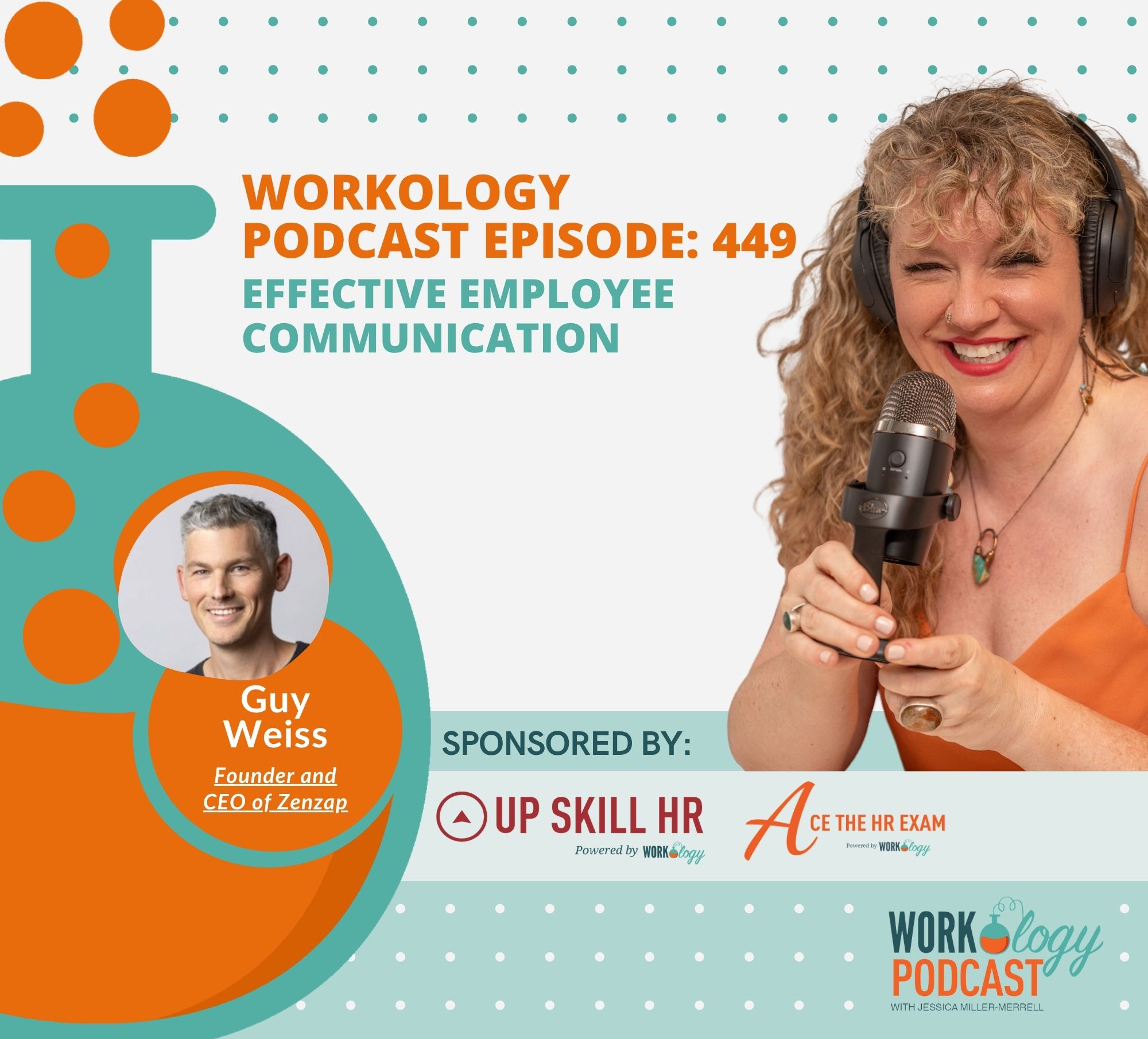
Welcome to the Workology Podcast, a podcast for the disruptive workplace leader, join host Jessica Miller-Merrell, founder of Workology.com as she sits down and gets to the bottom of trends, tools and case studies for the business leader, HR and recruiting professional who is tired of the status quo. Now here’s Jessica with this episode of Workology.
Jessica Miller-Merrell: Welcome to the Workology Podcast, sponsored by Ace the HR Exam and UpSkill HR microcourses. These are some of the resources and courses that we offer for certification prep, recertification, and continuous learning for HR and people leaders. You can learn more about these courses over at workology.com.
In today’s episode, we’re talking about one of the most overlooked drivers of employee engagement, retention, and workplace culture. It’s communication. And not just sending more emails or adding another Slack channel, but creating clear, intentional communication that helps employees feel informed, connected, and valued—whether your workforce is remote, frontline, hybrid, or spread across multiple locations.
The way leaders communicate can directly impact trust, productivity, and even turnover. We’re going to explore effective employee communication and what that looks like in practice, common mistakes that organizations make, and how HR leaders can build stronger connections with employees at every level. Because when communication breaks down, culture usually follows. And when you’re dealing with multi-location and high-volume hiring situations like restaurant, retail, and hospitality, it is so important. When communication works, employees are going to feel more engaged, and it helps them lead with confidence. Their managers do too, and organizations are better equipped to navigate all the changes. In the hourly market, that is happening all the time, and it’s so critical. So let’s get into it.
Before I introduce our guest for today’s episode, I do want to hear from you. Please comment “podcast” on our pinned Instagram post over @Workologyblog. You can slide into my DMs, leave comments, or make suggestions for future guests. I want to hear from you.
Guy Weiss is the CEO and founder of Zenzap, a secure communication platform designed specifically for frontline and mobile-first workforces. With a background in cybersecurity and entrepreneurship, Guy has built his career around solving complex technology and security challenges for businesses. After successfully exiting his previous company, he recognized a growing problem impacting organizations across industries: employees relying on personal messaging apps for communication. It’s happening a lot, and it creates significant risks around compliance, privacy, and operational efficiency.
Driven by the belief that frontline employees deserve communication tools built for the realities of the hourly and shift-based workforce, Guy launched Zenzap to help organizations create safer, more organized, and more effective communication practices. Under his leadership, Zenzap has focused on combining enterprise-level security with simplicity and ease of use, helping companies streamline collaboration while protecting employee boundaries and sensitive company information. Guy is passionate about improving workplace communication, reducing burnout, and helping leaders create healthier, more connected work environments for their teams.
Guy, welcome to the Workology Podcast.
Guy Weiss: Oh my god, you did it better than me.
Jessica Miller-Merrell: That’s why it’s my day job.
Guy Weiss: Wow, that’s a good one.
Jessica Miller-Merrell: Well, I’m great. Welcome, welcome to the podcast. I’m really excited to have you on. You have said that companies are still relying on personal messaging apps for workforce communication—things like WhatsApp and others. Can you talk to us about the risks that organizations are maybe overlooking when they use tools like WhatsApp or standard text messages for employee communication?
The Hidden Risks of Using Personal Messaging Apps at Work
Guy Weiss: Happy to be here. Yeah, for sure. So I think that the problem, when you look at a workplace—and you can think about hotels, restaurants, manufacturing businesses, law firms, hospitals, home care, any type of business where you have lots of employees, lots of day-to-day operations, lots of communication—the need to have instant communication is just there. The lack of tools built for these scenarios brings people to use the available tools they have. You know, if you don’t have the right hammer, you’ll use a simple hammer. So people use the default. It’s iMessage, it’s WhatsApp, it’s even Snapchat in Gen Z businesses. It’s all sorts of personal messaging apps as an attribute to run operations.
So when you want to help people understand and kind of think about it from a risk and business perspective, you should think about it this way: imagine a world where at any workplace you would go to, you would use your personal Gmail for any work communication. Does it make sense that you leave with the data? When you go to work for a company, they will shut down your email once you leave for security purposes, information purposes, and to make sure you have a separated inbox for your work and for your private life so you don’t get mixed up. Cyber security, productivity, you can react fast on this specific email. This thing does not exist when it comes to instant messaging.
Why WhatsApp and Text Messaging Create Business Vulnerabilities
So the risks are employee burnout—huge, huge risks for their businesses. Sexual harassment from having personal details shared, personal numbers shared inappropriately because “we’re in the same group chat.” We get tons of complaints. People are saying, “Hey, we want to switch to professional tools because we have a group chat and we got complaints for sexual harassment from some of the girls being hit on by a guy taking her phone number from the group chat because it’s there.” So privacy is a huge, huge issue.
Onboarding and offboarding employees, just managing who’s in and who’s out. Think about companies with turnover—huge turnovers, 30 to 40% a year. It’s removing hundreds of people from group chats and adding them to those group chats. And when you go to multi-location, multi-departments, it comes—it’s a nightmare. It’s something you can’t handle.
Information and secrets getting lost. Think about if you run a restaurant and all of your recipes are in there in group chats, and then someone leaves—one of the chefs or one of the cooks. He basically has everything he needs to run a competitor, or suppliers and pricing. So we get—it depends on the vertical—so many data points that are business secrets that you just give away, and they’re available for your employees even when they leave the company.
Updates—running a simple update from top management down to the bottom just can’t be done. You have no structured place to run a message from the CEO to the last employee. Costing mistakes, compliance, 24/7 notifications when you’re off shift, when you’re at home, and then the group chat continues to work. You always, constantly during dinner, open the WhatsApp or text messaging app and you see messages that, again, are work. So all of those things make it so inappropriate to use those personal tools for the overload of work messaging that it just doesn’t make sense. So that’s just at a high level.
Jessica Miller-Merrell: What was the moment or experience that made you realize frontline hourly workers needed a completely different communication solution other than WhatsApp, Slack, or Microsoft Teams?
Guy Weiss: Yeah, it’s a great question. So I think the question is a little bit bigger, so let me rephrase maybe the question, then answer broadly. So it’s worth mentioning Zenzap is backed by top VCs from the US—Bessemer, Lightspeed. And the question is, why have they decided years ago to back Zenzap? And I think the answer is, when you look at the market, and that’s the opportunity we’re looking at, you have Slack. You mentioned Slack; it’s a vertical tool eventually. It’s used by developers and tech companies—40 to 50 million users. And that’s very small compared to any other industry. The fast-food industry in the US is 25 to 28 million people, for us users, potential users. Hospitality is just huge. So you’re talking about billions of users across the world that don’t have a similar tool. And the question is, why? Right? Why don’t they use those available tools?
And the answer is simple. They’re not simple enough. They’re not mobile-first. They were never intended to be used by those types of users where the lowest common denominator is super low. It’s just about being a basic text app that can be expanded to lots of use cases, and the pricing point, which is super important. Not every organization is as rich as tech organizations. So those two answers very broadly brought us to the idea where you had to have something like WhatsApp for work or iMessage for Teams, built from the ground up with the security metrics and all the compliance and garbage you would need, layering also productivity, integrations, connectivity, but enabling it for other markets.
And within those markets, there’s a huge opportunity and huge need for 24/7 businesses, right? They’re always texting, they’re always on the go. It’s always mobile-first. It’s a variety of people with different backgrounds, different tech skills. They always want to get things done quickly and feel connected. Those 24/7 businesses are super intense with the volume of communication. And when it happens on group chats, it creates chaos, and scaling chaos is an issue. So frontline employees—mobile-first, as we want to call them, or deskless employees—are just a sweet spot as a target audience to serve them and serve them super well. And that’s what we do. So that’s how we came across it.
It started by having customers going onto the platform, and you see adoption. You see, I don’t know, in less than a few months, you see the ten largest food chains in America onboarding to Zenzap—McDonald’s, Burger King, Dunkin’ Donuts, Taco Bell, you name it, we have them. Target, Walmart, whatever it is. So you would see shift businesses, hotel chains, hospitals, daycares, home care, and suddenly it just makes sense. So it clicked. The problem is even stronger when it’s a 24/7 business where you want to opt in and opt out as an employee.
Jessica Miller-Merrell: In industries, some of that you mentioned like retail, healthcare, and food service, burnout and turnover are already high. How do you feel like poor communication contributes to employee stress and disengagement in those industries?
Guy Weiss: I can give you just some numbers. We had a customer—I listen to lots of demos with customers, I love it, it’s my passion being close to customers—and one of them said that they run a restaurant with 200 employees, five locations. They claimed during the conversation—it’s like an exploration conversation—they claimed that employees left the company and told them the reason for resigning was the constant flow of notifications flooding their—then it was Snapchat. That’s what they used for the group chats with the Gen Z. It’s crazy. Because they couldn’t tell which notification was work-related and which was personal. The overflooded, over-capacity overload of notifications for somebody who works for you three times a week or four times a week, and then has another half of the week off, was too much. And they said, “Just f*ck it.”
This was a direct cost of a few tens of thousands of dollars to replace those employees with new employees, just for the sake of being burnt out from this constant flow of messages 24/7. Think about a restaurant that opens at 11 in the morning and closes up at 12 at night—it’s crazy. And then management and staff… so there’s a real cost. There’s like a dollar cost you can put on it. And what’s the solution? You can just move the team to a tool built for that; it would cost you a fraction of the price, and then you retain employees for a much longer time. So that’s a huge cost.
Jessica Miller-Merrell: Absolutely. Well, one other area that I wanted to chat about is legal and compliance issues. And I know that you’ve worked with companies who have faced legal and compliance issues because of work-related texting on personal devices. Can you maybe share some examples of what can go wrong when businesses don’t have clear communication boundaries in those areas?
The Hidden Compliance Risks of Work Messaging on Personal Devices
Guy Weiss: Yes, yes. I won’t mention names, but I can give you examples. So the first example, and we talked about it a few minutes ago, is sexual harassment. Something that is not publicly known or spoken outspokenly, but HR deals with harassment due to the sharing of private data and private information, and that happens all the time. You would be shocked if I told you that every business goes through these situations—it’s a mess—once a month. It depends on the number of employees, but if it’s tens of employees or hundreds of employees, once a month somebody will come and say, “Hey, he is texting me after working hours,” etc., etc. Why should he be texting me on my personal phone? “I’m afraid, I’m this, I’m that.” And that’s all because you would use WhatsApp for communicating with your team. So that’s one side of things.
The other side is an ex-employee leaving the company and having all the historical data on his phone, right? So everything everyone said to him. And then you would get complaints and even legal actions for things that got written in the chat in the past, and now it could be used against the company in a different context. So think about words or certain words that could be just thrown away in the air in a group chat, which might be offensive when reading it in a different context. This data shouldn’t be stored on the employees’ phones when they leave the company. An ex-employee shouldn’t have access to historical data of real-life operations. And the fact is, using personal data, you need to subpoena—you need to actually subpoena devices to investigate those things. So this happens a lot.
We have a very large nail salon with a few hundred locations that started using Zenzap because they got sued by ex-employees a few times, tens of thousands of dollars each. And that’s just a shame. So you have many of those examples going through, and these are HR, proper HR issues that could be solved in a second by offboarding. These are just the tip of the iceberg.
Jessica Miller-Merrell: And I feel like having worked in retail and hospitality myself as an HR professional, every HR person that has been in those spaces right now is shaking their head like they can think of six or seven situations off the top of their head in recent—probably less than 24 months—from things that you’re describing.
Guy Weiss: Yeah, for sure. You know, just think about it as an HR person onboarding and welcoming new employees, or offboarding them. When talking about larger companies—more than 150 employees, let’s even talk about thousands of employees—not being connected to any HR platform… I don’t know what you use, Workday, Bob, whatever it is, or a payroll system as a directory of who is your employee and who is an ex-employee… that’s almost stupidity. You can use those technologies to empower day-to-day communications and sync those things together.
So it’s not just compliance of communication; it’s also sending them a “Have a great holiday” from the CEO from an HR perspective to empower them, or even connecting the payroll to a message saying, “Hey, your paycheck has arrived. Great.” We didn’t even talk about the mess and the chaos around shift management and how that happens over group chats. So…
Jessica Miller-Merrell: Well, yeah, talk to us about shift changes and schedule changes because I have a teenager and she has her first summer job as a lifeguard in a nearby city. And there are—I mean, there are probably 300 lifeguards, right, that are seasonal there. So you can imagine the messages that are flying. So talk to us about shift changes and kind of the complexities, and what Zenzap does to make that simpler.
Guy Weiss: Yeah, for sure. So think about 300 people messaging all day long in a f*cking group chat about who can come tomorrow and who can switch with me because “I need to go to this party,” yes and no. For every message, it’s 300 disturbing messages—maybe 299 beside the one who’s sending—for other people when they’re doing something. It doesn’t make sense. And that’s just for one message. You’re talking about thousands of messages for every shift being changed or switched.
That could be solved super easily once you have a purposely built group chat for that, or an agent that is connected to the calendars and knows the shifts, and you can speak with him like a human shift manager. You can tell him, “Hey, I can’t come tomorrow.” He can look and see and say, “Hey, you know what? I’ll DM Jessica because I know her schedule is pretty loose this week. Hey Jessica, can you please switch with Guy? He can’t come.” Yeah, boom. Saved thousands of notifications. Made it so easy to switch shifts. But you can’t do it without a governed, controlled, connected tool, right? It doesn’t matter if you use, I don’t know, 7shifts or whatever it is to run your shifts. So that’s a huge pain. And that’s HR. Shift management today is a nightmare.
Jessica Miller-Merrell: Absolutely. And I will say, like at the pool for my daughter, HR isn’t super involved, it’s the managers for the pool that are navigating all these shift schedule changes and the communication around it. And those people are really critical to the success of the summer. And so we want to make sure that managers have a way to effectively communicate and then be able to have their own downtime and disconnect.
Guy Weiss: You want to hear a crazy story?
The Surprising Link Between Communication and Manager Burnout
Jessica Miller-Merrell: Of course. What’s the story?
Guy Weiss: We had a manager telling us in the very early days—super early days—that he used to text people on WhatsApp, and one day nobody showed up to the shift. All right? A five-person team, nobody showed, he can’t open his business. Think it was a barbecue restaurant in San Diego. By the way, a great place, one of our guys went to visit. And I was shocked. I was like, what, did the message not go through? And he said, “No, no, it did go through. But it was after a holiday or whatever it is, and people didn’t read the message because they all claimed that they saw it after the shift.” And I couldn’t blame them because it’s a private tool. Well, he missed the message under hundreds of messages he gets on a daily basis from his mother, his father, his friends, groups, whatever it is. So who can I blame?
When you have a purposely built tool used only for work, the excuse of “I didn’t see it” is much harder to use. So that’s a loss for a business—one day out of, I don’t know, 25 days a month he works. That’s just a 5% loss on his volume in this month. For what? One message that didn’t get read. So managers are suffering the most. And by the way, they have the biggest burnout. Managing shifts is the biggest burnout for managers—the biggest. These are the guys who would churn first, and these are the guys who are hardest to hire and hardest to trust as a business owner. So burnout with managers is an even bigger pain point.
Jessica Miller-Merrell: Absolutely.
Let’s take a reset. This is Jessica Miller-Merrell, and you’re listening to the Workology Podcast powered by Ace the HR Exam and our UpSkill HR microcourses. Today I’m talking with Guy Weiss, CEO of Zenzap, about effective employee communication.
So, bigger picture. For anyone—not just those who are interested in Zenzap, although I hope everybody will schedule a demo and learn more about you and what you do—but what communication best practices can managers do right now, even if they don’t have your tool, to help make things more streamlined and just less stressful?
Building Better Communication Systems for Frontline Teams
Guy Weiss: I would recommend hiring a tool built for work. It doesn’t matter if it’s Zenzap or Slack or Teams. Because I don’t see separation. You know, when you go to a party or with friends or dinner and you’re kind of bored, everyone checks their emails, right? So you check your work inbox and then you move to, “Maybe I got something from Amazon,” maybe, I don’t know, it is a personal thing. So people need to opt in and opt out quickly. You can’t do it with personal messaging apps. You just can’t. You’re always online, always on the go, always connected.
I would recommend starting by exploring this market. Try to figure out which tool works best for you. And I think I would put the attention on: what tool can we adopt with zero learning curve? So anyone would use it immediately the day after. And start by just moving those communications from personal to professional. Once you do the separation, 50% of the issues go away. Then you can boost it with agents, with agentic workflows, with search, with to-dos, with lots of features that this or other alternatives will obviously provide.
The first step is to understand that you have a problem. Second step is to find a way to solve it. Third step is to adopt. And I think this is what I would suggest. I would suggest trying to find a tool that fits your needs. And you have special needs—everyone has their own special needs, every industry, every business, every business owner, how he sees the structure. I would try to just go out and start learning and exploring, and talking to people, talking to your employees. Ask them, “What if? What if we had a tool for that? What if you wouldn’t get those messages? What if? What if I could save you tons of gigabytes on your phone from pictures being sent or private pictures being stored on your phone? So what if?” So I would start with acknowledging the problem, searching for the alternative or for the solution—you have a few alternatives—and trying to adopt.
Jessica Miller-Merrell: This is great. And I will say, like the number of random photos I have on my phone from WhatsApp because it automatically downloads those… and I’m like, I have no idea who this dude is, but I’m in some WhatsApp group for professionals or friends or whatever. It’s a real thing. Where can people go to learn more about you guys and what you’re doing over at Zenzap?
Guy Weiss: First of all, whoever wants to speak with me can connect. Just write me an email or on LinkedIn. I try to respond to almost all the messages going through, and we get a lot. So it’s either me or one of the team, and then we escalate. So whoever wants to speak, we’re open. Zenzap is easy; just log into search for Zenzap WorkChat or Zenzap on ChatGPT, Google, or Gemini, and you can find out. You have lots of content on YouTube, explanatory content, and try to learn about team communication. Less about Zenzap, more about team communication. Then you choose your alternative. But as somebody who works in this industry, I think it’s good for the industry so everyone uses some sort of a tool and does not use those private messaging apps.
Jessica Miller-Merrell: Well, we’ll link to your LinkedIn and then the Zenzap website in the show notes, as well as some other helpful resources for employee communication. But I really appreciate you taking the time to chat with us today about effective employee communication.
Guy Weiss: Thank you. It was a pleasure. Thank you. Thank you, Jessica.
Jessica Miller-Merrell: That is a wrap on today’s conversation about employee communication, burnout, workplace boundaries, and the growing risks that come with relying on personal messaging apps to manage frontline teams. A big thank you to Guy Weiss for joining us and sharing practical insights on how organizations can create better, safer, clearer, and more intentional communication practices specifically for your hourly and mobile-first workforce.
What Gen Z’s Snapchat Habits Can Teach Employers About Communication
One thing that I was fascinated about, because I don’t use Snapchat, is how prevalent Snapchat communication is for your hourly workforce. And yes, many managers and leaders are communicating with teams over Snapchat. You might not even know about that. As a note, I’ll include some research around Snapchat and employees from Gen Z, finding that Snapchat is their preference as a digital native. So 40% of those surveyed from this research from Emerald are using Snapchat to build a relationship online with workplace leaders—so with their peers and also their leadership teams. I’m including that in the show notes for this podcast. And maybe talk to some of your leaders to see if employees are creating groups—they probably are—on Snapchat to talk and communicate, and what kind of stuff is going down.
Another takeaway from the episode is this: if communication is about sending effective messages, right? Intentional messages. It’s not about sending more messages. It’s about building trust, protecting employees’ time and privacy, and creating a system that allows for operational efficiency and employee well-being. Because those employees, especially our hourly workforce doing the job out there in the field, they are incredibly important to the success of our business.
If you enjoyed this episode, be sure to subscribe, share it with a colleague, and leave us a review wherever you listen to podcasts. And for more resources, HR insights, and conversations designed to help you lead smarter, visit workology.com. Thanks for listening, and we’ll see you next time.
If you enjoyed this episode, please subscribe, leave a review, and share it with another HR leader. Thank you for listening and joining the Workology Podcast, sponsored by Ace the HR Exam and our UpSkill HR microcourses. Workology has a learning platform for HR certification, recertification, and manager training. You can also check out our new marketplace over at marketplace.workology.com. This podcast is for the disruptive workplace leader who’s tired of the status quo. I’m Jessica Miller-Merrell. Until next time, visit workology.com to listen to all the episodes and catch up on the Workology Podcast.
RESOURCES