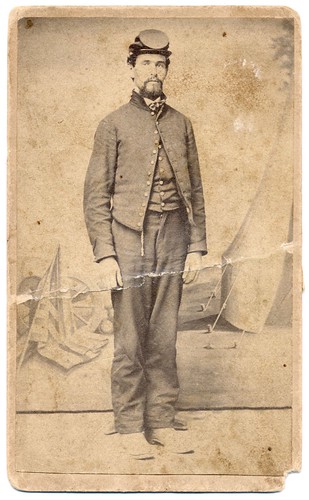
Summary Data
State or Country of birth: Deerfield, Portage Co., Ohio
Home prior to enlistment: Mecca township Trumbull Co., Ohio
Occupation prior to enlistment: farmer
Service:
Co C 2nd Ohio Cavalry – Aug. 1861 – Sept. 1865
Rank at enlistment: private
Highest rank attained: corporal
Principal combat experience:
Independence, Missouri
Grand River, Indian Territory
Fort Gibbson, Indian Territory
Numerous other small engagements with confederates in southeast Kansas, northern Arkansas, Indian Territory, Kentucky and Tennessee
Buffington Island, Ohio
The Wilderness, Virginia
Ashland (Hanover Court-House), Virginia
Third Winchester, Virginia
Fishers Hill, Virginia
Waynesboro, Virginia
Toms Brook, Virginia
Cedar Creek, Virginia
Waynesboro, Virginia
Five Forks, Virginia
Sailor’s Creek, Virginia
Appomattox Station, Virginia
Appomattox Court House, Virginia
Casualties: Typhoid Fever, July 1862 & Malarial Fever, June-Aug. 1864
Photograph by: Reeve & Watts, Columbus, Ohio (The photo was probably taken either while the regiment was at Columbus in the winter of 1862-1863 or after its veteran reenlistment in January 1864.)
Inscription in period ink on back: "Silas Laughlin Born Jan 27, 1839 Enlisted in 1861 discharged in 1865"
Painted backdrop depicting flag, cannon and tent.
* * * * *
"Broken Down by Hard Service"
Silas Laughlin was born January 27, 1839 at Deerfield, Portage County, Ohio, and at the outbreak of the Civil War he was living in Mecca township, Trumbull County, Ohio. On August 22, 1861, at the age of 22, he enlisted at Warren, Ohio, in Company C, 2nd Ohio Cavalry. His enlistment papers identified him as being a farmer, and described him as having brown eyes, dark hair, and standing 5’11" in height.
Although he had no way of knowing it when he enlisted, but over the next four years he would cover a wide swath of territory, all the way from Oklahoma to the Chesapeake. By the time the war was over, the 2nd Ohio Cavalry had traveled farther and fought in more theaters of the war, including the only significant battle to take place in Ohio, than probably any other regiment in the Civil War.
In January 1862 the regiment was moved to the troubled border area between Missouri and Kansas where it was assigned scouting duty in a region that was infested with Southern partisan guerrillas. On February 22, 1862 the Second Ohio Cavalry encountered and drove the notorious William Quantrill and his guerrilla raiders from the town of Independence, Missouri.
For the rest of the spring and into the summer the Second Ohio was involved in numerous small engagements with Confederates in southeast Kansas, northern Arkansas and the Indian Territory [Oklahoma]. One such encounter with a group of Indians in Confederate service is described in a report by Colonel Charles Doubleday of the Second Ohio.
"I arrived at Grand River on the same day [June 6, 1862] about sundown, and learned that the enemy were encamped 3 miles distant to the number of 1,500, commanded by Stand Watie [the only Indian to eventually become a general in the Confederate army], Coffee, and others. I ordered the First Battalion, Second Ohio Cavalry, across the river, to take position south of the rebel encampment, advancing at the same time my artillery, supported by infantry, in skirmishing order, through the woods to the crossing, which was effected by the entire force by 9 p.m., the enemy’s pickets merely firing a few scattering shots as they fell back. Not having daylight I could not accurately ascertain their precise positions, except in the camp of Stand Watie, which was in a grove. I ordered the artillery to the front, and from the distance of about 500 yards, threw a few shot and shell into their camp, causing thereby considerable commotion, audible to us. About 1 a.m. I ordered my troops to lay on their arms, having previously thrown out a strong chain of cavalry pickets; but during the night the enemy escaped along the brush-wood and made a rapid march toward Fort Smith. I did not follow them, under your orders not to proceed farther south, but employed the next day collecting the horses and cattle which they left in their flight, and which are now, to the number of 500 or 600 head, under convoy of my command to this place."1
The Second Ohio took part in the capture of Fort Gibbson, Indian Territory on July 18. The summer campaign took a fearful toll on the soldiers of the 2nd Ohio Cavalry. "I well remember the march from Hat Rock, I. T. to Fort Scott, KS in the month of July 1862," recalled the regimental surgeon, "and that many soldiers of the Reg’t during that march were taken sick with Typhoid Fever with marked cerebral symptoms and to exposure to extreme heat."2 Laughlin was one of those stricken somewhere between Ft. Gibson and Ft. Scott. The company muster roll lists him as being in the regimental hospital for about six weeks in July & August of 1862, suffering from what was diagnosed as brain fever.
In December the regiment was ordered to Columbus, Ohio. There was at that time a newspaper, called the "Crisis," published in Columbus by a particularly outspoken Copperhead (a name given to those Northerners in sympathy with the South) who frequently expressed the wish in print that none of the Second Ohio Cavalry or other Ohio soldiers should return from the war alive. Naturally enough the soldiers swore vengeance on the newspaper.
On a snowy evening in early March 1863, a group of men from the Second Ohio Cavalry left Camp Chase. The men claimed to be a Church Party bound for divine services in town, but "they were armed with hatchets, axes, clubs, &c. Some who had no arms pulled pickets off a farm fence." When the party arrived at the Crisis Office, some men went upstairs while others went to the corners of the block "with instructions to prevent any interference, from guards, police, or anybody else…Then a column of men poured into the building, then the windows were smashed, and furniture, books, paper, maps &c came pouring out into the street." Policemen responding to the noise were met by the men posted on the corners and told that some soldiers were "cleaning out the Crisis Office" and that it would be fatal to them to try to interfere. The police, possibly in sympathy with the soldiers, did nothing. When the destruction was complete, the men "moved off pretty lively, as they didn’t expect to escape from the Provo Guard as easily as the police…The next morning there was a rumor that authorities were making an effort to find the perpetrators, and that the 2nd O. Vol Cav, were suspicioned for it," however nothing was ever proven against those guilty of the raid.3
Laughlin’s role in the incident, if any, is not recorded, but it is reasonable to assume that he and his superior officers may have harbored a secret sympathy for the crime. Shortly after the attack on the Crisis Office the regiment was ordered to Somerset, Kentucky, where it was engaged in scouting and raiding against the confederates until June 27. During this time, Laughlin’s name appears in the Company records twice for dockages against his pay for equipment he had lost; the first time in April with the record stating, "Due U.S. Gov’t for one Watering Bridle, one Cap Pouch & one Cloak Strap lost," and the second time in June with the note, "Due U.S. Gov’t for one haversack."
In June and July, the Second Ohio Cavalry was among the troops called upon to give chase when Confederate General John Hunt Morgan staged his ill-fated raid into Ohio. The Buckeyes’ first clash with Morgan’s raiders came on July 3, 1863 at Columbia, Kentucky, and though the rebels later managed to slip across the Ohio River and into the Northern state, the invasion was immediately overshadowed by the far-off Confederate defeat at Gettysburg. Northern troops relentlessly pursued Morgan and his men on their rush through Ohio and kept them under continuous pressure. The role of the Second Ohio Cavalry was outlined in a report by its colonel, August Kautz.
"At Winchester, Adams County, Ohio, on the morning of the 16th of July, I was directed by General Hobson to press on with my command as fast as possible, and crowd the enemy as much as possible…I reached Jasper at 11 p.m., and there found my progress obstructed by the destruction of the bridges across the Scioto Canal. Five or six hours were required to construct a bridge sufficient for the command to cross on the following morning…At Rutland I got reliable information that Morgan intended to cross the Ohio River at Buffington Island, and, halting only to feed and refresh the men, I pushed on through Chester, and followed the enemy on the Chester and Portland road. Soon after daylight the enemy’s pickets fired on our advance about 2 miles from Portland. Believing the enemy to be crossing the Ohio, I decided to attack immediately, hoping to disconcert the enemy thereby, though I could not parade more than 200 men.
"Colonel Sanders was an hour behind with the artillery…I had reason to believe…that the gunboats must be near on the river, but I had no reliable information when either would be on hand.
"The Second and Seventh were dismounted and deployed as skirmishers, and the enemy driven out of the woods, when the artillery and Colonel Sander’s command came up. The artillery was immediately opened, and the enemy soon began a precipitate retreat, as, about the same time, we heard artillery on the right, and soon after the heavier guns of the gunboats, and the retreat soon degenerated into a general rout…
"The particular work accomplished by my command in this affair was the continuous march from Jackson to Portland, a distance of nearly 70 miles, in less than thirty hours, and coming upon the enemy in time to prevent his orderly retreat from the river if molested by other forces, and the spirited attack of the men that induced the enemy to believe that General Hobson’s entire force was at hand, thus causing in a great measure their disorderly retreat."4
Later that summer, the 2nd Ohio Cavalry was transferred to the 23rd Army Corps at Danville, Kentucky and then advanced south into Tennessee, engaging in numerous and scattered small scale engagements with Confederates. On January 1, 1864, many men of the 2nd Ohio Cavalry, including Silas Laughlin, re-enlisted as veterans while the regiment was encamped at Mossy Creek, Tennessee. The re-enlisted veterans were granted a veteran’s furlough that allowed them to go home for a month. During their time in Ohio, the men were mustered in as veteran volunteers at Camp Chase, Ohio on February 10, 1864 (but their muster was backdated to January 1, 1864).
On March 20, 1864, following the veteran’s furlough, the Second Ohio Cavalry was ordered to Annapolis, Maryland to join the Army of the Potomac for the spring campaign in the east. In May the regiment participated in the Army of the Potomac’s advance from the Rapidan to the James River. Lieutenant Colonel George Purington, of the 2nd Ohio Cavalry reported on the regiment’s encounters with Confederates in the days immediately after the Battle of The Wilderness.
"At daylight [May 9, 1864] we discovered the enemy advancing a line of skirmishers to feel our position. I immediately dismounted the First and Second Battalions, with orders to hold the line of rifle-pits recently vacated by the Ninth Corps [infantry]. These we held until 6 a.m., when I deemed it advisable to fall back, which we did in good order, closely followed by the enemy…[May 11] went into camp on old Fredericksburg pike road, 2 miles east of Chancellorsville. Here we drew 5 pounds of forage and removed our saddles for the first time is six days, during which period we had marched from the Rappahannock to Chancellorsville, doing duty both by day and night."5
A couple of weeks later the Second Ohio had a severe fight with the rebels. Lieutenant Colonel Purington’s report continues with the narrative. "At about 9 a.m. [on May 31] met the enemy at cross-roads near Hanover Court-House, drove in their pickets and was ordered to make a reconnaissance on the Richmond road. Had not proceeded far before we met the enemy in strong force; dismounted, deployed the regiment and formed on the left of the road in the woods, charged through, and drove the enemy over an open field beyond, they stubbornly contesting the ground and slowly falling back along the railroad on Hanover Court-House. This position the enemy retained until sundown, at which time a charge was ordered, to feel their strength or dislodge them. This regiment was formed in an open field on both sides of the road…We moved forward, under a heavy fire of shot and shell, until within 600 yards of the top of the hill where a general charge was ordered, and the skirmish line, being re-enforced by the reserve, dashed forward with a shout and a yell, carrying everything before them. As we gained the crest of the hill our ammunition failed, and in some parts of the line the enemy were actually driven from their position with stones and clubs."6
Thomas Baker, who lost an arm in the fracas, remembered the fearful seriousness of the fight with these words of understatement. "It was a pretty hot fight. Our regiment was dismounted and we were advancing slowly upon the enemy, who was disputing every foot of ground. Thus we had been going all day, and at night, when darkness fell upon us we were still fighting our way slowly along. We had got into woods, and nothing could be seen but the flashes of our guns, and these were constant and frightful. The experience of fighting in the woods on a dark night is a very solemn business."7
Lieutenant Colonel Purington concluded his after-battle report with the observation that, "This battle, for the number engaged, and taking into consideration the nature of the ground over which it was fought, as it was composed of creeks and swamps, through which the men had to wade waist deep, and the superiority of the enemy’s force (at least 3 to 1) was the severest I ever witnessed, and only evinces what Yankee cavalry soldiers can accomplish when determined to win."8
But in spite of the determination exhibited by the men, Purington took the opportunity to point out to his superiors the flaws in the supply system as manifested by the recent events. "Allow me to call your attention to the necessity of having some organized system of ordnance sergeants or men detailed, whose duty it shall be to keep cavalry commands well supplied with ammunition during engagements. Men armed with the breech-loading weapon will necessarily fire a greater number of rounds than those armed with a muzzle-loading piece, and it is utterly impossible for a cavalry man to carry more than from 60 to 80 rounds upon his person, and when dismounted and away from his horse this supply can be easily exhausted in a few hours’ firing. In this case my regiment expended its ammunition in the battle of May 31. At daylight details were sent to [the nearest supply] train, but no ammunition of that caliber (No. 54) could be obtained. Captain Weeks, in command of detail, with great promptness immediately started for our own train, some 9 miles distant, to obtain a supply, making trip back to Hanover Court-House, thence to Ashland, 27 miles, each man loaded with 85 pounds ammunition, in less than one half day, and even then hardly arrived in time, as three boxes were captured by the enemy before we could issue it to the men. And I feel warranted in saying that had this ammunition not arrived, and with our already too small force weakened by the withdrawal of my regiment, the consummate bravery of the brigade could not have prevented serious disaster."9
As the infantry settled in to lay siege to Petersburg, the cavalry were kept busy disrupting Confederate movements of troops and supplies. Though they still had to contend with rebel bullets, there were other hazards as well. The report for operations of the Second Ohio Cavalry in June 1864 elucidates. "Next morning, June 24, at 8 a.m., marched as rear guard for Meherrin Station, on the Richmond and Danville Railroad. Proceeded down the railroad, assisting in tearing up the track and destroying the road generally to Roanoke bridge, on Staunton River, arriving there June 25. The work of these last two days, performed under a burning sun and over hot fires, was extremely exhausting, and many of the men have not and will never recover from its effects…Sunday, June 26…was the hottest day of the raid, the thermometer standing at 105 degrees Fahrenheit in the shade at 2:30 p.m."10
Laughlin was one of the men overcome by the extreme heat and fatigue. He was variously diagnosed as suffering from intermittent fever or Malarial poisoning. He was sent to the military hospital at City Point on July 4, 1864 and entered the Cavalry Corps Hospital July 5, 1864 with intermittent fever. He was transferred from there July 7, arriving July 10 at McDougal USA General Hospital at Fort Schuyler, in New York City. Laughlin recovered sufficiently to return to duty on August 26, 1864, at which time he was sent back to the 2nd Ohio Cavalry, which in early August had been transferred to Sheridan’s Cavalry Corps in the Shenandoah Valley. Laughlin had returned in time to take part in the great cavalry battles of Third Winchester, Fishers Hill, Waynesboro, Toms Brook, and Cedar Creek.
In March 1865, the 2nd Ohio Cavalry participated in Sheridan’s Raid from Winchester to Petersburg, rejoining Grant’s forces there. During the Appomattox Campaign, the regiment fought at Dinwiddie Court House, Five Forks, Namozine Church, Sailor’s Creek, and Appomattox Station before Lee finally surrendered the Confederate Army of Northern Virginia at Appomattox Court House on April 9.
Along the way, at Five Forks on April 1, Laughlin was promoted from private to corporal. After participating in the Grand Review in Washington, DC on May 23, the regiment was ordered west to St. Louis and spent a couple of months on duty in the Department of Missouri. However Laughlin was reported as being absent sick once again during June and July 1865. Apparently, either while recovering or while traveling en route to rejoin his regiment in St. Louis, Silas Laughlin married Mary Jane Johnson on July 24, 1865 at Mayesville, Pennsylvania. He was mustered out of the army on September 4, 1865 at Benton Barracks, Missouri.
During Laughlin’s four years with the 2nd Ohio Cavalry he had served in five armies: the Army of the Missouri; Army of the Frontier; Army of the Ohio; Army of the Potomac; and Army of the Shenandoah. Though it was not involved directly in the war’s biggest battles, the regiment fought long and hard in nearly all theaters of the war and was remembered for its varied service. "The 2d Ohio Cavalry was the leading regiment, in point of loss, in the mounted service of the State [of Ohio]…Its service was a varied one, fighting in the Indian Territory, Arkansas, Missouri, and East Tennessee until April, 1864, when it joined the Army of the Potomac. Its fallen heroes, buried where they fell, form a vidette-line of patriot graves from the Missouri to the Chesapeake."11
After the war Silas Laughlin lived at Mecca, Ohio until 1872, and then moved across the state line to Jamestown, Mercer County, Pennsylvania. In the post war years he applied for a Federal disability pension stating, as a basis for his claim, that "by hard service in the Wilderness and campaign against Petersburg immediately following and in the Spring of 1864 he became completely broken down." His physician reported that he suffered from rheumatism, neuralgia, malaria, and general debility. Laughlin died on October 13, 1899 of progressive muscular atrophy, assumed to have been caused by malarial fever.12
Notes for Silas Laughlin
1. Official Records
2. Pension Records, United States Archives
3. Diary account of William J. Smith, Co. M, Second Ohio Volunteer Cavalry
4. Official Records
5. ibid.
6. ibid.
7. Thomas Baker in The Ironton Register, June 7, 1888, Narrow Escapes; Interesting War Experiences No. 82
8. Official Records
9. ibid.
10. ibid.
11. Fox’s Regimental Losses
12. Pension Records, United States Archives
Posted by Piedmont Fossil on 2021-04-14 14:04:15
Tagged: , antique photo , CDV , carte de visite , Civil War , Union , soldier , uniform , painted , backdrop