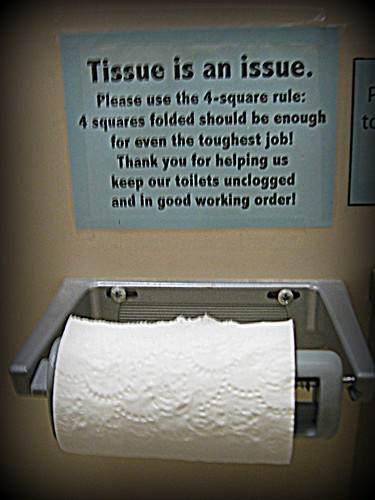
Toilet Paper Statistics
What is the average number of toilet tissue sheets a person uses in one day?
On average, consumers use 8.6 sheets per trip – a total of 57 sheets per day. That’s an annual total of 20,805 sheets.
What 20th century “convenience” is most taken for granted?
• 69% – TOILET PAPER!
• 42% – zipper
• 38% – frozen foods
If stranded on a desert island with only one “necessity”, what would you choose?
49% chose toilet paper as their greatest island necessity (ahead of food!)
What do we hate about PUBLIC RESTROOMS?
• Unsanitary conditions – 69% of men and 71% women
• Fear of contracting germs – 10% of men and women
• Bad odor – 8% of men and women
• Do not like sharing public restrooms with “strangers” – 5% of Men and Women j
• Poor quality of towel and tissue products – 2%
• Hate watery hand soap – 1%
What do we hate about the TOILET TISSUE IN PUBLIC RESTROOMS?
• An empty dispenser – 33%
• The tissue breaking off before you get your needed amount – 23%
• The roll sitting on top of the dispenser or toilet tank – 12%
• Tissue hanging off of the roll and onto the floor – 11%
Britons lead the way in toilet paper use
Every Briton flushes 17.6 kilos (39lb) of toilet paper down the lavatory every year, almost two and half times the European average, according to tissue industry figures.
British toilet paper consumption of 110 rolls per capita is 25 times that of Ukraine’s, Europe’s lowest.
Americans pull 15.7 kilos off the roll, ahead of Western Europe’s average flush of 12.4, but still well behind the British.
Out of the EU states, new Europe’s Baltic countries trail with 3.9 kilos annual consumption, three times less than the Germans.
Toilet Paper History: How America Convinced the World to Wipe
Since the dawn of time, people have found nifty ways to clean up after the bathroom act. The most common solution was simply to grab what was at hand: coconuts, shells, snow, moss, hay, leaves, grass, corncobs, sheep’s wool—and, later, thanks to the printing press—newspapers, magazines, and pages of books. The ancient Greeks used clay and stone. The Romans, sponges and salt water. But the idea of a commercial product designed solely to wipe one’s bum? That started about 150 years ago, in the U.S.A. In less than a century, Uncle Sam’s marketing genius turned something disposable into something indispensable.
The first products designed specifically to wipe one’s nethers were aloe-infused sheets of manila hemp dispensed from Kleenex-like boxes. They were invented in 1857 by a New York entrepreneur named Joseph Gayetty, who claimed his sheets prevented hemorrhoids. Gayetty was so proud of his therapeutic bathroom paper that he had his name printed on each sheet. But his success was limited. Americans soon grew accustomed to wiping with the Sears Roebuck catalog, and they saw no need to spend money on something that came in the mail for free.
Toilet paper took its next leap forward in 1890, when two brothers named Clarence and E. Irvin Scott popularized the concept of toilet paper on a roll. The Scotts’ brand became more successful than Gayetty’s medicated wipes, in part because they built a steady trade selling toilet paper to hotels and drugstores. But it was still an uphill battle to get the public to openly buy the product, largely because Americans remained embarrassed by bodily functions. In fact, the Scott brothers were so ashamed of the nature of their work that they didn’t take proper credit for their innovation until 1902.
“No one wanted to ask for it by name,” says Dave Praeger, author of Poop Culture: How America Is Shaped by Its Grossest National Product. “It was so taboo that you couldn’t even talk about the product.” By 1930, the German paper company Hakle began using the tag line, “Ask for a roll of Hakle and you won’t have to say toilet paper!”
As time passed, toilet tissues slowly became an American staple. But widespread acceptance of the product didn’t officially occur until a new technology demanded it. At the end of the 19th century, more and more homes were being built with sit-down flush toilets tied to indoor plumbing systems. And because people required a product that could be flushed away with minimal damage to the pipes, corncobs and moss no longer cut it. In no time, toilet paper ads boasted that the product was recommended by both doctors and plumbers.
In the early 1900s, toilet paper was still being marketed as a medicinal item. But in 1928, the Hoberg Paper Company tried a different tack. On the advice of its ad men, the company introduced a brand called Charmin and fitted the product with a feminine logo that depicted a beautiful woman. The genius of the campaign was that by evincing softness and femininity, the company could avoid talking about toilet paper’s actual purpose. Charmin was enormously successful, and the tactic helped the brand survive the Great Depression. (It also helped that, in 1932, Charmin began marketing economy-size packs of four rolls.) Decades later, the dainty ladies were replaced with babies and bear cubs—advertising vehicles that still stock the aisles today.
Currently, the United States spends more than $6 billion a year on toilet tissue—more than any other nation in the world. Americans, on average, use 57 squares a day and 50 lbs. a year.
Posted by elycefeliz on 2012-10-08 21:15:39
Tagged: , Cincinnati , Ohio , toilet paper , restroom