Atopic eczema can be caused by sensitivity to certain food, such as dairy products, eggs or fish. Infants with food allergies often have hives in the eczema. The child also may also experience atopic symptoms from the respiratory system (asthma) and stomach discomfort.
Atopic eczema on the cheek of a baby showing red, inflamed skin.
While an allergy or hypersensitivity reaction can cause atopic eczema, the origin of the eczema is usually unclear.The initial skin irritation can also be triggered by chemical substances or physiological challenges to the skin, such as contact with hot tub water or with a rough surface. Heredity and climate could also cause eczema.
Atopic eczema (also known as atopic dermatitis). Infantile eczema when affecting young children. Many children outgrow these symptoms between the age of one and two, but then develop an itchy eczema instead in some regions, such as arm and knees.
Similar skin problems: Contact dermatitis, Irritative eczema
While atopic eczema commonly affects children, it can persist into adulthood or even appear for the first time in adults, frequently affecting areas like behind the knees, elbows, and other joint flexures.

Atopic dermatitis on the back of the knee, characterized by red, inflamed, and itchy skin with small bumps
Symptoms of Atopic Eczema
Red, thickened, itchy patches on the skin are symptoms of atopic eczema. It usually appears when the child is around one year’s old. Typically affects face, creases of elbows, behind knees, wrists, and neck (flexural pattern). Coin-sized patches (discoid pattern) and small bumps around hair follicles (follicular pattern) also common. Even though young children cannot scratch the affected area, itching could cause loss of sleep or frustration.

Atopic eczema on the skin showing a red, inflamed patch

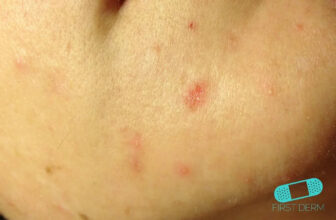
Atopic Eczema on the stomach, marked by red, scaly patches, which are characteristic signs of chronic inflammation and irritation common in atopic dermatitis

Atopic Eczema on the arm – Skin with small, red, inflamed bumps and mild scaling, indicating atopic eczema
What can I do?
It takes time to treat eczema. If your child is showing a tendency to develop eczema, dry the skin after bathing with gentle pats, rather than rubbing. Lubrication is important because the affected skin lacks certain fats, grease and moisture. Eczema is usually not improved by any particular diet, except for small children who sometimes have a food allergy that aggravates eczema.
Lubricate eczema several times a day
Lubricate the affected areas with unscented moisturizing cream, such as emollients and cortisone cream.Use emollients regularly, at least 2-3 times daily, replacing soap with emollient-based cleansers. Emollients are in the form of ointments, creams and lotions.
Cortisone is an anti-inflammatory drug that also reduces the itching of eczema. Weak hydrocortisone cream can be bought without prescription at the pharmacy. Cortisone cream should only be lubricated at the eczema, while moisturizing cream can be used all over the skin.
Try to reduce the itch
The best way to relieve the itch is to treat with the right creams. Specially treated silk for underwear, socks and hats can also reduce the itch. Distract your child with toys, because scratching will prompt a habitual behavior that worsens the itching.
Avoid stress on the skin
- Avoid excessive washing with water and soap.
- Protect the sensitive skin from excessive heat or cold.
- Use mild soap and unscented products designed specifically for dry and sensitive skin.
- Do not use excessive detergent to wash the clothes and sunbathe in moderation.
- Avoid wool clothing, which can cause irritation and itch, and synthetic clothing, which can make the skin feel trapped.
Get more information
As a parent of a child with eczema, you should get good information. This means, among other things, knowing when to use stronger cortisone cream, how to deal with escalation to milder cream, and how to use moisturizing cream. You can talk with a doctor or a dermatologist for more information.
Should I seek medical care?
It is usually insufficient to treat the eczema your child solely with moisturizing creams and/or prescription cortisone creams that relieves the itching and reduces inflammation. If the symptoms continue, treatment may be needed.
Seek medical advice from your GP or dermatologist if eczema:
-
Causes severe itching uncontrolled by standard treatments.
-
Shows signs of infection such as yellow crusts or blisters.
-
Rapidly worsens despite emollient and topical corticosteroid use.
Treatment for Atopic Eczema
Infections with bacteria or viruses can make eczema worse. Bacterial infection (usually with Staphylococcus) makes the affected skin yellow, crusty and inflamed. In this case, you may need specific treatment.
An infection with the cold sore virus (herpes simplex) can cause a sudden painful widespread (and occasionally dangerous) flare of eczema, with weeping small sores. In this case, you may need treatment with oral antiviral treatment. Topical steroids should not be used.
Sometimes a dermatologist will perform a patch test. This medical test is used to find allergies. It involves placing tiny amounts of allergens (substances that cause allergies for some people) on the child’s skin. The dermatologist will check the skin for reactions. Checks are often done after a few hours, 24 hours and 72 hours. Studies suggest that some allergens can make the eczema worse. A treatment plan often includes medicine, skin care and lifestyle changes.