What is atopic dermatitis in children?
It’s completely normal to feel anxious when you notice dry, rough patches on your baby’s soft skin — maybe red spots that come and go without warning. As a parent, your mind instantly races: Is this an allergy? Just a rash? Or something more serious?
In many cases, these skin changes point to atopic dermatitis (AD) — the most common form of eczema in children. It affects about one in five kids worldwide and often appears during the first six to twelve months of life.[2]
Atopic dermatitis is a long-lasting (chronic) condition that tends to flare up and settle down over time. Your child’s skin gets super dry, itchy, and inflamed, and that itch? that persistent itch can make it hard for your child — and you — to get a good night’s sleep.[2]
But here’s the reassuring part: With some simple, consistent care and a bit of know-how about what sets it off, you can get it under control and bring back those smiles.[2],[3]
What is the “Atopic March”?
Children with atopic dermatitis often have a natural tendency toward other allergic conditions — such as asthma, hay fever (allergic rhinitis), or food allergies. Doctors call this pattern the “atopic march.”[1],[2]
In simple terms, it means that some children who start out with eczema may later develop other allergy-related conditions as they grow. Not every child with eczema will experience this, but being aware of the connection helps parents watch for early signs and manage them effectively.[1],[2]
What does it look like?
That intense itch? It’s something every kid with AD deals with, no matter their age. And the dryness? It’s a constant companion. But here’s the thing—the rash itself has a pretty predictable pattern that changes as your child grows. Knowing where to look can help you spot it early and stay one step ahead.[2],[3][1]
Infants (0–2 years)
In babies and toddlers, AD typically appears on the cheeks, forehead, scalp, and trunk. It often avoids the diaper area, which is usually moist. The rash looks like red patches or plaques with scaling, and may have oozing when flaring (acute lesions).[1]

Atopic dermatitis in an 8-month-old infant, showing red, dry eczema patch on the buttocks — a common area affected during early childhood flares.
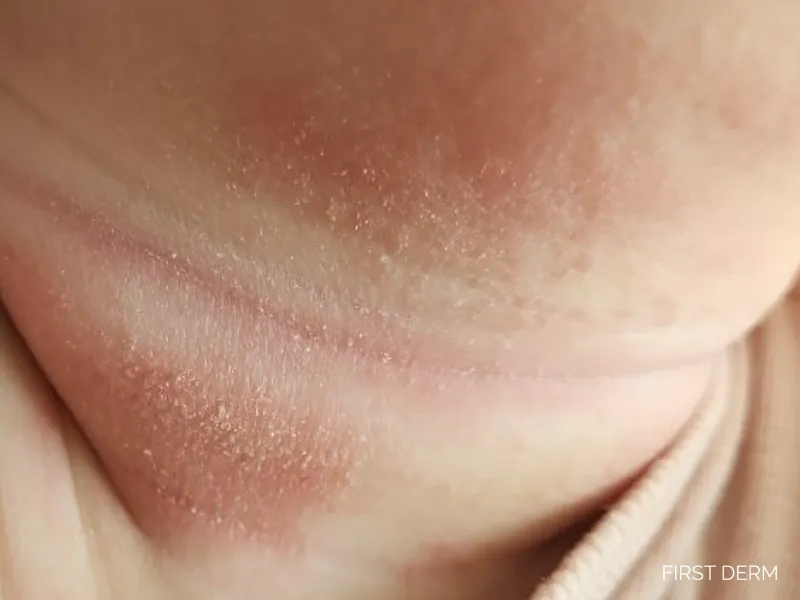
Atopic dermatitis in an infant showing red, dry eczema rash around the neck folds — a common site due to moisture and friction in early childhood
Children (2–12 years)
As children get older, the rash shifts to the flexural areas—the creases of the elbows and knees. It can also affect the neck, wrists, ankles, hands, and feet. With chronic scratching, the skin in these areas often becomes lichenified (thickened and leathery).[1]

Atopic dermatitis in an 8-year-old child, showing a red, dry eczema patch on the inner elbow — a typical site where eczema flares appear in school-age children

Atopic dermatitis in a 4-year-old child — red, scaly eczema patch on the arm
Teens
In teenagers, the pattern is similar — often affecting the flexures, hands, and eyelids. At this stage, it’s not just the itching that’s tough — it’s how visible the condition can be Flare-ups on the face or hands may sometimes affect a teen’s self-confidence and social comfort, especially when appearance starts to matter more.[2]

Atopic dermatitis in a teenager, showing red, inflamed eczema patches on the forehead after sun exposure — a common trigger for flare-ups during adolescence
How It Shows Up on Different Skin Tones
Atopic dermatitis doesn’t always look the same on every child’s skin. Those classic “red rash” descriptions can be misleading if your child has brown or Black skin. What appears bright red on lighter skin might look violet, gray, or slightly darker than the child’s normal skin tone. Sometimes, the changes are subtle — but they’re just as real and just as itchy.[2],[1]

Atopic dermatitis on dark skin in an infant — dry, scaly eczema patches with mild color lightening after healing, a common feature in darker skin tones
Here are a few key features to look for:
-
Lichenification: Thickened, leathery skin caused by repeated scratching.[2]
-
Follicular accentuation: Small, raised bumps that make the skin look textured or dotted around hair follicles.[2]
-
Hypopigmented patches: Lighter areas that appear once a flare has healed — these are called post-inflammatory changes and are temporary.[2]
Common Symptoms of Atopic Dermatitis in Children
When a child has atopic dermatitis, the signs can show up in different ways — but a few symptoms are nearly always there. Recognizing them early can help you calm flare-ups before they get worse.[2],[1]
1. The Itch That Never Quits (Pruritus)
The itch is the most common and frustrating part of atopic dermatitis. It can be intense, especially at night, disrupting your child’s sleep — and yours too. The more they scratch, the more irritated the skin becomes, creating the classic “itch–scratch cycle.”[2]
2. Dry, Rough Patches (Xerosis)
Children with eczema almost always have very dry skin. You might notice rough, flaky, or dull patches on their arms, legs, cheeks, or hands. In dry or cold weather, these spots can crack, sting, or appear slightly red.[2]
3. Weeping or Crusting During Flares
During a flare-up, eczema patches can become red, bumpy, and ooze clear fluid before forming a yellow crust. These are signs of inflammation — and if you see yellow crusting or pus, it might signal a bacterial infection that needs medical attention.[4]
4. Thickened or Tough Skin (Lichenification)
When your child scratches the same areas repeatedly, the skin can become thick, leathery, or darker than the surrounding skin. This change, called lichenification, is a sign of long-term irritation. In more persistent cases, small, firm nodules (called prurigo nodules) may also develop.[2]
Sometimes, eczema flares can look similar to viral rashes in children — especially when red spots appear suddenly or spread.