

In a restaurant kitchen, a chef benefits from consistency–the space is known, the equipment has its place, and the team is in rhythm for each service. There is a sense of stability in a kitchen that allows creativity to thrive within that controlled environment.
Catering on the other hand removes that sense of comfort for a chef almost entirely. One night, we may be working in a fully equipped ballroom kitchen. The next night we are building a functioning culinary operation in the middle of the Arizona desert. The expectation, however, does not change. You are still responsible for the culinary experiences of hundreds or even thousands of guests within a tight service window, and the food must meet the standard of a restaurant experience.
In many settings, creativity alone is not enough. The most successful large scale culinary experiences happen when creativity and operational precision are fully aligned. As chefs, we are trained to always push boundaries and explore new ideas. The challenge I often run into is not whether those ideas are creative enough, but whether they can be executed consistently regardless of where you are, how many people you’re serving, or the complexity of the event. It begins with the right infrastructure.
The right infrastructure
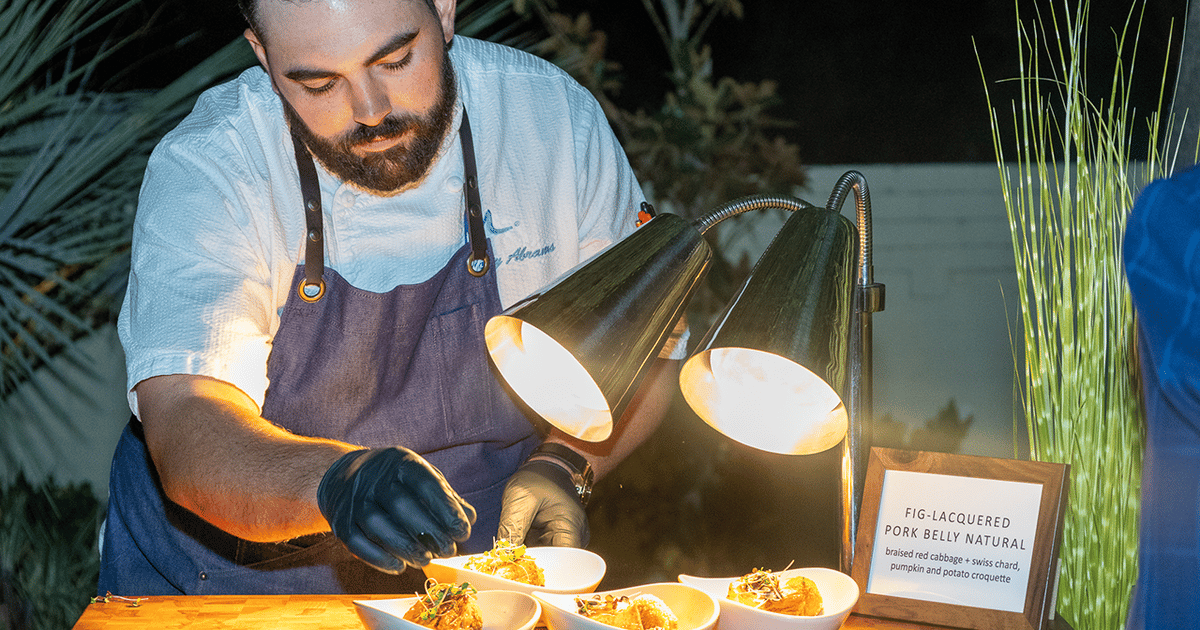
My philosophy is that limitations should never define the food itself. At many of M Culinaryʼs events, we build a fully functional culinary workspace on site and break it down once everything is complete. This approach allows our team to operate much closer to a restaurant style model rather than designing food purely around transportation or holding and convenience.
Submissions are now being accepted for the 2027 Cater+Event Gala Awards! We are thrilled to announce the launch of the Cater+Event Gala Awards, a groundbreaking fusion of two of the industry’s most prestigious honors: the Achievement in Catering Excellence (ACE) Awards and the Special Events Gala Awards. Now, these two celebrated programs come together to create something even more powerful: a unified platform that honors the full spectrum of catering and event excellence under one prestigious banner. SUBMIT NOW
Something that is part of our key philosophy is what I call the 60/40 ethos. Roughly 60% of the work is completed in our main kitchen, while the remaining 40% is finished onsite. This is intentional. The first 60% of the work gives us control and allows us to complete work that benefits from a stable environment. The remaining 40% of that work protects the guest experience. Finishing dishes onsite allows us to service food closer to how it would leave a restaurant pass–fresh and properly plated–rather than compromised.
Protecting quality at high volume
As guest counts increase, small inconsistencies sneak through. If one station falls behind or a preparation is not standardized, those issues quickly snowball into even more problems during service. High volume catering cannot rely on individual effort alone. The biggest players in a high-volume catering operation are the systems put in place to support the operation.
A successful event begins long before guests arrive. Every member of the team should understand their role and how it connects to that larger picture. Everything from preparation and transportation to equipment set up, replenishing, and breakdown all need to be communicated clearly and even rehearsed. Despite this, things rarely go exactly according to plan. Anyone working in large scale events knows that something will likely shift, whether it’s the timeline of equipment failure or weather causing us to pivot. Strong culinary systems are not built to eliminate those issues but rather give the team the structure to respond to these changing conditions without compromising the integrity of the food. When those fundamentals are clear and repeatable, the team gains the ability to adapt in real time without losing control of the overall experience. An important lesson that Iʼve learned over the years: you earn flexibility through preparation.
Cross training is key
Pressure is part of every professional kitchen. At large events, that pressure is intensified by scale, complexity, and the limited ability to recover once service begins. A chef must be able to perform in that environment. For me, that starts with cross-training. I prefer moving cooks between roles rather than keeping them locked into a single station. It keeps the work engaging, but more importantly, it reveals strengths, gaps, and opportunities for growth across the team.
Someone who excels in one area may thrive in another. Someone else may need more development before taking on additional responsibility. Over time, this creates a more complete and adaptable team.
That versatility becomes critical during large events. When something changes, you are not dependent on a single person for a single task. You have a team that understands multiple parts of the operation and can shift where needed. The best teams do not panic under pressure. They trust their preparation, rely on their systems, communicate clearly, and keep moving forward.
Not about numbers
In large-scale event planning, it is easy for everything to become about numbers:
-
How many guests do we have?
-
How many plates do we need?
-
How many servers make the most sense?
-
How much time do we need to execute service?
Those numbers matter, but they are not what guests remember. A successful event is built on the relationship between food, environment, and service. The food must be well executed and beautifully presented, and the environment should feel intentional and immersive.
Despite these aspects, service is often what leaves the most lasting impression. Weeks after an event, most guests will not recall every detail of the menu or every design element in the room. They will remember how they felt. They will remember the server who noticed what they needed before they asked. They will remember a moment of connection that made them smile. They will remember being taken care of in a way that felt personal, even in a large crowd.
Those moments matter just as much as what comes out of the kitchen. That is why hospitality must scale alongside the culinary operation. Training, service standards, and attention to detail cannot be reserved for small, intimate dinners. The expectation should remain the same whether you are serving 50 guests or 5,000.
When all of these elements come together, something important happens. The complexity behind the event disappears from the guest’s perspective. They do not see the prep lists, the mobile kitchens, the timelines, or the coordination that made the night possible. They simply experience a well-executed meal and genuine hospitality. That is always the goal.