

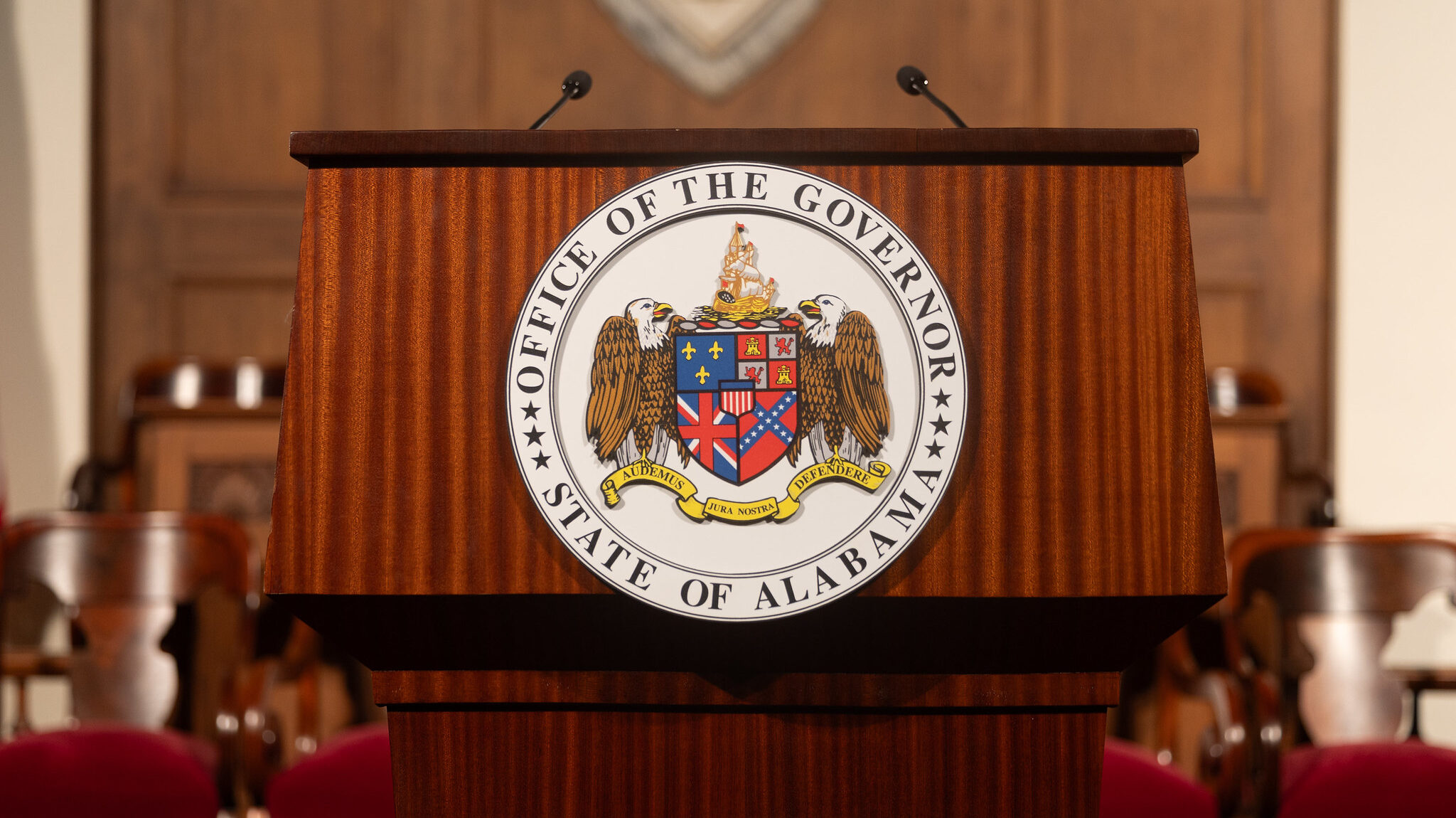
Alabama’s governor has the biggest bully pulpit in state government. The office can make an issue a statewide priority, bring competing interests together and give lawmakers political cover to act.
Major initiatives rarely advance without the governor’s support. That support can be decisive. It cannot guarantee passage.
The governor can command attention. The governor cannot command the votes.
That distinction is easy to lose during a campaign, when candidates speak as though winning the office will give them control over everything from taxes to schools to the cost of living. The promises belong to one candidate. The authority to fulfill them is spread across a government.
Alabama elects a governor. It does not elect a government that takes orders from one.
The Legislature holds the stronger hand in making laws and deciding how public money is spent. The governor’s veto illustrates how firmly that hand is held.
Under Article V, Section 125 of the Alabama Constitution, lawmakers can override an ordinary gubernatorial veto with a majority of the elected membership of each chamber—53 votes in the House and 18 in the Senate. No supermajority is required.
A veto gives the governor an opportunity to raise objections, seek changes and make lawmakers reconsider. But if a majority of the elected membership in each chamber remains behind the bill, lawmakers can enact it over the governor’s objection.
The same distribution of authority governs the budget. The governor submits recommendations, negotiates priorities and can veto individual items in appropriation bills. The Legislature decides what it will enact. When lawmakers have the votes to override, they have the final legislative word.
That leaves a governor with considerable influence over a budget, but no authority to treat a campaign promise as an appropriation.
The special session gives the office another means of shaping legislation. The governor calls the session and identifies its subjects. Legislation outside that call requires a two-thirds vote in each chamber. The power lies in bringing lawmakers together around a defined agenda.
Governor Kay Ivey used special sessions to advance the Rebuild Alabama gas tax in 2019 and prison construction legislation in 2021. Those efforts show how a governor can turn a priority into legislative action. They also show the limit: Lawmakers still had to pass the bills.
Governors must work with a Legislature whose leaders possess powers of their own.
The speaker of the House and the Senate president pro tempore wield substantial influence through committee assignments, procedural authority and control over the agenda. They help determine which proposals receive a vote and which never get that far.
Both are elected to the Legislature by voters in their own districts, then chosen for leadership by their colleagues. Their authority extends well beyond the people who elected them.
Their power reaches across Alabama. Public scrutiny should reach just as far.
The Senate’s treatment of the lieutenant governor shows how deliberately lawmakers have guarded that authority.
In 1999, after a weeks-long standoff with Republican Lieutenant Governor Steve Windom, a Democratic Senate transferred most of the lieutenant governor’s legislative powers to the president pro tempore. This spring, a Republican Senate went further. In a 32-0 vote, senators removed the lieutenant governor from the committee that assigns committee chairs and took away the office’s authority to appoint conference committee members.
The party changed. The instinct did not. Power in the Senate stays with the senators.
A governor who wants major legislation must understand that arrangement and turn public support, working relationships and negotiation into legislative agreement. The office can help create the conditions for action, but it cannot issue instructions to either chamber. The Legislature’s work continues whether the governor leads a particular effort or stays out of it.
Nor does the governor command the entire executive branch.
The lieutenant governor, attorney general, secretary of state, treasurer, auditor and agriculture commissioner are elected separately. They exercise their own lawful authority and do not serve at the governor’s pleasure.
This is why the presidency is a poor model for understanding Alabama’s governorship. The governor leads important executive agencies, but separately elected officers hold authority the governor cannot assume merely by winning an election.
Yet those limits do not make the office powerless. Much of its authority lies in the daily administration of government.
There is an old State House saying that the governor has two powers: asphalt and appointments.
The governor appoints the Alabama Department of Transportation director. Through transportation leadership and administration, the office influences how the state carries out its road-building responsibilities within the funding and requirements established by law.
Appointments reach much farther than highways.
The governor chooses the leaders of corrections, Medicaid, mental health and state law enforcement. The governor appoints the finance director who helps prepare budget recommendations, fills positions on more than 450 boards and commissions and fills many vacancies in elected offices as provided by law. Some choices require Senate confirmation or selection from designated nominees.
Through those agency leaders, the administration sets priorities, manages operations and carries out the laws the Legislature enacted. Statutes, funding and other legal requirements constrain that work. They still leave consequential decisions in executive hands.
A capable, honest agency head can steady a broken department. One chosen for loyalty alone can let it rot.
For Alabamians seeking medical care, depending on safe roads or worrying about someone in state custody, this is where government becomes real. They encounter the consequences of administration whether they follow Montgomery politics or not.
The Legislature’s control over funding does not erase the administration’s responsibility for how an agency operates. The administration’s responsibility does not erase the Legislature’s duty to provide workable laws and adequate resources.
Knowing the difference makes accountability possible.
It also makes campaign promises easier to judge. A proposal requiring a new law must survive the Legislature. An agency change may be within the governor’s existing authority, though it still requires resources and capable leadership. Promising to “get it done” tells voters little unless a candidate explains how.
The governor can rally Alabama behind an idea. Lawmakers decide whether to make it law. The administration must then make the law work.
Governing Alabama requires understanding all three—and knowing when to persuade, when to negotiate and when to exercise the authority already entrusted to the office.
Alabama’s governor cannot do everything. The powers the office does hold are enough to shape lives. Their limits deserve understanding. Their exercise demands accountability.