


As an actor, I’m sure you’ve had everyone (and their dog) shout the same advice at you. “Create your own work!!” It’s great advice, but most of the time it ends there. Oftentimes, it can leave you reeling and your head full of follow up questions: How do I actually do that? How do I put on a show? What are the practical steps? Ahhh, someone help!
Producing a show isn’t as hard as it sounds, but if you’ve never done it before it can feel overwhelming. Below, we’ll guide you through the main stages of producing a theatre show on a modest budget. Take my hand, and let me guide you thorough this exciting journey!
And if you’re looking for more, we have heaps of other resources on StageMilk! Check out our info about about how to make a web series, creating a series for social media, writing a vehicle for yourself, devising work, or thinking about putting on a show at a fringe festival! So much creative goodness to explore! Now, let’s get stuck in.
What Does Producing a Show Actually Involve?
There’s an old saying about producers that goes, “What does a producer actually do?” The answer: “Whatever it takes!”
The producer is responsible for getting the show from vague idea in someone’s head, to a living, breathing creative output on the stage. They typically handle the budget, contracts, and oversee the production. But they also jump in to solve problems, hammer out ideas, and save the day! Ultimately, the duties might change but the goal is the same: Get the show on it’s feet (and those bums into seats.)
A producers main responsibilities include
- Acquiring the rights to the production.
- Assembling a creative team.
- Determining and balancing the budget.
- Handling contractual obligations (with a venue, and/or with contracted members of the creative team).
- Scheduling and logistics.
- Marketing and selling tickets.
- Production week practicalities.
- Post-mortems on the production + payment.
As an actor who is also looking to produce, you need to be aware that the roles are different. Acting is highly creative and has no real rules. Producing involves contracts, money and legalities. While producers do not to be able to problem solve creatively, it requires a very practical approach. As a producer, you’ll be looking at the facts and making logistical decisions.
Step 1: Choose (or Create) the Right Material
The very first step as an actor-producer is to determine what show you’re going to produce. This decision guides all your other decisions.
If you’re reading this article, I imagine you’ve probably already got an inkling of the show you want to produce. Maybe it’s a published play you’ve fallen in love with or maybe you’ve even written a play yourself! Below, we cover the basics of acquiring rights to a script so that you have the permission to stage the show.
Acquiring The Rights for A Play
No matter what script you’re producing, the very first step is to get permission from the owner to produce it. Scripts written by other people require permission. So, if you’ve written your own play, go ahead and skip this section! As the writer, you own the work and don’t need permission to use it. Otherwise, read on.
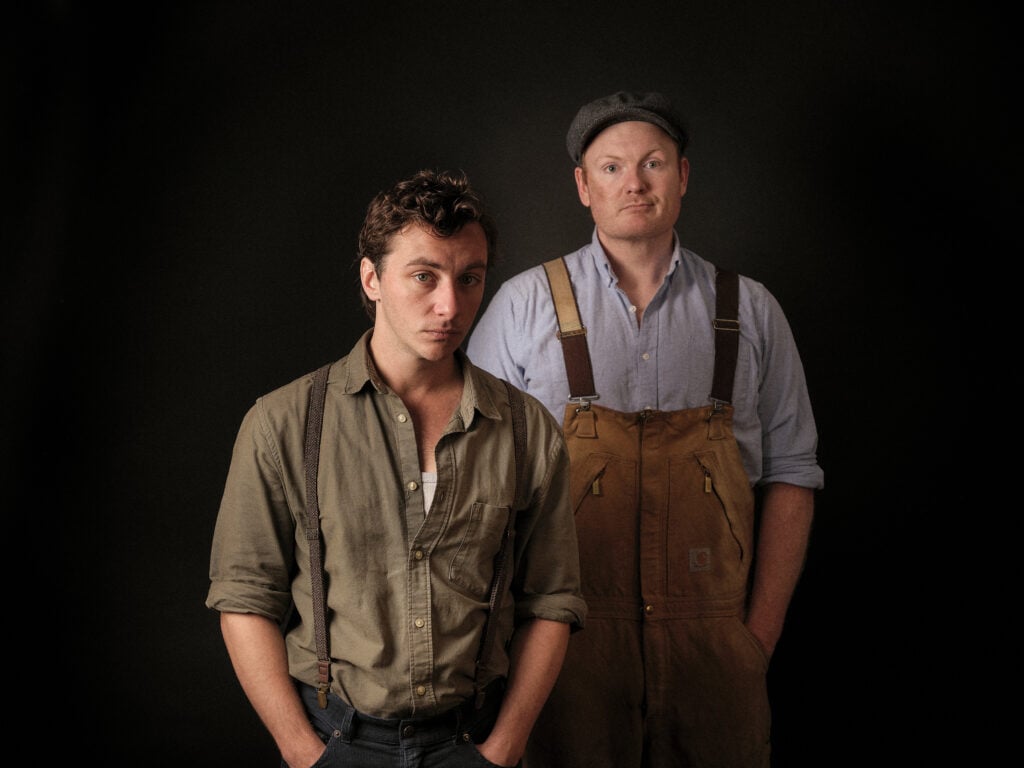
Marketing photos from Of Mice and Men, a show I recently produced.
Scripts written by others will either have an active copyright or they will have moved into the public domain. Most countries protect works for the life of the author plus 70 years. Check the public domain rules where you live before you move ahead. If a script is in the public domain, the copyright has expired and permission is automatically granted. Think, Shakespeare, Oscar Wilde, Henrik Ibsen, or the Greek Tragedies. You can use the work in whatever way you wish!
A script with an active copyright requires permission from the author. This permission is usually administered by the publisher, who liaises with the author or the author’s representative to grant permission. Usually you can find he contact information for the rights (also called licensing of a publication) by searching on Google for the play + licensing rights. Unpublished or independently published plays may require a bit more hunting!
Step 2: Build Your Core Team
The size of your team is going to depend greatly on the production that you’re creating. There are a number of decisions that you will need to make about the size of your team. In general, you want the team to be as small as reasonably possible while distributing the work in a manageable way. There are also budgetary considerations to consider. If the show is profit share, fewer team members means a bigger slice of the pie for each team member! However, if your play has 10 cast members, you will probably need at least 5-6 actors (with some role doubling.)
It’s not necessary to have a separate team member for each responsibility. Responsibilities can easily be merged between roles. For example, rather than hiring a marketing coordinator, the marketing plan may be created by the producer (that’s you!) or instead of having a costume designer or stage manager, actors might be responsible for sourcing their own costumes and organising their on props outside.
Here’s a list of backstage roles that are typically involved in a large scale production:
- Producer
- Director
- Stage Manager
- Designer (Set, Costume, Props)
- Lighting Designer and Operator
- Sound Designer and Operator
- Marketing
Even with a small budget, having help makes a big difference! Have a think about what team members you actually need, and make a plan to fill those roles. Don’t be afraid to get people involved to help out with just one task, or give a few hours here and there (an afternoon painting sets, a friend to go thrifting with for costumes!)
Step 3: Budgeting a Theatre Show
The next step is to show me the money, baby! Every theatre show will cost something to produce, even if it’s just the gas money you spend driving to rehearsal. Considering the costs up front will help ease the burden later, and guide you to make smart decision throughout production.
Expenses of a Theatre Show
Below we’ve included a sample micro-budget breakdown with the typical costs to consider for a small budget production. Use it as a guideline for your own budget.
| Budget Line | Estimated Cost (AUD) | Notes |
|---|---|---|
| Performance Rights | $250 | If using an existing play |
| Music Rights | $200 | If using recorded music. Obtained through APRA AMCOS (in Australia) |
| Venue (4 performances + tech day) | $1,200 | Small black box / fringe venue. Base fee. (box office % from ticket sales separate) |
| Rehearsal Space | $– | Friend’s living room |
| Set, Props & Costumes | $200 | Materials + some hire |
| Lighting & Sound | $150 | Extra hire + consumables |
| Marketing (design, print, ads) | $450 | Photographer payment, social media advertising campaign |
| Insurance (Public Liability) | $300 | Essential |
| Cast & Crew Expenses | $300 | Travel, bump-in, rehearsal snacks, printing scripts, etc. |
| Contingency (10%) | $285 | Always include this |
| TOTAL | $3,135 |
Income of a Theatre Show
Now that we’ve had a chance to look at expenses, et’s figure out what our profit might be! There are some key assumptions we’ve made here to determine our projected income.
For this show we are assuming:
- 7 performances (Tuesday – Sunday, with 2 shows on Saturday)
- 125 seats maximum
- Average 30% capacity → 263 tickets sold
- Ticket price: $25
- Venue takes 50% of gross box office
- Profit shared equally between 4 people
| Income / Profit Line | Amount (AUD) | Notes |
|---|---|---|
| Gross Ticket Sales | $6,575 | 263 tickets × $25 |
| Venue Box Office Share (50%) | – $3,288 | 50% of gross ticket sales |
| Net Box Office Income | $3,287 | What the production receives |
| Total Production Expenses | – $3,135 | From expense budget |
| Net Profit | $152 | After all expenses |
| Profit Share per Person (÷ 4) | $38 | Equal split between 4 team members |
This is a realistic budget, and show us that we can essentially break even as long as we sell 30% of tickets. Any extra tickets you can sell above 30% will be more money in you and your mates’ pockets!
If you’re struggling to decide what matters in your budget , let me suggest the following. When building your budget, start with the unavoidable costs. These will probably be:
- Licensing fees
- Public Liability Insurance
- A venue hire fee (though the amount is highly variable.)
Everything else is changeable! While building out your budget, funnel the money towards what matters most: making a great show and getting the word out there so that people will come and see it.
Step 4: Finding and Booking a Venue
When it comes time to look at venues, there are a number of considerations for the producer. The right choice of venue will satisfy all of the necessary requirements for your production (eg. type of stage, ability for certain technical elements), while also being available and realistic in terms of budget and access.
Fringe Festivals
Begin your conversations with venues early and seriously as soon as you have decided to go ahead with a season. Research, ask around, and look at past year’s programs. Then, once you have a long list, start to get in touch with venues. For large fringe festivals like Edinburgh or Adelaide, also consider which venues will realistically program your show.
While established venues like the Summerhall or Pleasance Courtyard bring huge audiences and prestige, they are also highly competitive and have strict requirements that must be met before they will consider programming your show. Assuming that you would be able to secure one of these venue for your first ever show is probably not realistic.
Independent Productions
For shows that are not part for a fringe festival, there are still considerations in terms of realistic programming possibilities. Typically, independent productions will struggle to be programmed at large professional theatres (ie. The National).
Connecting with fringe or independent venues will be much more fruitful. Consider looking for:
- Black Box Theatres
- Independent Theatres
- Community Theatres
- Pub Theatres
- Outdoor Theatres
Ultimately, you need a venue that is willing to work with you for a reasonable price. You and your audience should also be able to access the location and it should satisfy the needs of the show.
Key Practical Considerations
Your final choice of venue will come down to factors like:
- Location
- Marketing support and audience engagement
- Budget
- Available dates + length of the run
- Technical capabilities
- Audience size
It’s also worth consider venue fees before you sign a contract. Some venues charge a flat fee for a certain number of days or shows, others charge a box office split (eg. 50% of ticket sales), others will do some combination a box office split + base venue hire fee. Make sure that you understand what you’re signing up for. In your budget, aim to have a break even point of 30-40% capacity to avoid financial difficulty if the show does not sell out.
Step 5: Scheduling & Logistics
As producer, you will most likely be organising the schedule for the production. This will include the overall schedule, from pre-production, rehearsal, tech, and the production season. It will also include the finer points of scheduling auditions, rehearsals with cast members, production meetings with the creative team (even if they’re informal and over a coffee, or pint at the pub!), and tech week and production timelines for things like bump in and bump out.
Questions to ask yourself include things like:
- How long will each phase of the show take?
(eg. 1 week pre-production, 3 weeks rehearsal [with 1 week of technical rehearsal], 1 week run of the show) - How will schedules be shared and requirements communicated?
- Will there be any need for transporting people or goods to and from the theatre or rehearsal space? How will that happen?
- Any deadlines, eg. off-book date for actors, first full run of the show, final tech dress, etc.
- Do you need to book any photography or videography for marketing ?
Whatever system you use, be sure you have a clear overview of the upcoming tasks and requirements. You will also need a reliable way of communicating with all members of your team! Be clear, concise, and direct.
Step 6: Marketing & Selling Tickets
Marketing and sales can be overwhelming, on top of producing a whole show! Especially when theatre isn’t exactly famous as a money printing endeavour. But when it comes to selling tickets and getting bums on seats, your common sense is your most valuable tool.
Marketing and Ticket Sales Considerations
Start marketing early, and often. Be strategic about your materials and message. Figure out who your audience is and speak directly to them. A good rule of thumb is to allocate around 30% of your entire budget to marketing and to start far in advance of your show. Remember the “Rule of 7”: it often takes at least seven exposures to your show before someone actually books a ticket.
The decision to buy tickets is highly personal and usually comes down to a combination of factors. Think about what makes you want to see a show, and use that as your starting point. There’s no single right way to market a production, it’s as unique as the show itself.
 A simple, high-quality shot used for a theatre show I wrote, produced and acted in.Here’s what typically drives people to buy a ticket:
- Awareness. They actually know the show is happening (this is often overlooked).
- Perceived quality. The production looks professional and well-made.
- Clarity. They understand what the show is about.
- Strong visuals. Good photos or video that give a real taste of the show.
- Engaging copy. The marketing text is interesting and makes them want to know more.
- Personal connection. They have a reason to care, such as:
- A friend is in it
- They’ve seen marketing they like
- It’s at a venue they trust
- Friends are going
- They like the writer or the play
- It has good reviews
- Easy booking. Tickets are simple to buy.
- Fair pricing. The ticket price feels reasonable.
Quick test: Which would make you more likely to book… A professional photo of the cast in costume, or a generic Canva stock-image flyer? An interesting, funny trailer, or nothing at all? I know what I’d pick!
In general, the better a show looks, and the more people can get an idea of what the show will be, the more people be willing to commit their hard earned dollars to buying tickets. Consider coming up with one ‘HERO SHOT’ you can use across platforms and as your main marketing image, then supplement that with other photos or videos that help visually share your show. Get creative and have fun with it!
Step 7: Production Week & Show Week
If you’ve ever been in a show before, you know that tech week can be a slog. There are often long days, with huge stretches of time spent fine tuning technical elements so that everything runs smoothly on opening night. Make sure that you secure everyone’s availability for tech week up front, and that you only call actors who are absolutely required. The days are long enough without them showing up when they’re not needed!
If you’re working with a technical operator included with the venue, make sure you communicate in advance to ensure they are available for the tech day(s). Don’t be afraid to ask friends and family for help with bumping in and bumping out. You never know whose uncle has a truck you can borrow for a day! Then, when opening night comes, let go and enjoy the feeling of successfully getting a show up off the ground. Soak in that applause. You earned it!
After the Show: What Next?
You’ve done so much hard work to get this show up off of the ground. Make sure you collect any reviews, photos or video taken of the show. Once the run is over, they’re all you’ll have left of your wonderful work.
Then, once you have all of this evidence, you can use it on your acting profiles, social media, or even on a website. If you loved the process and want to do something else in the future, continue to nurture your relationship with the venue and fellow creatives.
Momentum starts with a single action! Who knows where this one show could lead?
Common Mistakes First-Time Actor-Producers Make
The most common mistakes we see from first-time producers include:
Legal & Administrative Mistakes
- Not securing the correct performance rights or licensing for the script (or music)
- Skipping public liability insurance
- Not reading the venue contract carefully (especially cancellation clauses, tech inclusions, and box office splits)
- Failing to clearly communicate with the venue. Never bluff or hide what you don’t know — venues would rather help you than deal with problems later
Money & Team Mistakes
- Not defining responsibilities clearly (both financial and practical) from the start
- Hiring too many people and ending up with a tiny (or non-existent) profit share
- Poor budget management — especially forgetting venue fees, box office splits, and a contingency
- Not being strategic about where money is spent (spending on the wrong things while underfunding essentials)
Creative & Production Mistakes
- Choosing a play with a limited potential audience
- Having almost no set, props or costumes and no lighting or sound design, leaving the show visually and atmospherically flat
- Not considering rehearsal space needs and potential costs
- Running out of time due to unrealistic scheduling
- Trying to do everything yourself instead of asking for help or delegating
Marketing & Audience Mistakes
- Leaving marketing until the last minute (or doing almost none)
- Using low-quality marketing assets (blurry photos, poorly designed posters, weak copy)
- Feeling embarrassed or hesitant to talk about and share the show — people generally want to support you
Mindset Mistakes
- Believing you have to know everything or do everything alone
- Overcomplicating the production instead of keeping things simple and achievable
Bearing these in mind will help guide you towards a great first time producing!
Conclusion
There’s no magic formula to creating a successful show. It’s a combination of careful consideration and planning, a concerted team effort throughout the process, and an artistic product that holds up. Expect to make mistakes, and don’t hold yourself to unrealistic standards. Your first time producing will be a learning process, but that doesn’t mean it can’t be fun!
Stay positive, and lean on your community. If you go in with the right attitude, producing your own show is one of the most rewarding artistic experiences you can have!