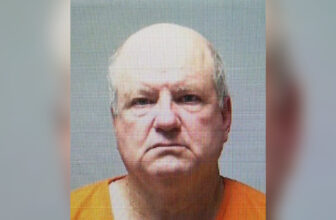


This past week, a federal board released records on the 1957 murder of Rogers Hamilton, revealing that the U.S. Department of Justice chose to close the case rather than follow up on allegations of possible law enforcement involvement.
Two white men kidnapped the Black teen from his home west of Hayneville late on October 22, 1957. Hamilton’s mother, Beatrice Hamilton, arrived at the scene just as the two men shot her son in the head. Law enforcement never arrested or charged anyone in connection with Hamilton’s murder.
“Most of these cases aren’t whodunits. In most of them, the perpetrator was known,” Alabama native Hank Klibanoff said. Klibanoff is a member of the Civil Rights Cold Case Records Review Board and a Pulitzer Prize-winning author who leads the Georgia Civil Rights Cold Cases Project at Emory University. “But these records help us better understand not just the details of the incident, but the environment around it—and how the system was set up to keep perpetrators from being held accountable.”
The trove of newly released documents followed the board’s release of records in 54 cases since 2024. A third of the case records released to date are from Alabama, by far the highest number of cases from any single state.
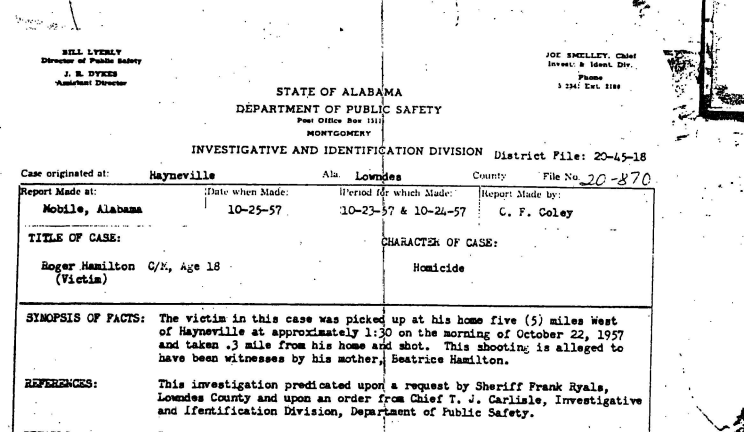
Alabama Bureau of Investigation’s 1957 inquiry
Alabama Bureau of Investigation inquiry
“Local law enforcement’s investigations into these crimes were often perfunctory, at best,” Klibanoff said. “What the records reveal, especially in the South, are officials protecting the status quo—a status quo that ensured Black residents were treated as second-class citizens.”
Newly released files included the Alabama Bureau of Investigation’s original 1957 inquiry detailing state investigator Oscar Corley’s probe into Hamilton’s death.
The documents indicated that Corley contacted Lowndes County Deputy Sheriff Joe Jackson, the brother of one of the two white men allegedly involved. Jackson’s involvement in the state’s investigation likely dissuaded Hamilton’s mother from identifying the men she saw kill her son to investigators. As a result, Corley’s efforts didn’t identify anyone involved in the shooting.
After two days, Corley turned the inquiry back over to the Lowndes County sheriff, who took no further action on the case.
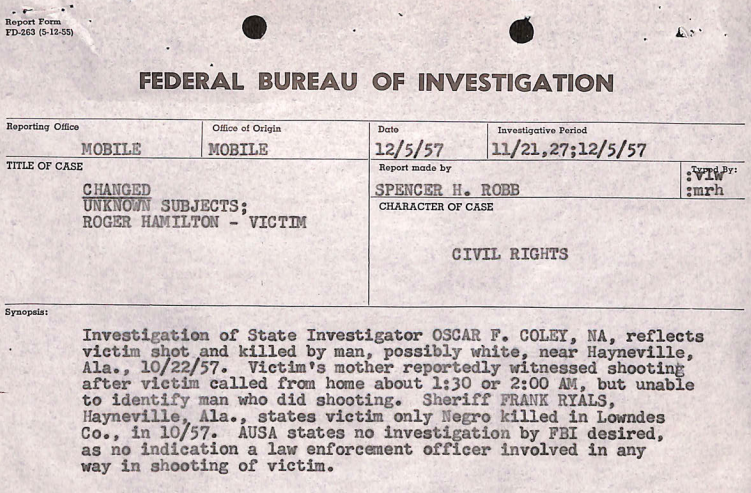
FBI’s 1957 file on the Rogers Hamilton case
FBI’s preliminary investigation
The documents also revealed that FBI special agents Spencer H. Robb and John C. McCluney opened a preliminary federal investigation.
The FBI received tips in November 1957 suggesting the possible involvement of Thomas Coleman, an alleged Klansman and part-time deputy sheriff. It also received an anonymous letter addressed to FBI Director Hoover claiming that the Lowndes County sheriff and his deputies were responsible for Hamilton’s death.
The documents contained no evidence that the FBI followed up on any of these leads in 1957 and indicated that FBI agents did not interview anyone who had witnessed the murder, such as Hamilton’s mother.
Instead, FBI agents interviewed only three people, including Assistant U.S. Attorney Robert Varner of the Middle District of Alabama. Varner urged the FBI to close the investigation, asserting that law enforcement officers were not involved.
“The indications are that the victim was killed by private individuals and that no officer was involved,” Maceo W. Hubbard, one of the Justice Department’s first Black civil rights attorneys, wrote in a handwritten note on the manila envelope containing the December 17, 1957, notice-to-close documents.

John Fleming, veteran journalist formerly of The Anniston Star
Journalists applaud document release
“I’m very happy to see the release of the files surrounding the Rogers Hamilton case,” veteran journalist John Fleming said. Fleming, formerly of The Anniston Star and founder of the Civil Rights Cold Case Project, reported extensively on Hamilton’s death. His groundbreaking reporting resulted in James Bonard Fowler’s 2010 guilty plea in the 1965 murder of Jimmie Lee Jackson. “The public and especially his family deserve to know everything. I think we can all agree that knowing the whole truth makes us a better society.”
Newly released documents showed that the FBI and the Alabama Bureau of Investigation reopened their cases on Hamilton in 2009, after the passage of the Emmett Till Unsolved Civil Rights Crime Act of 2008, and closed the cases shortly afterward.
“The Civil Rights Cold Case Records Review Board is releasing all the records it can—including original investigations and, if there were any, re-investigations,” Klibanoff said. “This is about transparency, so the American public can better understand not just how horrifying these cases were, but how prevalent.”

Hank Klibanoff, member of the Civil Rights Cold Case Records Review Board
Federal board reauthorization
The U.S. Senate passed reauthorization legislation for the federal board in December 2025. The U.S. House of Representatives is considering it.
“If the Board’s tenure is renewed past next January, we expect to release records in hundreds more cases,” Klibanoff said. “There are countless families still waiting for answers. They deserve them.”