
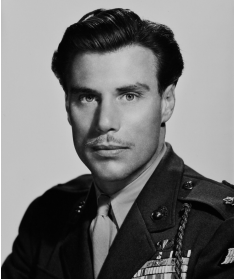
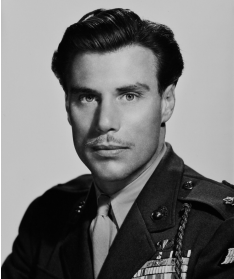
Germans knew U.S. Marine Pete Ortiz as Das Fantom. They had placed a half a million French francs on his head because of his work in Nazi-occupied Europe as a scout, spy, saboteur, and French Resistance leader. In The Phantom, authors Bob Drury and Tom Clavin reveal the untold story of this marine legend—one who later became one of the most decorated Marine officers of WWII. Read on for a featured excerpt from The Phantom.
PROLOGUE
August , 1944: Savoie Department, France
FRESH BLOOD, EVEN A SMEAR, HAS a metallic odor. Clean, impersonal, like the smell of a sheared brass bullet casing. It filled Major Pete Ortiz’s nostrils as he bent over the broken body of his fellow United States Marine, Sergeant Chuck Perry.
Thin red rivulets, like scarlet worms, leaked from Perry’s nose and ears, streaking his tawny hair. The twenty-two-year-old noncom had bitten off the tip of his tongue, and a flap of the severed muscle remained impaled on a broken front tooth. Pete Ortiz had witnessed violent death before; inhaled its pungent musk from corpses across two continents. Arab and Italian, French and German. Fellow Americans. This felt different. As if he were personally responsible.
Earlier that morning, prior to climbing into the hold of the B-17 that would jounce across the English Channel, pass over the secured Normandy beachheads, and soar inland above occupied France, young Perry had confessed to Ortiz that he had a “bad feeling” about this mission.
Ortiz had known the boy for but a few weeks, barely long enough to learn that he had only just married his stateside sweetheart before volunteering to drop behind Nazi lines. Recalling his own first clandestine insertion into enemy territory, he understood the dread. To soothe Perry’s nerves, Ortiz offered to switch parachutes. The sergeant could jump with Ortiz’s lucky silk, the one he had packed himself. The gesture, coming from an officer whose exploits were already legend across the French Foreign Legion, the U.S. Marine Corps, and now within America’s nascent spy agency, the Office of Strategic Services, or OSS, had the desired effect. Perry visibly calmed as the two exchanged rigs on the rutted tarmac.
To minimize casualties against antiaircraft batteries and Luftwaffe sorties, Ortiz and his six-man team had boarded separate planes. None of Sgt. Perry’s flight crew noticed that the steel static line that connected his deployment bag to the cable in the belly of the bomber had somehow kinked when he’d hooked it in place. The wire snapped when Perry leaped from the rear side door. His chute, Ortiz’s chute, never opened. Perry plunged some four hundred feet before crumpling into the alpine meadow with a broken neck.
It was not a good omen. Particularly considering that even before any of the Americans had jumped, the entire operation appeared to be sliding sideways. T-U in service slang. Tits Up.
***
The trouble began on approach to the target area—the pinpoint, in special operations jargon—a thirty-mile break in the French Alps called the Col des Saisies. The rugged and isolated mountain pass, rising some fifty-five hundred feet in the shadow of the towering Mont Blanc, was the logical site to deposit a squad of Allied spy-saboteurs. Although a small detachment of Germans was known to occupy the nearby town of Albertville, the vast majority of enemy troops had been headquartered far enough away in Grenoble, about seventy miles to the south, to chance a daylight jump. The peaks to the east were dusted gold by the sun when the three waves of Flying Fortresses approached the alpine saddle at staggered altitudes; seventy-eight planes tasked with delivering their human cargo, as well as nearly nine hundred canisters of weapons and provisions, to the disparate French Resistance cells of the area collectively known as the Maquis.
Though the “Forts” had picked up a squadron of American P-51 fighter escorts somewhere over the Channel, the formation had improbably encountered no opposition since lifting off from England’s Knettishall Air Station close to seven hours earlier. Perhaps it was the fierce air battle currently being waged over Chartres, far to the north, that had attracted the attention of what was left of the Luftwaffe, the German air force.
But as the aircraft neared the pass, the pilots of the first wave— designated Group A and carrying Ortiz and his men as well as a portion of the provisions—failed to spot the smudge pots and bonfires delineating the drop zone, or DZ. Following preflight instructions, the bombers overflew the Col before turning to make a second pass. This time, coming in hot and so low that the lynx-eyed Marine Sergeant John Bodnar could make out the cowbells hanging from the necks of the small herds below, the airmen saw the DZ smoke.
Each man on Ortiz’s team, all six in uniform, was freighted with a wirereinforced canvas bag containing a Winchester semiautomatic M1 carbine with a folding metal stock—about half the weight of the standard, Marineissue Garand rifle—a Colt .45 sidearm, and a double-edged Fairbairn-Sykes stiletto. Their mountain packs were stuffed with topography maps printed on silk and enclosed in cylindrical leather cases; a hip flask of “medicinal” cognac; cartons of Lucky Strike cigarettes; and the equivalent of $1,000 in French francs, concealed in secret flaps sewn into their boxer undershorts. Ortiz, lumbering under the additional burden of a Thompson submachine gun and a second rucksack holding nearly a million francs to be delivered to the partisan fighters, had to be lifted and tossed from his bomber by the waist gunner and the tail gunner. He was barely out his jump door when the navigators of Group A belatedly realized they were vectoring on a direct collision course with the planes of Groups B and C, approaching from the west.
Ortiz, on the ground now, blanched as he peered up into the cornflower sky. A tangle of thirty-two-ton aircraft were headed for each other at closing speeds of close to three hundred miles per hour, pitching, rolling, jinking out of each other’s way. By either pilot skill, instinct, or luck, none of the planes collided while the crews from all three flight groups frantically jettisoned the steel supply containers. Each crate, dangling from its parachute, weighed between 150 and 300 pounds and was packed with matériel ranging from Sten guns to hand grenades to explosive charges to medical supplies. Some even included spare bicycle tires and boxes of chewing gum.
But Chuck Perry was not the afternoon’s only casualty. As scores of guerrilla fighters poured from the enveloping conifers like teams of choreographed formation dancers to pry open the bomb-shaped canisters, Major Ortiz—collecting Perry’s dog tags and personal effects—spotted a small circle of men forming around the body of the Marine Gunnery Sergeant Bob LaSalle. The somber group included the veteran Free French fighter Joseph “Jo-Jo” Arcelin, an experienced wireless radio operator. The sinewy twenty-one-year-old Arcelin had been tasked with acting as the American team’s liaison with the various factions of maquisards who awaited their arrival.
Arcelin initially struck Ortiz’s fellow Marines as an odd duck to be traipsing about a war zone. As thin as a Giacometti bronze, he sported a dark beret worn at an angle just a degree or so shy of jaunty. This rested above his corvine face and the sort of eyeglasses you might find perched on the bridge of a rural parson’s nose. Adding to the incongruity was his jerky gait, which resembled a praying mantis folding and unfolding its spindly legs before striking its kill. Yet despite his youth, Ortiz knew Arcelin to have brass for a spine; he had shown it as a fearless getaway driver during the major’s previous covert operations in-country.
Arcelin, crouched over the inert LaSalle, was conferring with what looked to be a medic of some sort. A third Frenchman stood silent a few feet away. Unlike Chuck Perry’s, the gunny’s chute had opened, but during the jump, his static line had somehow coiled around his torso and tightened like a boa constrictor. He had blacked out during his descent. When Ortiz reached LaSalle, he feared that his spine was snapped. Arcelin’s companion, who was indeed a French physician working with the Maquis, waved off the unspoken thought. The wire, he said, had merely broken several ribs and wrenched LaSalle’s back. But LaSalle had also shattered his ankle upon impact. Lifting the Marine’s eyelids and examining his dilated pupils, the doctor added that it was likely he had suffered a concussion. He would have to be carried. The tiny American outfit was barely on the ground, and they were already down two men.
Ortiz opened his rucksack and tossed Arcelin the identification papers and spare Marine sergeant’s uniform his OSS handlers in London had provided. Though the Frenchman had been born and raised in the nearby Haute-Savoie region of southeastern France, tucked between Switzerland and Italy, he was now to pose as a French Canadian named George Andrew who had enlisted in the United States Marine Corps. The ruse would not stop the Gestapo from executing him if he were captured—in the wake of the Normandy landings, Adolf Hitler had personally ordered all Allied commandos taken behind the lines, even those in uniform, “to be shot immediately.” But the gambit might shield Arcelin’s three sisters, all couriers for the Maquis.
Arcelin introduced Ortiz to the third man. This was Jean-Marie Bulle, the legendary commander of the Free French Maquis battalion that bore his name. Bulle told Ortiz that close to twelve thousand German troops were currently stationed in and around Grenoble. This came as a shock. Months earlier, during Ortiz’s first infiltration, he had surreptitiously entered the quaint City of the Alps on multiple occasions to gather information and scout the enemy’s strength.
Though the presence of the Gestapo had hovered over the town’s cobblestoned streets like a toxic vapor, Grenoble had housed nowhere near that many Wehrmacht soldiers. The Germans had originally stationed a mere skeleton force of somewhat passive Sicherungs-Bataillone, or security battalions, around Grenoble. These were composed of elderly soldiers considered neither sufficiently trained nor physically fit enough for frontline duty. They patrolled alongside companies of captured Czechs, Poles, and Russians pressed into service to police the sector.
But since D-Day, Bulle said, the new Wehrmacht replacement troops included several Ost Bataillones, ruthless veterans transferred from the Eastern Front. There, alongside the euphemistically named Special Action Groups, these men had murdered undesirables across Poland and Ukraine, across Lithuania and Latvia and Belorussia. Most Americans would never recognize names like Minsk or Pinsk, much less villages such as Olyka, Grushvitsy, or Mlinov, but a few of the scores of towns and hamlets where tens of thousands of men, women, and children, predominantly Jews, had been executed and buried in pits of their own digging. But the French Resistance knew the names well. And now these Nazis were here, practicing a brutal version of total war that barely distinguished resistantes from luckless civilians.
Equally as ominous, working in conjunction with the newcomers were companies of Heinrich Himmler’s Waffen Schutzstaffel, black-uniformed SS combat units—Black Angels—who had also seeped into the area since the Normandy invasion. These men, having sworn allegiance to Adolf Hitler and Hitler alone, were not under the command of the somewhat louche German military authorities who had governed the region since replacing Benito Mussolini’s Italian “chicken thieves” in late 1943. The most senior Wehrmacht officers could not control the Black Angels, even if they had a mind to.
Ortiz had read the reports of the atrocities committed against French noncombatants since the Normandy landings. But to men on the ground like Arcelin, like Bulle, it had been a summer out of Revelation. Incidents like the June massacre of the entire population of the town of Oradour-sur-Glane or the torching of nearby Vassieux-en-Vercors only a month earlier burned in local memory like a branding iron.
Bulle’s grim report indicated that the war had taken a new turn since Ortiz’s last clandestine mission. The Nazi occupation had grown increasingly cavalier about putting the torch to its human kindling, and Ortiz and his team were suddenly highly combustible. It would be best to heed the notion that the desperate Germans were, for the first time, on the defensive on the Western Front. Cornered, like animals at their most vicious.
Both Bulle and Ortiz understood that Vichy spotters had undoubtedly reported the daylight parachute drop to the Wehrmacht command center in Grenoble. But with several hundred maquisards setting up ambush sites along the few dirt footpaths that led up to the Col des Saisies, it would be hours before any pursuers arrived. Still, it would pay to move fast.
It was nearing dusk—l’heure bleu—by the time Bulle and his guerrillas had collected and loaded the tons of military gear onto a packtrain of carts pulled by mules. Arcelin joined Ortiz, Sgt. Bodnar, and Sgt. Jack Risler in hefting the bodies of their two Marine comrades onto makeshift stretchers. Bodnar and Risler made an unlikely pair. Bodnar, twenty-one, with closecropped hair that sat atop his head like a black garrison cap, was a barrelchested noncommissioned officer, or NCO, with a stubbed, broken nose that bent toward the left side of his face. He wore the earnest expression of a well-trained gun dog. The fair-skinned, twenty-four-year-old Risler, by contrast, was altogether more feline and wary, with small, searching blue eyes and a mouth as pursed as a government accountant’s. Ortiz had already informed his team that he would preside over a formal military interment for Sgt. Perry as soon as possible; any Nazis closing in be damned. After the ceremony, the injured Bob LaSalle, already regaining consciousness, would be ensconced in a safe house, far from Albertville, to await rescue.
Ortiz knew Albertville, and the Germans there knew Ortiz. Das Fantom, the Gestapo had dubbed him during his earlier operations across the region. Hitler’s leather-coated myrmidons had even placed a bounty of half a million French francs on the head of the brazen American Marine parading about the alpine countryside in his officer’s whipcords, raising hell at the head of local partisan units. As a spy and saboteur, Ortiz had spent four months blowing bridges, attacking munitions plants, ambushing troop convoys, and spiriting downed Allied airmen to safety in Spain. For this latest assignment, however, the major had been tasked with a larger role.
Ortiz had once been a singular ghost charged with leading tactical assaults to dishearten and distract the Germans from the waves of GIs and Tommies soon to land on the Normandy sands while simultaneously attempting to coalesce the disparate and feuding partisan units into a cohesive soldiery. This latter objective had been only partly successful. And now, two months later, Ortiz had returned to finish the job. In two weeks, he knew, another half million Allied troops would swarm into southern France from the Mediterranean in a second invasion, originally code-named Operation ANVIL. It was up to Ortiz’s squad of infiltrators to ensure that a unified resistance army would act as the hammer to that anvil, striking the enemy between.
That August evening, as the Americans and the Maquis battalion trudged the dusty paths farther up into the mountains of southeastern France, the words of the American spymaster General William Donovan rang in Ortiz’s ears. Your job, Donovan was overfond of telling his operatives, “is to let fly an arrow of penetration behind enemy lines.” Ortiz and his team were the sharpened tip of that weapon.
Start listening to an audio excerpt of The Phantom!
The Phantom. Copyright © 2026 by Bob Drury and Tom Clavin. All rights reserved.