

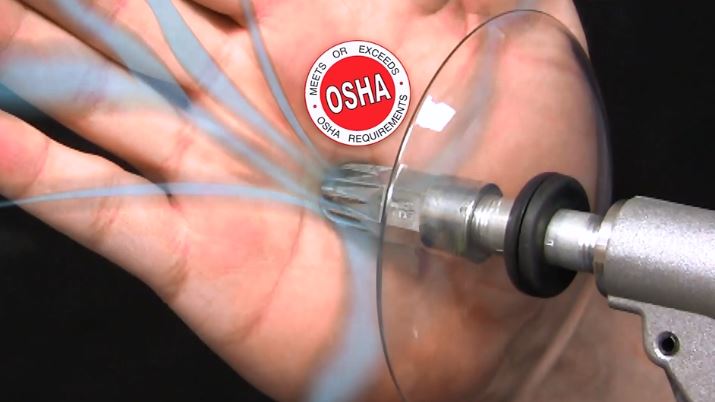

Safety in the workplace is of paramount importance, and it is widely recognized that annual safety training is a common practice among organizations. A fundamental message from these training sessions is that safety is a collective responsibility, not limited to a select few. At EXAIR, we prioritize safety in all aspects of our operations. Our product line, particularly our Safety Air Guns, exemplifies this commitment, as they are engineered with safety considerations at the forefront. This emphasis on safety is critical, especially given the potential health hazards associated with the improper use of compressed air.
In the United States, the Occupational Safety and Health Administration (OSHA) is responsible for enforcing regulations that promote safe and healthy working conditions. This agency possesses the power to levy significant fines for any infractions. Among the frequent violations related to compressed air are those concerning air guns and blow-off devices, specifically detailed in 29CFR 1910.242(b), which addresses dead-end pressure and chip shielding, as well as 29CFR 1910.95(a), which pertains to permissible noise exposure levels.
The regulation 29CFR 1910.242(b) addresses the use of hand-held tools, particularly emphasizing that blow-off devices must not operate at pressures exceeding 30 PSIG when there is a risk of compressed air becoming dead-ended. In situations where there is no escape route for the air, it poses a serious risk of penetrating the skin and causing an air embolism. A potential remedy is to drill a hole to create an alternative escape route. However, this solution may introduce additional safety hazards, which will be discussed later. EXAIR’s air nozzles are engineered with fins that facilitate safe air escape, thereby preventing skin blockage. Consequently, users can operate the EXAIR Super Air Nozzles at pressures exceeding 30 PSIG with confidence.

The regulation 29CFR 1910.95(a) specifies the permissible sound levels for safe human exposure, emphasizing that extended exposure to elevated noise can result in irreversible hearing loss. However, the cross-drilled nozzle falls short in this regard, as it generates significant noise due to turbulent airflow, despite being suitable for dead-end pressure applications. In contrast, EXAIR’s nozzles are engineered to incorporate ambient air, resulting in a significantly quieter laminar flow. For example, the Model 1210 Safety Air Gun, equipped with the Model 1100 Nozzle, operates at a sound level of only 74dBA, which is comfortably below the noise exposure threshold for an eight-hour work shift.
If you have any inquiries about compressed air safety, or any EXAIR products, please feel free to contact us.
Jason Kirby
Application Engineer
Email: [email protected]
Twitter: @EXAIR_jk