

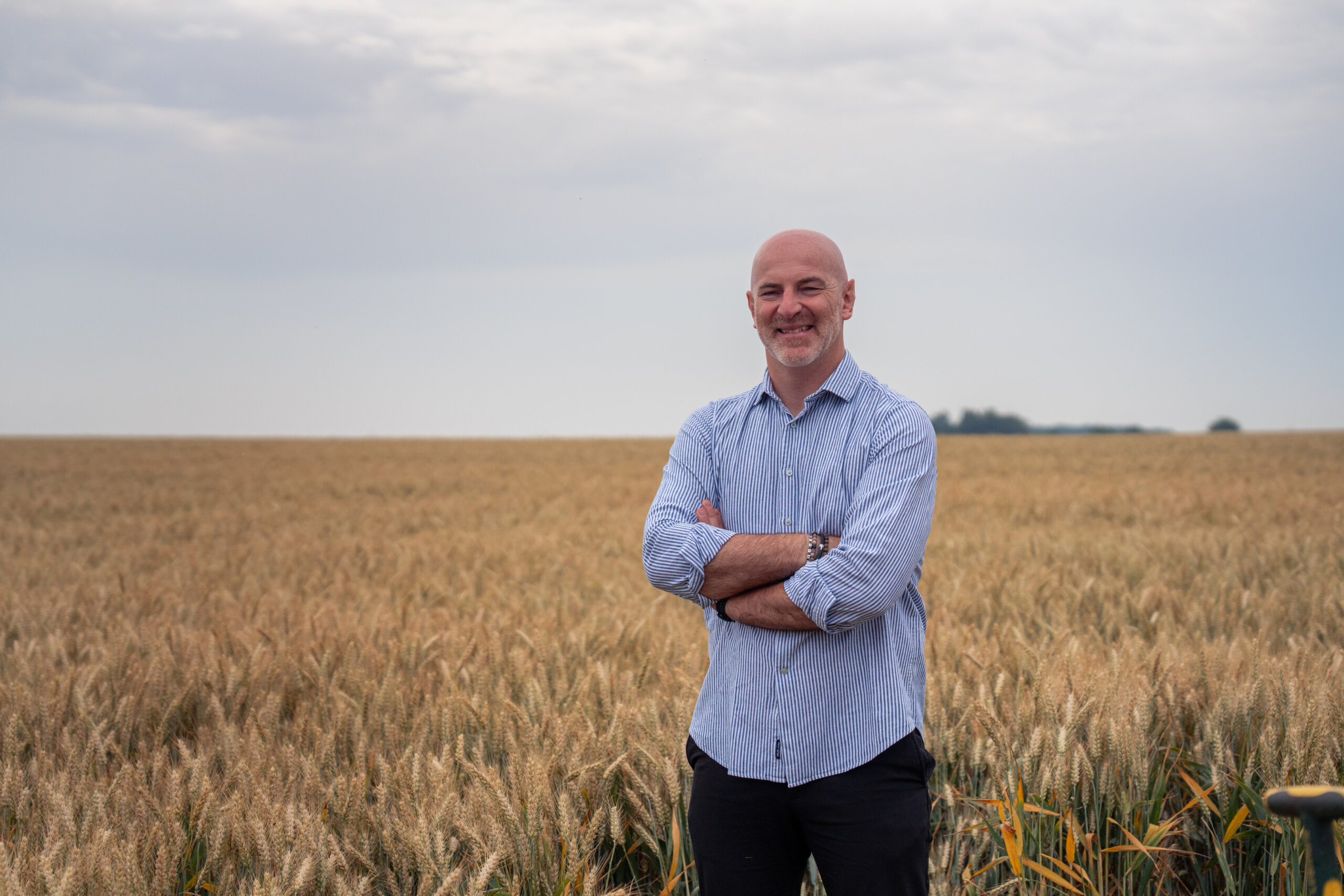

For Gianluigi “Gigi” Torta, becoming master distiller of one of the world’s best-known premium vodkas, Grey Goose, feels like the convergence of three separate strands of his life – tradition, food science and R&D. He talks to Australian Bartender about wheat, technology, consistency and why there can be no compromise when it comes to what goes into the bottle.
From growing up in his family’s flour mill to overseeing, Grey Goose master distiller Gianluigi “Gigi” Torta brings a combination of to the role.
The Italian-born food technologist grew up in a family of millers. The family home sat beside the mill and Torta was involved in the business from an early age.
“I was born and grew up in a mill,” Torta says. “My grandfather Luigi started in 1932 as a miller, then my father and my mother continued the activity until 2014.”
It ultimately led him to study food science and technology in Turin then into his career in quality and manufacturing. For almost two decades, Torta has been with Bacardi, including years in R&D.
He started as a quality laboratory technician at the Martini production facility in Italy, moved into manufacturing and worked alongside Martini’s master blender, before shifting into R&D. In 2019, Torta relocated to Geneva, where he became part of the team responsible for spirits R&D, including process and technology work for Grey Goose.
It was there he began working closely with Grey Goose founder and cellar master François Thibault.
“My experience in R&D makes a difference today, because technology is always something that we explore,” Torta says.
But there was another connection.
“Grey Goose is made with wheat. In our process, we have a mill, so we mill our own wheat. I combine everything, and that was a perfect fit for me to be a master distiller.”
It starts with the wheat
For a spirit often defined by its apparent simplicity, Torta is keen to draw attention to the agricultural and technical complexity behind vodka.
Grey Goose sources soft winter wheat through two cooperatives in Picardy in northern France, with wheat travelling from farms within roughly 50 kilometres of its distillery.
The company does not grow a dedicated Grey Goose variety. Instead, Torta says it selects high-quality wheat suitable for the bakery industry, looking particularly at protein and starch characteristics.
Once at the distillery, the wheat is milled into flour. And this is where Torta says the process differs significantly from conventional grain neutral spirit production.
Where other producers may separate valuable gluten and higher-grade starch fractions before fermenting the remaining material, Grey Goose retains the whole flour for fermentation.
“We mill our flour and we use the whole flour in the fermentation,” he says.
The process achieves an extraction rate of about 86 kilograms of flour from every 100 kilograms of wheat, according to Torta. Retaining more of the grain means keeping vitamins, fibres and proteins that then provide naturally occurring nutrients for the yeast during fermentation.
For bartenders accustomed to discussing provenance in whisky, rum, agave spirits or wine, Torta argues vodka deserves the same attention to raw material.
It is also one reason his background in milling has become unexpectedly relevant.
Consistency without compromise
Agricultural ingredients, of course, vary. Maintaining a consistent premium vodka while working with wheat that changes from season to season is therefore a significant part of the job.
Grey Goose manages the transition between harvests by holding stocks from the previous crop and progressively blending them with the incoming harvest rather than making an abrupt switch.
Varietal selection provides another tool. Farmers supplying the wheat grow around 20 varieties of soft winter wheat, with varieties selected according to planting conditions and their suitability for the season.
Crop rotation also plays a role, with wheat and sugar beet alternated rather than wheat being grown repeatedly in the same field
Torta likens some of the thinking to wine.
“You do a selection and you keep only the best,” he says.
Inside the distillery, that variability meets an intensely controlled production system. The facility was designed specifically for Grey Goose and operates continuously, 24 hours a day, seven days a week.
Torta says more than 500 quality checks take place across the journey of each bottle, from cultivation through to bottling.
That number speaks to what he sees as his fundamental responsibility as master distiller: consistency.
“Be very precise and meticulous in the quality,” he says. “My main activity today is to be the guardian of the quality.”
Fermentation is checked multiple times each day. If markers move outside specification, production can be stopped and the batch restarted.
“We don’t want any compromise.”
Technology meets tradition
Torta’s R&D background is particularly relevant as Grey Goose tackles one of the more difficult issues facing distillers: reducing the energy requirements of production without changing the liquid.
At the beginning of 2027, Grey Goose plans to introduce a new electric distillation column to replace a column currently powered by natural gas.
Torta says the change is expected to reduce CO2 emissions associated with that stage of production by around 40 per cent.
For him, however, the environmental gain comes with a non-negotiable condition: the vodka still has to meet the same quality specification.
“This is the big learning that is the legacy with François: zero compromise. Never.”
The longer-term ambition is to push process emissions as low as technically possible.
“Zero probably will be impossible, but as much as possible. This is my mission.”
It is a revealing distinction. Technology, in Torta’s world, is not being deployed to reinvent Grey Goose. It is being used to find better ways of making the same Grey Goose.
Premium in a changing market
That philosophy also shapes Torta’s response to changing drinking habits.
The global drinks industry is watching moderation, changing consumption patterns and the drinking behaviour of younger consumers closely. Grey Goose follows those trends, Torta says, but that does not mean reformulating the product in pursuit of them.
“We know perfectly the trend. We study the trend. We follow the trend, but there are a lot of consumers that are looking, moving to and searching premium products,” he says.
“We don’t want any compromise on quality. We change our product to adapt to the trend? No.”
Instead, Grey Goose is backing the continued appeal of premium spirits and serves that allow the base spirit to show itself.
During his Australian visit, one thing in particular caught Torta’s attention: our enthusiasm for the Martini.
“In a couple of days, I saw Martini cocktails everywhere, and I’m so happy because, of course, it’s one of my favourite cocktails.”
He nominates both the Martini and the simple vodka soda as drinks where vodka quality can be readily appreciated.
His own preferred Martini uses Noilly Prat vermouth. But his favourite Grey Goose serve is rather more niche: an “Altini”, made with artichoke and finished with a spray of génépi
Beyond the founder
Grey Goose turns 30 in 2027, and Torta is thinking not only about how it is made today, but how its knowledge is carried into the next generation.
He worked alongside Thibault for six years, an experience he clearly regards as formative. But Torta is equally clear that his role isn’t to imitate the man who created Grey Goose.
“I’m not François,” he says.
Instead, he wants the conversation around the vodka to expand beyond its founder and give greater prominence to three pillars: people, raw materials and process.
“For me, we must be transparent totally on our process because it makes the difference.”
That means talking about the wheat, milling, fermentation and technology – the details that can sometimes disappear behind vodka’s reputation as the quietest spirit on the back bar.
And it means planning for whoever eventually follows him.
Torta is 45 and hardly preparing to retire, but succession is already part of his remit.
“Grey Goose is not mine. It’s not François’. François invented Grey Goose. I’m part of this journey of Grey Goose, but I need to ensure the succession.”
It is perhaps the most telling insight into how Torta views being a master distiller. His job is not simply to make today’s vodka. It is to safeguard the knowledge, standards and people required to make it into the future.
For someone who grew up watching one generation hand a milling business to the next, there is a certain symmetry to that.
The technology will change. The energy source will change. Harvests will change. Eventually, the person guarding the process will change too.
The objective, Torta says, is that it doesn’t change the quality.