
Have you ever looked at a long layover and thought, What if instead of sitting at the airport for hours, we actually went out and explored?
Well, this is exactly what happened to us in Oman!
We were leaving Italy after spending several weeks there and heading all the way to Kuala Lumpur, Malaysia. Getting from Florence to Kuala Lumpur was already going to be quite the journey: trains, planes, airports. However, when we booked our flight, we realized that we were going to have a very long transit in Muscat, Oman, about 15 hours.
At first, 15 hours at an airport sounded pretty terrible. But then we started thinking about it differently. Fifteen hours was actually enough time to leave the airport. And if we could leave the airport, why not turn our layover into another adventure?
That is one of the things we love most about traveling. Sometimes a place isn’t necessarily part of the original plan. You might simply be passing through, but that doesn’t mean you can’t take advantage of it. So instead of spending 15 hours sitting inside Muscat International Airport, we decided to use those hours to get our first little taste of Oman. And I am so glad we did!

Arriving in Oman
We arrived in Muscat after what had already been a pretty long travel day.
We had left Florence, taken the train to Milan and then flown to Oman. Our final destination was Kuala Lumpur, but for the moment, we had landed in a completely new country. Oman!
This was our first time here and, to tell you the truth, we really didn’t know that much about the country before arriving.
That is actually one of my favorite parts of travel. You can read about a place and look at photos, but there is nothing like actually stepping outside and seeing it for yourself.

Oman sits on the southeastern side of the Arabian Peninsula, bordering the United Arab Emirates, Saudi Arabia and Yemen. Muscat is the capital, and while we certainly weren’t going to be able to discover an entire country in a few hours, we could at least get our first little taste of it.
Since we were only in transit, we didn’t have to worry about our luggage. It was continuing on to Kuala Lumpur, which made getting out of the airport much easier.
We quickly made our way out of the gate area, went through immigration and headed to a café where we were going to meet our guide for the day.
At this point, we were definitely tired! It was early, and after traveling through the night, we needed to wake ourselves up a little before starting another full day. So while we waited for our guide, we grabbed some breakfast and tried to get ourselves going. Soon our guide arrived and just like that, instead of spending the next 15 hours sitting inside an airport, we were heading out to discover Oman!
Planning Our Oman Layover
We knew from the beginning that our goal wasn’t to try to see everything in Oman. With only around 15 hours between flights, that would have been impossible.
Instead, we wanted to use the time we had to get a better understanding of the country and see a little more than just Muscat.
A few weeks before our trip, I found a local tour agency Oman Landscape Tours and contacted them explaining exactly how much time we had. Since we were visiting in July, we also knew it was going to be very hot, so spending the entire day walking around Muscat didn’t sound like the best idea!
We wanted to get out of the city too, see some of the landscape and get a better feel for the territory. I told the agency how much time we had available and gave them an idea of the type of things we wanted to see. They came back to me with some suggestions, we made a few modifications, and eventually we had our plan.
The original itinerary was actually quite ambitious. We would start with the Sultan Qaboos Grand Mosque in Muscat, then drive to Nizwa Fort and Nizwa Souk, continue to Birkat Al Mouz and the Al Kattmyn irrigation system, and finally make our way up to Jebel Akhdar, the Green Mountain, before returning to Muscat International Airport.

It sounded like a great way to see different sides of Oman in the short time we had. We would get some history, visit a traditional souk, see an old village, learn about Oman’s irrigation system and also get out into the mountains. At least, that was the plan!
As often happens when we travel, once the day actually started, we made a few changes along the way. And to tell you the truth, that is one of the reasons I like having a private guide. We had a plan to follow, but we weren’t stuck with it. If we wanted to spend more time somewhere or change something, we could.
Having everything arranged before we arrived also made leaving the airport much less stressful. Our guide knew when we were arriving, how much time we had before our next flight and, most importantly, that we needed to be back at the airport with plenty of time to catch our flight to Kuala Lumpur.
So instead of arriving in Oman and trying to figure out what we could possibly do in 15 hours, we had someone waiting for us and an entire day already planned.
Now we just had to see how much of that plan we would actually follow!

Our First Stop: Sultan Qaboos Grand Mosque
Our first stop of the day was the Sultan Qaboos Grand Mosque in Muscat, and it was definitely a good place to start our introduction to Oman.
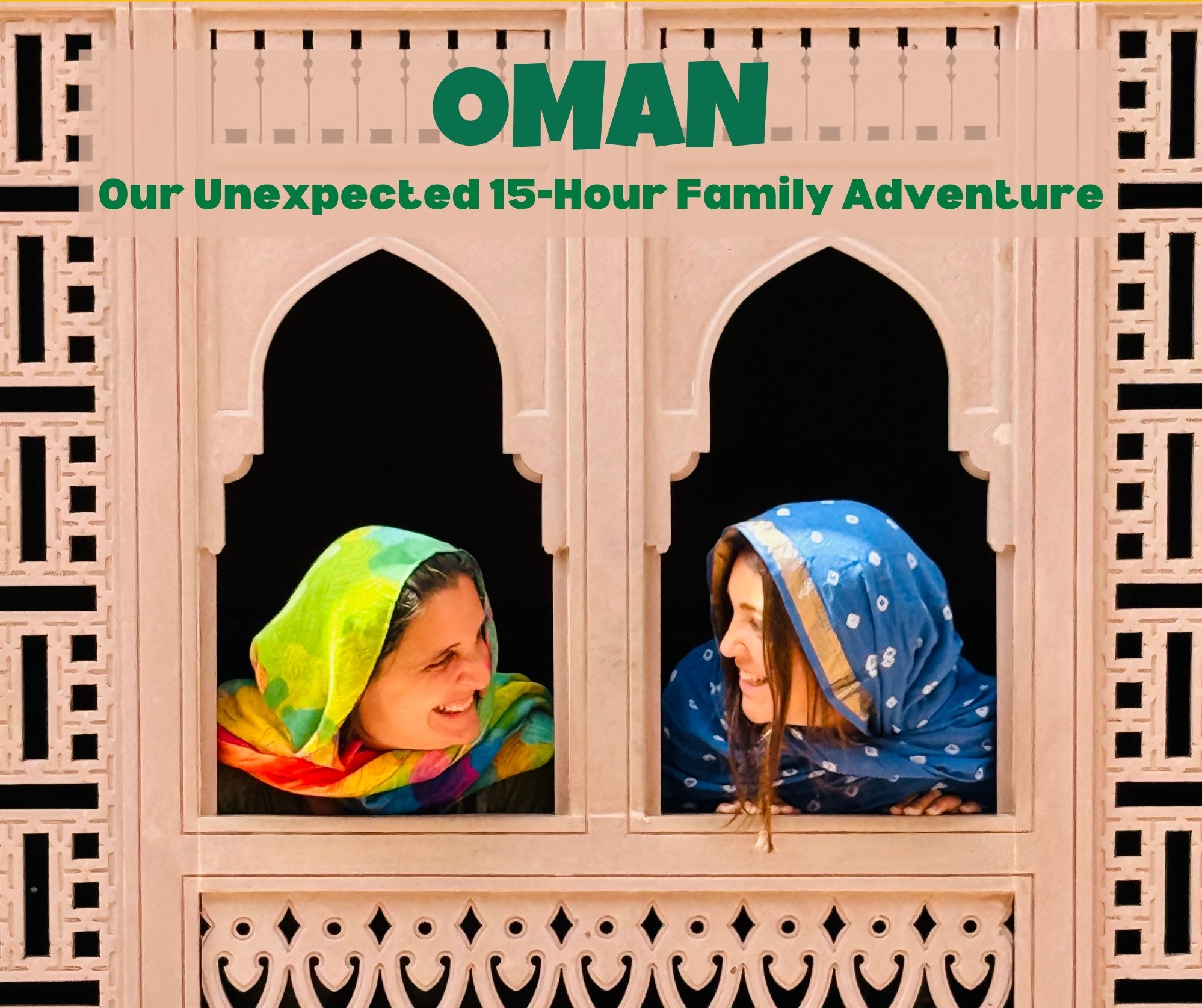
Before visiting, we had already been told about the dress code, so we came prepared. Men need to wear long trousers and have their shoulders covered, while women need to cover their arms and legs as well as their hair. I had brought a scarf with me, so once we were all properly dressed, we were ready to go inside.
This was also where we immediately realized how nice it was to have a guide with us. Instead of simply walking around, taking photos and leaving, he explained what we were looking at and told us about the history of the mosque, Islam and Omani culture. We were constantly asking questions, and he was very informative and happy to explain everything to us.

The mosque was commissioned by Sultan Qaboos bin Said, the Sultan who ruled Oman from 1970 until his death in 2020. He wanted Oman to have a grand national mosque that would not only be a place of prayer but also a center for Islamic learning and culture. An architectural competition was held to choose the design, and construction eventually took about six years. The mosque was completed and inaugurated in 2001.
The entire complex is enormous and can accommodate around 20,000 worshippers. There are five minarets, with the main one rising more than 90 meters high. Our guide explained so many little details as we walked through the complex that we probably would never have noticed if we had visited on our own.
The gardens and long covered walkways are beautiful, but the part that really impressed us was the main prayer hall.
And there are two things inside that are almost impossible not to notice: the carpet and the chandelier.

The carpet covering the floor of the main prayer hall is incredible. It was produced by an Iran Carpet Company and handwoven in Iran. Around 600 weavers worked on it, and the entire process took several years. The finished carpet covers more than 4,000 square meters of the prayer hall and weighs around 21 tons! It contains an incredible 1.7 billion knots and uses 28 different colors, many of them created using traditional natural or vegetable dyes. When the mosque opened, it was considered the largest single-piece handwoven carpet in the world. It has since lost that title, but standing there looking across it, that really doesn’t make it seem any less impressive.

What I liked was that our guide made us stop and actually look at the details. From a distance you see one enormous carpet, but when you look closer, you begin to notice the individual patterns, colors and all the work that went into creating it. Knowing that hundreds of people spent years making something we were now standing in front of gave us a completely different appreciation for it.
After spending all that time looking down at the carpet, our guide told us to look up. And there was the chandelier. The enormous chandelier hanging beneath the central dome is about 14 meters high, weighs around 8 tons and contains approximately 600,000 crystals and 1,122 lights. It was made by Faustig, a specialist chandelier manufacturer, and its metalwork is gold-plated. When it was installed, it was one of the largest chandeliers of its kind in the world.
What I found funny is that something 14 meters tall can almost look normal inside the prayer hall because everything around it is so big! And the huge chandelier isn’t the only one. There are dozens of smaller chandeliers throughout the mosque that follow a similar design.
Between the carpet below us, the chandelier above us and all the details covering the walls, ceilings and arches, there was constantly something new to look at.
But what I enjoyed most about our visit wasn’t simply learning that something weighed 21 tons or contained hundreds of thousands of crystals. It was having our guide there to explain why this mosque was so important to Oman and to answer all the questions we had about what we were seeing.
We weren’t simply walking through a beautiful building. We were getting our first little introduction to Oman’s history, religion and culture.
And this was only our first stop! We still had a pretty ambitious itinerary ahead of us, so it was time to leave Muscat and start driving toward Nizwa.

Leaving Muscat and Heading to Nizwa
After leaving the Grand Mosque, it was time to leave Muscat and start driving toward Nizwa, about an hour and a half away.
This was exactly why we had decided to hire a guide and not spend our entire layover in Muscat. We wanted to see more of the country and, even if we only had one day, get a better idea of what Oman actually looked like. And the drive definitely helped with that.
As we left Muscat behind, the scenery began to change. The city slowly disappeared behind us and the mountains became a much bigger part of the landscape.
I have to admit that before visiting Oman, I mainly imagined desert. I knew very little about the geography of the country and didn’t realize just how mountainous this part of Oman was.

Our guide continued explaining things to us as we drove, which made the journey itself part of the tour. We could ask questions about what we were seeing, about life in Oman and about the places we were heading to.
I’ll be honest though, we also took advantage of the drive to power nap! Our flight to Oman had been overnight and we hadn’t managed to get many hours of sleep. Add the jet lag and the fact that we had an entire day of exploring ahead of us before getting on yet another flight, and those little naps in the car were definitely needed.
So our drive to Nizwa was a combination of looking out the windows, listening to our guide, asking questions and occasionally closing our eyes for a few minutes!
Our destination was Nizwa, one of the oldest and most historically important cities in Oman. Nizwa was once the capital of Oman and for centuries was an important center for religion, education and trade. Its location also made it an important meeting point for routes connecting different parts of the country.
Today, two of its best-known attractions sit right beside each other: Nizwa Fort and Nizwa Souk. When we arrived, however, we didn’t head to the fort first as we had originally planned. Our guide told us we needed to visit Nizwa Souk before it closed for lunch, so we switched things around. It was time to explore Nizwa Souk.

Tasting Our Way Through Nizwa Souk
The souk is right next to Nizwa Fort and is divided into different areas selling everything from pottery and spices to dates, traditional clothing, silver and, of course, the famous Omani khanjars. But before looking around too much, we started with something that always gets our attention when we travel: food! Our guide had us try a traditional Omani dessert, and I have to say, I really enjoyed this one!
We tried Omani halwa, a very popular traditional sweet in Oman. It is quite different from the type of halva you might have tried in other countries. Omani halwa has a thick, almost jelly-like consistency and is made with ingredients such as sugar, starch, ghee and rose water, with different versions adding spices, nuts or saffron. It was sweet, rich and very different from anything I normally eat. I truly enjoyed it and would have happily had some more!

Then it was time for another very important food in Oman: dates. I knew dates were important throughout this part of the world, but I didn’t realize how many different varieties and qualities there were. We were able to taste several of them and compare the differences. Some were softer, some firmer, some much sweeter and others had a completely different texture and flavor. It was almost like doing a little date tasting!
This is exactly the kind of experience we love in markets. Instead of simply seeing a pile of dates for sale, someone was explaining the differences to us while we tasted them for ourselves.

After our little food tasting, we continued exploring the souk and started learning about some of the traditional Omani clothing. We saw the dishdasha, the long traditional garment commonly worn by Omani men, as well as the different styles of headwear. It was interesting because we had already seen people wearing them since arriving in Oman, but now our guide could actually explain what we were looking at. And then we got to the part that immediately caught Luca’s attention: the knives!
These weren’t just regular knives. They were the traditional Omani khanjars, the distinctive curved daggers that are such an important symbol of Oman. Some were very simple while others were incredibly detailed, with decorated handles, beautiful sheaths and intricate silver work. Luca loved them all!

He wanted to look at every different one, and I can’t say I was surprised. Put a ten-year-old boy in front of a display filled with beautifully decorated traditional daggers and you can pretty much guess which part of the souk is going to get his attention!
Our guide explained how the khanjar is worn with traditional clothing and that today it is generally reserved for special occasions, celebrations and official events. It is also one of Oman’s most recognizable national symbols.
Between tasting halwa, comparing dates, learning about the traditional clothing and trying to get Luca away from the khanjar displays, our quick visit to Nizwa Souk ended up being much more interesting than simply walking through a market. But we couldn’t stay too long. The souk was closing for lunch, and right next door was another place we had come all the way to Nizwa to see: Nizwa Fort.

Exploring Nizwa Fort
After the souk, it was time to visit Nizwa Fort, which is right next door.
By this point, however, our overnight flight was starting to catch up with us! Between the lack of sleep and the July heat, Mass and Luca were really struggling to keep their eyes open. They decided that the best option for them was to stay behind and get some rest, while the three of us continued on to explore the fort. Our guide found a couch in a hotel close by where they could rest while we explored. And there was a lot to explore!

Nizwa Fort dates mainly from the 17th century and was built during the rule of Imam Sultan bin Saif Al Ya’rubi, although parts of the complex are older. Its enormous circular tower is probably its most recognizable feature, standing around 30 meters high and 36 meters in diameter. As we made our way through the different rooms, staircases and passageways, we learned even more about the history of the fort and how it was designed to defend Nizwa.
The part I found particularly interesting was learning about all the traps built into the fort. Getting inside was definitely not as simple as breaking through a door and running up the stairs! The stairways leading toward the upper parts of the fort were designed with defense in mind. There were hidden openings and trapdoors along the routes attackers would have needed to take. Some of the openings above the entrances and passages could be used by defenders to pour boiling liquids or other materials down onto anyone trying to force their way through. There were also false doors, narrow passages and concealed pits designed to confuse or trap intruders.
As our guide explained each one, we started looking at the fort completely differently. Something that at first looked like a simple staircase or doorway suddenly had a reason for being designed exactly the way it was.

It must have been incredibly difficult to attack this place!
We continued making our way around the fort, exploring the rooms and eventually climbing higher until we reached the top of the huge circular tower. From there, we had a beautiful view over Nizwa, the palm trees and the mountains in the distance. Standing up there also made it much easier to understand why the location was so important. From the fort, you could see across the surrounding area and spot anyone approaching long before they reached the town. Of course, there was one other thing we couldn’t ignore from the top. The heat!

It was July in Oman, and by this point in the day it was HOT. Mass and Luca’s decision to sit this one out was starting to make a lot of sense!
Still, I was really happy that the three of us had gone inside. I had expected Nizwa Fort to be interesting, but learning about all those clever defensive tricks and traps was what made the visit stand out for me.
By the time we finished exploring and met back up with Mass and Luca, we were definitely ready to get back into the air-conditioned car.

What We Didn’t Get to See
Our original itinerary didn’t end in Nizwa. We had actually planned to continue to Birkat Al Mouz, see the Al Kattmyn Falaj irrigation system and then make our way up to Jebel Akhdar, also known as the Green Mountain. But by this point, we had to be realistic. We had already been traveling all night, barely slept on the flight, spent the morning sightseeing in the July heat and still had another flight to Kuala Lumpur ahead of us. Mass and Luca had already reached the point where keeping their eyes open was becoming a challenge!
So we decided not to try to squeeze everything in simply because it was written on our itinerary. I was a little disappointed because the places we missed sounded really interesting, but I also realized that we had all reached our limit for the day, and it was ok.
Birkat Al Mouz is an old village at the foot of Jebel Akhdar, known for its traditional mud-brick houses, date palms and ancient irrigation channels. It would have also given us the chance to learn more about something very important to Oman’s history: the falaj irrigation system.
The nearby Falaj Al Khatmeen is part of Oman’s UNESCO-listed Aflaj Irrigation Systems. These traditional systems have been used for centuries to channel water from underground sources and springs to villages, farms and date plantations. What makes them particularly interesting is that they allowed communities to farm and live in an environment where water has always been extremely precious.
Our final planned stop was Jebel Akhdar, which translates to the Green Mountain. It is part of the Al Hajar mountain range and, because of its higher altitude and cooler temperatures, is known for growing things you might not immediately associate with Oman, including pomegranates, apricots and roses.
That was the part I really would have liked to see, especially after being so surprised by how mountainous Oman was. But sometimes when you travel, you have to know when enough is enough. We had already seen and learned so much in just a few hours, and forcing everyone to continue when we were exhausted wasn’t going to make the experience better. Besides, now we have a few very good reasons to come back one day!

Tips for Planning a Long Oman Layover
If you are thinking about doing something similar during a long Oman layover, there are a few things I would keep in mind.
First, I would definitely organize your transportation or tour before arriving. We only had one day, so we didn’t want to waste any of it figuring out where to go once we landed. Having our guide waiting for us at the airport made everything much easier.
Also, don’t try to plan too much. We had quite an ambitious itinerary and ended up changing it during the day. Between an overnight flight, jet lag and the July heat, we quickly realized that seeing fewer places and actually enjoying them was much better than rushing through everything.
If you visit during summer, be prepared for the heat. Having an air-conditioned car between stops made a HUGE difference for us.
You should also check the dress requirements if you plan to visit the Sultan Qaboos Grand Mosque. Women need to cover their hair, arms and legs, and men also need to dress appropriately.
Finally, always check the current entry requirements for Oman based on your nationality before making plans to leave the airport. Requirements can change, and you don’t want to discover when you arrive that you can’t actually go through immigration.
Most importantly, leave yourself plenty of time to return to Muscat International Airport. Exploring Oman was definitely worth it for us, but missing our flight to Kuala Lumpur certainly wouldn’t have been!

Was Our Oman Layover Worth It?
Looking back, I am really happy we decided to leave the airport during our Oman layover. It would have been very easy to look at a 15-hour connection and think, “Great, now we have to spend an entire day at the airport.” Instead, we turned it into the chance to discover a country none of us had ever visited before.
In just one day, we visited the beautiful Sultan Qaboos Grand Mosque, drove through a landscape that was completely different from what I had expected, tasted Omani halwa and different varieties of dates at Nizwa Souk, learned about traditional clothing and khanjars, and explored all the hidden defenses and traps inside Nizwa Fort.
Were we tired? Absolutely!
By the end of the day, I think all five of us were ready to get on that plane and sleep.
Would I do it again? Absolutely!

For me, the important thing was not trying to see everything. Once we realized we were simply too tired to continue with the entire itinerary, we changed the plan. We missed Birkat Al Mouz, the ancient irrigation system and Jebel Akhdar, but that was okay.
What we did see gave us a much better understanding of Oman than we would ever have gotten from sitting inside Muscat International Airport for 15 hours.
I also think having a private guide made a huge difference. We didn’t waste our limited time trying to figure out transportation or deciding where to go next. We had someone who could explain what we were seeing, answer our many questions and change the itinerary when we needed to.
If you have a long Oman layover, I would definitely consider getting out of the airport, as long as you have enough time and check the current entry requirements before you arrive. Just don’t make the same mistake of thinking you need to see everything in one day. Choose a few places that really interest you, leave yourself plenty of time to get back to the airport and enjoy the fact that a layover can sometimes become an unexpected part of the trip.
We arrived in Oman thinking of it as the place between Italy and Malaysia.
We left tired, but very happy that we had decided to see what was outside the airport.
And next time, Jebel Akhdar is definitely staying on the list!

Continue the journey with:
If you are planning a trip to Asia, these unique destinations should definitely be on your radar:
I hope our experience helps you plan an unforgettable Asia adventure of your own!