
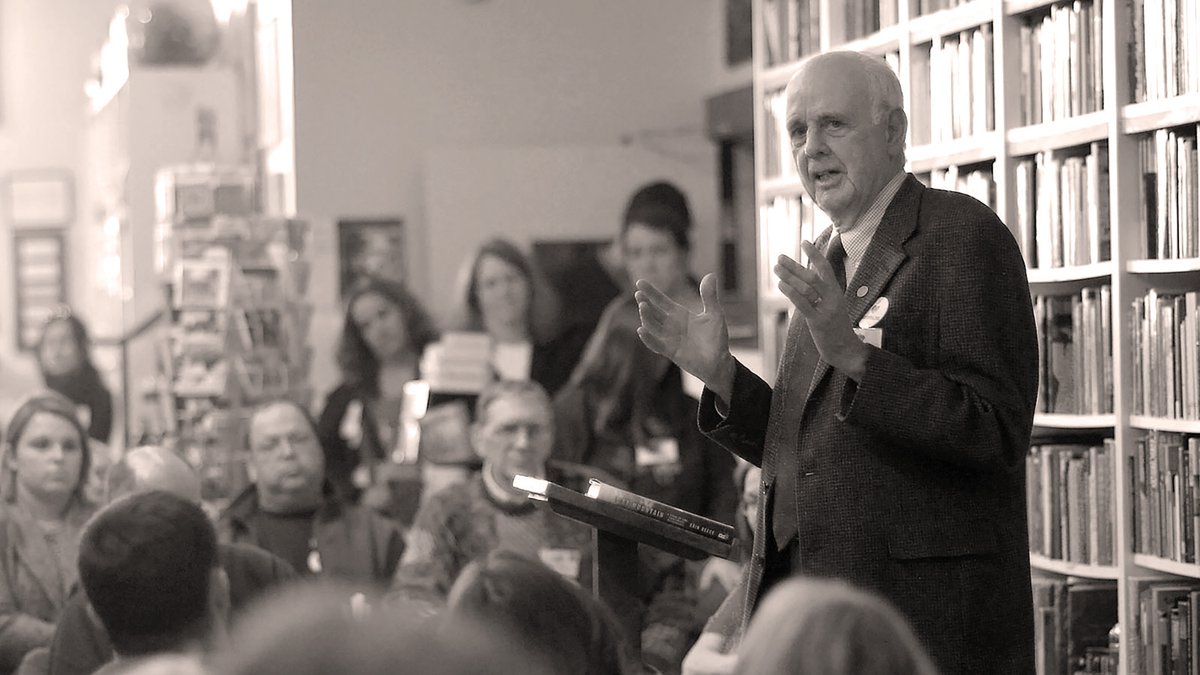

“Wendell has left the building,” my dad texted me on Monday, August 31, the day the great Kentucky agrarian and writer passed away. Within hours, his obituary had appeared in The New York Times, under a headline Berry would have greatly disliked: “Wendell Berry, Writer Who Extolled America’s Agrarian Past, Dies at 92.”
Berry was not nostalgic about the agrarian past. He wrote persuasively and worked urgently to defend the present and the future of the land and the people that he loved. Through The Berry Center, his daughter, Mary Berry, carries on that work of “changing our ruinous industrial agricultural system into a system and culture that uses nature as the standard, accepts no permanent damage to the ecosphere, and takes into consideration human health in local communities,” as the center’s website puts it.
Like millions of people touched by Berry’s poetry, novels, and essays, I felt a stab of heartache when I got the news. I was lucky to grow up reading his books, shared with me by my father, a lifelong Berry admirer, and to get to know him later, when I had the delightful privilege of hearing his lilting baritone on the line when he called about the essays he wrote for The Progressive. Like many lucky people who were recipients of his correspondence, I felt a thrill whenever I received his letters, written in elegant, unmistakable longhand on yellow sheets of lined paper.
I took my daughter, Rose, to visit the Berrys in Kentucky right after she graduated from high school, and Berry was generous enough to talk with me and let me interview him for my book on Midwestern dairy farmers and Mexican workers. He welcomed both Rose and me with a twinkly sense of humor and a warmth that belied his literary stature. Rose told him about the semester she had spent at an outdoor school, hiking and winter camping as she and her classmates “circumnavigated Vermont.” That phrase tickled him and he returned to it, teasing her gently about the things “we circumnavigators know.”
Berry’s genuine interest in other people, the warmth that comes through in his deeply empathetic fictional portraits, drawn from his loving observation of real characters, illuminated the world. My favorite part of the somewhat patchy New York Times obituary of him is an interview the writer Robert McFadden conducted with Berry in 2018 for the purpose of writing the piece. McFadden asked Berry about his decision to give up an illustrious career as a professor at New York University and return home to rural Kentucky.
“ ‘It made a permanent connection between me and my native place, and with its landscape,’ he said. ‘The landscape was there to check me if I was wrong. I could never go away and make up stuff at cocktail parties about the backwoods of Kentucky. I worked with people here in all walks of life and learned from them. It’s been a very rich experience.’ ”
Berry was the opposite of a snob. But he did not suffer fools gladly. In an April 2002 essay for The Progressive about Harvard scientist Richard Lewontin’s dismissive criticism of Vandana Shiva, the Indian scientist and defender of traditional agriculture, he wrote: “Apologists for industrialism seldom feel any need to notice their agrarian critics, but when a little dog snaps at the heels of a big dog long enough, now and again the big dog will have to condescend. On such occasions, the big dog always says what Lewontin has said in his article: You are a bunch of Luddites; you are a bunch of romantics motivated by nostalgia for a past that never existed; it is too late; there is no escape. The best-loved proposition is the last: Whatever happens is inevitable; it all has been determined by economics and technology. This is not scientific objectivity or science or scholarship. It is the luxury politics of an academic islander.”
Berry fought that kind of thinking all his life—carrying on a family tradition of resistance and refusing to knuckle under to the strong-arm tactics of soulless industrialists.
He took inspiration from his father, John, who worked during the New Deal to renew the Burley Tobacco Growers Cooperative Association, bringing together tobacco farmers in his region, setting production limits, and assuring them a fair price for their product. The tobacco program made it possible for small farmers to earn a decent living and sustained the local economy for the next sixty years.
“My dad remained sure that the tobacco program’s principle of price supported with production controls could be applied to all agricultural products,” Berry told me when I visited him. His daughter, Mary, has put that theory to the test, launching a new iteration of the Burley Tobacco Program, a farmer’s cooperative called Our Home Place Meat. It uses the principles of supply management and price control to help small cattle farmers sell high-quality beef. It has saved farmers on the brink of losing their livelihood to the live-and-let-die logic of “get big or get out” agriculture. And it has renewed a regional food economy, becoming the only purveyor of meat to West St. Louis, Missouri, during the pandemic, when the big meatpacking plants shut down, their workforce stricken by COVID-19, grocery store shelves were empty, and cattle ranchers euthanized their animals in the fields.
“The problem for Lewontin and others like him is that the faith in industrial agriculture as an eternal pillar of human society is getting harder to maintain,” Berry wrote in The Progressive back in 2002, “not because of the attacks of its opponents but because of the increasingly manifest failures of industrial agriculture itself: massive soil erosion, soil degradation, pollution by toxic chemicals, pollution by animal factory wastes, depletion of aquifers, runaway subsidies, the spread of pests and diseases by the long-distance transportation of food, mad cow disease, indifferent cruelty to animals, the many human sufferings associated with agricultural depression, exploitation of ‘cheap’ labor, the abuse of migrant workers. And now, after the catastrophes of September 11, the media have begun to notice what critics of industrial capitalism have always known: The corporate food supply is highly vulnerable to acts of biological warfare.”
His message is as timely as ever, as food-borne illness sweeps the United States and the developers of artificial intelligence tell us there is nothing to be done to stop the “inevitable” dystopia they are concocting for us.
Like every human being, Berry had his limitations, though not the ones noted by McFadden in the Times, who, in addition to rehashing the usual pro-industrial and anti-small-farm dismissals, suggests oddly that Berry’s novels lacked plot and “character development.” In his beautifully crafted, complete body of novels and stories set in a fictionalized version of his small, Kentucky town, Berry paints the entire human drama on a relatable scale—people’s connection to place, community, and the land through generations. The stories unfold slowly and beautifully, not with fast-paced plot twists but with a quiet power and painful honesty that plumbs the deepest layers of life.
I briefly argued with Berry about his last nonfiction book, The Need to Be Whole: Patriotism and the History of Prejudice, because he took on the subject of racism in a way I thought could be read as too facile and even dismissive. It was a provocative book, I told him, and I was provoked by it. He laughed at that. He accepted the criticism graciously, but was not too worried about it. That was typical of him. Bighearted, ever open to other people, passionate about what he believed, and accustomed to being misunderstood. He leaves a legacy of great beauty, humanity, and grace.