
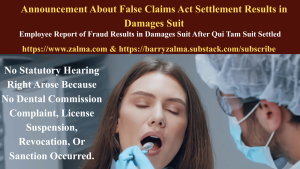
No Statutory Hearing Right Arose Because No Dental Commission Complaint, License Suspension, Revocation, Or Sanction Occurred.
Post 4855
 In Abbas Mohammadi et al. v. William M. Tong et al., No. AC 47598, Court of Appeals of Connecticut (September 29, 2026) Abbas Mohammadi owned and operated Columbia Dental, P.C., which provided dental services through multiple Connecticut offices; Columbia Oral Maxillofacial Imaging, LLC served as the billing entity.
From April 2012 to February 27, 2013, Columbia Dental employed Brittany Ames Mahoney as a dental assistant. During her employment, Mahoney claimed to have discovered certain billing irregularities, including, but not limited to, false and fraudulent reimbursement claims submitted to the Department of Social Services for services rendered to Medicaid beneficiaries. Mahoney filed a complaint and an affidavit in the United States District Court for the District of Connecticut regarding these irregularities under the federal False Claims Act. The United States, the state, Mahoney, and the plaintiffs subsequently entered into a settlement agreement to resolve the qui tam action.
The state did not suspend Mohammadi’s dental license or Medicaid billing eligibility and conducted no disciplinary hearing but it issued a press release about the suit. The plaintiffs claimed the release was inaccurate, damaged their reputations and businesses, caused insurers and financing companies to end relationships, impaired hiring and retention, and was issued without an opportunity for a hearing.
LAW
Qualified immunity is an affirmative defense to a 42 U.S.C. § 1983 damages claim; it does not affect subject matter jurisdiction and ordinarily should be raised in a motion to strike or motion for summary judgment, not a motion to dismiss.
A substantive due process claim requires identification of a protected constitutional interest and state conduct sufficiently egregious to shock the conscience.
ANALYSIS
The Appellate Court agreed that qualified immunity was improperly presented through a motion to dismiss but held that the plaintiffs waived that procedural objection by not making it below. It then reviewed the four appealed federal counts de novo.
On procedural due process, reputational injury, lost contracts, lost revenue, hiring difficulties, and social-media consequences flowed from private reactions to the press release rather than from a separate state-imposed burden. No statutory hearing right arose because no Dental Commission complaint, license suspension, revocation, or sanction occurred.
The Lanham Act theory failed because the government press release was not commercial speech. The substantive due process count failed at the threshold because the plaintiffs did not identify a protected liberty or property interest were insufficient.
The privacy count failed because the alleged disclosures involved business matters and unwanted publicity, not the narrow category of constitutionally protected personal information. Because none of the counts plausibly alleged a violation of a clearly established federal right, qualified immunity applied.
DISCUSSION
The difficulty of converting allegedly defamatory governmental speech into a federal constitutional claim failed.
Business losses and reputational harm do not become procedural due process violations unless the government itself imposes an additional legal burden or status change.
CONCLUSION
The trial court concluded that qualified immunity applied to the allegations.
The Connecticut Appellate Court affirmed the judgment dismissing the challenged counts. Counts one, two, five, and six did not plausibly allege violations of clearly established federal rights, so the defendants were entitled to qualified immunity.
It takes a certain amount of chutzpah (Yiddish for unmitigated gall) to sue the government after settling a false claims act suit by a dental service defrauding a governmental agency. Rather than go to trial on the fraud charge Abbas Mohammadi paid the government to settle the suit and then sued the state and federal government for reporting the settlement which Mohammadi claimed cost him business which could include restarting the fraudulent conduct that resulted in the qui tam suit.

(c) 2026 Barry Zalma & ClaimSchool, Inc.
Please tell your friends and colleagues about this blog and the videos and let them subscribe to the blog and the videos.
Subscribe to my substack at https://barryzalma.substack.com/subscribe
Go to X @bzalma; Go to Barry Zalma videos at Rumble.com at https://rumble.com/account/content?type=all; Go to Barry Zalma on YouTube- https://www.youtube.com/channel/UCysiZklEtxZsSF9DfC0Expg; Go to the Insurance Claims Library – https://lnkd.in/gwEYk.