
Understanding the Impact of Credit Scores on Rental Applications


Landlords or property managers run various checks on prospective renters during the tenant screening process. Aside from speaking to references and performing background checks, analyzing a tenant’s credit report is important. A credit check can show how an applicant has handled past debts and payments, but it can’t guarantee they’ll pay rent on time. However, a good credit score doesn’t necessarily guarantee you’ll be approved for a rental. Today, we’ll go over the impact of credit scores on rental applications and how you can rent with a lower credit score. Check out the video below!
Main Takeaways
- There’s no universal credit score requirement for renting. Each landlord’s screening criteria may differ, and a strong score doesn’t guarantee approval.
- Your credit score is only part of your application. Landlords may also review payment history, income, rental references, and other information.
- You have rights if a screening report affects your application. If a landlord denies you or requires less favorable terms based on the report, they must provide an adverse action notice.
Does Your Credit Score Matter for a Rental Application?
As we mentioned in the video, a thorough tenant screening process can help you find reliable tenants for your rental properties. While many landlords and property managers in Philadelphia run credit checks on prospective tenants, they’re not necessarily zeroing in on the score.
In fact, some landlords might not care about your credit score at all. Instead, they’ll look for other factors within a credit report, like your payment history, to determine the likelihood that you’ll pay rent on time.

For instance, some of the things landlords or property managers may look for on a credit report include the following.
- Payment History- Landlords often pay close attention to an applicant’s payment history. For instance, they’ll look for patterns of on-time payments, late payments, or delinquencies on credit cards, loans, or other lines of credit. Consistent on-time payments can demonstrate financial responsibility and reliability.
- Rental Payment History—Some credit reports include rent payments if a landlord or rent-reporting service submits them. However, many don’t, so landlords may also review payment records and contact previous landlords.
- Collection Accounts- Landlords may look for red flags like collection accounts or charge-offs on a credit report. These negative marks may suggest that the applicant has failed to pay off debts and may indicate a higher risk of late rent payments.
What Is the Impact of Credit Scores on Renting?
While you may think your credit score doesn’t matter for a rental application, it may influence whether you’ll be approved for a lease. However, although landlords look for higher credit scores, a low score doesn’t mean you’ll immediately get denied for a rental home.

After all, many landlords or property management companies have their own specific requirements and criteria for evaluating rental applicants. That said, the requirements or the impact of credit scores may vary depending on the rental market or the type of property you want to rent.
A strong credit history may support your application and, in some cases, help you negotiate rental terms. A lower score may lead a landlord to require a co-signer or a larger security deposit, if applicable law allows it. If information in a consumer report leads to those conditions, the landlord must provide an adverse action notice.
In a competitive rental market, a strong credit history may help your application stand out. However, landlords should follow applicable screening rules and apply their lawful criteria consistently rather than simply choosing the applicant with the highest score.
What Credit Score Do You Need to Rent?
Local screening laws may limit how landlords use credit scores. In Philadelphia, landlords cannot automatically reject an applicant solely because their credit score or tenant screening score falls below a set number. They must review the individual application using uniform screening criteria.
Here’s a general guideline of credit scores and what they mean for renters and landlords.
- Exceptional Credit—FICO scores of 800–850 are considered exceptional. A score in this range may strengthen your rental application, but it doesn’t guarantee approval or better lease terms.
- Very Good Credit—FICO scores of 740–799 are considered very good. This may support your application, but you’ll still need to meet the landlord’s other screening requirements.
- Good Credit—FICO scores of 670–739 are considered good. Landlords may also review your income, payment history, and rental references when deciding on your application.
- Fair Credit—FICO scores of 580–669 are considered fair. Renting may be more challenging if your score falls below the property’s requirements, so ask about the screening criteria before applying.
- Poor Credit—FICO scores below 580 are considered poor. Some landlords may still consider your application if you can provide proof of stable income, positive rental references, or a qualified co-signer
These categories describe FICO scores, not rental approval requirements. Other scoring models may use different ranges, and landlords may review more than the score itself. Before paying an application fee, ask about the property’s credit requirements and how the landlord evaluates your overall application.
However, to increase your chances of being approved for a rental, you’ll want to maintain a good credit score and demonstrate financial responsibility and stability.
Options for Renting With a Low Credit Score
While it’s important to understand the impact of credit scores and reports, they don’t hold all the weight when reviewing rental applicants. Although it’s best to have a good credit score while renting, you can still get approved for a rental with a lower score. Communicating effectively and explaining your situation during the screening process is important. So, here are a few ways to secure a lease with a lower credit score.
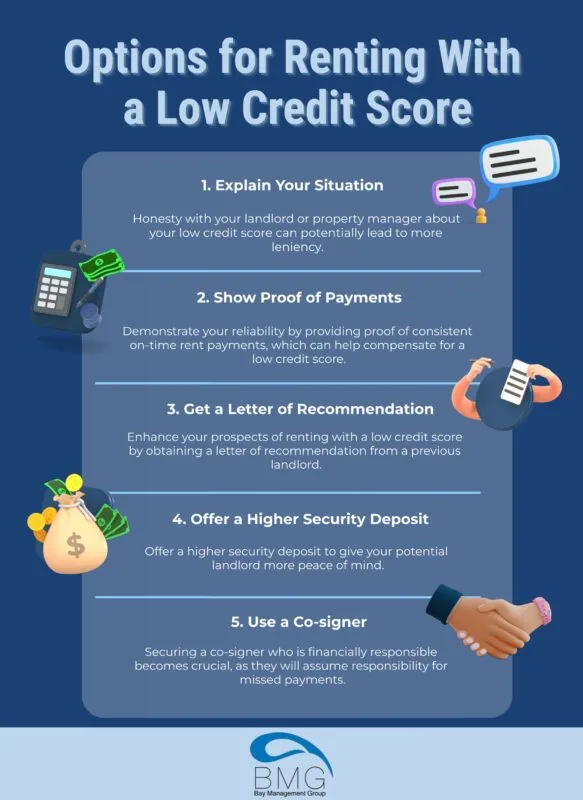
- Explain Your Situation—If there’s relevant context behind your credit history, you can briefly explain it and provide supporting documents you’re comfortable sharing. Ask how the landlord considers that information under their screening criteria. You don’t need to share unnecessary personal or medical details.
- Show Proof of Payments- If your credit score is low, but you’ve always paid rent on time, show your potential landlord proof of your on-time rent payments. That way, they can see that you’re reliable and may be more willing to rent to you.
- Get a Letter of Recommendation- A letter of recommendation from a previous landlord can help boost your chances of renting with a low credit score. If another landlord can vouch for you and put in a good word, it may be easier to secure a lease.
- Ask About Deposit Options—Some landlords may accept a larger security deposit, but local or state law may limit the amount they can collect. Ask what’s permitted before offering extra money. A security deposit doesn’t replace your obligation to pay rent.
- Ask About a Co-signer—If the landlord accepts co-signers, someone who meets their financial requirements may help support your application. The co-signer should understand the agreement before signing, since they may become responsible for unpaid rent and other covered charges.
Before applying, check your credit reports for errors and dispute inaccurate information with the reporting company. If a landlord denies your application or requires less favorable terms based on a screening report, the adverse action notice should explain how to request a free copy of that report within 60 days and dispute errors.
The notice must also include the reporting company’s contact information and explain that it did not make the rental decision. If the landlord used a numerical credit score in making the adverse decision, they must provide additional written or electronic disclosures, including the score, its range, source, creation date, and the key factors that negatively affected it.
FAQs About Credit Scores and Rental Applications
Your credit history can affect a rental application, but the score alone doesn’t tell the whole story. Here are answers to common questions renters have before applying.
What Credit Score Do You Need to Rent a Home?
There’s no single minimum that applies to every rental. Ask the landlord or property manager about their screening criteria before paying an application fee. A score that meets their requirement still doesn’t guarantee approval.
Can You Rent With a Low Credit Score?
You may be able to. Some landlords consider proof of income, a record of on-time rent payments, and references alongside your credit history. Ask if they accept a qualified co-signer or other supporting documents.
Can You Rent With No Credit History?
Possibly. Having no credit history is different from having a history of missed payments. Ask how the landlord evaluates applicants without a score and if you can provide income records, rental references, or a qualified co-signer.
Does a Good Credit Score Guarantee Rental Approval?
No. You may still need to meet income requirements, provide verifiable application details, and satisfy other lawful screening criteria. Your credit score is one part of that review.
What Happens If Your Application Is Denied Because of Your Credit Report?
The landlord must give you an adverse action notice if information in a consumer report contributed to the denial. It identifies the reporting company and explains your right to dispute errors and request a free copy of the report within 60 days.
Can a Landlord Require a Co-signer Because of Your Credit Report?
Some landlords may make approval conditional on a qualified co-signer, subject to applicable law. If that requirement is based partly or entirely on a consumer report, they must provide an adverse action notice—even if they approve your application with the co-signer.
Find Reliable Tenants With Property Management
Credit history can help you understand how a rental applicant has handled past payments, but it’s only one part of tenant screening. Reviewing income, rental history, and references can give you a fuller picture.
A property management company can help you apply consistent screening criteria and manage the application process. Beyond screening, professional management can also support rent collection, maintenance coordination, and tenant communication.
Bay Property Management Group offers full-service property management around Baltimore, Philadelphia, Northern Virginia, and Washington, DC. So, if you need help managing and maintaining your properties, contact us today to learn more about our services and how we can help your rental business succeed.