


I’ve been using Black Diamond headlamps since around 2000, and as a professional photographer I’ve spent a good number of winter nights in Iceland and Scotland standing next to a tripod waiting for the northern lights to do something. Jess has two Black Diamonds she bought for her Kilimanjaro climb in 2014. All of them still work, which says something nice about Black Diamond. None of them has a red light, which is why I’m writing this.
If you photograph the night sky, or you just want to find your way back to the car without blinding everyone else at the viewpoint, the headlamp you want is not the brightest one. It’s the one that gives you a dim red light without flashing white in your face first, has a very low low setting, locks so it doesn’t switch itself on in your bag, and keeps working when it’s well below freezing. I’ve ranked these by whether I’d be happy wearing one at an aurora shoot.
If you want the quick answer: the Black Diamond Spot 400 is the one I’d buy for most people. Red light that comes on without cycling through white, a 6 lumen low, a proper lockout, runs on three AAAs or Black Diamond’s rechargeable pack, and it’s waterproof to IPX8. For the lightest option with the same red-first behaviour, the Nitecore NU25 MCT UL weighs just 47 grams.
I haven’t field-tested the 2026 versions of these headlamps. My Black Diamonds are old enough to vote.
Quick Picks: The Best Headlamps for Night Photography and Travel
Short on time? Here are my picks by what you need, with the full write-ups and a comparison table below.
- Black Diamond Spot 400, the best all-round pick. Red from off, 6 lumen low, lockout, AAA or rechargeable, IPX8. The Spot 400-R is the same lamp with a built-in battery.
- Nitecore NU25 MCT UL, the lightest. 47 grams, red from off, USB-C, and the cheapest lamp here that the maker says goes straight to red.
- Petzl Actik Core, the best rechargeable with an AAA fallback. 625 lumens on Petzl’s CORE battery, USB-C, and it takes three AAAs when the battery’s flat.
- BioLite Range 500, the one for cold, wet nights. IP67, a 1.5 lumen low, and BioLite publishes an operating temperature range (minus 20°C to 60°C), which I couldn’t find for any other lamp here.
- Fenix HM65R V2.0, the most power and the longest runtime. 2,200 lumens, a swappable 18650 cell, IP68. Overkill for the tripod, right for a long walk in.
- Black Diamond Cosmo 350, the budget pick. Red mode, lockout, IPX8, 79 grams, AAA or rechargeable. The Petzl Tikka is the alternative if you prefer Petzl’s battery system.
- INIU RG-10000 power bank, a backup worth carrying. Not a headlamp. A rugged 10,000 mAh battery with a built-in light that has a red mode, so it can charge the camera and light the tripod.
How I Chose These Headlamps (and What I Haven’t Done)
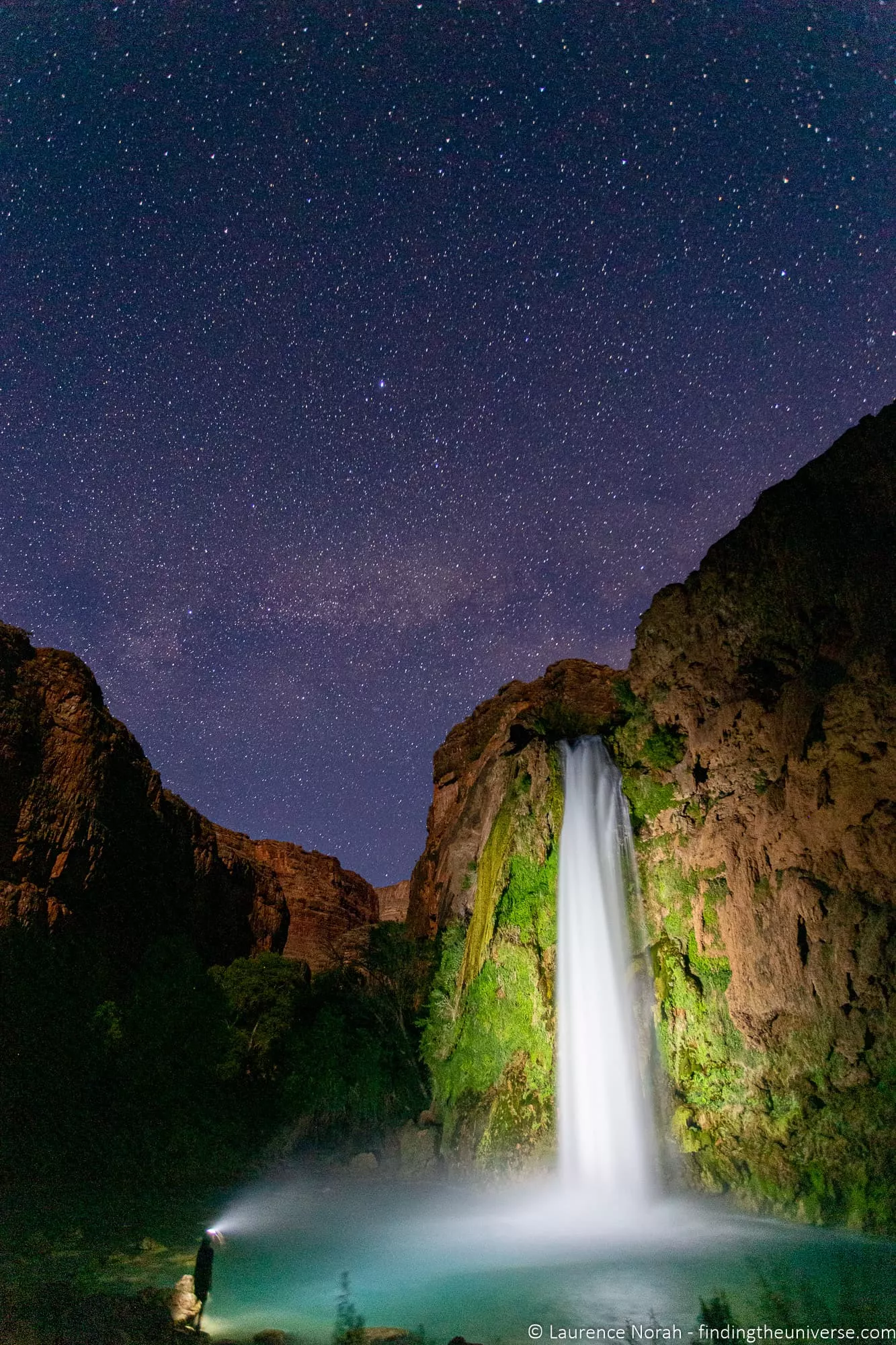
What I bring to this is years of standing in the dark with a camera. Northern lights in Iceland and Scotland, the Milky Way over Havasu Falls, star trails in places I couldn’t name without checking the EXIF.
That experience tells me what a headlamp has to do on a shoot, and it’s a short list: get me to red light without a white flash, go dim enough to read a dial without wrecking my night vision, not switch on in the bag, and keep going in the cold. I’ve used Black Diamond lamps for all of that since around 2000, and Jess has used hers since 2014. Those specific lamps aren’t on sale any more, so I can’t link you to them.
What I haven’t done is buy and run the current versions of the eight lamps below through a winter. Every spec in this article comes from the manufacturer’s own product page or manual, read in full for each lamp in October 2026, and I’ve linked those pages so you can check them yourself.
Where I found a figure, I quote it. Where I didn’t, the table says so. I haven’t measured any lumens or burn times myself, and I’d treat every runtime figure here as a best case, because manufacturers test warm and you’ll be using the lamp cold.
The picks are also deliberately few. There are a lot of good headlamps. These are the ones that pass the photographer’s list above, cover the obvious price points, and come from makers I’d trust with a warranty claim.
What to Look for in a Headlamp for Night Photography
These are the five things I judged the picks on. They apply to any headlamp, including ones I haven’t listed.
Red Light You Can Reach Without Going Through White
Nearly every headlamp sold today has a red mode. Far fewer let you get to it from off without the white LED firing first. On a lot of lamps the sequence is press for white, press again for brighter white, hold for red. By the time you’re on red, you’ve already lit up your own foreground, your own eyes and anyone standing near you.
Black Diamond states on the Spot 400 page that red “activates without cycling through the white mode”. Nitecore’s manual for the NU25 MCT UL says a one-second hold on the mode button from off takes you to red low. Fenix says a double-click from off on the HM65R V2.0 goes to red. For the other lamps here I haven’t been able to confirm it from the maker’s published material, and I’ve said so in each write-up instead of assuming.
A Very Low Low
The number that counts at the tripod is the lowest setting, not the highest. You want enough light to read the dials and find a lens cap, and no more. The BioLite Range 500 goes down to 1.5 lumens. The Black Diamond and Nitecore lamps go to 6. The Petzls go to 7. Any of those is fine.
A Lockout
A headlamp that switches itself on in a camera bag arrives at the shoot flat. Every lamp in this list has a lockout. It’s also the practical answer to the airline rule that a battery-powered device in checked luggage must be protected against switching on, which I’ll come to.
Batteries That Work in the Cold
Alkaline AAAs lose much of their capacity in the cold. Lithium AAAs don’t, to nearly the same degree. Rechargeable lithium-ion packs work fine cold but mustn’t be charged below freezing. Which of those you can use depends on the lamp, so the battery system is a real decision, not a footnote. There’s a whole section on this below.
Weight, Beam and Comfort
On your head for four hours, 50 grams either way is quite noticeable. For photography you mostly want a flood (a wide, soft beam) instead of a spot, and you want to be able to tilt the lamp down so the beam lands at your feet and not on the horizon you’re photographing. All of the lamps here tilt. The lightest is 47 grams, the heaviest 144.
The Best Headlamps for Night Photography and Travel in 2026
Prices come live from Amazon under each lamp, and every figure is also in the comparison table after the picks.
1. Black Diamond Spot 400: Best All-Round Headlamp for Night Photography

The Spot 400 is the lamp I’d hand to most people. Black Diamond’s spec page lists 400 lumens on high, 200 on medium and 6 on low, a red night-vision mode with its own dimming and strobe, and a digital lockout. The line that puts it top of this list is that the red “activates without cycling through the white mode”. That’s pretty much the whole requirement for a photographer, stated by the manufacturer.
It runs on three AAAs, which come in the box, or on Black Diamond’s BD 1500 rechargeable pack, which doesn’t. Black Diamond calls this Dual-Fuel. In practice it means you can carry lithium AAAs for a cold trip and use the rechargeable the rest of the year. Black Diamond’s burn times are 2.5 hours on high with AAAs (4 with the BD 1500) and 200 hours on low (225). Weight is 86 grams with AAAs, 72 with the pack.
It’s rated IPX8, which Black Diamond defines as operating at least 1.1 metres underwater for 30 minutes, so rain is not a conversation.
The trade-offs: the BD 1500 is an extra purchase and charges separately, so there’s no port on the lamp itself, and if you want 400 lumens for a long walk in, the Petzl and Fenix below will outlast it. For the tripod, none of that bothers me much.
If you don’t want to deal with AAAs at all, the Spot 400-R is the same lamp with a sealed 1500 mAh lithium-ion battery charged over micro-USB. Same 400 lumens, same 6 lumen low, same red-from-off behaviour and lockout, 86 grams, and rated IP67 instead of IPX8. It’s still micro-USB in 2026, which is a bit of a shame and means one more cable in the bag, and it can’t take AAAs, so when it’s flat on a cold night it’s flat. I’d take the AAA version for winter trips and the R for everything else.
Check price on Amazon
Check price on Amazon
2. Nitecore NU25 MCT UL: Lightest Headlamp With Red From Off
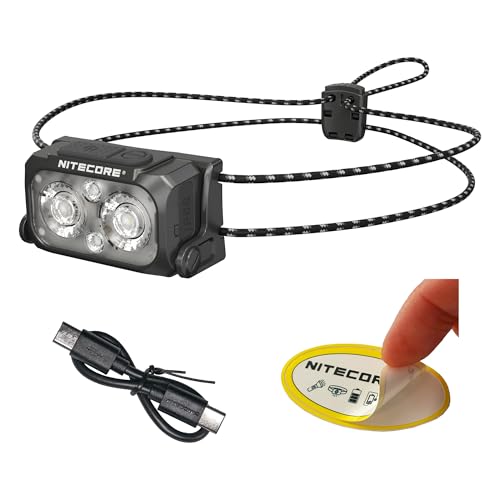
At 47 grams including the headband, the Nitecore NU25 MCT UL is the lightest lamp in this list by a distance, and it’s also the cheapest one whose maker states that red is reachable from off. Nitecore’s page gives 400 lumens, a 700 mAh built-in battery, USB-C charging, IP66 and a 45 hour maximum runtime. The manual adds the details a photographer wants. From off, holding the mode button for one second gives you red low (5 lumens, 26 hours); a double press on the power button from off gives you the 6 lumen ultralow white. The lockout is a two-second hold on both buttons.
The MCT in the name means three white colour temperatures, 3000K, 4500K and 6500K, which is a pretty nice touch for a photographer who prefers warm light to blue. Nitecore’s ANSI runtimes are 2 hours 40 minutes on high, 5 hours at 200 lumens and 13 hours at 60.
The battery is built in, so there’s no cold-night swap; you top it up from a power bank. Nitecore also recently replaced the older NU25 UL with this MCT version, and some listings still carry the old name, so check you’re getting the MCT UL (the three colour temperatures are the giveaway).
It’s a bit less water-resistant than the Black Diamonds on paper (IP66 means heavy jets of water, not immersion). That has never bothered me on a headlamp, though if you spend a lot of time behind waterfalls the Black Diamonds are the safer bet.
3. Petzl Actik Core: Best Rechargeable Headlamp With an AAA Fallback

The Petzl Actik Core is the lamp for someone who wants a rechargeable but has been caught out by a flat one. It ships with Petzl’s CORE battery (1250 mAh, 4.5 Wh), which charges over USB-C in about 3.5 hours, and the same compartment takes three AAAs when the CORE is empty. Petzl calls this Hybrid Concept. It’s the same idea as Black Diamond’s Dual-Fuel, with the difference that the rechargeable comes in the box here.
The current Actik Core (the 2025 update) is rated at 625 lumens on the CORE battery (450 on AAAs), with a 7 lumen low that Petzl rates for 100 hours, a continuous red mode at 2 lumens for 60 hours, and a lock function.
Petzl’s figures are ANSI/PLATO FL 1, which means they’re measured to a standard and comparable with Nitecore’s; most of the others here aren’t stated to a standard.
At 100 lumens, the setting you’d use for walking, Petzl gives 7 hours on the CORE and 10 on AAAs. Weight is 88 grams. It’s IPX4, which means rain from any angle but not immersion.
What I can’t tell you is whether the red comes on from off without a white flash. Petzl’s product page says the single button selects brightness or colour; the button sequence is in the manual’s diagrams, and I’m not going to turn a drawing into a claim. If that’s the deciding feature for you, the Spot 400 and the Nitecore have it in writing.
One more thing for buyers: there have been several generations of Actik Core, and older ones (450 lumens, micro-USB) are still floating around online. The current one is 625 lumens with USB-C, and the link above goes to that version.
4. BioLite Range 500: Best Headlamp for Cold, Wet Nights

The BioLite Range 500 gets this slot for two reasons. It’s rated IP67 (submersible to a metre for 30 minutes), and BioLite publishes an operating temperature range, which I couldn’t find for any other lamp here: minus 20°C to 60°C for use, and 0°C to 45°C for charging.
BioLite’s product page FAQ also gives the most useful piece of cold-weather advice I’ve seen from a lamp maker: if you need to recharge in the cold, put the headlamp and the power bank in an inside pocket first, so your body heat helps.
The specs are 500 lumens on high and a 1.5 lumen low, the lowest in the list, which is a lovely setting for a tripod.
Modes are white spot, dimmable white flood, white strobe, red flood and red strobe. There’s a lock mode and a brightness memory. The battery is a built-in 1634 mAh lithium-ion, charged over USB-C, and BioLite claims 0 to 80 percent in 30 minutes. Burn times are 6 hours on high and 200 on low.
Weight is 75 grams, and the battery sits with the lamp in one slim unit at the front, with nothing on the back of the band. BioLite sells that as “No Bounce”, and it’s a fair description of the design. The warranty is three years.
I couldn’t confirm from BioLite’s published material whether red is reachable from off without white, so I’m not claiming it. The battery is also sealed, so on a long cold night you’re relying on a power bank instead of a spare set of cells.
BioLite’s older HeadLamp 425, which you may see recommended elsewhere, has been replaced by this Range series.
5. Fenix HM65R V2.0: Most Powerful Headlamp With the Longest Runtime

Of course, you don’t need 2,200 lumens to photograph the stars. You might want them for the two-hour walk to the spot, or for finding a trail in snow, and that’s where the Fenix HM65R V2.0 comes in. Fenix’s page gives a 2,200 lumen maximum from the spot and flood together, a 229 metre throw, a 296 hour maximum runtime, and an IP68 rating with 2 metre impact resistance. (The same page also says 2,300 lumens in one place; I’ve gone with the figure in the specification table.)
It’s a serious lamp for photographers too, and it’s one of the three here where the maker states red is reachable from off: a double-click on either switch with the lamp off goes to red, and there are three red levels plus a flash. The lockout is electronic, a three-second hold on both switches.
The battery is a removable 3,400 mAh 18650 cell that charges in the lamp over a waterproofed USB-C port, and the lamp also accepts CR123A or 16340 cells. For a photographer that’s the main attraction: a spare 18650 in a warm pocket is pretty much the cheapest insurance there is against a dead lamp at minus 15.
The costs are weight and money. At 144 grams including battery and headband it’s three times the Nitecore, and it’s the most expensive lamp here. I couldn’t find the lowest white output in lumens on Fenix’s page, so I can’t tell you how dim it goes, and for tripod work that’s a bit of a gap. If you mostly stand still in the dark, buy the Spot. If you walk a long way to get there, this one.
6. Black Diamond Cosmo 350: Best Budget Headlamp With a Red Light

Finding a cheap headlamp with a red mode is a bit harder than it should be. Two budget lamps I’d planned to include, Black Diamond’s own Astro 300 and Petzl’s Tikkina, turned out to have no red at all once I read the spec pages properly, so they’re out. The Cosmo 350 is the one that passed.
Black Diamond’s page gives 350 lumens on high, 175 on medium and 6 on low, a red night-vision mode with dimming and strobe, and the same digital lockout as the Spot. It runs on three AAAs (included) or the BD 1500 pack, with burn times of 3 hours on high (5 with the BD 1500) and 200 hours on low (225). Weight is 79 grams with AAAs. It’s IPX8, the same waterproof rating as the Spot 400, which at this price is unusual.
What it doesn’t have, as far as I can tell, is the Spot’s stated red-from-off behaviour. Black Diamond makes that claim on the Spot 400 page and I haven’t seen it made for the Cosmo, which describes the red as “quickly activated with dual-button interface”. That’s the difference you’re paying for with the Spot. If you shoot the night sky a few times a year, the Cosmo will do quite nicely; if you do it every month, spend the extra.
If you want a Petzl instead, the Petzl Tikka is the equivalent: 350 lumens on AAAs (450 on the optional CORE battery), a 2 lumen red rated for 60 hours, a 7 lumen low for 110 hours, a lock function, 94 grams and IPX4. It’s heavier and less waterproof than the Cosmo, and like the Actik Core I can’t confirm its red-from-off behaviour from Petzl’s published pages, but it takes the same CORE battery as the Actik, which is handy if you already own one.
Check price on Amazon
Check price on Amazon
A Backup Red Light: INIU RG-10000 Power Bank
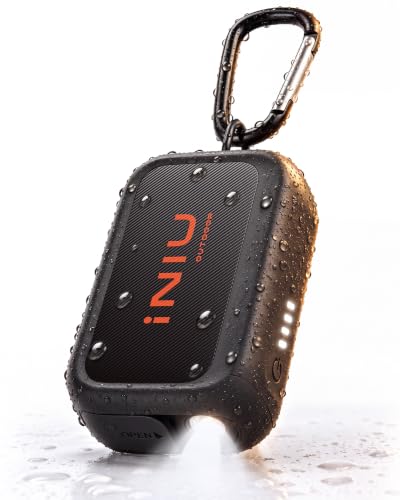
This isn’t a headlamp, so it isn’t ranked with them, but I’ve been carrying it on my recent travels and its light has a red mode, which is why it’s here. First, the disclosure: INIU sent me this unit and paid me to review it. That review is mine and they didn’t see it first, and I’d already been recommending two of their other power banks for years before this one turned up.
The RG-10000 is a 10,000 mAh power bank with 45W USB-C output, an IP67 rating with the port cover closed, and a built-in light on the end with a white mode and a red mode. I’ve used both.
The red is dim and diffuse, which for a tripod is exactly what you want, and because the bank has a quarter-inch thread in the base you can stand it on a small tripod and point it at your camera bag while your hands are busy. When I asked INIU for the light’s figures, they told me the LED is rated at 80 lumens, 43 lumens measured through the diffuser, and about 65 hours on white.
At a night shoot that means two jobs from one device: it keeps the phone and camera batteries topped up, and it gives you red light without putting anything on your head.
At 10,000 mAh it’s well inside the 100 Wh airline limit. It’s a fair bit heavier than any headlamp here, and it doesn’t replace one if you’re walking anywhere in the dark. For the way I tend to shoot at night, mostly standing next to a tripod a short walk from the car, it would be a pretty useful thing to have in the bag.
Headlamp Comparison Table
Every figure here is the manufacturer’s own, from the product page or manual linked in each write-up, read in October 2026. “Red from off” means the maker states in writing that red is reachable without the white light coming on first; “Not confirmed” means I couldn’t establish it from the maker’s published material, not that the lamp can’t do it. Runtimes are only directly comparable where the maker states an ANSI/PLATO standard (Petzl and Nitecore do).
| Headlamp | Max output | Lowest white | Red mode | Red from off (maker) | Lockout | Battery | Charging | Weight | Water rating | Price |
|---|---|---|---|---|---|---|---|---|---|---|
| Black Diamond Spot 400 | 400 lm | 6 lm (200 h AAA / 225 h BD 1500) | Yes, dimmable + strobe | Yes | Yes, digital | 3 x AAA (included) or BD 1500 pack | None on lamp (BD 1500 charges separately) | 86 g AAA / 72 g BD 1500 | IPX8 | Check price on Amazon |
| Black Diamond Spot 400-R | 400 lm | 6 lm (225 h) | Yes, dimmable + strobe | Yes | Yes, digital | Built-in 1500 mAh Li-ion | Micro-USB | 86 g | IP67 | Check price on Amazon |
| Nitecore NU25 MCT UL | 400 lm | 6 lm (45 h) | Yes, 15 lm / 5 lm | Yes (hold mode 1 s) | Yes, two-button | Built-in 700 mAh Li-ion | USB-C | 47 g | IP66 | Check price on Amazon |
| Petzl Actik Core | 625 lm (450 lm on AAA) | 7 lm (100 h) | Yes, 2 lm (60 h) | Not confirmed | Yes | CORE 1250 mAh (included) or 3 x AAA | USB-C (CORE) | 88 g | IPX4 | Check price on Amazon |
| BioLite Range 500 | 500 lm | 1.5 lm (200 h) | Yes, flood + strobe | Not confirmed | Yes | Built-in 1634 mAh Li-ion | USB-C (0 to 80% in 30 min) | 75 g | IP67 | Check price on Amazon |
| Fenix HM65R V2.0 | 2,200 lm | Not stated in lumens (296 h max) | Yes, 3 levels + flash | Yes (double-click) | Yes, electronic | Removable 3400 mAh 18650 (included) | USB-C | 144 g | IP68 | Check price on Amazon |
| Black Diamond Cosmo 350 | 350 lm | 6 lm (200 h AAA / 225 h BD 1500) | Yes, dimmable + strobe | Not confirmed | Yes, digital | 3 x AAA (included) or BD 1500 pack | None on lamp (BD 1500 charges separately) | 79 g AAA / 73.5 g BD 1500 | IPX8 | Check price on Amazon |
| Petzl Tikka | 350 lm (450 lm on CORE) | 7 lm (110 h) | Yes, 2 lm (60 h) | Not confirmed | Yes | 3 x AAA (included) or CORE (optional) | USB-C (CORE only) | 94 g | IPX4 | Check price on Amazon |
Red Light for Night Photography, Explained
Astronomers, submariners and aurora photographers all work by red light, and knowing why changes how you use the lamp as well as which one you buy.
Your eyes have two kinds of light receptor. Cones handle colour and detail and need a fair amount of light. Rods handle dim light and are what you’re using when you can see the Milky Way. Rods take a long time to get going, around 30 minutes to adapt fully from bright light to darkness according to BBC Sky at Night, and they’re largely insensitive to red light. So a dim red lamp lets your cones read the camera’s dials while your rods carry on seeing the sky. One burst of white resets the clock.
So brightness counts as much as colour. A bright red light still costs you adaptation; use red, and as dim as you can work by. Petzl’s 2 lumen red and Nitecore’s 5 lumen red low are about right, and the Spot’s red dims too.
It’s also why I keep going on about the button sequence. A lamp that flashes white on its way to red has already done the damage, so buy one that goes straight there, or learn the sequence with the lamp pointed at the ground.
A few habits that help, learned the hard way:
- Tilt the lamp down. The beam should land at your feet, not on the foreground of the shot you or the person next to you is taking. A headlamp left pointing at the horizon during a 20-second exposure puts a red glow across everyone’s frame.
- Switch it off between tasks. You need light to change a lens or check the histogram. You don’t need it while the shutter’s open.
- Use the lockout in the bag and in your pocket, so it isn’t on when you take it out.
- Learn your camera in the dark. The fewer times you need the lamp, the better your shots, and the better everyone else’s.
On that last point: I once switched my headlamp on in white at a shared viewpoint in Jasper National Park and got yelled at by the other astrophotographers there. They were right, of course. These days I try to stick to red whenever I’m shooting the night sky.
If you’re new to shooting at night, my guides to photographing the northern lights and photographing the stars cover the camera side in detail.
Headlamp Batteries in the Cold
The nights you most want a headlamp are the cold ones, and cold is where batteries let you down. The details depend on what’s inside the lamp.
Alkaline Versus Lithium AAAs
If your lamp takes AAAs, buy lithium ones for winter. Energizer’s own datasheets make the case: the standard alkaline E92 is rated to operate down to minus 18°C, while the lithium L92 is rated to minus 40°C.
The lithium cell also weighs 7.6 grams against 11.5, and has a 25-year shelf life against 10, so a set in the camera bag will still be good years from now.
Alkalines lose much of their capacity well before minus 18, so even on a merely cold night the lithium set lasts longer. They cost a bit more, and for a lamp you use on a handful of winter nights a year that’s money well spent.
Of the lamps here, the Spot 400, Cosmo 350, Actik Core and Tikka all take AAAs.
Rechargeable Packs in the Cold
Lithium-ion packs, whether built in or removable, work fine in the cold but must not be charged below freezing. Petzl’s technical notice for the CORE battery gives an operating range of minus 20°C to 40°C and a charging range of 0°C to 40°C. BioLite gives minus 20°C to 60°C for use and 0°C to 45°C for charging, and recommends warming the lamp and power bank in an inside pocket before you plug them in. INIU told me the RG-10000 stops accepting a charge at 0°C and keeps delivering power, at reduced output, down to around minus 20°C.
I couldn’t find a temperature range on the Black Diamond, Nitecore or Fenix pages, so I can’t quote one for them.
Capacity also drops as the pack gets cold, which is why the maker’s burn times, measured warm, are optimistic for winter.
The practical advice is the same as for camera batteries, which I cover in my cold weather photography guide: keep the spare warm, and swap instead of charging. A removable cell (the Fenix’s 18650, the Petzl CORE, the Black Diamond BD 1500) can live in an inside pocket and go in warm. A sealed lamp (the Spot 400-R, Nitecore, BioLite) relies on a power bank, which should also be warm. The power banks I travel with are in a separate guide.
For a winter aurora trip, the setup I’d pack is a Dual-Fuel or Hybrid lamp with lithium AAAs in it and the rechargeable pack as the spare, so whichever one goes flat, the other works.
Flying and Travelling With a Headlamp
Headlamps are small, so the travel questions are mostly about batteries, and the rules are a bit stricter than you might expect.
For US flights, the FAA’s PackSafe rules say spare lithium batteries of any kind, which includes loose 18650 cells, the Petzl CORE, the BD 1500 and every power bank, must go in carry-on baggage, never checked. Lithium-ion batteries up to 100 Wh need no approval; with airline approval you can carry up to two spares between 101 and 160 Wh. Everything in this article is far below 100 Wh (the Petzl CORE is 4.5 Wh; a 10,000 mAh power bank works out at roughly 37 Wh at the usual 3.7 volts, my arithmetic rather than INIU’s figure; the exact number is printed on the pack).
Terminals should be protected, so keep loose cells in their case.
A battery installed in the lamp is fine either way, but if the lamp goes in checked luggage the FAA says the device must be completely powered off and protected from switching on. That’s the lockout again. I’d keep the headlamp in your carry-on regardless; it weighs next to nothing and it’s handy on the plane.
If you’re flying from or within the UK, the rules changed on 27 March 2026. The UK Civil Aviation Authority now limits passengers to two power banks each, carried in the cabin, and they must not be recharged on board or used to charge other devices during the flight. The 100 Wh and 160 Wh thresholds are the same as the FAA’s. The change comes from international (ICAO) guidance, and some airlines elsewhere already ban using or recharging power banks in flight, though the FAA hasn’t adopted the two-bank cap. Check your carrier before you fly.
In Britain, by the way, the thing on your head is a head torch, not a headlamp, so search for that on UK sites. And for a camera bag, weight is the other spec that counts: the Nitecore at 47 grams disappears in a side pocket, while the Fenix is a deliberate choice. My travel photography kit and hiking camera backpack guides cover where it all goes.
A headlamp is on my packing lists for Iceland in winter and for Scotland, where from November to January the sun is down by late afternoon (before four o’clock around the shortest days) and most of the interesting photography happens after it.
How Many Lumens Do You Actually Need?
Far fewer than the box suggests. Lumens are the number manufacturers compete on, so today’s headlamps are rated at many times what mine were when I started, and for photography almost none of that is useful.
At the tripod, working on a camera a foot in front of your face, 5 to 10 lumens of red is plenty, and a lamp whose lowest white setting is 20 or 30 lumens will feel like a car headlight at 2am. Walking an easy path in the dark, 50 to 100 lumens of white is comfortable; this is the setting the makers tend to call “standard” or “medium”, and it’s the one whose runtime figure you should look at when comparing lamps.
The 300 to 600 lumen high settings are for route-finding on rough ground, looking for something you’ve dropped, or spotting the trail marker across a field.
The 2,000 lumen turbo modes are for a few seconds at a time, and they drain the battery fast.
So if you’re choosing between two lamps for night photography, compare the low end of the range and the red light, and treat the big number as a bonus for the walk in.
Frequently Asked Questions
What is the best headlamp for night photography?
For most people, the Black Diamond Spot 400. The maker states that its red light comes on without cycling through white, it goes down to 6 lumens, it has a lockout, and it runs on AAAs or a rechargeable pack, so it works in the cold. If weight is the priority, the Nitecore NU25 MCT UL at 47 grams has the same red-from-off behaviour.
Is red or blue light better for night vision?
Red. The rod cells that give you night vision are largely insensitive to long-wavelength (red) light, so a dim red lamp lets you see what you’re doing without undoing your dark adaptation. Blue light is at the other end of the spectrum and is the worst choice; it’s close to the wavelengths rods are most sensitive to. Green sits in between. For photography and stargazing, red and dim is the answer.
Why do astronomers and astrophotographers use red lights?
Because it takes around 30 minutes for your eyes to fully adapt to darkness, and a single white light resets that. Red light preserves the adaptation, which is why observatories and star parties use it, submarines still rig their control rooms for red, and aircraft cockpits were lit red for decades.
At a shared viewpoint it’s also good manners: a white headlamp during a long exposure puts a glow across everyone else’s photograph.
What does “red from off” mean, and why does it matter?
It means you can switch the headlamp on directly in red mode, without the white LED lighting first. Many headlamps only reach red by cycling through white, which defeats the purpose. Of the lamps in this guide, Black Diamond (Spot 400 and 400-R), Nitecore (NU25 MCT UL) and Fenix (HM65R V2.0) state it in their published material. For the others I couldn’t confirm it either way.
How many lumens is a good headlamp?
For photography, look at the lowest setting before the highest: 5 to 10 lumens of red at the tripod, 50 to 100 lumens of white for walking. Anything from 300 to 600 lumens on high is more than enough for route-finding. The 2,000 lumen lamps are for short bursts and long walks, and their batteries pay for it.
Is Black Diamond or Petzl better?
Both make headlamps I’d buy, and my own experience is with Black Diamond, whose lamps I’ve used since around 2000 and which are still working. On the specs that matter for night photography, Black Diamond’s Spot 400 has the edge because the company states red is reachable without white and rates the lamp IPX8. Petzl’s Actik Core is brighter (625 lumens), charges over USB-C with the rechargeable battery included, and publishes its figures to the ANSI/PLATO standard, which I appreciate. If you already own a Petzl CORE battery, stay with Petzl.
Should I buy a rechargeable or an AAA headlamp?
For travel and cold weather, one that does both. The Black Diamond Spot 400 and Cosmo 350 (Dual-Fuel) and the Petzl Actik Core and Tikka (Hybrid Concept) take either a rechargeable pack or three AAAs, so a flat battery on a cold night is a swap rather than the end of the shoot. A sealed rechargeable like the Nitecore NU25 MCT UL or BioLite Range 500 is lighter and simpler, and you top it up from a power bank.
Do rechargeable headlamps work in the cold?
Yes, with two caveats. Capacity drops as the pack gets cold, so expect less than the maker’s burn time, and lithium-ion batteries must not be charged below 0°C. Petzl and BioLite both publish a charging range starting at 0°C. Keep the lamp or the spare cell in an inside pocket and warm it before you plug it in.
What do IPX4, IP66, IP67 and IPX8 mean on a headlamp?
They’re ingress protection ratings. The first digit is dust (X means not rated), the second is water. IPX4 means splashes and rain from any angle, which covers most hiking. IP66 means powerful water jets. IP67 means immersion to a metre for 30 minutes. IPX8 means immersion deeper or longer than that, and Black Diamond specifies 1.1 metres for 30 minutes. For photography in rain and spray any of them will do; for waterfalls and canyoning, go for IP67 or above.
Can I take a headlamp on a plane?
Yes. A headlamp with its battery installed can go in carry-on or checked luggage, though in checked luggage the FAA requires it to be completely switched off and protected from switching on, which is what the lockout is for. Spare batteries of any lithium type, including power banks and loose 18650 cells, must go in carry-on only. Keep the whole lot in your hand luggage and you’ll never have to think about it.
Can I fly with spare 18650 batteries for my headlamp?
Yes, in carry-on baggage only, with the terminals protected (a plastic case or tape over the ends). An 18650 cell is well under the 100 Wh limit that applies without airline approval. UK and ICAO rules from March 2026 also cap passengers at two power banks each and ban charging them on board, so if your spare cells live in a power bank, count them.
Do I need a headlamp to photograph the northern lights?
You need a light of some sort, and a headlamp with a red mode is the best kind, because it leaves both hands free for the camera and doesn’t ruin your night vision or anyone else’s exposure. A phone torch is white only, bright, and needs a hand. I use my phone for most things in the dark, but on an aurora or astro shoot I try to use red.
What is the lightest headlamp with a red light?
Of the lamps in this guide, the Nitecore NU25 MCT UL at 47 grams including the headband. The BioLite Range 500 is 75 grams and the Black Diamond Cosmo 350 is 79 grams with AAAs. Lighter lamps exist, but once you drop below this weight you start losing the red mode, the lockout or the battery life.
What is the best budget headlamp with a red light?
The Black Diamond Cosmo 350: red mode, lockout, IPX8 waterproofing, and it takes AAAs or a rechargeable pack. Be careful at this end of the market; two popular budget lamps, Black Diamond’s Astro 300 and Petzl’s Tikkina, have no red mode at all according to their own spec pages.
Can I just use my phone instead of a headlamp?
You can, and for everyday walking about in the dark it’s mostly what I use. The problems are that a phone torch is white only, far too bright for a dark-adapted eye, needs a hand to hold it, and runs down the battery you’ll want for navigation and the camera app. A power bank with a built-in red light, like the INIU RG-10000 above, is a halfway house. For walking anywhere in the dark, a headlamp.
Have any of these headlamps been recalled?
No. None of the lamps in this guide has been the subject of a US Consumer Product Safety Commission recall or safety alert. For the brands, the historical record is a 2004 recall of Black Diamond Soliras headlamp batteries (CPSC recall 05-043, about 1,000 units) and a 2008 CPSC safety alert on Petzl MYO headlamps used with rechargeable batteries (08-403), both for long-discontinued models.
INIU recalled a different 10,000 mAh power bank, model BI-B41, in December 2025 (CPSC 26-135, serial numbers 000G21, 000H21, 000I21 and 000L21, sold on Amazon between August 2021 and April 2022). The RG-10000 is a different 2026 model and isn’t covered by it.
Which headlamp do you use?
Old Black Diamonds, bought around 2000, and Jess’s pair from her 2014 Kilimanjaro trip, all still going and none of them with a red mode. If I were buying today it would be the Spot 400 for winter trips and the Nitecore NU25 MCT UL for the camera bag.
Further Reading
If you’re planning a night shoot, these guides cover the rest of it:
And as always, if you’ve got a question about any of this, or a headlamp you’d argue for, let me know in the comments below!