


What are accrued expenses?
Accrued expenses, also known as accruals, are costs for goods or services an entity has used or received that they will pay at a later date, and for which they haven’t received a bill or invoice.
For example, a business might incur an expense for a utility (i.e. electricity) that accrues over the period when they’re using it, but they don’t receive an invoice or pay for it until after the usage period has ended. The company knows they will be receiving a bill for the service even if they do not know the exact amount to be charged, since they have not completed the usage.
This means businesses may be required to estimate the amount due using prior bills or historical analysis. Once the estimate is in place, the business must recognize an accrued expense journal entry for the period. That initial entry will be a debit to the expense and a credit to the accrued liability.
What are accrued liabilities?
An accrued liability is an entity’s financial obligation to pay the costs of goods or services they have received, but haven’t paid and for which they haven’t been billed or invoiced. In other words, accrued liabilities are simply the financial obligations to pay the costs associated with accrued expenses.
On the balance sheet, accruals are recorded as liabilities because they represent future payment commitments. This is crucial for compliance with US GAAP reporting standards, which require entities to use the accrual basis of accounting when recording accrued expenses. Under the accrual basis, expenses should be recognized during the period or periods when they are incurred, regardless of when they are paid.
Accrued expenses vs. accounts payable
Under US GAAP, accrued expenses (and the associated accrued liabilities) and accounts payable are similar in that they both represent liabilities for goods or services that have already been received by an entity. The primary difference between them, however, lies in whether or not the entity has received a bill or invoice for the goods or services. Accounts payable are financial obligations for goods and services that an entity has received and for which they have received a bill or invoice, whereas with accrued expenses, the entity has not yet been invoiced.
To learn more, read our blog, “Accrued Expenses vs. Accounts Payable Explained.”
Common examples of accrued expenses
Entities can accrue expenses for a number of reasons. As long as there is a benefit being received, an expense should be recorded. Below are some common examples of transactions that can result in accrued expenses:
Accrued expenses vs. prepaid expenses
Accrued expenses are, essentially, the opposite of prepaid expenses. While accruals are paid after an entity has received goods or services, prepaid expenses are paid in advance. These advance payments create a type of asset called a prepaid asset. Organizations may also refer to the prepaid as a “deferred expense.” This is due to the fact that by paying early, you are inherently recognizing the expense later (i.e. defer). Unlike accruals, prepaid expenses are recorded as an asset on the balance sheet at the beginning and the expense that has been deferred into the future is recognized each period until the service has been fully utilized.
How are they similar?
Accrued and prepaid expenses are, however, similar in that they are often expensed over multiple periods using the accrual basis of accounting. For example, in the case of an accrual, the usage period may cover several months before an invoice is received. Likewise, for a prepaid expense, the company may make a prepayment in full for a service that is actually incurred over a period of several months. In both cases, the expenses would be recognized over the full usage period and not necessarily when they are actually paid.
Accrual vs. cash accounting
Entities reporting under US GAAP are required to use the accrual basis of accounting. There is a fundamental concept in accrual accounting called, “the matching principle.” The matching principle states that revenue and expense should be recognized in the period when they occur and not necessarily when they are paid. In other words, businesses using the accrual basis should recognize expenses for goods and services they have received when they use them even if they have not paid for them.
The accrual basis is significantly different from the cash basis of accounting, which requires entities to recognize their expenses in the same period in which they make payments for them. It does not require them to match the costs of their expenses with the periods in which they used the associated goods or services. A business using the cash basis of accounting will simply expense their purchases in full when the associated payments are made.
Here is an example: a company receives consulting services for a period of three months, during which they are not yet billed for the services. Under the accrual basis, the company would begin recording an accrued liability based on expected payment due and recognizing an expense starting the month the consulting services began.. They would continue to do so each month until the services were no longer in use. When the company receives an invoice for services after the three-month period is over, they would then make a payment and reverse out their accrued liability balance. Under the cash basis of accounting, they would not take action until the invoice was received and they would pay the full amount when due.
When compared to the cash basis, the accrual basis of accounting is generally better for providing an accurate assessment of organizations’ financial health, which is why it’s required under US GAAP.
Financial statement presentation
Accrued expenses on the balance sheet
Businesses should consider the utilization period for their accrued expenses and liabilities when classifying them on the balance sheet. If the service period and payment occur within a span of 12 months, then the accrued liability is classified as short-term. Accrued expenses and liabilities are generally classified as current liabilities because their payments are due within a year.
Conversely, if the service period is more than a year, the liability is classified as non-current, or long-term.
Accrued expenses on the income statement
Under US GAAP, accrued expenses should be recorded throughout the period in which the associated good or service is in use, and recognized on the income statement in conjunction with the associated accrued liability on the balance sheet.
In simpler terms, think of the income statement as a record of a company’s financial performance over a specific period. When we talk about accrued expenses, we’re discussing costs that a business has incurred and benefited from, even if they haven’t yet paid for them or received a bill, over a specific period of time.
Accrued expense accounting treatment and journal entries
Under US GAAP, the accounting treatment for accrued expenses is typically composed of two main parts:
- The initial recognition of the accrued expense and corresponding accrued liability
- The reversal of the accrued liability balance after the payment is made
Before a business is invoiced, they often estimate the dollar amounts for their accrued expenses because, in many cases, the accountants do not know exactly how much they will be billed for services. However, estimating these costs is necessary in order to adhere to the accrual basis of accounting. Without these estimations, you would not be able to perform the monthly expense reporting in some cases. Because of this, there are two main types of journal entries used in accounting for accrued expenses: the accrual adjusting entry and the accrual reversal entry.
Accrual adjusting entry
The accrual adjusting entry is made after the end of the period in which the accrued expense is incurred. This journal entry includes a debit to the accrued expense and a credit to the accrued liability. Below is an example of the adjusting entry:

If the cost of the accrued expense was estimated, then this adjusting entry will be an estimate.
Accrual reversal entry
After the accrued expense is paid, the accrual reversal entry is made at the beginning of the following period to record payment of the accrued expense and reverse out the accrued liability balance. It includes a debit to the accrued liability and a credit to cash paid. Below is an example of the reversing entry:

Accrued expenses accounting example
The following is a full example of how to account for accrued expenses using the accrual method of accounting:
Salvan Manufacturing, LLC, pays for their usage of electricity utilities on a quarterly basis. In the past, they paid a fixed monthly rate, but with the change to working from home, they have agreed to pay each quarter based on their usage.
Salvan Manufacturing uses historical analysis to estimate that, based on prior usage since the work from home began, they should expect to pay $2,000 per month ($6,000 each quarter) for electricity.
The accounting team starts by building an amortization schedule to account for the accrual:
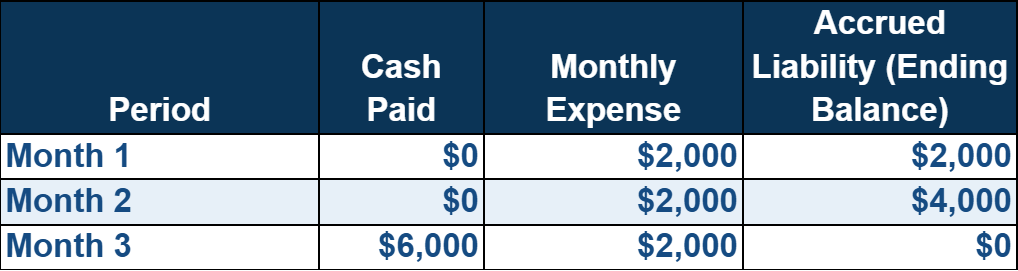
Here we see one of our entries that Salvan will record in the three months of the service. This entry aligns with the expectation set from our initial schedule. We are increasing our accrued liability by $2,000 until the invoice/payment date.

At the end of the quarter, Salvan Manufacturing receives the bill for their electrical utilities. If we recall, the estimate was $6,000. At this time, the accountants would record the accrual reversal entry to record payment for utilities and to reverse out the accrued liability balance of the estimated $6,000. Below is the journal entry if everything goes to plan:

Unfortunately, the world does not always follow our estimates. In reality, there is a high likelihood that Salvan Manufacturing either over or underestimated the payment for their utilities and will need to recognize a correction to their balances when they receive the actual invoice.
Let’s look at what Salvan Manufacturing would need to do if the invoice came in higher than their estimate. Below is the journal entry necessary at the end of the quarter for the invoice received at $9,000.
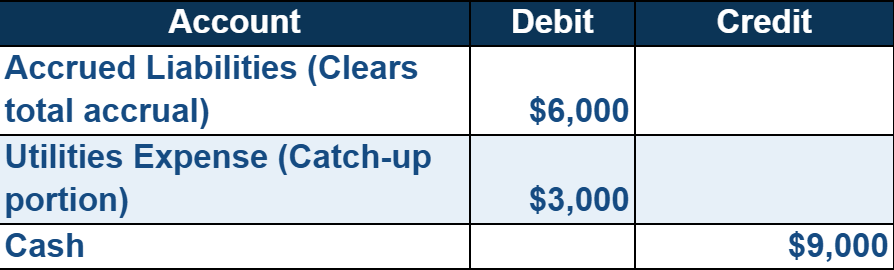
Here, the accounting team has successfully recorded the cash of what is owed of $9,000. The team then removed the accrual for the liability balance of $6,000. They then needed to “true up” the difference of $3,000, which would have gone to expenses over the prior three months.
While underestimates can happen, so can overestimates. So, using the same example, let’s see what the accounting team would need to do if they were to overestimate and the invoice received turned out to be $3,000.
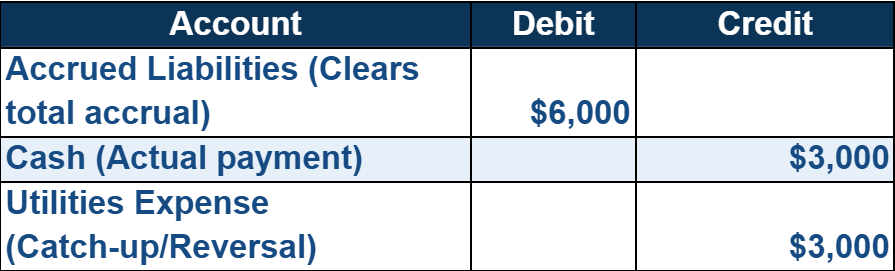
In this overestimation, the accounting team must still pay the cash that is owed and clear out their accrued liability balance. The key difference is in how this is “caught up”, as the team recognized a greater expense than they should have and will need to reverse the difference to bring everything to balance.
While this example was fairly simple in its values and execution, many companies are faced with hundreds of accounts that have accrued balances across multiple vendors. This exercise is simple for now, but as estimates get more difficult and values become more complex over longer periods, accountants find themselves with their hands full trying to manage the values and estimates versus actuals. This, along with the potential for late invoices, can cause headaches for teams if they are not actively tracking the accruals they have in place.
For more full examples of accounting for accruals and prepaids with journal entries, be sure to download our Ultimate Guide to Accrued and Prepaid Accounting:
Finding missing accrued expenses
As we have seen from the examples, accrued expenses are not triggered by an invoice, but rather by consumption of goods/services as we build the schedule at the beginning. While it can be difficult to estimate, some businesses may have an even harder time organizing all of their accruals. More routine accruals are predictable and the calculation is often straightforward. However, in our example, we see that even simple accruals can gain complexities that make tracking more difficult. A structured approach to identify and calculate accruals is absolutely necessary and, in an age of AI and technology, it’s crucial to use resources and tools to save time, increase accuracy, and reduce stress.
Examples of ways to estimate accruals
Historical data analysis
The most common method involves analyzing past trends. For recurring expenses like utilities, a company can average the costs from prior periods to estimate the current period’s expense. This method is simple but may not be accurate if there are significant changes in usage or pricing.
Analysis of open purchase orders
A systematic review of open purchase orders (POs) at the end of the accounting period should be completed to review POs for which goods or services have been marked as received but for which no vendor invoice has yet been processed. This gap is an indicator that an expense has been incurred and an accrual is necessary.
Vendor confirmations
For significant, non-recurring expenses, such as professional services or project-based costs, direct communication with vendors is crucial. Requesting a summary of unbilled work performed as of the period-end can provide a highly accurate basis for an accrual.
Contractual analysis
For expenses governed by contracts, such as software or maintenance agreements, the terms of the contract will dictate the amount to be accrued.
Project-based accruals
For large-scale projects, accruals can be estimated based on the percentage of project completion. This often involves collaboration between the accounting and project management teams to determine a reasonable estimate of the work performed.
Conservative estimation
In situations of high uncertainty where a precise figure is difficult to ascertain, a company may adopt a conservative approach by slightly overestimating the expense. This helps to ensure that liabilities are not understated, though it may slightly depress current period earnings. A subsequent true-up is required when the actual invoice is received.
Despite the implementation of robust estimation processes, the risk of missing accruals remains a significant concern, as the failure to identify and record these liabilities can lead to overstated profits and understated liabilities, potentially misleading stakeholders and impacting financial ratio analysis.
Summary
Correctly identifying and accounting for accrued expenses is crucial for compliance under US GAAP, so it is important for accountants to know how and when to apply the accrual basis of accounting. If your organization has a lot of financial contracts that require using the accrual basis, your accounting for accruals and prepaids could be costing your accounting team time and money. Schedule a demo of FinQuery Accrual and Prepaid Accounting to see how we can help your team save time and streamline its accounting processes by tracking every contract in one system and automating your accounting for accrued and prepaid expenses.