

Link building is still the hardest part of SEO, and most guides get it wrong in one of two directions. Some make it sound impossible without a big budget. Others hand you a list of tactics that stopped working years ago.
The best links I’ve earned didn’t come from paid placements or mass outreach, but from joining things other people were already building, like an expert roundup, a community post request, and a weekly content roundup. None of them took a big budget. All of them took showing up with something useful.
This guide covers 10 link building strategies that work in 2026. For each one, I tell you what it is, what it costs, and how long it takes.
If you want to see how links fit into the bigger picture, my guide on getting organic traffic without backlinks covers the other side of the coin.
The 10 strategies at a glance
The effort, cost and timing below are my own estimates for a solo blogger or small site. Your results will vary by niche.
| Strategy | Effort | Cost | Time to first results | Best for |
|---|---|---|---|---|
| 1. Contribute to expert roundups | Low | Free | Weeks | New and established blogs |
| 2. Answer editor and community requests | Low to medium | Free | Weeks | Bloggers with a clear specialty |
| 3. Get into curated roundups and newsletters | Medium | Free | Weeks to months | Sites publishing strong content regularly |
| 4. Build linkable assets | High | Free to low | Months | Sites with original data or tools to share |
| 5. Pitch your content to existing articles | Medium | Free | Weeks | Sites with a genuinely better resource |
| 6. Guest posting done right | High | Free | Weeks to months | Writers who can match a publication’s standards |
| 7. Journalist requests and digital PR | High | Free to high | Days to months | Experts with real credentials or data |
| 8. Competitor backlink gap analysis | Medium | Free to paid tools | Weeks | Finding where to focus the other tactics |
| 9. Reclaim and replace links | Low | Free | Days to weeks | Sites with existing mentions |
| 10. Partner and community links | Medium | Free | Weeks | Sites with tool, partner or community ties |
What makes a good backlink in 2026
Before choosing a tactic, know what you’re trying to earn. Not all links are worth the effort.
Relevance. A link from a site that covers your topic tells search engines and readers that you belong in that conversation. One relevant link beats ten random ones.
Editorial placement. The best links sit inside the body of an article, placed there by an editor or author because it helped the reader. Links in footers, sidebars or bought “sponsored” slots carry less weight.
A real audience. A link on a page nobody visits does little. A link on a page that gets steady traffic can send you visitors on top of any SEO value.
Link attributes. Links can carry nofollow, sponsored or ugc attributes, which tell Google not to treat them as ranking endorsements. Followed links are ideal, but nofollow links from respected sites still build visibility, referral traffic and credibility.
Natural anchor text. The clickable words should describe the page in plain language. Exact-match keyword anchors on every link look manufactured.
NOTE:
Domain Authority, Domain Rating and Authority Score are third-party numbers. They help compare prospects, but Google does not use them. Google retired its public PageRank score years ago, yet links remain part of how it evaluates pages.
There is also a newer reason to care. AI search tools seem to lean on credible third-party sources when deciding what to cite, so mentions and links from trusted sites may help there too. The research is young, so treat this as a reason to value mentions, not as a guarantee.
A four-question check before you chase any link:
- Is the site relevant to my topic?
- Does the page get real traffic or have real credibility?
- Would an editor place this link on its merits?
- Would I be happy with this link even if Google didn’t exist?
If you answer yes to most of these, it’s worth pursuing.
1. Contribute to expert roundups
An expert roundup collects short answers from many people on one question. They’re one of the easiest ways to earn a link because the host does the heavy lifting, and you only have to contribute a useful answer.
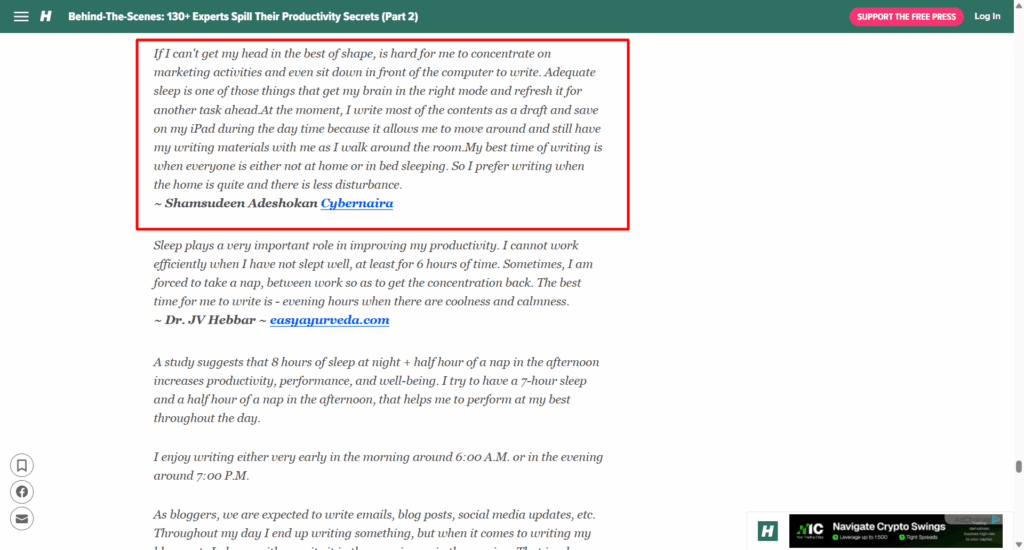
That’s how I earned my HuffPost link. A fellow blogger put together a roundup of 130 expert tips on HuffPost, and I contributed one. I didn’t pitch a guest post or negotiate anything. I answered a question clearly and quickly. You can see the roundup here.
How to do it:
Watch for:
Roundups with 100 or more contributors are crowded, and some links carry nofollow attributes. I still count them. The real benefit is association with a respected publication and exposure to a new audience.
2. Answer editor and community requests
Many blogs and publications ask their audience to contribute content, such as reader case studies, writing projects, community posts, “submit your story” calls, and similar. Because they asked, you’re not cold pitching. You’re answering an invitation.
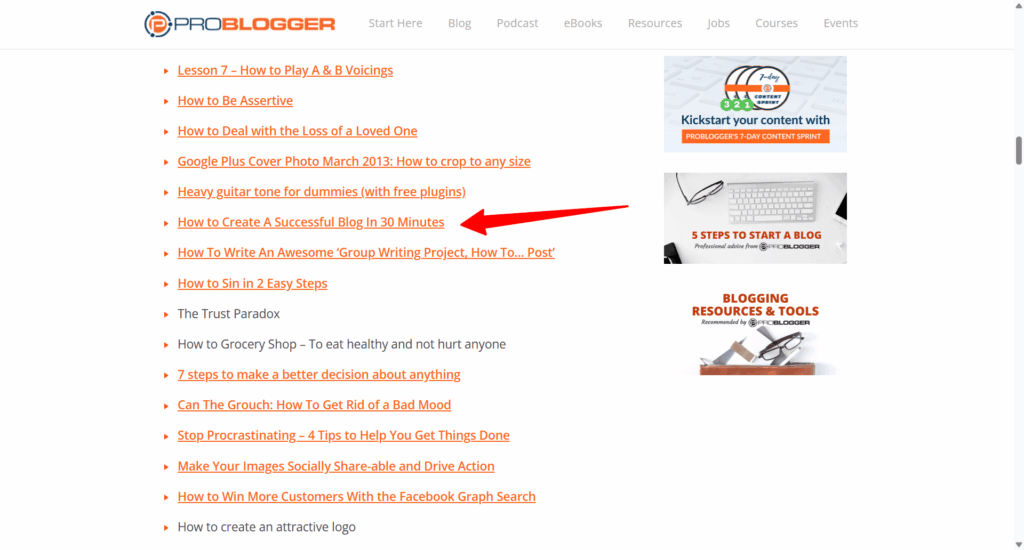
Years ago, Darren Rowse ran a “Group Writing Project” where readers submitted entries in a particular writing style.
In one of these projects, I submitted an entry, and ProBlogger featured it. That’s how I got my ProBlogger link.
How to do it:
Watch for:
The window is often short. Having a few ready-to-adapt ideas or past write-ups saves you from missing deadlines.
3. Get included in curated roundups and newsletters
Many publications run weekly or monthly roundups of the best content in their space. Getting included puts your link in front of their whole readership.
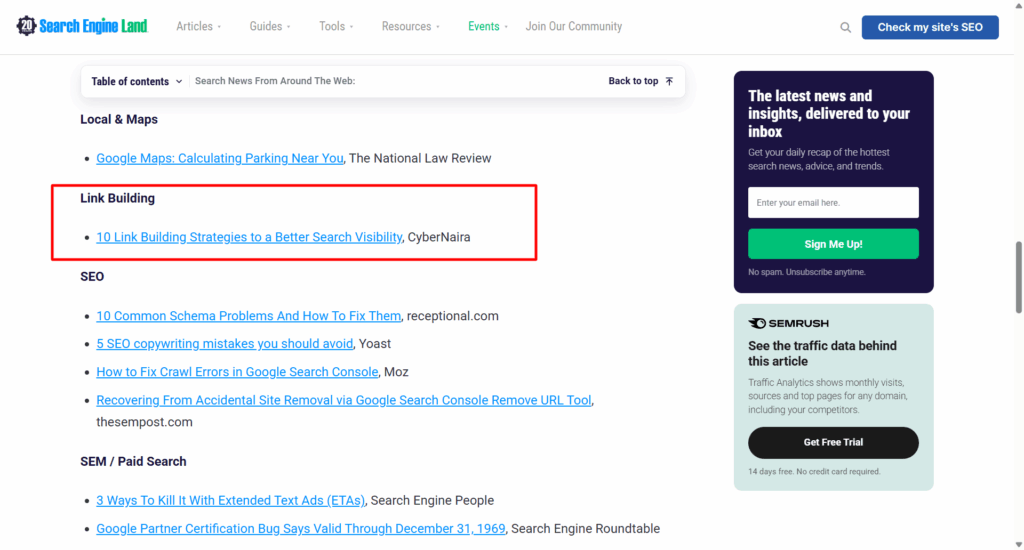
Search Engine Land included a piece of my content (the first version of this very post way back in 2016) in its weekly roundup of top content. I didn’t pay for it or ask for it. It happened because the content was strong and visible (at the time) to the curators.
How to do it:
Watch for:
You can’t force inclusion. This tactic rewards consistent quality more than any outreach trick.
4. Build linkable assets
I’ve published strong-opinion posts or product review posts that drew more attention than neutral explainers or blatant sales pitches. For example, my piece on the Rank Tracker review got picked up by Link-Assistant and cited in one of their publication.
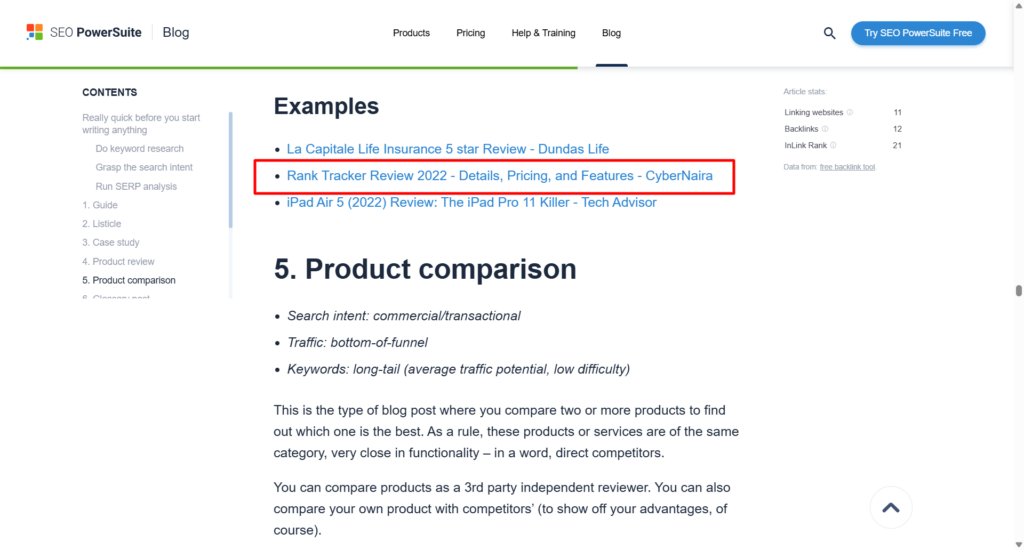
You may argue Link-Assistant developed Rank Tracker and may have an incentive to link to my content, but you don’t see that every time a product developer does this. Besides, they also compete for the same search term, so why would they vote my content as better?
A linkable asset is something people cite because it saves them time or proves a point. You publish it once, and it keeps earning links.
Formats that tend to work:
How to choose: Ask what a writer in your niche would need to cite. If the answer is “a number” or “a tool,” build that.
Then promote it. An asset nobody sees earns no links. Share it with your email list, on social channels, and with the people already writing about the topic. Update it every year so it stays worth citing.
Watch for:
This is the highest-effort strategy on the list, and the payoff is slow. Pick one asset and do it well rather than starting five.
5. Pitch your content to existing articles
Instead of asking for a link in the abstract, you find a specific article where your content would genuinely improve it, then tell the author exactly how.
This type of outreach mostly reaches people interested in paid partnerships rather than mutual collaboration. However, if your content is highly relevant and offers great value, you’re more likely to land some wins.
How to do it:
- Search Google for articles on topics adjacent to your best content.
- Check the publish or update date. Focus on pages that are actively maintained.
- Find the gap: an outdated stat, a thin section, a missing resource.
- Write a short note that points to the gap and offers your page as the fix.
A short template:
Subject: Resource suggestion for [article title]
Hi [Name],
I read your piece on [topic]. The section on [subtopic] doesn’t point readers to anything on [specific gap]. I recently published 10 Link Building Strategies That Work in (2026), which covers [what it adds]: [URL].
If it fits, I’d appreciate your consideration. Either way, thanks for the useful article.
[Your name]
Watch for:
Most pitches will go unanswered. Send fewer, well-researched pitches rather than a large batch of generic ones. Only pitch content that is truly better than what the article already links to.
6. Guest posting done right
Guest posting has a complicated history. Google warned against guest blogging for links in 2014, and its spam policies today target large-scale guest posting campaigns built around keyword-rich anchor text.
That does not mean guest posts are off limits. It means the way you do them matters.
I found one of my best guest opportunities by looking at where a blogger friend was getting links. The site was a high-authority blog; I pitched a post, and they accepted it with contextual links in the body.
Nobody was selling a placement. It was an editorial decision based on content quality.
Do it this way:
Avoid: “Write for us” sites that advertise prices, publish anything, or promise a specific authority score. Those are link farms in disguise.
The reverse works too. Inviting guest contributors to your own blog can bring fresh content and occasional links when they share their post. Keep your standards high so you don’t become the low-quality site. For more on the mechanics, see my guest blogging tips.
7. Journalist requests and digital PR
Journalists regularly look for expert quotes. Platforms such as Featured and Qwoted let you respond to requests, and a quote that gets used can include a link. HARO has changed hands and formats over the years, so check which version is currently active before you rely on it.
Some journalists also post requests on social media.
How to do it:
Be realistic about the odds. This is competitive, and a used quote doesn’t always come with a link. Agencies that do this work for clients typically charge somewhere between $350 and $700 or more per secured link, according to Semrush’s analysis. That price reflects the effort involved.
Digital PR goes a step further. You create a newsworthy asset, such as original research or a data study, and pitch it directly to journalists. For a solo site, one well-built study a year is a realistic goal. It also doubles as a linkable asset (strategy 4).
8. Competitor backlink gap analysis
You don’t need to guess where links come from. Your competitors’ backlink profiles show you which sites are already willing to link to content like yours.
How to do it:
- Pick three or four sites that rank for the topic you want to win.
- Run a backlink gap report to find domains linking to them but not to you. Tools such as Semrush, Ahrefs and SE Ranking do this, and SEO SpyGlass is another option. Free tools like Ahrefs’ backlink checker show a limited sample of top links.
- Prioritize domains that link to several competitors. They clearly link out to your niche regularly.
- Sort the opportunities by type: roundups, resource pages, guest posts, directories.
- Match each opportunity to a strategy in this guide, and pitch the specific improvement you can offer.
This is how I found the guest posting opportunity in strategy 6. For a step-by-step walkthrough, see my guide to competitor analysis using Semrush, and my comparison of SE Ranking vs Semrush if you’re picking a tool.
Watch for:
A gap report is a list of ideas, not a to-do list. Ignore anything irrelevant, low quality or clearly paid.
9. Reclaim and replace links
This strategy has three parts, all based on links that are already close to existing.
Unlinked mentions: Someone mentioned your site, name or brand but didn’t link. Search for your brand name excluding your own domain, set up alerts, or use a brand monitoring tool like Rankdot.
Then send a short, friendly note thanking them and asking them to add the link. If your name has appeared in roundups or interviews, start here.
Broken links: Find relevant pages that link to dead pages, then offer your content as a replacement. Competitor backlink reports often have a “broken pages” filter.
A browser extension can also scan a resource page for dead outbound links. Always check that the link is truly dead, since some errors are temporary. And only offer a replacement that genuinely fits.
Lost links: Backlink tools show links you once had but no longer do. If the page is still live and your content still fits, a short note asking to restore the link often works.
Watch for:
This works best when you already have mentions and links to reclaim. For a brand-new site, start with strategies 1 to 3.
10. Partner and community links
Some of the most natural links come from places you’re already connected to or people you’ve established a business relationship with.
Partners and tools: If you use, review or partner with tools and services, check whether they have a customer showcase, partner directory or resource page. If you qualify, ask to be listed.
Associations and communities: Industry groups, local organizations and niche communities often have member or resource pages.
Forums and discussion sites: Communities like Reddit and niche Q&A sites can send visitors and visibility, but only when your answer genuinely helps. Drop-in links get removed and can damage your reputation. These links typically carry nofollow or ugc attributes, so treat them as visibility, not ranking power.
Watch for:
These links usually carry less SEO weight. The value is relevance, referral traffic and being a recognized name in the space.
How to pick the right strategy for your situation
You don’t need all ten backlink building strategies. Pick a few that match your resources and stick with them for a few months.
| Your situation | Start with |
|---|---|
| New blog, little time, no budget | 1, 2 and 9 (unlinked mentions) |
| Established blog with a few mentions already | 9, 3 and 8 |
| You have original data or can create a tool | 4, then 5 and 7 |
| You have a strong network of peers | 1, 6 and 10 |
| You want a competitive edge | 8 first, then match findings to the others |
What no longer works (or puts you at risk)
Google’s spam policies treat link schemes as a problem. Avoid these:
The test is simple. If a link exists only because you arranged it for ranking reasons, and an editor wouldn’t have placed it otherwise, it’s a risk.
How to measure your link building Impact
Links take time to show up in rankings, so measure the right things early.
Track these for each target page:
A simple spreadsheet works. Log the target page, tactic, date pitched, date live, link type (followed or nofollow), and any referral traffic. After a few months, you’ll see which tactics actually work for your site.
Keep expectations realistic. Link effects commonly take months to show in rankings, and a single great link can matter more than a dozen weak ones.
When you review results, compare periods that are close enough to be fair, and account for outside changes such as algorithm updates or a site move.
Frequently asked questions
Final thoughts
You don’t need a big budget or a long list of tactics. You need a few strategies that fit your resources, and the patience to keep showing up.
The three links I’m proudest of did not come from a clever hack. They came from joining an expert roundup, answering an editor’s request, and publishing content good enough to be noticed.
Start with whichever of those fits your situation, and build from there.