

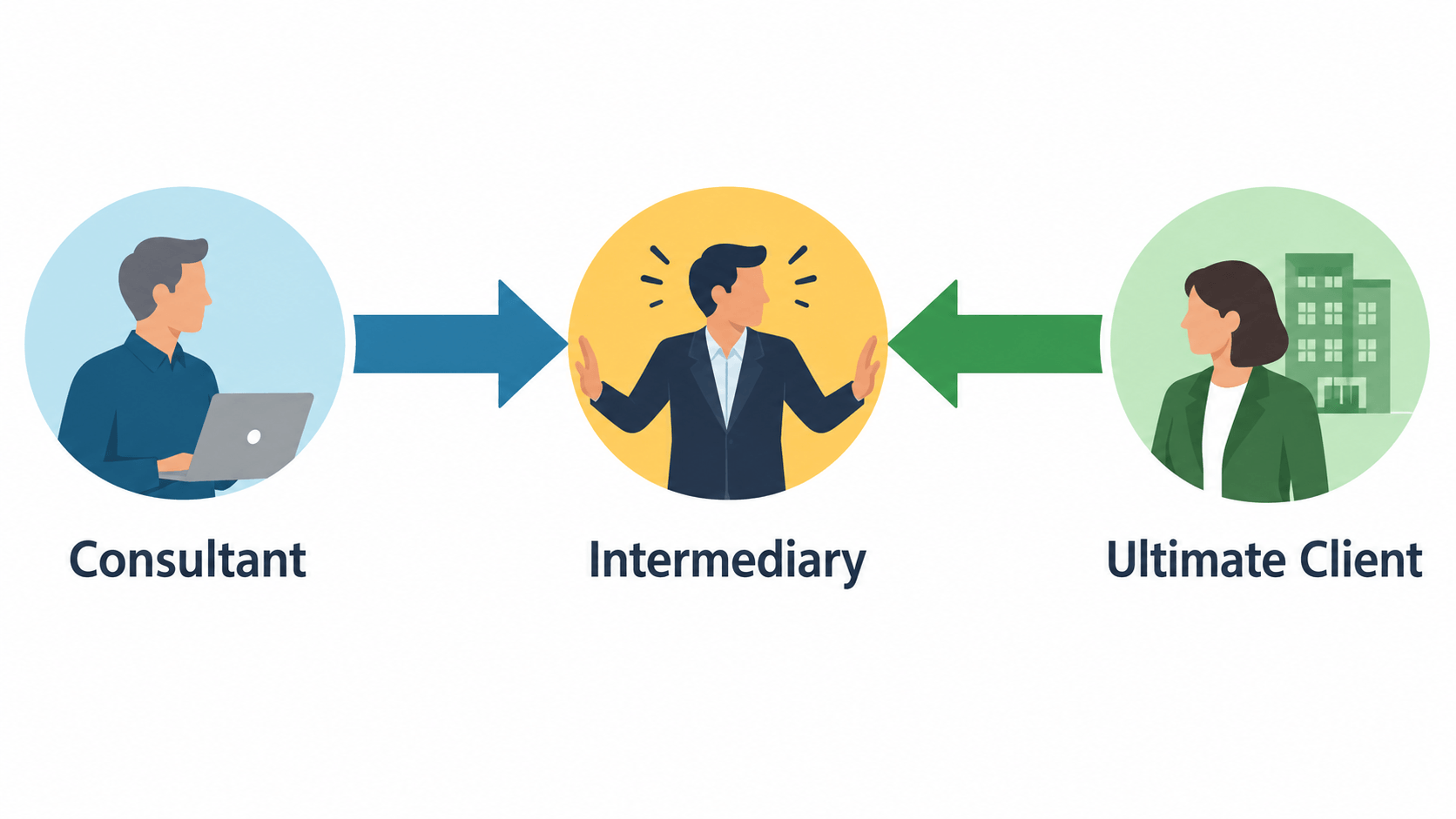
 As a consultant, I try to avoid working through intermediaries. Sometimes an intermediary can be useful, but putting another organization between me and the ultimate client can create problems that neither the intermediary nor I can easily solve.
Here are two examples of times when working through an intermediary didn’t go well.
1. An intermediary hires me to produce white papers for a sponsor
I was once contracted to write white papers for an event industry publication sponsored by my intermediary’s client. The first few assignments went fine. I wrote the pieces, they went through minor edits, the articles were published, and I got paid.
Then a problem arose.
I sent my client the piece for my latest assignment, and they wrote back that the sponsor wanted several significant edits. I made them and explained that after a certain date, I would be very busy and would need any further edits finished before then.
Several more rounds of requests followed. Despite my warning, the sponsor kept requesting additional changes right up to the deadline.
Eventually I told my client that I simply couldn’t keep editing the piece. We had run out of time.
They were annoyed with me, which I suspect reflected their own difficult position as much as anything I had done. They paid me for the work, but the article was never published.
My client, the intermediary, was trapped between my time constraints and the sponsor’s demands.
That ended our professional relationship.
In retrospect, it would have been helpful if my client had shared more of their own frustrations about being caught in the middle. Instead, I experienced their communications primarily as increasingly urgent demands from their client.
The intermediary was in an impossible position. Their client wanted something that their contractor could no longer provide within the available time.
The fundamental problem was that I was responsible for producing the work, but I had no direct relationship with the person ultimately deciding whether the work was acceptable.
2. I’m contracted by an intermediary to create software for a large book publisher
When I was an IT consultant, an organization contacted me to ask whether I could write macOS software to display the contents of a video disc of images that would accompany a well-known medical textbook.
They asked what I would charge.
After learning they were an intermediary for a large, well-known textbook publisher—and that the publisher had a reputation for paying contractors slowly—I decided to charge twice what I normally would for the work.
Everyone agreed to my fee. I delivered the software on time and sent my invoice.
The large textbook publisher took eight months to pay my intermediary.
Even though I had anticipated a long delay, I was still annoyed. For eight months, I had no certainty about when—or even whether—I would be paid.
When the payment finally arrived at the end of the year, I was relieved.
The extra money was nice, but it didn’t compensate me for months of worrying about whether I would get paid.
That’s when I decided to avoid intermediary contracts whenever possible.
The intermediary problem
These two experiences taught me that intermediaries can create two quite different kinds of risk for consultants.
In the first case, the intermediary created a communication and authority problem. The person paying me wasn’t the person making the final decisions about my work. My client had to reconcile the ultimate customer’s demands with the constraints of the person doing the work.
In the second case, the intermediary created a payment problem. I had completed the work, but my payment depended on someone else’s customer paying them.
Neither problem stemmed from bad intentions. They were structural consequences of having an additional organization between the ultimate client and me.
Intermediaries can make sense in some situations. They may find work that I couldn’t find myself, handle administrative tasks, aggregate specialized expertise, or provide a useful relationship with a large organization that would otherwise be difficult to access.
But if I’m going to work through an intermediary, I want to understand exactly what role they play, who controls the work, who owes me the money, and what happens if the ultimate client changes its mind or doesn’t pay.
Consequently, I now generally prefer to work directly with the organization that wants my work. It eliminates a layer of communication, authority, and payment risk that I don’t control.


