
Navigating the convergence: The strategic evolution of institutional Digital Asset infrastructure

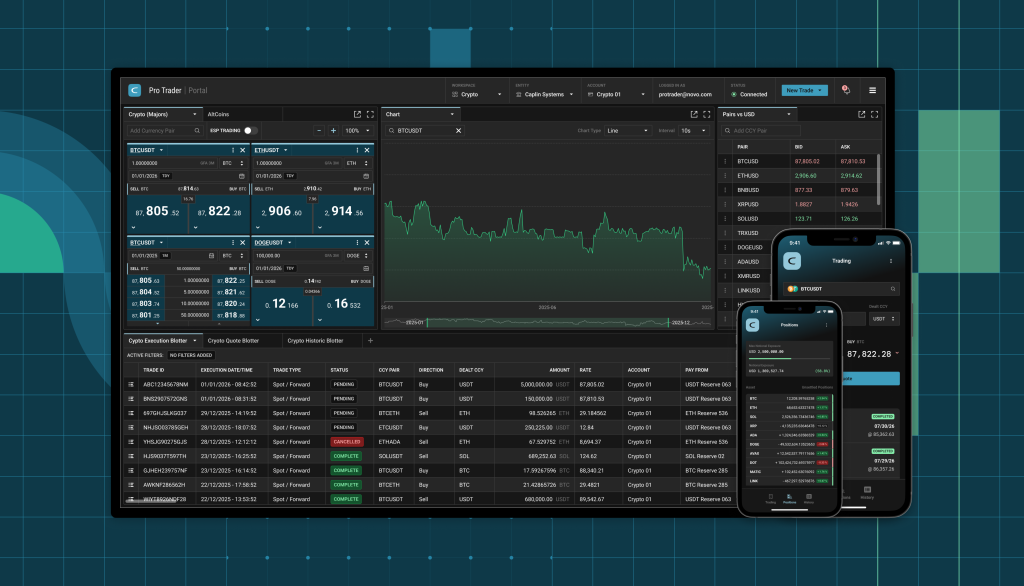
We are seeing a significant increase in institutional interest, yet the “last mile” of distribution often remains manual. What does this reveal about current market structure?
There’s still a fundamental disconnect between electronic execution capabilities and client-facing distribution technology. While liquidity and algorithmic execution have evolved rapidly, the interface through which OTC desks and brokers engage with institutional clients for digital assets often lags behind – frequently relying on instant messaging platforms, email and spreadsheets for the ‘last mile.’ This creates an operational ceiling, introduces systemic risk, and limits a firm’s ability to handle high-volume, multi-asset enquiries.
For the market to truly scale, the industry must transition toward a unified electronic framework that treats digital assets with the same structural rigour as institutional FX.
As digital assets move into professional trading environments, how are financial institutions facing the challenge of integrating a new asset class into infrastructure designed for traditional securities?
The primary challenge is architectural rationalisation. The traditional ‘build’ strategy, even when accelerated by modern AI tools, often underestimates the long-term burden of security compliance, maintenance, and the complexity of 24/7 integration. Conversely, buying an off-the-shelf platform can lead to opaque cost structures – such as volume-based fees and hidden brokerage costs – that erode margins as the business grows. Best practice now dictates a hybrid approach: leveraging proven, high-performance integration layers while maintaining full control over the user experience and the underlying liquidity ecosystem.
Successful institutions are prioritising platforms that offer transparency. Avoiding rigid ecosystems that force specific liquidity, or introduce transaction-based friction, is essential for maintaining a competitive edge. As institutions scale this new asset class, focus has shifted from merely ‘getting online’ to building a robust, secure digital asset distribution layer that reflects the institution’s unique brand and sophisticated risk rules.
From a strategic perspective, what should a modern distribution engine look like to ensure operational scalability?
A modern engine must act as a revenue growth catalyst rather than a utility. It requires an integration layer that offers native support for 24/7 trading with zero downtime – a standard we’ve long applied at Caplin. This layer must centralise distribution, authentication, and entitlements across fragmented systems, ensuring that pricing and execution remain secure and consistent across all client touchpoints, from web to mobile. To achieve true scalability, the architecture must support seamless connectivity between the front-end and specialised partners for custody and risk. By decoupling the interface from the liquidity and storage layers, institutions gain the flexibility to evolve their stack without rebuilding their client-facing presence, significantly reducing the time-to-market for new asset classes.
How can firms bridge the gap between their established FX heritage and the emerging digital asset landscape?
The path to convergence lies in applying battle-tested institutional standards to new markets. The requirements for digital assets – low latency, high availability, and comprehensive audit trails – are identical to those in global FX.
Leading firms are not merely wrapping digital assets in an FX shell; they are using established architectural foundations to build purpose-built solutions that respect the nuances of this new asset class while maintaining bank-grade security and streaming precision.
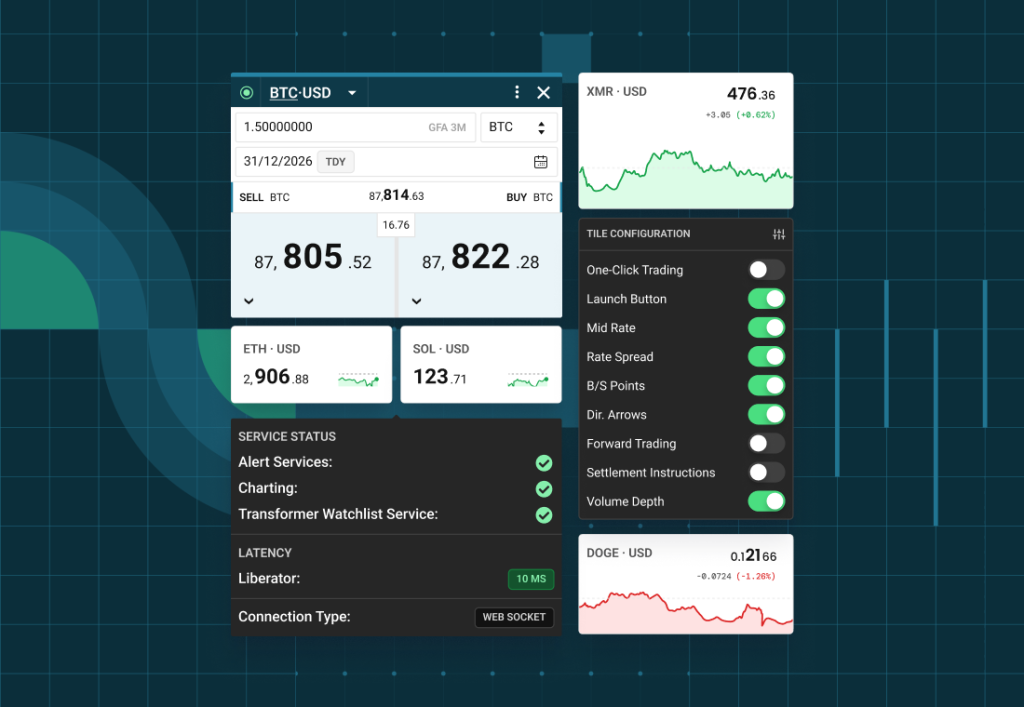
Beyond digital assets, what is the broader footprint of Caplin’s offering today?
The strategic vision for the industry is the multi-asset workspace. Whether managing FX, fixed income, or digital assets, the professional user requires a unified interface. Our experience suggests that institutions who consolidate these workflows into a single, out-of-the-box native platform are better positioned to capture market share and provide a superior client experience than those operating in silos. This approach not only solves for client experience, but also desks within the bank/institution; a single multi-asset tech stack reduces ongoing IT cost by offering a single integration layer, and reducing time to market for onboarding new assets.
How do different market segments benefit specifically?
Operational scalability is achieved by solving specific segment pain points through automation. For OTC desks, this means expanding capacity without linear headcount growth. For institutions, it means providing the lineage and regulatory auditability required for compliance. Finally, for brokers and market makers, it offers the high-performance liquidity distribution and rapid execution needed to maintain competitive spreads. In both cases, success depends on a distribution layer that is rapid, branded, and deeply integrated into existing workflows.
Can you walk us through the primary workflows and features supported on the front-end?
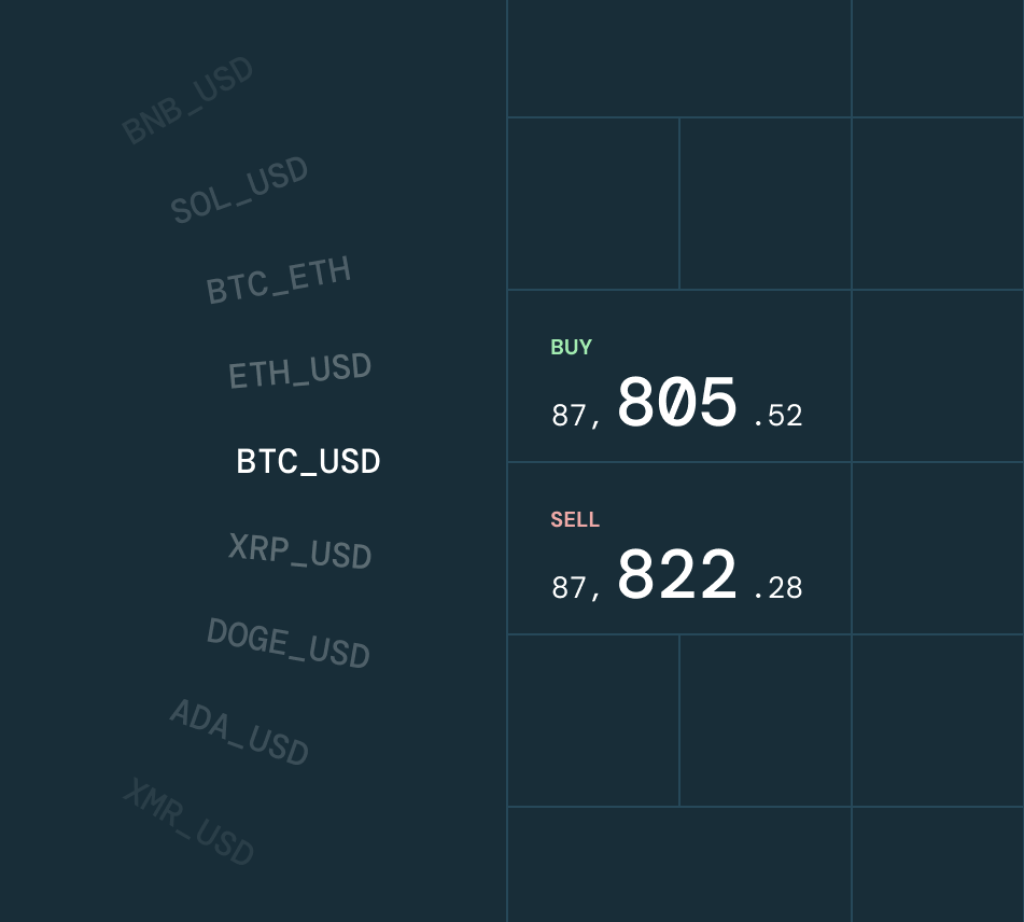
A tier-1 front-end must harmonise automated execution with hybrid manual workflows. This includes streaming executable pricing alongside limit and algo order strategies, interactive charting, and real-time blotters with a multitude of self-serve post-trade actions such as allocations. Furthermore, a sophisticated Sales UI should digitise high-touch trade inquiries, allowing sales traders to price and execute complex requests with precision, directly integrated into custody and settlement infrastructure.
How does Caplin differentiate itself from digital asset-native platform providers and ECNs?
As institutional markets become more fragmented, technology and liquidity are treated increasingly as separate layers: firms want infrastructure that can connect them to multiple venues and liquidity providers without locking them into a single execution ecosystem.
Rather than relying on a single supplier for connectivity and liquidity, institutions look for specialised technology partners whose platforms best meet their specific technology needs. Focus should be on workflow precision – handling complex, high-touch interactions where generic tools create friction – while supporting flexible integration across diverse liquidity networks.
Beyond the software itself, professional domain expertise is the catalyst for successful digital transformation. With a clear roadmap for implementation and customisation, transitioning from manual legacy systems to scalable, managed SaaS solutions allows firms to handle exponential volume increases without vendor lock-in.

Looking ahead to the rest of 2026 and beyond, what is Caplin’s vision for digital asset distribution?
The ultimate vision for the future would of course be complete convergence of traditional and digital infrastructure. On the road to that ideal end state, we will likely see more and more institutional buyers rejecting siloed platforms in favour of more unified workspaces. The firms that will thrive in this new world order will be those that view technology not just as a tool for today, but as a flexible foundation for long-term strategic value across the entire asset lifecycle.