
By Bjorn Fehrm: Aerospace Analyst
October 9 2026
We started looking at thermoplastic composite production last week. The high melting point of 380°C to 400 °C for the PEEK variant and over 305 °C for the LMPEAK (Low Melt PAEK), and the high viscosity when melted (like honey), make dry fiber infusion a no-go method. Instead, heated closed molds bring heat to the matrix and force the composite into shape, often with hydraulic pressure on the mold surfaces.
Because thermoplastic composites can be joined by welding, they are attractive for producing composite aircraft fuselages, where the main challenge is joining thousands of parts. But the need for closed, heated molds, often combined with pressure, makes it difficult to produce the 30- to 50-foot-long outer skin panels with this method.
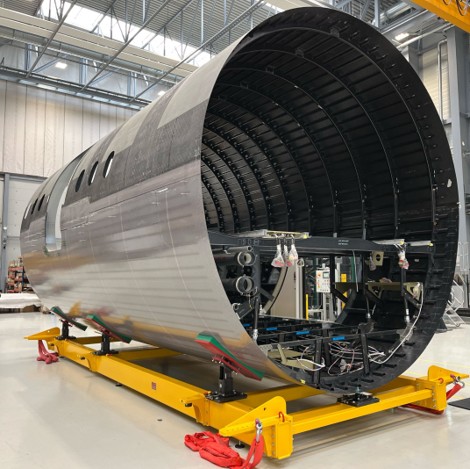
When Airbus did its MFFD (Multi Functional Fuselage Demonstrator) fuselage section with thermoplastic composites that were welded together (Figure 1), it had to post-consolidate the AFP in-situ-consolidated outer skins in an autoclave before welding on stringers, clips, and frames to the section.

Figure 1. The eight-meter single-aisle MFFD fuselage section. Photo credit: Airbus.
Thermoplastic composite manufacturing of large parts
We described several thermoplastic manufacturing methods that use heat, pressure, and closed tools last week. These methods produce the internal components of the fuselage section in Figure 1, which can be welded together.
To produce the fuselage outer skins, the MFFD project used female quarter-circumference molds where an AFP system applied thermoplastic tape that was consolidated in situ, i.e., melted into place using nip-point laser-heated placement (Figure 2) at the Dutch aeronautical research organization, NLR.

Figure 2. An AFP robot applies thermoplastic tape onto the MFFD skin layup. Photo credit: NLR.
The skins were then weld-joined into a lower fuselage half skin in a large tool to form the lower half skin of a next-generation narrowbody (Figure 3).

Figure 3. The two quarter-circumference skins are welded together to a lower fuselage half skin in a large tool. Source: NLR.
The joined skins were then transported to the German aeronautical research organization, DLR, in Stade, Germany, where the skin was post-consolidated in an autoclave at 7 Bars and 400°C (Figure 3).

Figure 3. The MFFD lower fuselage skin is post-consolidated in the DLR autoclave in Stade, Germany. Photo credit: DLR.
The reason for the post-consolidation is that the AFP layup of thermoplastic tape has problems with melting through and consolidation of the merger of the layup and tape when the head moves. It must run at one-fifth the speed of thermoset AFP; still, the non-post-consolidated strength is below 50% of a fully consolidated composite. This means post-consolidation is required, either in an autoclave or in an oven after bagging and vacuum application.
The low AFP speed and need for post-consolidation are not aligned with the MFFD and US HICAM (NASA and industry Hi-Rate Composite Aircraft Manufacturing project) targets of developing high-rate, low-cost composite structure techniques for the next generation of narrowbodies.
The alternative method to in-situ AFP consolidation
The alternative is to use a closed, heated tool to produce the skins, using the techniques described last week. It would produce a closed tool with dimensions never produced before. If the preform is produced as a flat AFP layup, the tool would also need to be a pressure tool, using a very large press to achieve the round shape. Placing door, window cutouts, etc. on the flat preform would be tricky, as it would be hard to achieve the correct final position in the final form skin after pressing.
Fuselage production would have to cover all 40 to 50 meters with this skin tooling divided into several sections. Figures 2 and 3 give an idea of the size of a closed tool. Once the tooling is produced and the process proven, it can produce the thermoplastic skin at a very high rate. Given the high rate of heated pressing, the large presses might be shared between several sectional tools, producing the sectional skins in batches.
The technology to master these mega-sized closed-tool parts must be researched, perfected, and proven economically viable, as many very expensive tools are needed, before this alternative can deliver the challenging thermoplastic fuselage skins for a composite next-generation narrowbody.
Related