
7
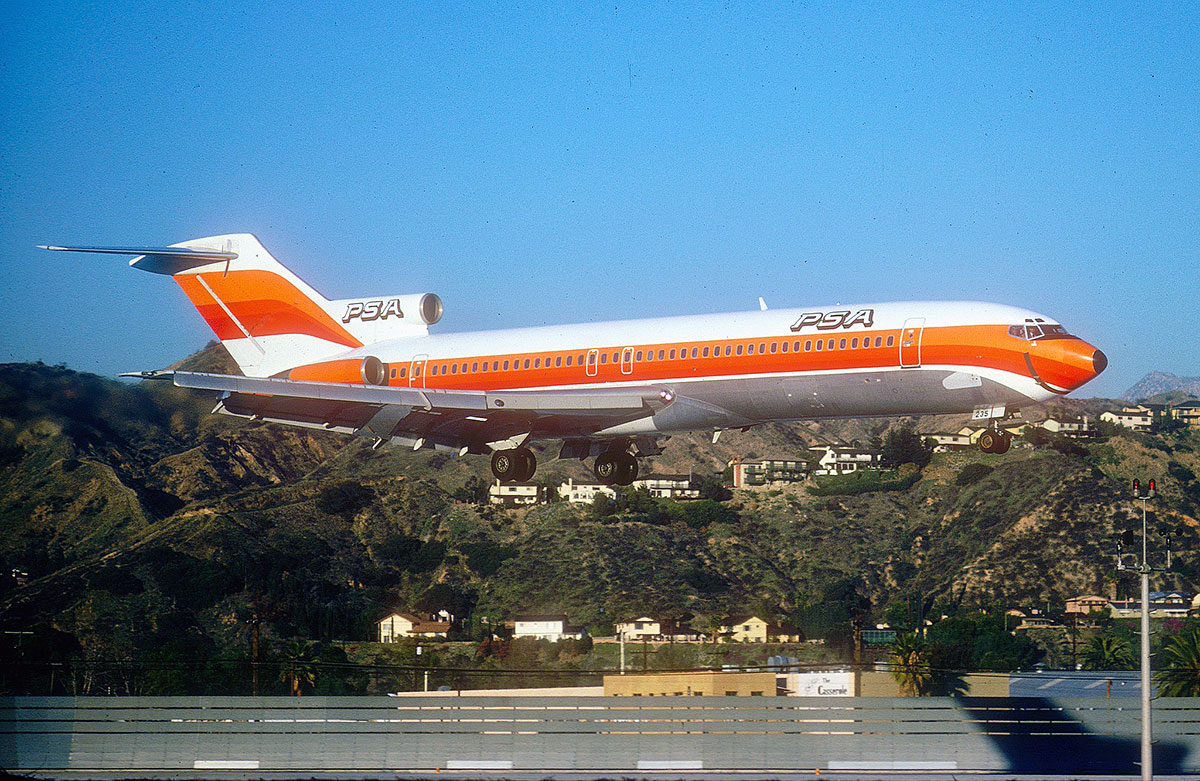
For almost 40 years, Pacific Southwest Airlines – better known simply as PSA – was one of the most distinctive airlines in America.
Based in San Diego, PSA became almost an unofficial airline of California, shuttling passengers between Los Angeles, San Francisco, San Diego and other cities with a succession of classic aircraft.
Its famous slogan was “The World’s Friendliest Airline”, while its aircraft became known as “Grinningbirds” thanks to the smiles painted beneath their noses.
But in 1988, PSA disappeared.
So, what happened to Pacific Southwest Airlines? And why can you still find the PSA name – and even its famous livery – in the American Airlines family today?
From One DC-3 to California Favourite

Photo: Ian Abbott
PSA began flying on 6 May 1949, initially using a leased Douglas DC-3. Its first route linked San Diego with Oakland via Burbank, operating just once per week.
California was growing rapidly and its major cities were separated by distances which made air travel extremely attractive. PSA offered affordable fares and a relaxed approach to flying which contrasted with the more formal image of many established airlines.
It proved popular and San Francisco was added in 1951, and PSA steadily developed into a major force in California air travel.
PSA’s Classic Aircraft

Photo: Brave Heart
PSA is particularly memorable because of the wonderful variety of aircraft it operated.
The Douglas DC-3 which started the airline was followed by larger Douglas DC-4s.
Then came one of the great American turboprops when PSA introduced the Lockheed L-188 Electra, which became an important aircraft on the busy routes linking San Diego, Los Angeles and San Francisco.
By the middle of the 1960s, however, PSA was ready to enter the jet age. In 1965, it introduced five Boeing 727-100s.
These sleek trijets transformed the airline and became closely associated with its operations during the following years. Larger Boeing 727-200s would follow.
PSA also became an operator of the Boeing 737-200, giving the airline an efficient twin-engined jet for its intensive short-haul network.
With frequent flights and relatively quick turnarounds, PSA was already demonstrating many of the principles which would later become associated with the low-cost airline model. Indeed, PSA would become an important inspiration for another airline starting out in Texas – Southwest Airlines.
PSA Even Flew the TriStar

Piergiuliano Chesi, CC BY-SA 3.0
Perhaps the most surprising aircraft in the PSA story is the Lockheed L-1011 TriStar.
Yes, the airline which made its name flying short hops around California briefly operated widebody aircraft!
PSA introduced the TriStar during the 1970s in an attempt to add significantly more capacity to its busiest routes. The aircraft looked fantastic in PSA’s colourful livery, complete with that famous smile beneath the cockpit. But unfortunately, the economics didn’t work.
Putting a large three-engined widebody onto relatively short domestic sectors proved expensive, particularly during the fuel crisis of the period. PSA consequently disposed of its TriStars after only a short spell.
Smiles in the Sky
PSA was about much more than aircraft. The airline deliberately cultivated a fun and informal image.
Its flight attendants became famous for their colourful uniforms – including miniskirts and, later, hot pants – while crews were encouraged to interact and joke with passengers.
Most memorable of all were the aircraft themselves. PSA painted a black smile beneath the nose of its airliners.
Combined with the airline’s colourful red, orange and pink liveries, these aircraft were almost impossible to mistake.
The slogan “Catch Our Smile” became closely associated with the airline.

Deregulation Changes Everything
For much of its existence, PSA had operated primarily as an intrastate airline, flying within California. This gave it considerable freedom from the federal regulation which controlled many aspects of the wider US airline industry.
But the Airline Deregulation Act of 1978 changed the landscape dramatically. PSA was now free to expand beyond California.
The airline added destinations across the western United States and into Mexico, but it also suddenly faced much greater competition. The comfortable California market which had allowed PSA to thrive was changing.
The MD-80 and BAe 146 Era

PSA nevertheless continued modernising its fleet. One of the most important additions was the McDonnell Douglas MD-80, or Super 80.
The long, sleek twinjet became another classic PSA aircraft during the 1980s, eventually forming a large part of its fleet.
PSA also became an early operator of the British Aerospace BAe 146. With four small turbofan engines and excellent short-field performance, the BAe 146 allowed PSA to serve smaller airports and expand into thinner regional markets.
By the end of 1986, PSA’s fleet included 31 MD-80s, 20 BAe 146s and four DC-9-30s.
That year the airline carried a record 10.7 million passengers. But behind those impressive numbers, things were becoming difficult.
USAir Buys PSA
Consolidation was sweeping through the American airline industry. American Airlines acquired PSA’s California rival AirCal, while Delta took over Western Airlines and Northwest acquired Republic.
PSA suddenly faced competitors backed by much larger national networks.
Then came USAir. The East Coast airline had approached PSA previously, but circumstances had changed. In 1986 a deal was agreed for USAir to acquire PSA.
On 29 May 1987, Pacific Southwest Airlines became a division of USAir. For a while the familiar PSA aircraft continued flying, but gradually those colourful liveries and famous smiles began disappearing beneath USAir colours.
The end finally arrived on 8 April 1988, when the last PSA flights operated. After 39 years, Pacific Southwest Airlines was gone.
What Happened to the Aircraft?
Many of PSA’s aircraft continued flying after the airline disappeared. The MD-80s were absorbed into USAir’s operation and many were moved away from California.
The BAe 146s initially remained particularly important on the West Coast, although USAir eventually reduced much of the network it had inherited from PSA.
Other aircraft had already moved on to operators elsewhere around the world. The individual histories of PSA’s 727s, 737s, MD-80s and BAe 146s make interesting reading today, with some enjoying lengthy second careers after their time carrying the famous smile.
There Is Still a PSA Airlines Today

Coldstreamer20, CC BY-SA 4.0
Confusingly, PSA Airlines still exists.
But it isn’t the same airline.
Today’s PSA Airlines traces its own history to Vee Neal Airlines, founded in 1979 and subsequently known as Jetstream International Airlines. USAir eventually renamed the company PSA Airlines, helping it retain the rights to the famous name.
Following the merger of US Airways and American Airlines, today’s PSA became part of the American Airlines Group. It now operates regional flights under the American Eagle brand using Bombardier CRJ aircraft.
So, while the PSA name survives, you won’t find smiling PSA aircraft shuttling passengers around California anymore.
The PSA Retro Jet
There is, however, still a wonderful reminder of the original airline flying in the United States.
US Airways introduced a series of heritage liveries celebrating airlines which had become part of its family tree, including Allegheny, Piedmont and PSA. An Airbus A319 initially carried the PSA heritage colours.
After the US Airways-American Airlines merger, the tradition continued under American. More recently, the PSA scheme has been transferred to an American Airlines Airbus A321, reproducing the classic pink, orange and red colours – and, importantly, the famous smile beneath the nose.
It is one of American’s most attractive heritage liveries and a fantastic tribute to the original California airline.
So, if you’re lucky enough to see it today, you’re looking at a reminder of an airline which disappeared almost four decades ago.
Did you ever fly with Pacific Southwest Airlines or photograph one of its famous “Grinningbirds”? Let us know your memories in the comments below.
Title image: Aero Icarus