
Ghost, Pharaoh, Carpenter, Crazy ants. Physical traits, behavior, damage types & treatment differences
Singapore is home to over 200 recorded ant species, though only a small number are considered structural or household pests. The most common pest species are Ghost Ants, Pharaoh Ants, and Crazy Ants. Understanding which species you have is the critical first step to permanent elimination.
Why Ant Species Identification Matters
Each species requires completely different treatment approach
- Food preference difference: Ghost ants favor sweet and sugary foods. Pharaoh ants prefer oily or protein-rich foods and will live anywhere they can form colony. Wrong bait = ants ignore it.
- Nesting location variation: Ghost ants commonly found in kitchens under sinks, in cabinets, or behind appliances. Pharaoh ants nocturnal and nest indoors hiding behind newspapers or inside wall cracks. Treatment must target actual nest.
- Spray sensitivity crisis: Multi-queen tramp species (Ghost Ant, Pharaoh Ant, Crazy Ant) react to repellent sprays by splitting their colony—a survival mechanism called budding. This worsens the infestation. Wrong spray = colony multiplication.
- Colony structure differences: Single-queen species (Carpenter Ants, garden species) can be controlled with direct nest treatment and residual sprays. Multi-queen species cannot. Treatment method depends on colony type.
- Damage risk variation: Carpenter ants carve out areas for colony with mouths, causing structural damage. Ghost ants cause food contamination. Damage type differs by species.
- Professional expertise requirement: Professional NEA-licensed technicians accurately identify ant species group and apply correct targeted treatment. No guesswork. No worsening infestation.
The Four Most Common Singapore Ant Species
1. Ghost Ants (Sugar Ants)
Physical identification
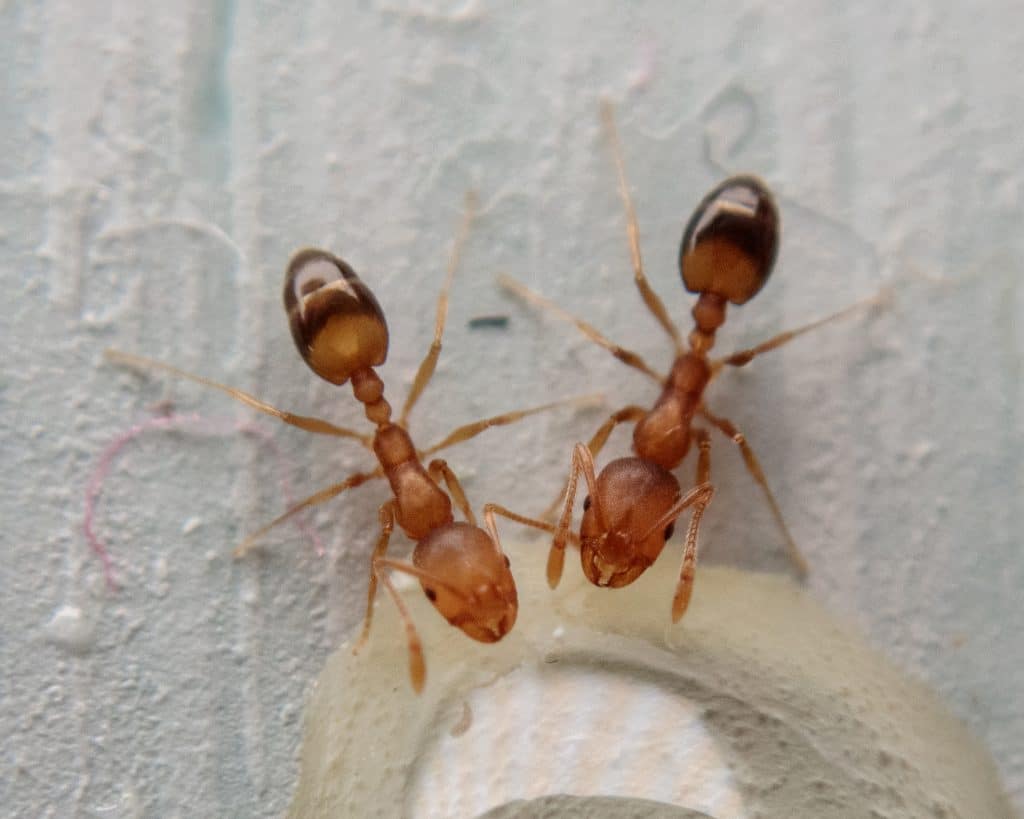
- Size: 1.3 to 1.5 mm long
- Dark head and translucent body
- Pale colored body, dark head and abdomen
- Extremely small, difficult to spot individually
- Move in organised trails when foraging
Behavior & nesting
- Favour moist environments. Commonly found in kitchens under sinks, in cabinets, or behind refrigerators.
- Colonies moderate to large, thousands of workers, numerous functional queens across multiple nesting sites
- Very fond of honeydew, feed on dead and living insects
- Form massive trails to food sources
- Non-aggressive unless threatened
Food preferences
- Favour sweet and sugary foods
- Attracted to carbohydrate sources
- Found wherever sweet foods stored or spilled
- Kitchen pantries, under stoves, near garbage
Professional treatment
- Non-repellent gel bait most effective for Ghost ants and other tramp species
- Sweet-based gel baits essential
- Never use repellent spray (causes budding)
- Typical elimination: 7-14 days with professional treatment
2. Pharaoh Ants (Most Dangerous Species)
Physical identification
- Size: 2 mm long
- Distinctive golden or yellow-brown colour
- Bodies yellow or brown, abdomens usually red or black
- Uniform color throughout body
- Extremely tiny, easy to miss
Behavior & nesting
- Nocturnal. Queens live 4 to 12 years. Difficult to eliminate.
- Tend to scatter and establish new colonies when threatened, making hard to eradicate. Species challenging to get rid of due to complex colony structure.
- Nest indoors in walls, appliances, hidden crevices
- Multi-queen colony (polygynous) with satellite nests
- Will bite when threatened
Health risks & damage
Disease transmission
Pharaoh ants are considered the most dangerous as they carry and transmit serious diseases to people. Implicated in spread of more than a dozen disease pathogens including salmonella and Streptococcus pyogenes. Hospital infestations critical risk.
- Food contamination via bacterial transmission
- Bite and sting when defending nest
Why DIY fails
- These pests do not react well to pesticides. When sprayed, ants break up colony and scatter to new locations.
- Spraying causes colony splitting (budding)
- Each satellite colony independently functional
- Problem multiplies instead of decreases
- Requires professional non-repellent gel baiting
3. Carpenter Ants (Structural Damage Risk)
Physical identification
- Size: up to 15 or 17 mm (largest common ant)
- Typically black and reddish-brown
- Large, visible to naked eye
- Segmented body with pinched waist
- Elbowed antennae
Behavior & nesting
- Derived their name from living in wooden structures and trees. Do not eat wood but carve out area for colony with mouths.
- Prefer moist, decaying wood. Often found in damp areas like bathrooms and kitchens. Excavate galleries inside wood with smooth appearance.
- Hunt for food mainly at night, occasionally during early spring/summer
- Rarely contact people, will try to escape if disturbed
- Cannot sting
Structural damage signs
Wood tunneling damage
Although they do not consume wood like termites, they excavate it to create nests, which can lead to structural damage over time. Carpenter ants tunnel through wood to create nests. They are attracted to moist environments and can be commonly found in bathrooms, kitchens and wooden structures such as door frames and furniture.
- Sawdust-like debris below wood holes
- Clean galleries with sand-papered appearance
- Damage to door frames, beams, furniture
- Structural compromise if left untreated
Food preferences & treatment
- Enjoy eating honeydew and dead insects. In homes attracted to sweet substances, fats, grease and meats.
- Single-queen species requiring direct nest treatment and residual sprays
- Nest location fixed, professional inspection finds galleries
- Treatment targets galleries directly (drilling/dusting)
4. Crazy Ants (Erratic Behavior)
Physical identification
- Size: 2-3 mm in length
- Usually dark red or black in colour
- Long antennae and legs (distinctive feature)
- Move erratically and quickly
- Named for unpredictable, uncontrollable foraging movements
Behavior & nesting
- Infamous for behaving erratically when colony disturbed, scattering in all directions
- Live in both dry and moist places
- Outdoor ants nesting under flower pots, gardens, wood
- Can be found in same regions as Ghost and Sugar ants
- Will feed on wide range of foods, prefer sugary
Damage & behavior risks
- Do not bite or sting
- Primarily outdoor nuisance pest
- Can enter homes during heavy rains or hot weather
- Defensive scatter behavior makes control difficult
Professional treatment
- Non-repellent gel bait effective for Crazy Ants (tramp species)
- Never use repellent spray (causes erratic scatter)
- Outdoor nest treatment required
- Bait placement along foraging trails critical
Species Comparison: Quick Reference Table
| Species | Size | Color | Primary Location | Food Preference | Danger Level | Treatment |
|---|---|---|---|---|---|---|
| Ghost Ant | 1.3-1.5mm | Dark head, translucent body | Kitchen, under sink | Sweet foods | Low (food contamination) | Sweet gel bait (no spray) |
| Pharaoh Ant | 2mm | Yellow-brown, red abdomen | Walls, appliances, everywhere | Oily/protein foods | High (disease transmission) | Non-repellent gel bait only |
| Carpenter Ant | 13-15mm | Black or reddish-brown | Moist wood structures | Honeydew, sweets, meats | High (structural damage) | Direct nest treatment, residual spray |
| Crazy Ant | 2-3mm | Dark red or black | Outdoor (gardens, pots) | Sugary foods, all types | Low (nuisance only) | Gel bait (no spray) |
Why Misidentification Leads to Treatment Failure
Real-world treatment failure examples:
- Wrong bait type: Using wrong bait for species causes ants to ignore treatment. Sweet bait on Pharaoh ant trail = no consumption. Protein bait on Ghost ant trail = no interest.
- Repellent spray mistake: Repellent spray on multi-queen species causes colony budding, splitting into multiple new colonies. Single infestation becomes 5-10 separate infestations.
- Nest location error: Treating visible trails without finding main nest leaves colony intact. Colony rebuilds trails within 48 hours.
- Carpenter ant misidentification: Carpenter ants often mistaken for termites because of wood damage behavior. Correct identification determines treatment approach.
- Professional treatment avoidance: Misidentifying an ant species can lead to ineffective control efforts, allowing the infestation to spread or worsen. DIY approaches with wrong species almost always fail.
Professional Identification Process
How professionals identify your ant species correctly:
- Visual inspection: Physical characteristics (size, color, body segments, antennae) examined under magnification if needed.
- Behavior observation: Trail patterns, movement speed, aggregation behavior, nesting location observations.
- Food preference testing: Strategic bait placement to assess consumption patterns (sugar vs protein response).
- Nesting location analysis: Professional inspection follows active foraging trails back to nest source to determine exactly where colony is located. Different species prefer different nesting areas.
- Colony structure assessment: Professional determines if single-queen (Carpenter ants) or multi-queen (Pharaoh, Ghost, Crazy) based on behavioral response to bait.
- Species-matched treatment planning: Only after accurate identification, professional applies correct bait type, application method, treatment frequency.
Frequently Asked Questions
How do I tell Ghost ants from Pharaoh ants?
Ghost ants have dark head and translucent body. Pharaoh ants have distinctive golden or yellow-brown colour with red abdomen. Ghost ants cluster near moisture (sinks). Pharaoh ants spread throughout building. Ghost ants form stable trails; Pharaoh ants scatter when disturbed.
Why shouldn’t I spray Pharaoh ants myself?
When sprayed with pesticides, Pharaoh ants break up colony and scatter to new locations, making them difficult to eliminate. Spray causes colony budding (splitting). One problem becomes ten. Professional non-repellent gel bait required instead.
Are Carpenter ants termites?
Both can damage wood, but they are biologically distinct. Carpenter ants have pinched waist (three clear body segments), elbowed antennae, leave clean smooth galleries with sawdust frass. Termites have broad waist (no pinch), straight antennae, consume wood entirely.
Can I treat all ants the same way?
No. Different control methods required for different species. Some ants, like Pharaoh ants, tend to scatter and form new colonies when disturbed, making them harder to control with typical methods. Targeted solutions needed for each species.
How long does professional treatment take by species?
Ghost/Crazy ants: 7-14 days. Pharaoh ants: 3-4 weeks (multi-queen complexity). Carpenter ants: 2-3 weeks (structural treatment). All require follow-up verification visits.
Professional Ant Species Identification & Treatment
Wrong species identification guarantees treatment failure. Professional inspection identifies your exact ant species and applies species-matched treatment for guaranteed elimination. Get accurate species identification and targeted treatment today.