

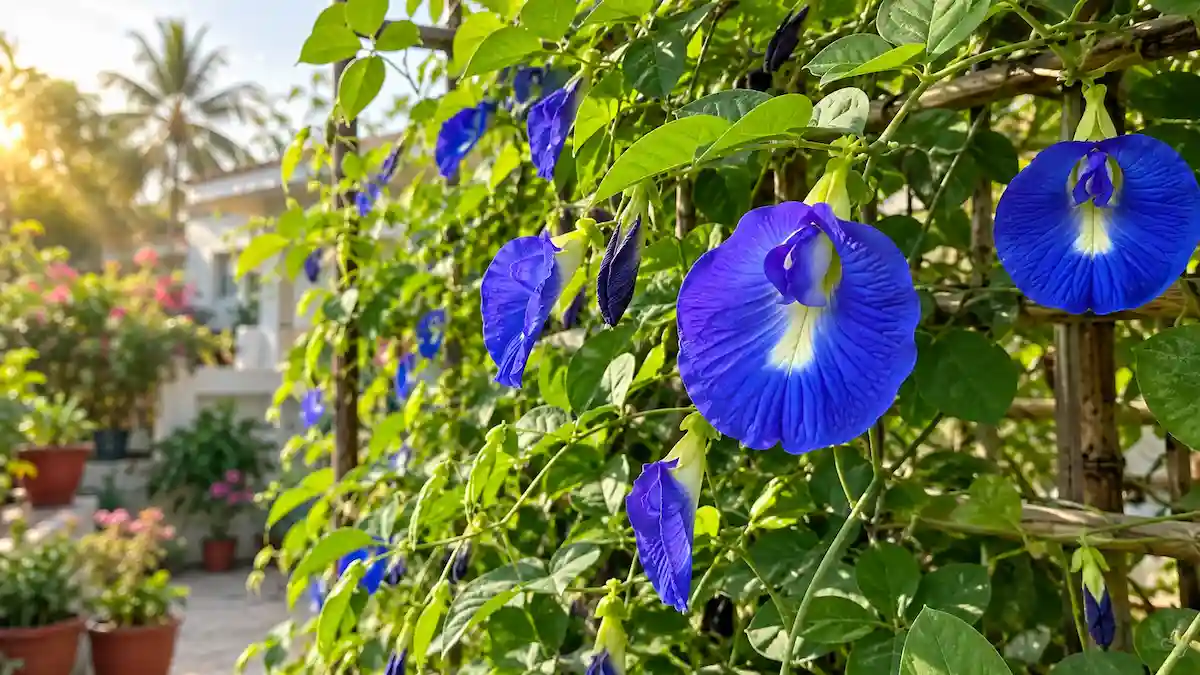
Aparajita plant benefits go beyond pretty blue flowers. The vine can fix atmospheric nitrogen through symbiotic bacteria in its root nodules. It also feeds pollinators, gives you natural blue tea, and holds a place in Vastu and Ayurveda.

Poor watering and drainage can quickly cause stress, yellowing and root problems. This guide covers what the plant really does, where Vastu says to keep it, and how to grow, propagate and rescue it in Indian conditions.
Aparajita Plant Care Requirements at a Glance
| Factor | Best Range | Why It Matters |
| Sunlight | 5 to 8 hours direct | Low light gives leaves, not flowers |
| Temperature | 24 to 32°C | Frost damages tender growth |
| Soil pH | 6.0 to 7.5 | Tolerates a wider range |
| Watering | When top 2 to 3 cm is dry | Wet roots turn leaves yellow |
| Pot size | 30 cm wide, 30 cm deep | The taproot needs depth |
| Feeding | Low nitrogen, more P and K | Symbiotic bacteria can help fix atmospheric nitrogen |
| First bloom | About 2 to 3 months from seed | Depends on sun and heat |
These figures are practical starting points from growing guides and trials, not fixed rules. Adjust them to your climate and pot.
What Is the Aparajita Plant?
Aparajita is Clitoria ternatea, a twining legume in the pea family. It is also called butterfly pea or blue pea, and Gokarni in Marathi and Gujarati.
Aparajita Plant Benefits and Uses
Some benefits are well documented, some are lab findings, and some are belief. This table separates them, drawing partly on a University of Queensland review of the plant.
| Benefit | Evidence | Practical Takeaway |
| Soil nitrogen | Strong | Legume roots fix nitrogen for the soil |
| Natural blue colour | Strong | Flowers dye rice, drinks and desserts |
| Antioxidants in petals | Lab studies | Real compounds, unproven in people |
| Memory and stress | Early animal data | Not a substitute for treatment |
| Weight loss | Not proven | Tea has no fat-burning proof |
| Hair growth | Not proven | Traditional rinse only |
| Vastu luck | Belief | Cultural, not scientific |
Aparajita Plant Vastu Benefits: What Followers Believe
In popular Vastu belief, Aparajita is an auspicious plant tied to Vishnu and Durga. Aparajita is also a name of Goddess Durga, meaning invincible.
It is believed to bring calm, protection and prosperity. These are beliefs, not tested claims. Placement rules are in the Vastu section below.
Aparajita Plant Uses at Home: Garden, Food & Tea
- Covers a grill, fence or balcony net fast, often within one season.
- Chop and drop trimmings around fruit trees as green mulch.
- Bees and butterflies visit the flowers.
- Flowers make tea and natural food colour. In Kerala, tender pods and flowers are also eaten as a vegetable.

Blue Tea Benefits from Aparajita Flowers
Blue tea is a caffeine-free herbal drink. The colour comes from anthocyanins, the same pigment family found in blueberries.
Steep 5 to 6 fresh flowers, or 1 teaspoon dried, in 200 ml hot water for 5 minutes. Add lemon and the blue turns purple or pink, because acid changes the pigment.
How to Harvest, Dry and Store Aparajita Flowers
Pick fully open flowers in the morning, once dew has dried. Regular picking usually keeps new buds coming.
Dry them on a mesh tray in shade for 2 to 5 days, until crisp. Store in an airtight jar away from light, and use within about 6 months for good colour.
Use only flowers from plants you have not recently sprayed.
Butterfly Pea Flower Tea Benefits
Lab studies show the flower extract carries antioxidant and anti-inflammatory compounds. Human trials are limited, so treat the tea as a pleasant habit, not a treatment.
Pregnant or breastfeeding women, and people on diabetes or blood pressure medicine, should ask a doctor first, since pharmacology reviews report extract effects on blood sugar and blood vessels.
Aparajita Tea for Weight Loss: What to Know
No solid human trial shows Aparajita tea burns fat. One mouse study linked petal extract to less weight gain on a rich diet, which is far from proof in people.
Any benefit likely comes from replacing sugary drinks with an unsweetened cup.
Blue Pea Flower Uses for Hair
Hair use is traditional, not proven. Steep a handful of flowers in hot water, cool it, and use it as a final rinse.
Patch test first. The pigment can tint very light or white hair.
Traditional and Ayurvedic Uses of Aparajita
Ayurveda uses Aparajita as a Medhya herb, meaning a mind-supporting plant, and it appears in brain tonic formulas. It is often sold under the Shankhpushpi name.
Is Aparajita Plant Safe? Precautions
Flowers are the commonly used part, in tea and food colour. Pharmacology reviews note that root extracts have been used as a laxative, and seeds appear in traditional medicine, so skip both.
Stop using it if you notice stomach upset, rash or breathing trouble. Medicine questions belong with your doctor or a registered Ayurvedic physician.
Aparajita Plant Vastu: Where Should You Keep It at Home?
Vastu guides agree on a few basics, though details differ between sources. Treat them as tradition, and check sunlight before choosing a spot.
Which Direction Is Best for an Aparajita Plant?
North, east or northeast is the most commonly recommended direction in Vastu guides, and northeast is named the most sacred. Pick the one that gets the most direct sun, because sunlight decides flowering.
| Direction | Common Vastu View | Sun Reality Check |
| North East | Most sacred, best pick | Soft morning sun |
| East | New beginnings | Good morning sun |
| North | Health and money | Often too shady |
| South, South West, West | Often advised against | Harsh afternoon heat |
A northeast corner with only 2 hours of sun will give weak growth and few flowers, so weigh sunlight along with direction.
Aparajita Plant at Home Vastu Rules
- Keep the plant clean, trimmed and healthy, as guides stress.
- The right side of the main door is a popular spot.
Is Aparajita Plant Good or Bad According to Vastu?
Popular Vastu guides commonly call it auspicious and link it with Vishnu, Lakshmi and Durga. Their warnings are about placement and neglect, not the plant itself.
Best Day to Plant Aparajita at Home
Common picks are Thursday for Vishnu and Friday for Lakshmi and Durga. Some traditions choose Saturday for blue Aparajita.
For growing, season matters more. Sow in warm weather, typically February to April or at monsoon onset, and avoid cold nights.
White Aparajita Plant Vastu Benefits
In popular belief, white Aparajita stands for purity, calm and Vishnu. Many people choose it for the puja corner or a northeast balcony.
Vastu Benefits of Blue Aparajita Plant
In popular belief, blue Aparajita is linked with Goddess Durga and, in some traditions, Shani.
Where Should You Avoid Keeping an Aparajita Plant?
Several sources advise against south, southwest and west corners. Avoid bathrooms, dark stairwells and cluttered corners too.
Sunlight matters here too, so skip any spot that stays shady most of the day.
Aparajita Plant Varieties and Flower Colors
| Type | Look | Best For |
| Blue single | Deep blue, yellow throat | Tea, dye, beginners |
| White single | Pure white | Puja corners |
| Double-petal | Layered, fuller | Display pots |
Blue Aparajita Plant
The classic form. Flowers are about 4 cm wide with yellow markings. Blue petals give the deepest tea colour.
White Aparajita Plant
Same plant, no blue pigment. White petals will not turn tea blue, so the brew stays pale. Growth habit is identical.
Double-Petal Aparajita Plant
Double types carry extra petal layers and look fuller. Seed may not repeat the look, so buy from a trusted nursery or root a cutting from the plant you like.
Blue Aparajita Plant Seeds
Good seeds are hard, dark and dry. Discard soft, shrivelled or mouldy ones.
Ripe pods burst and fling seed, so tie a small muslin bag over a pod that is turning brown. Store dry seed in a paper envelope in a cool, dark place.
Single-Petal vs Double-Petal Aparajita
| Point | Single | Double |
| Look | Simple, open | Layered, full |
| Best route | Seed | Cutting |
How to Grow Aparajita Plant at Home
How to Grow Aparajita Plant from Seeds
- Nick each seed lightly with a nail cutter, or rub it on sandpaper.
- Soak in water for 12 to 24 hours.
- Sow 2 cm deep in moist mix, 2 to 3 seeds per pot.
- Keep warm and bright. Seedlings usually show in 1 to 2 weeks.
- Keep the strongest seedling and snip the others at the base.

The seed coat is hard. In one university trial, the best treatment gave only about 55% germination, and germination is not always uniform, so sowing several seeds improves the chance of healthy seedlings.
| Region | Sowing Window | Watch Out |
| South and coastal | February to June | Monsoon rot |
| Central India | February to April | May heat |
| North plains | March to April | Late cold nights |
| Hills | April to May | Frost until then |
Aparajita Seeds Not Germinating? What to Check
- Seed coat was not nicked or soaked.
- Soil is cold, or so soggy that seed rots.
- Seed is too deep or too shallow.
- Seed is old or was stored damp.
Keep soil as damp as a wrung-out sponge, and wait up to 3 weeks before resowing.
How to Grow Aparajita Plant from Cutting

- Cut a 15 to 20 cm stem just below a node, from a healthy stem with no flowers.
- Strip the lower leaves, halve big ones, and remove any buds.
- Dip in rooting hormone if you have it.
- Plant in cocopeat with perlite or coarse sand, not garden soil.
- Keep in bright shade, damp but not wet.
- Tug gently after 3 to 4 weeks. Resistance means roots.
Water rooting works, but a soil-less mix gives stronger roots. Root several cuttings, because some will fail.
Seed vs Cutting: Which Should You Choose?
| Point | Seed | Cutting |
| Difficulty | Easier | Harder, more failures |
| Same as parent | Not always | Yes |
| Best for | Beginners | Double-petal types |
Best Soil for Aparajita Plant
Loose, well-drained loam or sandy loam with compost. It handles a wide pH range, roughly 5.5 to 8.9 per the NDDB Dairy Knowledge Portal, but 6.0 to 7.5 suits flowering best.
Drainage test: fill a 30 cm hole with water. If water still stands after an hour, add sand and compost or plant on a mound.
How Much Sunlight Does Aparajita Need?
At least 5 to 6 hours of direct sun. 6 to 8 hours gives the best flowering. Partial shade keeps it alive, but flowers drop.
Check the spot at 10 am, 1 pm and 4 pm. If sun touches it each time, you have enough.
How Often Should You Water Aparajita?
Water when the top 2 to 3 cm of soil feels dry. The gap depends on pot size, heat and soil: pots may need water daily in peak summer and only weekly in cool weather.
In the ground, a deep soak about once a week is usually enough once established.
Aparajita Plant Fertilizer Basics
Aparajita is a legume that fixes atmospheric nitrogen through symbiotic bacteria in its root nodules. Heavy nitrogen feeding is usually unnecessary and tends to give leaf, not flowers.
Mix compost or vermicompost into the top soil monthly. During bloom, use a low-nitrogen, high-phosphorus and potash fertilizer at label rate. When unsure, use half.
Aparajita Plant Care in Pots
For layout ideas, see this terrace gardening guide and these balcony flowering plants for Indian homes.
Best Pot Size for Aparajita Plant
Start with a 30 cm pot, at least 30 cm deep, with several drainage holes. The taproot is deep, so depth beats width.
Because Aparajita develops a deep root system, transplanting can disturb the roots, so sowing directly in the final pot is often preferable.
Best Potting Mix for Aparajita
| Ingredient | Share | Job |
| Garden soil or loam | 40% | Body and minerals |
| Compost or vermicompost | 30% | Slow food |
| Cocopeat | 20% | Holds moisture |
| Coarse sand or perlite | 10% | Drainage |
Need a base recipe? This potting soil mix guide is a good start.
How to Water Aparajita Plant in Pots
Water until it runs from the base, then stop. Empty the saucer within an hour.
Lift the pot to check. Light means dry. Heavy means wait.
Common Aparajita Plant Care Mistakes in Pots
- A pot with no drainage holes.
- A shallow pot for a deep-rooted vine.
Aparajita Plant Support and Climbing Requirements
Vines twine and can pass 2 to 3 metres. As a starting size, give a trellis, string grid or grill about 1.5 to 2 m tall.
Fix the support at planting time. Adding it later damages roots.
When and How to Prune Aparajita in a Pot
Prune after each flowering flush. Trim tips by one third and remove yellow or dead vines.
If the vine turns leggy, cut it back to roughly 45 cm outside the monsoon. Never remove more than half at once.
When to Repot: Root-Bound Signs
Repot when roots poke from the drainage holes, water runs straight through, or growth stalls. Move up one size, about 5 cm wider, in early spring or after the monsoon.
Aparajita Plant Care in Summer
Heat speeds growth, but 40°C afternoons can dry a pot in hours.
How Often to Water Aparajita Plant in Summer
Pots: check daily and water when the top soil is dry. An exposed terrace in extreme heat may need water twice a day. Ground plants: 2 to 3 times a week in the first summer, then about weekly.
Mulch 3 to 5 cm with dry leaves or coco husk.
Protecting Aparajita from Extreme Heat
- Use a 30 to 50% shade net for the harshest afternoon hours.
- Move pots against an east-facing wall.
Summer Fertilizer and Pruning Tips
Feed at half strength every 2 weeks, and water first. Skip feeding in heatwave weeks.
Trim only tips now. Save hard pruning for early spring or after the monsoon eases.
Common Summer Problems in Aparajita
| Sign | Likely Cause | Fix |
| Buds dropping | Heat or dry swings | Shade, steady water |
| Crisp leaf edges | Scorch or thirst | Deeper water, mulch |
For mites and aphids, a common neem starting mix is 2 to 5 ml oil and a few drops of mild soap per litre. Check the product label. Spray in the evening and test a few leaves first.
Aparajita Plant Care in Monsoon
Rain brings fast growth and fast rot. Drainage decides the season.
- Lift pots on bricks and clear drainage holes.
- Pause fertilizer, since roots cannot absorb it in soggy soil.
- Avoid hard pruning, because wet cuts invite infection.
Aparajita Plant Pests and Diseases: Quick Identification Guide
| Problem | Main Signs | What to Do |
| Aphids | Sticky, curling new growth | Wash off with water, monitor |
| Spider mites | Fine webbing, speckled leaves | Rinse leaves, neem spray |
| Root rot | Yellow leaves, mushy roots | Water less, improve drainage |
| Fungal leaf spots | Brown or black spots | Remove leaves, improve airflow |
| Slugs and snails | Holes in leaves | Hand-pick, clear hiding spots |
Aparajita Plant Care in Winter
Winter behaviour depends on where you live.
| Region | Winter Behaviour | Action |
| South and coastal | Grows, blooms | Water less |
| Central India | Slows, fewer flowers | Cut feed |
| North plains | Leaf drop, dieback | Shelter on cold nights |
| Hills | Dies back or dies | Resow after frost |
How Often to Water Aparajita in Winter
In cool weather many plants need less water. As a starting point, check pots every 5 to 7 days and ground plants every 10 to 15 days, and water only when the top 3 cm is dry. Water at midday so roots do not sit cold and wet overnight.
How Much Sunlight Does Aparajita Need in Winter?
Needs are the same as in other seasons. Winter sun is weaker and lower, so move the pot to a south-facing spot or the sunniest wall.
Protecting Aparajita from Cold Weather
Frost kills tender growth. In a cold snap, move pots against a wall or cover them overnight with cotton cloth.
Remove the cover in the morning.
Winter Pruning and Fertilizing Tips
Do not prune hard in winter. Dead-looking stems can protect the base.
Wait for new buds in spring, then cut back to healthy green.
Aparajita Plant Care Outdoors
Best Location to Grow Aparajita Outdoors
Full sun near a fence, grill or wall. Keep it off small shrubs, because the vine can smother them.
It self-seeds. Pull extra seedlings before they spread.
Sunlight and Temperature Requirements
Full sun and 24 to 32°C suit it best. Growth slows in cool weather, and frost damages it.
Watering Aparajita Grown in the Ground
Soak deeply at planting, then weekly through the first summer. After establishment, the deeper root system can help it tolerate short dry periods, but prolonged drought can still reduce growth and flowering.
Supporting and Training the Vine
Tie stems to the support by hand every few days in the first month. Pinch the tip at 45 cm to force branching.
After that, let it climb on its own.
Why Is My Aparajita Plant Not Flowering?
The two most common reasons an Aparajita plant does not flower are insufficient sunlight and excess nitrogen fertilizer. Fix those first. Compare your plant with the 365 days flowering plants guide, which flags the same two causes.
Lack of Sunlight
Too little direct sun gives green vines and few buds. Move the pot or trim whatever shades it.
Too Much Nitrogen Fertilizer
Dark, lush leaves with no buds point to nitrogen overload. Stop urea and leafy feeds, and switch to a bloom fertilizer.
Incorrect Watering
Buds drop when soil swings between bone dry and soaked. Water on a steady, finger-tested schedule.
Lack of Pruning
Long, bare stems may flower late. Tip-pruning encourages branching, which can provide more sites for flowering.
When Should Aparajita Start Flowering?
From seed, often 2 to 3 months in warm, sunny weather. Cuttings can bloom sooner. Young plants under 2 months just need time.
Aparajita Plant Leaves Turning Yellow: Causes & Solutions

Overwatering is the top cause. Check drainage first, then light, then feeding. A few old leaves yellowing at the base now and then is normal.
Overwatering
Wet soil, yellow lower leaves and soft stems. Skip watering until the top 3 cm dries.
Poor Drainage
Pooling water or a sour smell. Clear the holes, add sand or perlite, and lift pots on bricks in monsoon.
Nutrient Deficiency
Even pale yellow on older leaves means hunger. Give compost and a balanced feed once. Yellow between veins on new leaves can mean iron or magnesium shortage, so add a micronutrient feed.
Insufficient Sunlight
Pale, stretched growth with small leaves. Move it into more sun.
Aparajita Root Rot and Root Problems
Tip the plant out. White or tan roots are healthy. Brown, mushy roots mean rot.
Small pink or white lumps on roots are nitrogen nodules. They are normal, not disease.
How to Revive Yellowing Aparajita Leaves
- Stop watering until the top 3 cm is dry.
- Remove fully yellow leaves.
- Check drainage holes and roots.
- Repot in fresh mix if roots are brown.
- Resume with less water and wait 2 to 3 weeks for new growth.
How to Make Aparajita Plant Grow Faster
Best Fertilizer for Faster Aparajita Growth and Flowering
| Stage | Feed | How Often |
| Seedling to 30 cm | Compost top-dress | Monthly |
| Vine growth | Balanced NPK, half strength | Every 3 weeks |
| Buds and bloom | Low N, high P and K | Every 2 to 3 weeks |
| Heat or cold spells | Nothing | Pause |
Treat these as starting points. Follow the product label and adjust to how the plant responds.
How to Encourage More Flowers
Give full sun, low nitrogen and regular tip pruning. Pick spent flowers, and pick flowers for tea.
Let only 2 or 3 pods ripen for seed. Too many pods slow new buds.
How to Prune Aparajita for More Flowers
Pruning turns one long vine into a branched plant with more flowering nodes. Tip-prune at 45 cm, then after each flush.
Best Sunlight and Watering Routine for Aparajita Plant
Give 6 or more hours of morning sun and water early at the base. Regular, moderate watering works better than rare heavy soaks.
How to Train Aparajita on a Trellis
- Place the trellis close to the stem at planting.
- Tie the main stem loosely with soft cloth strips.
- Spread side shoots sideways across the grid.
- Recheck every week and retie loose stems.
Aparajita Plant Lifespan
How Long Does an Aparajita Plant Live?
In frost-free climates it is a perennial and can live several years. In pots or colder regions, plants may lose vigor over time, so refreshing them from seed or cuttings can be useful.
Factors That Affect Aparajita Plant Lifespan
| Factor | Shortens Life | Extends Life |
| Cold | Frost exposure | Wall shelter |
| Water | Soggy roots | Fast drainage |
| Pruning | Never done | After each flush |
| Pods | Every pod ripens | 2 or 3 pods only |
How to Keep Aparajita Healthy for Longer
Keeping a few seeds or rooted cuttings gives you replacement plants if the original declines.
Replace the top 5 cm of pot soil yearly, and repot every 2 years.
Aparajita Plant Care Calendar for India
| Season | Main Tasks | Watch For |
| Feb to Apr | Sow seed, root cuttings, light feed | Late cold nights |
| Apr to Jun | Water often, mulch, shade in heat | Mites, bud drop |
| Jun to Sep | Drain well, pause feeding | Rot, fungal spots |
| Oct to Nov | Light prune, start bloom feed | Aphids |
| Dec to Jan | Water less, shelter from cold | Frost in the north |
Frequently Asked Questions About Aparajita Plant
Is Aparajita Plant Good to Keep at Home?
Vastu guides commonly call it auspicious, and the plant also gives flowers for tea, can fix atmospheric nitrogen and attracts pollinators.
Which Direction Is Best for Aparajita Plant?

North, east or northeast in most Vastu guides. Pick the one with the most direct sun. Many sources advise against south, southwest and west corners.
Can Aparajita Grow in Full Sun?
Yes, it prefers full sun. In 40°C heat, add afternoon shade and keep soil evenly moist so buds do not drop.
Does Aparajita Flower Throughout the Year?
In warm, frost-free areas it can flower most of the year with enough sun. In north India it pauses in winter. Steady sun and low-nitrogen feed give the longest bloom.
How Do I Grow Aparajita from a Cutting?
Take a 15 to 20 cm non-flowering stem, cut below a node, strip lower leaves, and plant in cocopeat with perlite. Keep it in bright shade and damp. Roots form in about 3 to 4 weeks.
Disclaimer: Information on this site is for educational purposes only. Results vary by climate, soil, weather, and growing conditions. For region-specific gardening advice, consult a qualified local horticulture professional or your state agricultural university.