

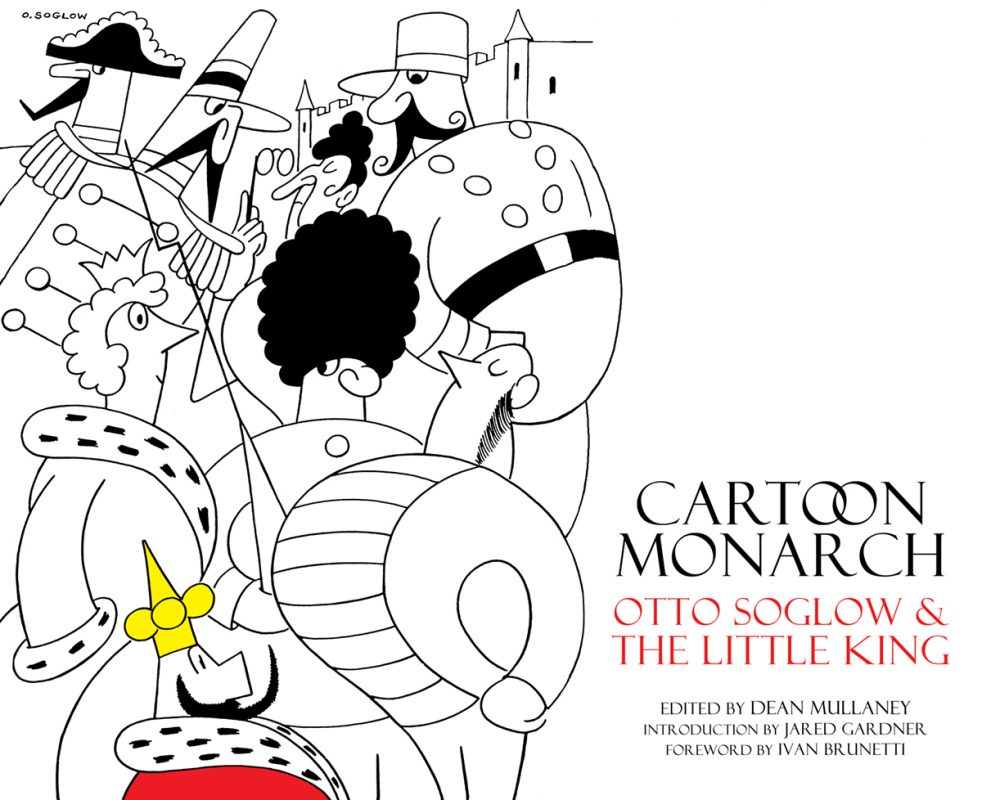
Cartoon Monarch: Otto Soglow and The Little King is one of our favorite LOAC entries, one that seems to fly under a lot of radars (sometimes, including our own!). Jam-packed with over three hundred fifty pages of The Little King’s inventive misadventures and featuring a meaty, entertaining introduction by Professor Jared Gardner of The Ohio State University, Cartoon Monarch was a terrific showcase for the forty-five-year run of Otto Soglow’s unique Sunday page feature.


Otto Soglow first brought his cartoon monarch to life in the pages of The New Yorker, but in September of 1934 shifted him into the Sunday newspaper pages as an offering from King Features Syndicate. By that time the character was already a hit thanks to his magazine appearances and starring roles in a dozen Van Buren Studios theatrical animated shorts. Those cartoons have been preserved with care on disc by Thunderbean Animation, and some are available via YouTube (click here, here, and here to view a sampling). Two years afterward, the King made a jump from Van Buren to the much-beloved Fleischer Studios to team up with the one-and-only Betty Boop.
Soglow was, in some ways, as popular as his royal creation. Like his fellow cartoonist (and eventual King Features stablemate) Milton Caniff, Otto was a member of any number of professional societies and “gentleman’s clubs,” and he was an eager participant in charity appearances. At times he appeared as himself, doing the sort of lectures and chalk-talks audiences looked forward to seeing from the “Big Name” cartoonists of the day.
Yet at other times Soglow put his thespian talents to work. In at least one instance, the show in which he participated was raided by John Law. Ten days before Christmas — on December 15th, 1935 — some newspapers gave big play to a Society of Illustrators charity event in New York featuring skits that included four ladies in various states of dishabille, which caused Manhattan’s Finest to bust up the proceedings on morals charges. The St. Louis Post-Dispatch told the tale in the full-page article below. Otto played the role of Thwarted Lover in a sketch titled “The Warming of the Bastille (or, Love’s Fever in Durance Ville)”; the plot had the cartoonist’s character already jailed for driving too fast en route to a hot date, but suddenly less eager to leave confinement when girls arrested at a nudist camp were brought into the hoosegow. “With a yell,” journalist Jack Alexander told his readers in Saint Loo, “Soglow leaped into their cell and shouted that he preferred jail to freedom. The audience cheered.”
The cheering died down when two patrolmen appeared on stage and told the spectators the show was being stopped as a violation of city indecency laws. It took some convincing — at first everyone in the seats thought the coppers were actors, hired as part of the show! Once it became clear this was no joke, and that the girls were being arrested, many of the attendees decided to follow the accused all the way to night court in order to speak on their behalf. Anderson wrote, “The result was an impressive parade of Rolls Royces, Minervas, and taxicabs. First the caravan went to the East 104th Street police station, where the girls were booked. Then several hundred artists and their pals jammed into Night Court to form the best-dressed room of spectators to whom it has ever been host.”

After a few rounds of legal hugger-mugger, all charges were dropped. The presiding judge was quoted as saying, “‘I won’t be bulldozed into holding prisoners merely because it seems the Police Department wants them held.’” It was quite a scene, and Otto Soglow was right in the middle of it all.
Conditions were much quieter three years later, during the summer of 1938, when Soglow used his typewriter rather than his pen and brush. He filled in for that popular columnist, Walter Winchell, during Winchell’s vacation, on this edition of the On Broadway column:

Otto’s outgoing personality made him a natural when King Features sent out members of its creative stable on publicity caravans to major cities that contained important client newspapers. You’ll find Soglow all over the extensive coverage the Minneapolis Star-Tribune gave King’s “Million Dollar Show” headliners during their mid-January 1938 week in what was likely a very chilly Twin Cities:


Soglow was still at it more than a decade later, this time in Pittsburgh, where he was joined by fellow cartoonists Fred (Snuffy Smith) Lasswell and George McManus, of Bringing Up Father fame:

Opportunities for public appearances and gaining the spotlight became increasing rare in the 1950s and ’60s, as television eroded the popularity of newspaper comics and cartoonists spent less time in the public eye. Soglow entered his seventies and his health failed; he passed away in early April, 1975 and newspapers such as the San Francisco Examiner paid him final tributes:

Both fun and fun-loving, Otto Soglow carved an enduring place in the history of newspaper and magazine cartooning. The Little King lives on in his animated cartoons — and in books such as Cartoon Monarch.