

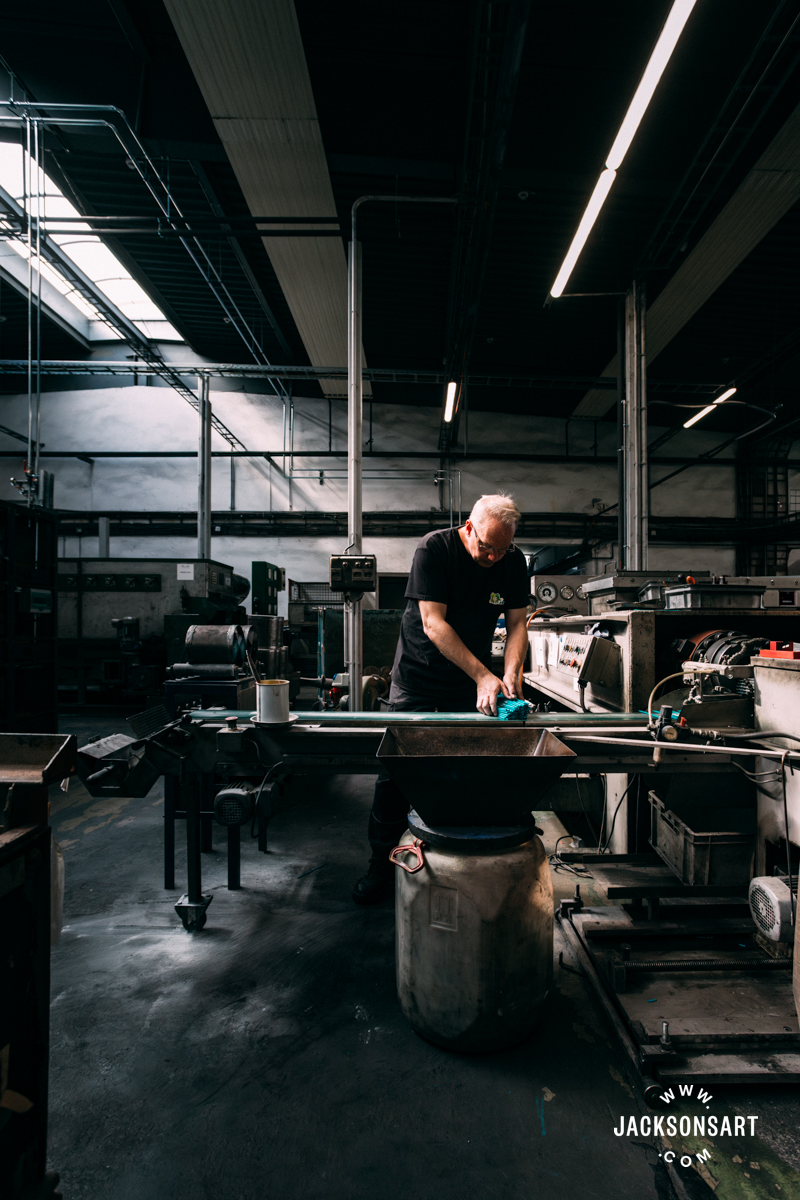
Our On Location series reveals where some of the best-loved art materials are made, and provides insight into the working methods of the people who make them. This time, we travelled to Austria to visit the Cretacolor pencil factories, where dedicated staff craft a wide range of artists’ pencils, charcoals and pastels. These include their classic Fine Art pencil range, versatile Aqua Monolith collection, and richly pigmented Karmina colour pencil sets.

The Origins of the Cretacolor Company
Cretacolor’s roots stretch back to 1790, when one of the earliest graphite pencils was developed in Vienna, and pencil production began there. In 1863, Carl Brevillier founded the Zeus pencil factory, with the aim of making drawing and writing tools more accessible. Production later moved to Hirm, where Hans Wolfgang Hromatka acquired the premises in 1996 and developed it into a specialist producer of artists’ materials. In 2007, he merged Cretacolor with Brevillier to create Brevillier Urban & Sachs, now home to Cretacolor and the children’s art material range, Jolly. Today, Cretacolor is known for its artists’ pencils and specialised dry media, combining heritage, craftsmanship, and a deep passion for art materials.

New Cretacolor Facility in Hornstein
Alongside the Hirm factory, Cretacolor have a brand-new facility in Hornstein, a few miles away. This features a large production floor with state-of-the-art production processes and a media and educational space with a plush auditorium for presentations. It also features administrative offices that work in tandem with the company’s HQ in nearby Vienna.

Production at the Hirm Factory
Cretacolor’s main production takes place on the outskirts of Hirm, a quaint village with classic Austrian-style architecture where storks nest on chimneys and rooftops. It is close to Neusiedler See, a large lake straddling the Hungarian border that never reaches more than two metres deep, making it popular with holidaymakers, birdwatchers, and sightseers.

The Colour Starts Here
The making of Cretacolor pencils begins with the preparation of the pigments, the majority of which are sourced from Austria and Germany, as well as internationally. The first thing you see as you enter the production building is a huge bank of shelves where pigments are stored in large containers.
For each pigment mix, the required containers are selected and taken to a dedicated room, where exact quantities are carefully weighed according to the batch worksheet and mixed for around 20 minutes.

Pigment Mixing
The prepared pigment is then transferred to large industrial machines that shake and churn the dry pigment before water and wax are added. The mixture is then blended and kneaded at around 115°C for seven to nine hours until it reaches the ideal consistency, with regular checks for moisture and pigment composition throughout.

Graphite and Charcoal are primarily made from pigment, binders, and water, while Coloured Pencils and sticks, including Pastels and Hard Pastels, also contain fillers, waxes, and other additives. Each formulation is carefully adjusted to achieve the desired handling and performance.
Extruding the Mix Into Cores
The colour mixture is now ready to be formed into a colour core. It is transferred via a drum and loaded by hand into an Extruder machine, where a vacuum system removes air pockets as the mixture is poured in. The machine uses pressure and heat to extrude the colour into the desired lead diameter, with pressure gauges used to set and monitor the process. The dies are heated to around 30°C to help the mixture pass through smoothly. Different lines have different lead widths, and the machine has interchangeable dies to produce a particular diameter.

The freshly formed cores then run along a conveyor belt to an endpoint where a staff member dusts them with talcum powder. This is because they are still hot, and the powder prevents them from sticking together. The cores are also monitored at this stage, and any faulty ones are collected and sent through the machine again, which avoids unnecessary waste.

For products that do not require a wood casing, such as the Monolith and 5.6mm Lead range for clutch pencils, a different Extruder machine is used. This performs in the same way but has a built-in, interchangeable stamper which embosses the cores with the Cretacolor logo, product code, and hardness grade. In this case, the Extruder delivers the leads in long continuous lengths with small incisions. These incisions indicate where they should be fully cut once cured and robust enough for cutting.

All leads are transferred to round cans which are lined up along banks of shelves, where they are slowly cooled.

The Furnace Room
In the case of graphite-based products such as Cretacolor’s Fine Art pencils, the leads are fired at temperatures of up to 900°C for around one hour. The furnace then remains closed for approximately 48 hours while it cools, before the leads are removed and left to cool further. In total, the cooling process takes around 60 hours.

The Wax Room
The lead cores in products such as Marino Watercolour Pencils and oil-based Nero Pencils need to be treated in the waxing area. They are left to marinate in an oil mixture that helps create their unique character and performance. The solution contains different levels of wax and oil depending on the product, and the leads can remain in the mixture for around 24 hours.
Graphite, oily artist pencils and sticks, and coloured pencils all pass through this process, while charcoal, dry artist pencils and sticks, pastels, and hard pastels do not. The leads are loaded into perforated containers and placed in vats before a Centrifuge machine is used to spin off any excess oil.

The ‘Sandwich’ Section
This is where the leads requiring a wood casing are prepared. Cretacolor use basswood, also known as lime or linden, for their artists’ pencils not only because it is lightweight but also for its straight grain, allowing for smooth, easy sharpening. Basswood slats are stacked into a Cutting Machine, which creates the grooves where glue is applied. The machine feeds the leads into these grooves, and the slats are then restacked onto a wheel-shaped contraption that distributes firm, even pressure as it slowly turns.

After about six hours, the slats are ready to be cut into either the round or hexagonal design that each range requires. Staff monitor the freshly formed pencils as they leave the machine that separates and shapes them. As the collection trays fill up, the staff wrap them in brown paper to keep them in contained batches for transporting to the Hornstein factory.

Hornstein is a short distance from Hirm. The factory has a vast, open floor with areas for lacquering, stamping, sharpening, and packing. The factory also boasts a new machine for handling wooden slats at a higher capacity.

When the freshly cut pencils arrive, they now require lacquering. The pencils require up to eight coats of lacquer, with light colours needing more. The lacquer is a tough, watersoluble formulation free from harmful fumes. The pencils are loaded onto, and run along, a conveyor belt, passing through a round or hexagonal-shaped ring. Above, a pot feeds the colour mix into the ring, which applies the paint evenly around the barrel as they pass through. The long conveyor belt has overhead heaters to dry the lacquer as they run along it. They go around again until the pencils are ready for the next stage.

End-tip Dipping, Stamping, and Sharpening
If the pencils require coloured end-tips, an oil-based lacquer is applied. Pencils are suspended in dipping racks loaded onto a harness, which is slowly lowered by hand into a vat of pre-mixed colour. The person tasked with this sets the harness to lower to a certain height for each strip of colour that the pencils require.
Once the pencils are fully cured, they are stamped with their barcode, series number, hardness grade, and the Cretacolour logo. Pencils are fed through a machine that simultaneously stamps the metal foil and sharpens the tips at the same time. The action is very quick; as the machine stamps, a rotating sander shapes the tips.

Packing
As with the other machines at Hornstein, the packing equipment is state-of-the-art and can sort assorted colours at the press of a button. Each colour is loaded into separate overhead containers before being fed through a machine and into tins, which are then checked and sealed. Depending on the product, packaging can be carried out manually, semi-automatically, or fully automatically. Finished products are then stored in Hirm before being distributed worldwide.

The Cretacolor Brand
Cretacolor’s strong heritage, sense of tradition, and meticulous craftsmanship are central to the brand. This is reflected in their expertly made art materials and openness to innovative technology. With a commitment to keeping the company based in Austria, Cretacolor employs more than 100 staff from the local area and neighbouring Hungary, many of whom stay for many years, with some remaining until retirement.

Cretacolor is also committed to reducing its environmental impact, with 60% of its energy coming from hydroelectric and wind power. The company recycles as much raw material as possible, including reusing wood waste from pencil production to provide heat and energy for the factory.

Education and community engagement are an important part of the company’s work. Cretacolor hosts events for schools and customers in its auditorium at Hornstein, organises art workshops with the local community, and also runs workshops internationally in partnership with its distribution network.
Further Reading
Inside the Sketchbook of Jake Lamerton
How to Prepare for Your First Life Drawing Class
The Dark History of the Pencil
How To Use Watercolour Pencils
Shop Cretacolor at jacksonsart.com







A home equity line of credit separates access to funds during a draw period from the later repayment stage. Ask how payments are calculated in both stages, whether rates can change and which fees apply. Interest-only payments may leave the principal unchanged. An unused credit limit is not cash already saved, and the home secures the borrowing. Review the agreement before planning expenses around the line.
BorrowCompass provides an informational starting point at heloc checklist. Review the current provider terms before making a borrowing decision. BorrowCompass does not issue loans or guarantee approval.