
ChatGPT advertising is still a new channel, which means there are plenty of predictions but relatively few real-world campaign results—especially from smaller advertisers.
To learn more, we ran three ChatGPT ad campaigns through the StackAdapt advertising platform:
- Two campaigns for IndoorMedia, targeting restaurant owners and real estate agents
- One campaign for Five Stars Auto Glass, targeting consumers who might need windshield repair or replacement
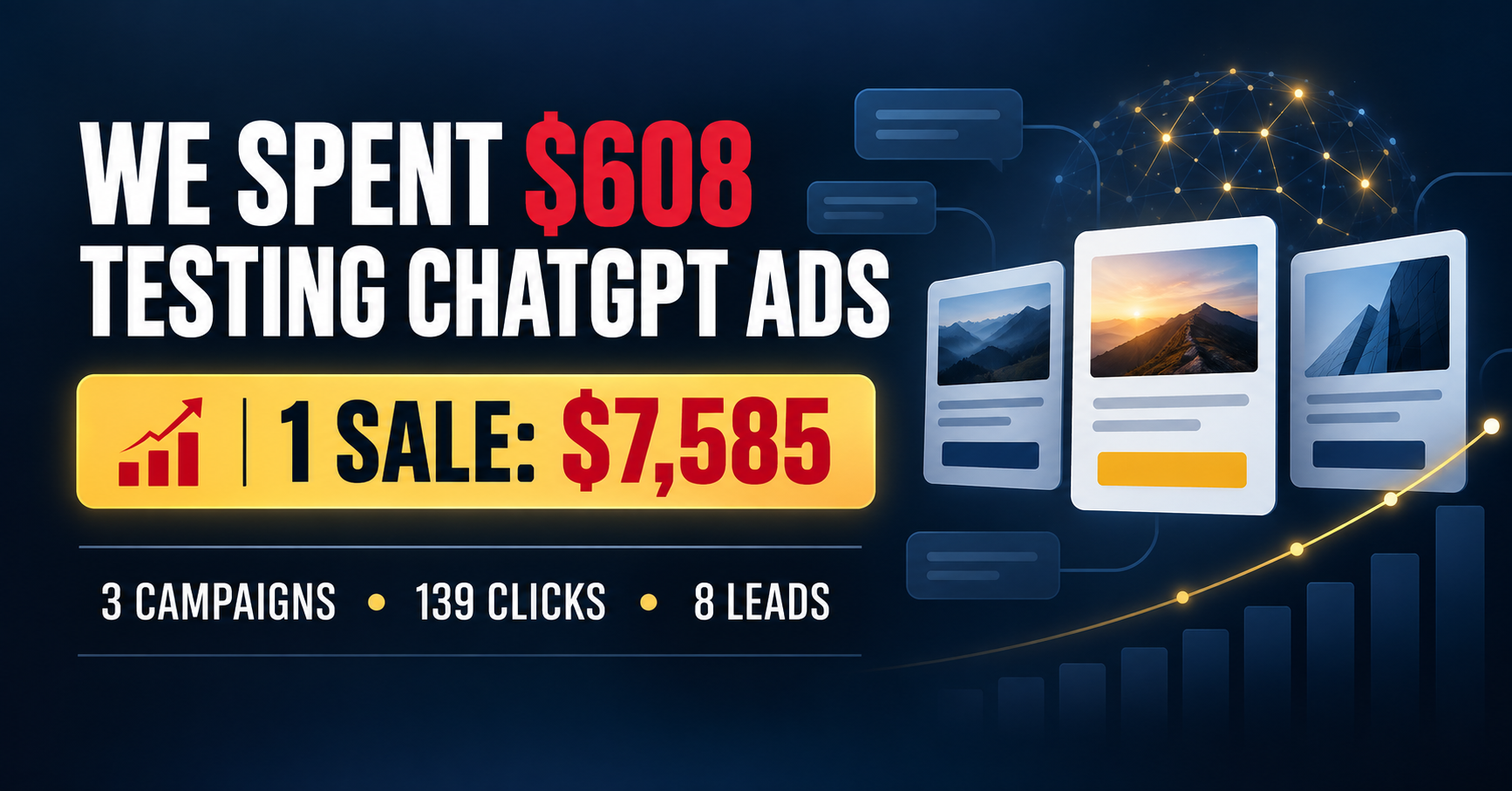
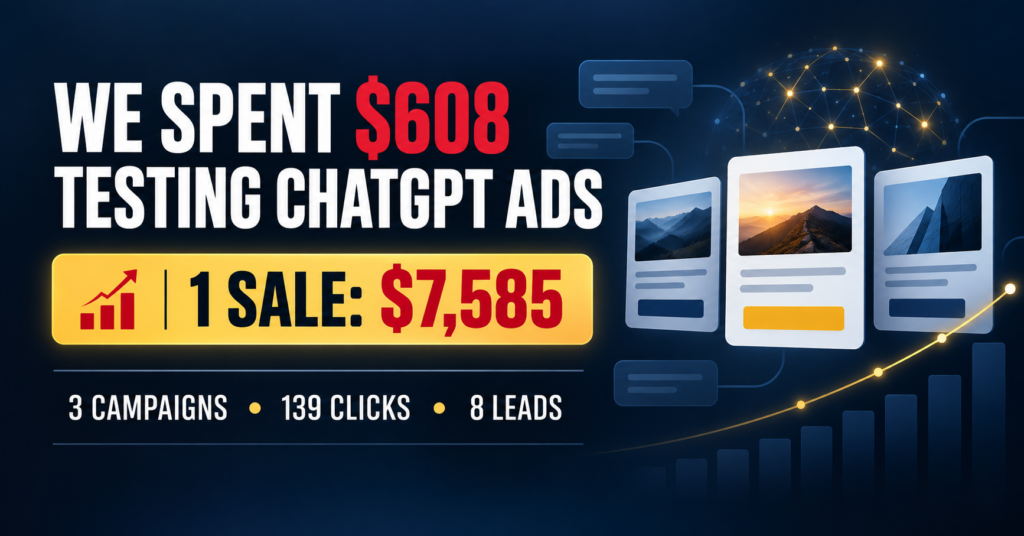
Altogether, the campaigns spent approximately $608 and generated 23,460 impressions and 139 clicks. One advertiser produced eight leads and a $7,585 sale. The other received substantial traffic, but no confirmed leads or sales.
These budgets are much too small to declare ChatGPT advertising a proven success or failure. However, the tests gave us an early look at campaign setup, CPC versus CPM buying, contextual targeting, creative strategy, attribution, and the difference between generating clicks and generating customers.
Where Can Advertisers Buy ChatGPT Ads?
We purchased and managed these campaigns through StackAdapt, one of OpenAI’s technology partners for ChatGPT advertising.
StackAdapt is not the only way to access ChatGPT ads. As of September 2026, advertisers have several possible buying paths:
- OpenAI Ads Manager: OpenAI is gradually rolling out a beta self-service platform that allows advertisers to create campaigns, set budgets and bids, upload ads, and review performance directly.
- Technology partners: OpenAI has announced relationships with Adobe, Criteo, Kargo, Pacvue, and StackAdapt.
- Agency partners: Advertisers may also obtain access and campaign support through agency groups including Dentsu, Omnicom, Publicis, and WPP.
- Amazon Ads: Amazon recently began a U.S. pilot that allows select advertisers to extend Amazon Ads campaigns into ChatGPT.
Access, eligibility, features, and service levels may differ among these options. Some are self-service platforms, while others are technology or agency partnerships intended for managed campaigns and larger advertisers.
OpenAI maintains control over whether and where an eligible ad is delivered, regardless of which partner an advertiser uses to purchase it. OpenAI provides a current overview of its buying options and partners here. The Amazon Ads integration is currently described as a pilot for select U.S. advertisers.
We used StackAdapt because it gave us a relatively straightforward way to build, launch, and manage these early campaigns.
How ChatGPT Ads Work
ChatGPT ads differ from traditional display and search advertising.
Rather than bidding solely on exact search keywords, advertisers provide context hints describing the topics, questions, needs, or conversations in which their product or service may be relevant. OpenAI then evaluates the context of a conversation and determines whether an eligible ad is a good match.
Advertisers can also limit campaigns geographically. This makes the format potentially useful for local businesses, although narrowly targeted campaigns naturally have a smaller pool of eligible users.
According to StackAdapt, the current ad format includes a square image, a short headline, brief body copy, and a link to the advertiser’s landing page. Ads appear separately from ChatGPT’s response and are clearly identified as sponsored. StackAdapt explains the current format and targeting model here.
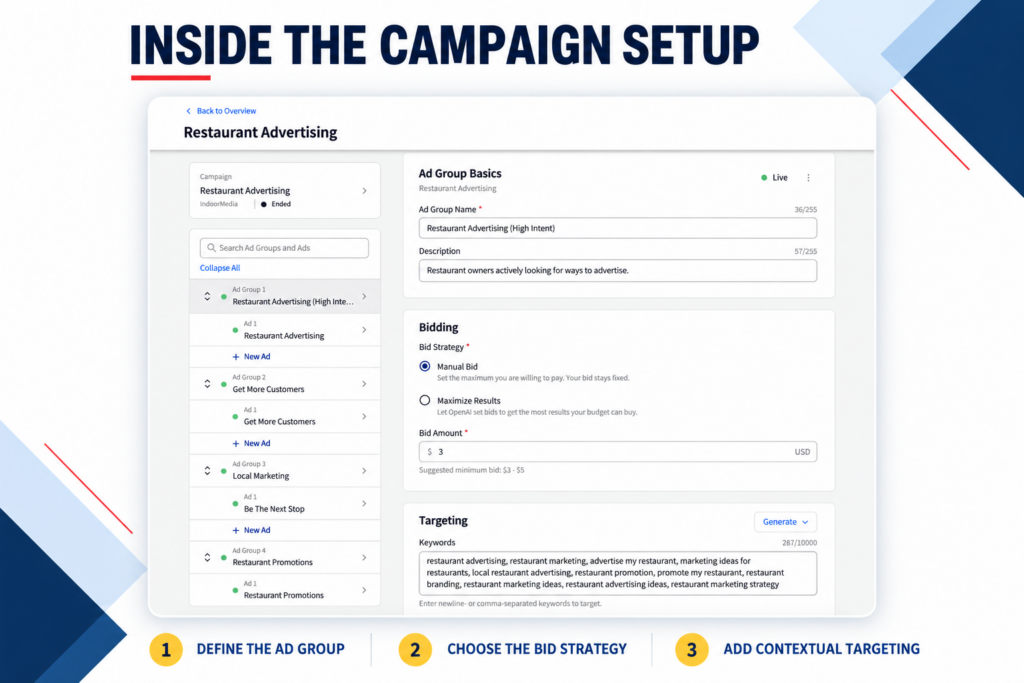
Campaign setup was relatively straightforward. The primary inputs included:
- Geographic targeting
- Daily or lifetime budget
- CPC or CPM buying
- Context hints describing relevant conversations
- Image, headline, and description variations
- Landing-page URL and tracking parameters
We created five ads for each campaign so that we could test different images and messages. We also added UTM parameters to the destination URLs and sent visitors to dedicated landing pages.
The mechanical setup was easy. Determining the right context, offer, creative, landing page, and measurement plan required more thought.
The Campaign Results
| Campaign | Bid Type | Spend | Impressions | Clicks | CTR | Cost per click |
|---|---|---|---|---|---|---|
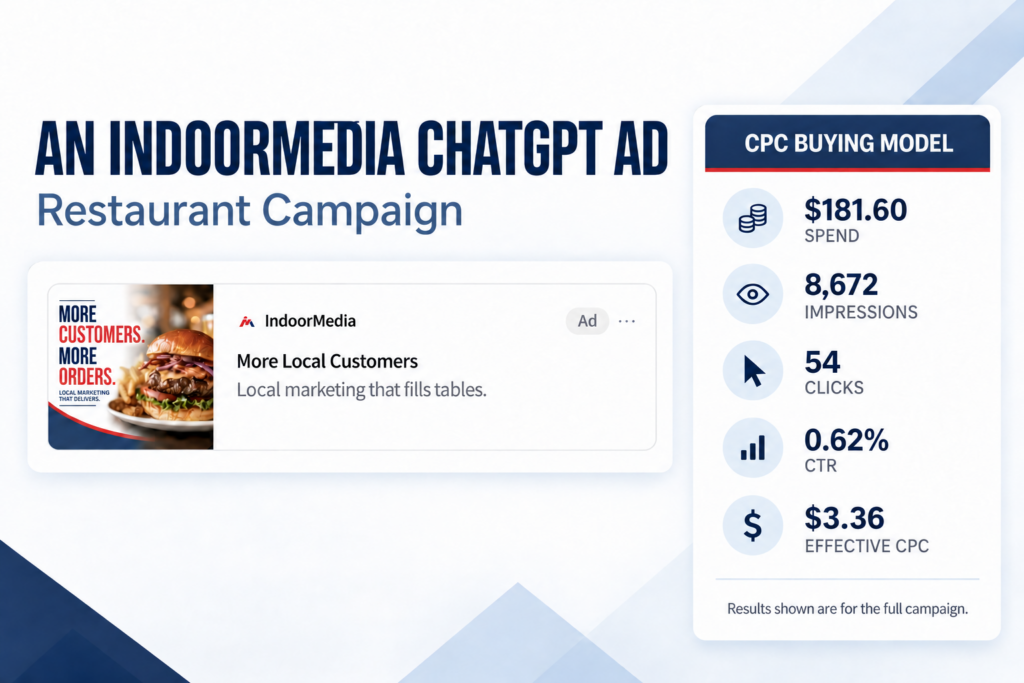
| IndoorMedia: Restaurant Advertising | CPC | $181.60 | 8,672 | 54 | 0.62% | $3.36 |
| IndoorMedia: Realtor Advertising | CPM | $196.29 | 3,366 | 13 | 0.39% | $15.10 |
| Five Stars Auto Glass | CPC | $230.00 | 11,422 | 72 | 0.63% | $3.19 |
The results varied considerably, even among campaigns with similar budgets.
That is one of the first lessons from these tests: a campaign’s total number of impressions or clicks does not tell the whole story. The value of that activity depends on who clicked, what happened after the click, and whether the business could accurately track the outcome.
IndoorMedia: Eight Leads and One Sale
IndoorMedia’s two campaigns spent a combined $377.89 and generated:
- 12,038 impressions
- 67 clicks
- 8 leads
- 1 sale worth $7,585
Across both campaigns, IndoorMedia’s blended cost per click was $5.64. Its cost per lead was approximately $47.24.
We were able to track these results because each ad used UTM parameters and directed visitors to a campaign-specific landing page. That allowed us to connect the leads—and ultimately the sale—to the ChatGPT campaigns.
If the $7,585 sale is credited to the campaign, the resulting revenue-to-ad-spend ratio was approximately 20 to 1.
That is an excellent initial result, but it needs context.
First, this calculation is based on revenue, not profit. Second, it came from a single sale. With such a small sample, one additional sale—or the absence of that one sale—would completely change the story.
The result is encouraging, but it should be viewed as a signal worth investigating rather than proof that every ChatGPT campaign will produce a 20-to-1 return.
The two IndoorMedia campaigns also performed differently. Restaurant Advertising generated 54 clicks at $3.36 each, while Realtor Advertising generated only 13 clicks at $15.10 each.
That difference could have been caused by several factors:
- The size of the eligible audience
- The number of relevant conversations
- Geographic restrictions
- Differences in competition
- The contextual hints supplied to the platform
- The creative and offer
- The CPC or CPM buying model
- How closely the landing page matched the ad
A larger test would be required to isolate which factors mattered most.
Five Stars Auto Glass: Clicks Without Confirmed Customers
Five Stars Auto Glass spent $230 and generated 11,422 impressions and 72 clicks. Its click-through rate was approximately 0.63%, and its average cost per click was $3.19.
Those numbers indicate that the ads attracted attention. However, the company reported that it did not receive any business from the campaign.
Google Analytics provides additional context, but it does not settle the question.
During the campaign period, GA4 reported:
- 16 sessions attributed to the “AI Assistant” channel
- Seven engaged AI Assistant sessions
- A 43.75% engagement rate for that channel
- 55 views and 51 active users on the campaign landing page
- Eight seconds of average engagement on that landing page
The website’s thank-you page also recorded 12 views during the period, but the available report does not show where those visitors came from. Those views therefore cannot automatically be credited to the ChatGPT campaign.
There is also a significant difference between StackAdapt’s 72 reported clicks, GA4’s 16 AI Assistant sessions, and the landing page’s 51 active users.
That does not necessarily mean either platform reported incorrectly. Clicks and sessions are different measurements. A person can click without allowing the page to load completely. Privacy settings, consent tools, browser restrictions, redirects, repeat clicks, and GA4’s channel-classification rules can all contribute to discrepancies.
The largest measurement issue, however, was phone calls.
Most Five Stars Auto Glass customers call the business rather than completing an online form. Although the ads used UTM parameters and linked to a dedicated landing page, those tools alone could not tell us which phone calls originated from the campaign.
To measure this campaign properly, the landing page needed a unique call-tracking number, ideally using dynamic number insertion. That would allow calls from ChatGPT ad visitors to be recorded separately and, when possible, connected to qualified leads, appointments, and completed jobs.
Without call tracking, it is possible that the campaign produced no customers. It is also possible that it generated calls the business could not identify as coming from ChatGPT.
The fairest conclusion is that the campaign generated verifiable landing-page traffic, but the available tracking cannot confirm whether it generated phone leads or customers.
CPC Versus CPM Buying
One objective of the IndoorMedia test was to compare CPC and CPM approaches.
With CPC, or cost per click, advertisers pay when someone clicks an ad. This approach can be useful when the immediate objective is website traffic, leads, calls, or purchases.
With CPM, or cost per thousand impressions, advertisers pay based on exposure. This may be appropriate when the objective is awareness, reach, or increasing recognition with a particular audience.
Neither approach is automatically better.
A CPC campaign can produce inexpensive clicks that never become customers. A CPM campaign can generate fewer clicks but still influence awareness or a later conversion. The appropriate model depends on what the advertiser is trying to accomplish and whether the business can measure that outcome.
For most small businesses seeking calls, quote requests, appointments, or purchases, impressions and clicks should be treated as intermediate metrics. Cost per qualified lead and cost per acquired customer are usually more meaningful.
Context Matters More Than a List of Keywords
One of the most interesting aspects of ChatGPT advertising is contextual relevance.
A windshield company does not simply need to target the phrase “auto glass.” It needs to think about the conversations potential customers might be having:
- Is a cracked windshield safe to drive with?
- Can a windshield chip be repaired?
- How much does windshield replacement cost?
- Does insurance cover auto glass?
- Is mobile windshield repair available near me?
Similarly, IndoorMedia’s restaurant campaign could align with conversations about attracting more local customers, increasing restaurant traffic, promoting a new location, or competing with nearby restaurants.
These context hints are not exact-match search keywords, and they do not guarantee placement in a particular conversation. They help the platform understand when an advertiser’s offer may be relevant. Final delivery is based on the full conversational context and the platform’s relevance system.
That makes message alignment especially important. The context hint, ad copy, image, offer, and landing page should all address the same need.
A Major Limitation: Reporting Is Still Thin
One of the biggest limitations we encountered was the lack of detailed reporting.
In the reporting available to us, we could see basic campaign metrics such as:
- Spend
- Impressions
- Clicks
- Click-through rate
- Average CPC
- Average CPM
What we could not see was equally important.
We could not see the actual prompts or conversations that caused our ads to appear. We also could not see a breakdown of where impressions and clicks were delivered within the geographic areas we targeted.
That made it difficult to answer several important questions:
- What types of questions triggered each ad?
- Were the conversations truly relevant to the advertiser?
- Which contextual terms produced the best results?
- Which cities or geographic areas received the most impressions?
- Did certain locations produce more clicks or conversions?
- Were some ad groups matching conversations too broadly?
UTM parameters and Google Analytics helped us understand what happened after some users clicked. GA4 may also provide geographic information about website visitors. However, that is not the same as receiving impression- and click-level geographic reporting directly from the advertising platform.
The absence of prompt-level reporting is understandable from a user-privacy perspective. Advertisers should not receive access to individual users’ private conversations. However, aggregated reporting by conversational theme, intent category, or context hint would make campaign optimization significantly more useful without exposing individual conversations.
The same is true for geography. An advertiser may target several cities or a larger region, but without geographic delivery reporting, it is difficult to determine where the budget was actually spent and which locations performed best.
For these early tests, we could evaluate overall traffic, leads, and sales. We could not fully evaluate why one contextual theme, ad group, or geographic area performed better than another.
As ChatGPT advertising develops, better aggregated reporting will be essential if advertisers are expected to move beyond experimentation and make larger, more confident investments.
What We Learned From the Tests
1. Online and offline conversions require different tracking
UTM parameters and dedicated landing pages worked well for IndoorMedia because prospects completed forms that could be traced back to the campaigns.
Five Stars Auto Glass illustrated a different challenge. When most customers call, web analytics cannot provide the entire answer. A unique tracking number, dynamic number insertion, and a process for identifying qualified calls are essential.
The measurement plan needs to match the way customers actually contact the business.
2. A dedicated landing page is still important
Each campaign directed visitors to a specific landing page rather than a general homepage. This made attribution easier and created a more focused experience.
However, simply having a dedicated page does not guarantee strong performance. The page must repeat the promise made in the ad, explain the offer, establish credibility, load quickly, and present one obvious next step.
Five Stars’ eight-second average engagement time suggests that the landing-page experience, audience quality, or message match may need additional testing.
3. More ad variations create better learning opportunities
We ran five ads in each campaign, testing different messages and creative approaches.
This is especially important in ChatGPT because the ads are compact. Advertisers have limited space to communicate the problem they solve, their key benefit, and the action they want someone to take.
Testing should extend beyond changing the image. Useful variables include:
- The problem named in the headline
- Urgency
- The primary customer benefit
- Promotional offers
- Trust signals
- Calls to action
- Alignment with different conversational themes
The next step is to compare performance at the individual-ad level and identify which combination of image, headline, description, and context produced the strongest response.
4. The customer journey continues after the click
A campaign does not end when someone submits a form or makes a call.
Lead-response time, sales follow-up, missed calls, appointment availability, and the quality of the sales process can determine whether advertising produces revenue.
A platform can generate a legitimate inquiry that never becomes a sale because the call went unanswered or the lead was not contacted quickly. This makes it important to track the full path from impression to click, lead, qualified opportunity, and closed sale.
5. Small budgets produce clues, not final answers
A $200 campaign can indicate whether an ad attracts clicks or produces an occasional lead. It is rarely enough to calculate a dependable average customer-acquisition cost.
Future tests should run long enough to compare:
- Multiple contextual themes
- Individual ad variations
- More than one offer
- CPC and CPM buying
- Geographic segments
- Landing-page versions
- Online forms versus tracked calls
- Lead quality and closed sales
6. Reporting currently limits optimization
We could measure overall impressions, clicks, website activity, leads, and sales, but we could not see which prompts triggered our ads or how delivery was distributed geographically.
That prevented us from identifying which conversational themes and locations performed best. Future reporting does not need to expose individual conversations, but aggregated information about intent, topic, context, and geography would make the platform much easier to optimize.
So, Are ChatGPT Ads Worth Testing?
Based on these campaigns, ChatGPT ads appear capable of generating affordable traffic and, in at least one case, measurable leads and revenue.
They are also not a shortcut.
IndoorMedia’s results show the potential upside: $377.89 in ad spend, eight tracked leads, and one $7,585 sale.
Five Stars Auto Glass demonstrates the measurement challenge: 72 clicks, observable landing-page activity, and no confirmed business outcome. Because most customers call and the campaign did not use a unique call-tracking number, we cannot confidently say whether the ads generated phone leads.
Both results are valuable because they illustrate what early advertising tests are supposed to do—produce information.
The right conclusion is not that ChatGPT advertising always works or never works. It is that the channel deserves disciplined experimentation.
Start with a clear offer. Match the message to the conversations customers are likely to have. Use geographic targeting where appropriate. Test multiple ads. Build a focused landing page. Track both online and offline actions. Most importantly, judge performance by qualified leads and sales rather than impressions and clicks alone.
ChatGPT ads may become an important way to reach customers while they are researching problems and considering solutions. For now, the opportunity is promising, the setup is accessible, and careful measurement matters more than hype.
Interested in ChatGPT Advertising?
We’re continuing to test ChatGPT ads and evaluate whether they should become part of our advertising services. Although we do not currently offer ChatGPT campaigns to customers, we would like to know how much interest there is.
If you would be interested in testing ChatGPT ads for your business in the future, contact us and let us know. There is no commitment—we’re simply gathering feedback as we explore the opportunity.
Want more practical conversations about advertising, AI, and what is changing in marketing? Listen to The Bounce Rate, the IndoorMedia podcast.