
“The dialogue between order and freedom remains at the heart of my work.”
Between Structure and Intuition
Ines Hildur creates paintings at the point where disciplined construction meets the unpredictable energy of intuition. Born in Freiberg, Saxony, and based in Leipzig, the German artist has developed a practice closely connected to Abstract Expressionism while moving between fine and applied art. Her visual thinking is informed by a life in which creative expression was present from an early age. Her grandfather, a painter, provided her first direct encounter with art, while her parents encouraged Ines and her two siblings to pursue their creative interests with considerable freedom. That environment established art not as a distant profession but as a natural language for observing and responding to the world. Music also formed part of the family background, reinforcing an awareness of rhythm that would later become significant within her compositions. Yet Hildur did not move immediately toward painting as her sole profession. Her path passed through architecture and interior design, disciplines that sharpened the structural sensitivity now embedded in her abstract works.
Before painting became her principal means of expression, Hildur studied architecture at TU Dresden and spent many years working professionally as an architect and interior designer in Germany and Austria. Architecture trained her eye to consider proportion, spatial relationships, texture, equilibrium, and the consequences of every formal decision. Painting eventually offered a contrasting kind of possibility. On the canvas or paper, she could loosen the requirement for predetermined outcomes and allow emotion, instinct, uncertainty, and accident to participate in the formation of an image. Rather than abandoning her architectural education, she absorbed its lessons into a more open creative process. Structure continues to operate beneath the freedom of her gestures, while intuitive marks disrupt the expectation of perfect order. This productive tension has become fundamental to her practice. Her paintings therefore arise neither from unrestricted spontaneity nor from rigid planning. They occupy a shifting territory in which control establishes conditions and intuition continually tests, alters, or overturns them.
Hildur also pursued artistic studies at the Hochschule der Künste Saar in Saarbrücken in 1991 and attended the International Summer Academy of Fine Arts in Salzburg, where her studies included encounters with Strawalde of Berlin and Gunter Damisch of Vienna. Strawalde had a particularly enduring influence during her artistic development. From the beginning, abstraction attracted Hildur more strongly than a predetermined representational vocabulary. Over time, she has worked to refine that attraction into an aesthetic that feels distinctly her own rather than conforming to an established formula. Her artistic history consequently reads as a gradual convergence of several ways of seeing. Architecture supplied precision and spatial intelligence, early family experiences established creative confidence, and painting created room for uncertainty to become productive. Since 1994, she has exhibited through projects in Germany and internationally, while since 2002 she has also taught fine art painting at academies across Germany, Austria, Switzerland, Italy, and France.

Ines Hildur: The Art of Wanting Without Intention
At the center of Hildur’s approach is a principle she describes with the German phrase “absichtsloses Wollen,” which can be understood as “desiring without intention.” The idea may initially sound contradictory, yet that contradiction explains much about how she works. She does not remove conscious choice from painting, nor does she attempt to control every stage before beginning. Instead, she seeks a balance in which experience and judgment coexist with trust in what happens during the act of making. The work is permitted to suggest its own next move. Decisions respond to emerging relationships among marks, surfaces, forms, and materials rather than simply executing an established plan. This attitude has affinities with the Japanese aesthetic of Wabi-Sabi and its appreciation of imperfection, impermanence, and incompleteness. For Hildur, these ideas offer an alternative to polished finality. A painting can retain uncertainty, visible history, irregularity, and even apparent contradiction without losing its compositional strength or aesthetic presence.
Her abstract visual language develops through relationships that are often poised between opposites. Stillness encounters tension, darkness is set against light, and restrained passages coexist with more forceful formations. Fine lines, fragments, traces, collaged components, and carefully modulated surfaces accumulate without resolving themselves into a fixed narrative. Hildur is currently giving particular attention to achromatic tones and subtly mixed, muted colors, allowing slight variations to carry considerable visual weight. Rhythm and proportion remain important, but they do not function as restrictive systems. Instead, they provide an underlying coherence within compositions that can feel provisional, layered, and open to change. Imaginary landscapes may seem to surface before dissolving again, while archaic looking signs and fragmentary structures suggest meanings without confirming them. This ambiguity is intentional. Hildur does not want the image to dictate a single reading. She creates conditions in which viewers can form associations of their own and encounter the work through memory, sensation, curiosity, or personal interpretation.
The search for an individual aesthetic repeatedly leads Hildur toward the problem of how fragments can become poetic without losing their rawness. She is interested in beauty, but not in beauty understood solely as refinement or decorative harmony. Opulence may enter a work, yet so may sparseness, abrasion, restraint, or an apparently untouched passage. These differences give her compositions their internal friction. Architecture, nature, Japanese aesthetics, and the visible effects of time are among her most important sources of inspiration. Weathered walls, worn materials, patina, and signs of use attract her because they carry histories that cannot be reproduced through perfection alone. Her architectural career taught her accuracy and systematic thought, while life strengthened her willingness to accept uncertainty and transformation. Both impulses now coexist in the studio. The resulting paintings treat change not as a disruption to be eliminated but as an active force, one capable of opening new formal possibilities while preserving evidence of what came before.

What Surfaces Remember
Hildur identifies Cy Twombly, Antoni Tàpies, Robert Motherwell, Franz Kline, and Pierre Soulages among the artists who have influenced or inspired her. Their significance is consistent with her interest in abstraction as a field of action, material presence, gesture, and concentrated visual thought. A statement attributed to Soulages has particular resonance for her: a craftsman knows what he intends to make, whereas an artist knows only where to begin. Hildur recognizes in that thought a fundamental condition of her own process. Starting a work does not mean possessing a complete image of its destination. Creation develops through a continuing exchange between reflective judgment and intuitive response, with each decision making another possibility visible. Years of practice and experience provide a foundation, but they do not eliminate uncertainty. Instead, they make it possible to enter uncertainty with greater awareness. For Hildur, that willingness resembles life itself, where knowledge and experience may support a person even when the outcome remains impossible to predict.
Materials play an active role in this process. Hildur often begins not with a conventional preparatory sketch but with surfaces whose existing characteristics can redirect the painting. Previously used paper has become particularly important, bringing an almost incidental form of upcycling into her practice. Rather than erasing the former life of the material, she allows some of its existing marks and structures to remain perceptible. The surface therefore enters the work with a history already attached to it. Layers of smooth, powdery color overlap, marks are covered, and drawn elements can vanish beneath paint before appearing again through subsequent interventions. Fine, fanned hatching may break through these accumulated layers, producing a sense of movement that Hildur compares to a captured vibration. Concealment and exposure become inseparable actions. What disappears can remain influential beneath the surface, while what returns may acquire a different significance because of everything that has happened around and over it.
This approach gives time a visible presence in Hildur’s paintings. Instead of treating the surface as a neutral ground awaiting an image, she works with what the material already carries and with the evidence generated through successive decisions. Painting over a trace does not necessarily destroy it; fragments can persist, reappear, or affect the character of later layers. Such transformations echo her fascination with weathered architecture, patina, and signs of repeated use. They also connect directly with her larger interest in imperfection and transience. Chance participates, but it is continually met by judgment. Intuition opens possibilities, while reflection determines whether and how those possibilities remain. The viewer ultimately encounters an image in which process has not been hidden behind a seamless finish. Instead, the stages of making become part of the visual experience. Hildur turns accumulation, disappearance, interruption, and rediscovery into compositional tools, allowing the history of an artwork to remain present within its final, yet deliberately unresolved, state.

Ines Hildur: A Dialogue That Can Be Rearranged
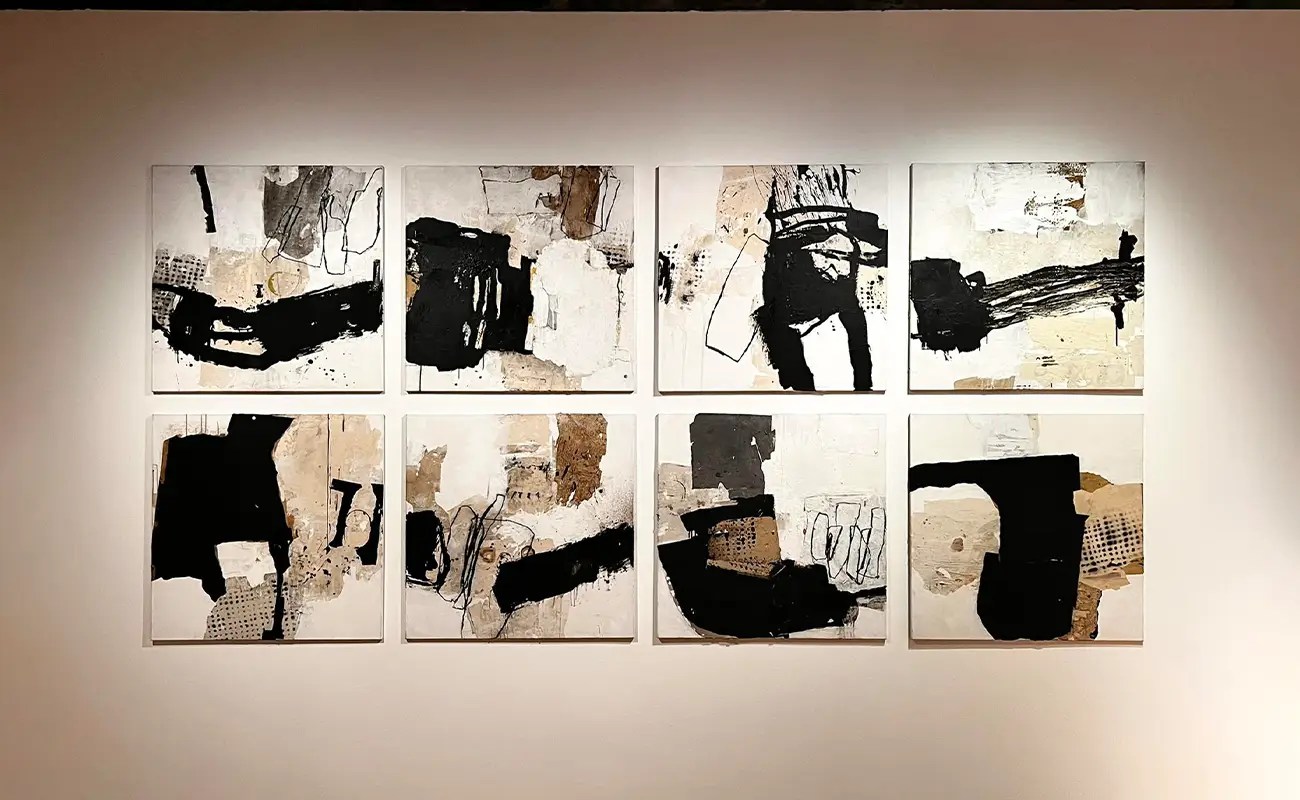
Among Hildur’s works, the eight part group “Dialogue: Clarity and Contrasts” carries particular importance. She is presenting the series in “Personal Structures – Confluences” at Palazzo Mora as part of the 2026 Venice Biennale. The project embodies her central concerns in a particularly direct form because its individual elements can be exchanged and rearranged, allowing the overall work to change. Its structure is therefore neither completely fixed nor entirely uncontrolled. Every reconfiguration renews the relationship among the components and makes the dialogue between intuition and conscious organization physically visible. The work turns a conceptual principle into an adaptable construction: clarity can coexist with variation, and a composed arrangement can remain open to transformation. This mobility reflects Hildur’s broader understanding of painting as a process that develops through decisions without becoming trapped by them. Rather than presenting control and spontaneity as opposing forces that must defeat one another, “Dialogue: Clarity and Contrasts” allows them to operate together, each giving the other greater significance.
Her participation in Venice extends beyond the presentation of completed work. Alongside the exhibition at Palazzo Mora, Hildur plans a live performance in which visitors can observe a large scale painting taking shape in real time. The format makes an aspect of painting that is usually private available to an audience: the sequence of physical movement, material response, intuitive adjustment, and conscious choice through which an image develops. This performative direction also connects with her wider interdisciplinary interests, particularly projects where painting, space, and material enter into immediate conversation. Later in August 2026, she is also participating in an exhibition by Galleria Palazzo Paveri Fontana at Palazzo Pisani Revedin in Venice. These projects continue an international exhibition history that has included presentations in Germany, France, Monaco, Austria, Switzerland, and Italy, with cities including Saarbrücken, Leipzig, Dresden, Düsseldorf, Salzburg, Paris, Nice, Monte Carlo, and Venice forming part of her professional trajectory since the 1990s.
The months following Venice continue that active program. Hildur is preparing to participate in contemporary art ruhr, or C.A.R. 2026, scheduled for October 16 to 18 at the UNESCO World Heritage Site Zollverein in Essen. The event marks the twentieth edition of the innovative art fair and adds another context in which her evolving practice can be encountered. Yet exhibitions and performances are not separate from the questions that animate her studio. Across these settings, she remains concerned with how an artwork can preserve the energy of its own formation and how materials, spaces, and gestures can influence one another without being forced toward a predetermined answer. Her movement between architecture, applied art, painting, teaching, and interdisciplinary practice has provided different ways to examine those questions. What persists is the tension that has shaped her work from the beginning: the desire to construct and the willingness to relinquish control, held together long enough for an unexpected image to emerge.