

Sheila Returns to the Screen Caring For Her Mother with Alzheimer’s and X Wants Her to Care For Them… “Need”
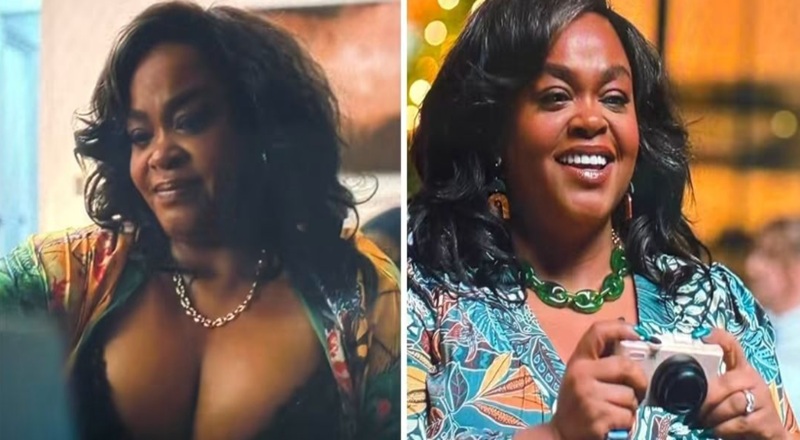
A four-panel collage of Jill Scott from Why Did I Get Married Again? was shared on X with a single-word caption: “Need.” The post, shared by @CochiseWebb on September 15, drew roughly 334,000 views, 14,600 likes, 1,449 reposts, and 308 quotes.
The images are film stills of Scott as Sheila, the character she first played in the 2007 film and its 2010 sequel. They show her in two settings: a low-cut top with a gold necklace, and a leopard-print slip under an open robe, alongside frames of her in a colorful patterned blouse holding a small white camera.
The conversation that followed focused on her appearance rather than the film’s plot.
A Destination Wedding in Lake Como, and the Same Old Questions
Why Did I Get Married Again? arrives 16 years after the last installment. The franchise began with the 2007 original and continued with a 2010 sequel, both built around couples confronting infidelity and secrets. This time the setting is a destination wedding in Lake Como, Italy, for the daughter of Angela and Marcus.
Sheila’s life has moved forward. She is married to Troy, played by Lamman Rucker, and has a son named Denver. She is also caring for a mother with Alzheimer’s, a storyline that shapes her scenes and her place in the ensemble.
The cast reunites most of the original group: Tyler Perry as Terry, Tasha Smith as Angela, Michael Jai White as Marcus, Sharon Leal as Diane, and Richard T. Jones as Mike. Taraji P. Henson joins as Roselyn. Janet Jackson does not appear in this installment. The franchise’s central question now applies to the original couples and their adult children at the same time.
The Camera in Her Hands Has a Meaning the Stills Don’t Show
One of the four images shows Sheila holding a compact camera at chest level, smiling at a gathering. In the film, that camera is not a prop. She takes photographs because her mother has Alzheimer’s and she wants to remember.
The role itself carries more weight than the collage suggests. Sheila is a supporting but emotionally grounded member of the returning ensemble. She cares for her mother, offers counsel to the younger couple, and sits inside the group conversations about imperfect marriages that give the franchise its title.
Her dialogue covers the same range, as she defends her husband with humor. As a result, she describes him as “my old man, with his weak knees and his farting in his sleep.” She mentions arriving in travel clothes and needing to change before dinner. Simultaneously, she works to keep secrets from derailing the wedding. The camera, the mother, the counsel, and the jokes are all part of the same character.
Returning to a Role She Once Called “Abusive”
Jill Scott played Sheila in the 2007 original in a storyline that involved an emotionally and physically abusive marriage to Mike, played by Richard T. Jones. That production included a sequence in which extras on a plane were directed to make fat jokes at the character. Scott later said she “hated that […]” and described the experience as abusive.
She has said the episode prompted her to reframe how she thought about her own body. That was 2007, and the character’s body was the punchline of a scene she had no control over.
The 2026 stills present a different visual register entirely. The response to them has been treated online as either a welcome update or as confirmation of something audiences already believed about Scott. The same performer, the same character, and a completely different conversation.
X Says Whether She’s Sheila or Jilly from Philly, Jill Scott Has Always Been a Fine Woman
Responses from the fans were overwhelmingly positive toward Scott, with a smaller strand of career appreciation. Body-focused language was common, and the tone ranged from affectionate to blunt.
Notable replies included “mane she perfect,” “That lady @missjillscott been Wavy her whole life. Her smile and complexion is everything. One of one on every level,” and “She so fine. Always been.” Others wrote “Jill always been” and “She gives the best hugs and smells amazing!”
Parallel posts used similar language. “Jill Scott has crazy sex appeal,” one read. “Jill Scott so […] fine this […] don’t make sense,” another said. One user noted they were watching with a spouse and expected agreement. Another framed the images as making them second-guess their usual preferences.
A few comments praised her acting or comedic timing in specific scenes, and a smaller number criticized the film itself, calling it unnecessary or poorly acted. Those remarks were outnumbered by posts about her appearance.
Reviews Were Split on the Film Itself
Critical response to Why Did I Get Married Again? has been mixed. Some reviews point to the returning cast’s chemistry and Scott’s quieter Alzheimer’s-related material as the strongest elements of the film. Those scenes give Sheila an emotional anchor the rest of the ensemble does not always have.
Others describe heavy-handed dialogue and underdeveloped younger characters. The franchise’s intergenerational premise — parents watching their children repeat similar marital mistakes — was noted as an idea that did not get the screen time it needed.
The film also carries familiar Tyler Perry formulas that critics have flagged across his catalog, and the question of whether the franchise needed another chapter has run alongside the reaction to the stills without intersecting with it. The image-driven conversation on X skipped the screenplay debate entirely. The stills did not require a verdict on the film to travel.
Final Thought
Jill Scott always finds ways to command attention, so this is nothing new.
For Netflix, the moment is one example of how a title can seed social conversation through shareable frames rather than trailer dialogue or critical consensus. The film’s intergenerational premise drew less attention than the costume and body details.
Two decades after the first film, the ensemble remains recognizable enough that four images and a one-word caption were sufficient to carry it. The film itself, and the Alzheimer’s storyline at its center, stayed largely out of the conversation.