
Kah Wah Chong won the Watercolour Award in Jackson’s Art Prize 2026 with his work Echoes of Yesterday. In this interview, he discusses how jogging helps him work through painting challenges, why an empty chair is depicted in his winning work, and how painting on cardboard has changed the texture and direction of his practice.
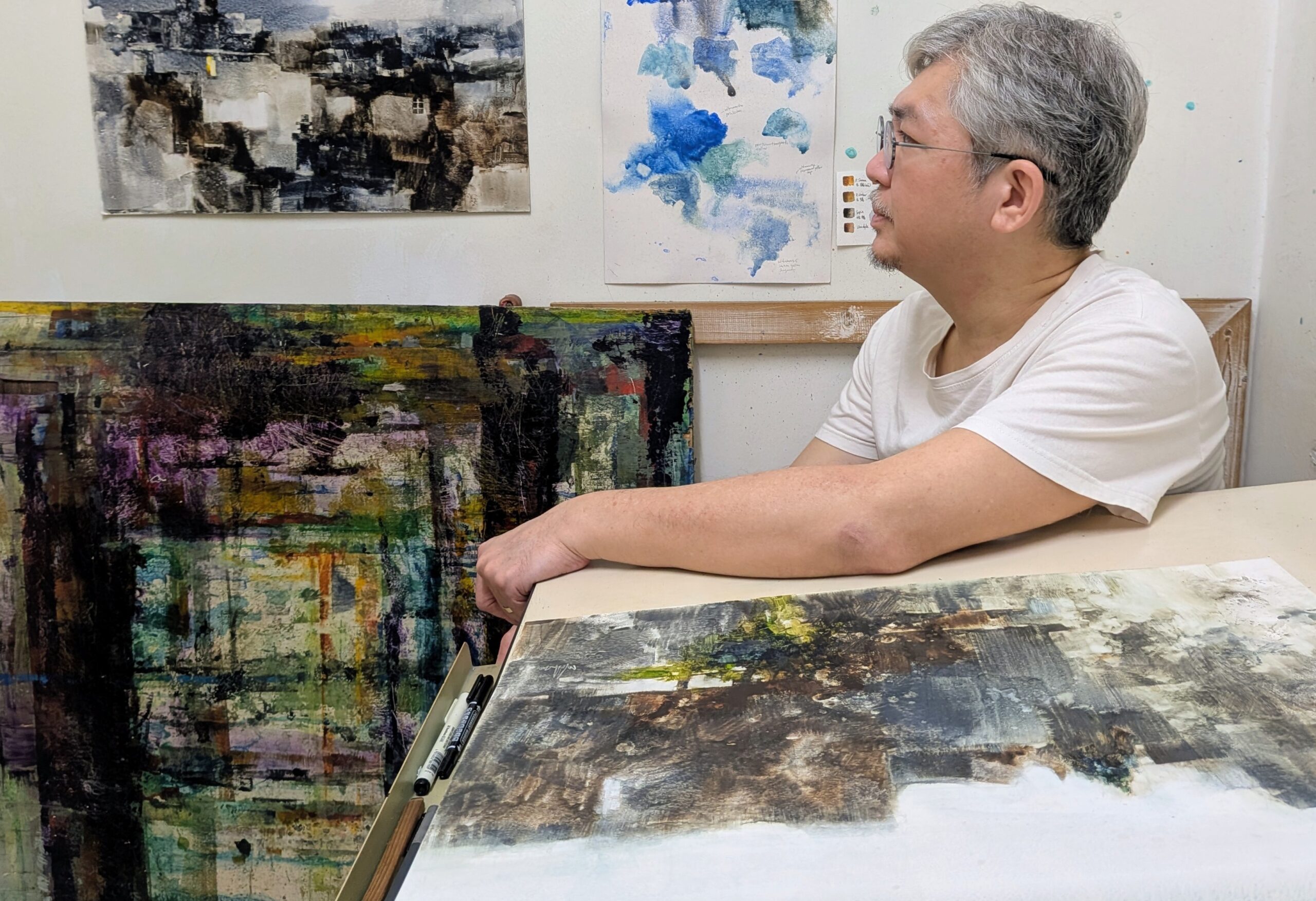
Above image: Kah Wah in the studio

Kah Wah Chong
Watercolour on cardboard, 53 x 38 cm | 20.8 x 14.9 in
Josephine: Could you share the story of how you became an artist and tell us more about your artistic background?
Kah Wah: I have been deeply interested in drawing and painting since childhood. At first, I learned by copying cartoons, and later, I taught myself through watercolour books. The arrival of the internet opened up an even wider world of learning and inspiration. It was only after working for several years that I seriously began to consider painting as my vocation. When my daily work became repetitive and I felt that I was no longer growing, I needed something that could give me a sense of purpose and make me feel truly alive. Painting naturally became my choice.
Because I could not initially take the financial risk of becoming a full-time artist, I continued developing my practice alongside my professional life. Over the years, painting gradually became much more than a hobby – it became an essential part of who I am.

Josephine: What does a typical working day in the studio look like for you? Do you have any important routines or rituals?
Kah Wah: Mornings are usually the most creative time for me. My mind feels freshest then, and the quietness of the early hours allows me to concentrate without distraction.

Josephine: Which materials or tools could you not live without?
Kah Wah: Watercolour has always been my favourite medium. I love its transparency, its constant change and, most importantly, its unpredictability.
Watercolour does not always behave exactly as you expect it to, and that is part of what attracts me to it. There is always a challenge in trying to understand and master the medium while still allowing its natural qualities to remain visible.

Josephine: Do you work from a reference? Tell us more about your process.
Kah Wah: Yes. I often work from references, but I don’t try to reproduce them literally. I extract certain details or impressions from them and use these for the painting. Usually, a work begins with something that moves me. It could be a place I have visited, a particular atmosphere, a memory, or even an emotional response to a piece of classical music.
I normally begin with sketches to explore the overall structure, composition and movement of the image. Once I am satisfied with the initial idea, I create a small watercolour study. At this stage, I experiment with the colour palette and consider the kinds of brushwork, washes, and watercolour effects I might use in the final piece. Only when I feel that these elements are working together do I begin the final painting.

Josephine: Do you regularly draw or keep a sketchbook? If so, how does this inform your work?
Kah Wah: Sketching is an important teacher at the beginning of my creative process. It helps me explore the overall arrangement, composition, and visual direction of a painting before I commit to the final work. More importantly, sketching allows an idea to emerge naturally. Some of the most important decisions in a painting are made before the brush touches the paper.

Josephine: Have you ever had a period of stagnation in creativity? If so, what helped you overcome it?
Kah Wah: Of course. I think creative stagnation is a natural part of being an artist. For me, jogging often helps. When I step away from the studio and allow my mind to wander, I often find solutions to problems that seemed difficult while I was jogging.
There are also paintings that simply don’t work. I have learned to accept these failures as part of the creative process. Not every painting has to succeed; sometimes a failed work teaches you something that becomes important in the next one.

Kah Wah Chong
Watercolour on cardboard, 53 x 38 cm | 20.8 x 14.9 in
Josephine: Are there any specific artists or mentors who have inspired you?
Kah Wah: Frank Webb and Chu Teh-Chun have both been important influences on me. Their work shows how colour, atmosphere, abstraction, and emotion can transform a visual experience into something more personal and expressive.

Josephine: What were you thinking about or exploring at the time you made Echoes of Yesterday? What inspired it, and how did it come to be?
Kah Wah: Echoes of Yesterday is a very personal work, inspired by my grandmother. When I was in college, there were times when I would not return home until late in the evening after classes. One night, I came home and saw my grandmother sitting outside, waiting for me beneath a single light. It was a very simple moment, but it stayed deeply in my memory. Looking back, I think that image remained somewhere in my subconscious and eventually became the starting point for Echoes of Yesterday.
The empty chair in the painting represents her absence – the presence of someone who is no longer there. For me, the painting is not really about a particular place. It is about memory, absence and the quiet feeling of looking back at something that can never return.

Josephine: What made you submit this piece to Jackson’s Art Prize?
Kah Wah: At the time, I felt that Echoes of Yesterday was one of the strongest and most personal works I had created. It also represented an important development in my watercolour practice. Through a new approach to the medium, I was able to explore richer and more varied textures, creating a surface that is quite different from traditional watercolour. I felt that the combination of its personal meaning and my exploration of new watercolour techniques made it the right work to put forward for Jackson’s Art Prize.

Josephine: Could you explain in detail how you handled watercolours to achieve the ephemeral and wavering nature of your piece? And did using cardboard as your chosen substrate also influence how you achieved this feeling?
Kah Wah: The substrate plays a very important role in my watercolour practice. For me, the relationship between paint and surface can determine the character of the finished work.
My exploration of cardboard actually became an important turning point in my practice. I discovered that its surface behaves differently from traditional watercolour paper. It changes the way water and pigment are absorbed and allows me to create textures, edges, and passages that I cannot achieve in quite the same way on conventional paper.
So the cardboard was not simply chosen to create an unusual texture. It became part of the process itself. The interaction between the watercolour and the surface introduced another element of unpredictability. And this opened up new possibilities for my work. I think this is also one of the reasons my paintings can feel different from more traditional approaches to watercolour.

Josephine: You aim to depict not specific locations in your paintings but convey an experience without permanence, or maybe being found in some sort of limbo. Why is this transition between the physical and memory important in your practice?
Kah Wah: I believe what truly connects with a viewer is often not the location itself, but the story or emotion behind the work. When a painting does not clearly belong to a particular geographical place, I feel that the viewer has more space to bring their own memories and experiences into it. Instead of thinking, ‘I know this place’, they may begin to ask themselves, ‘What does this remind me of?’
For me, this is important because I am more interested in capturing an emotional experience than documenting a location. A very specific place can sometimes turn a painting into a representation of a destination, whereas an ambiguous place can become a space for memory, imagination, and personal interpretation.

Josephine: Are there any new techniques or ideas you’re excited to explore using the materials from your prize?
Kah Wah: I have been enjoying exploring Schmincke watercolours. I find the pigment strength particularly impressive, and some of the colours have beautiful staining properties. I am especially interested in seeing how these characteristics can interact with my existing approach to surface and texture.
The prize has given me the opportunity to experiment with materials that I might otherwise not have tried, and I am looking forward to seeing where that experimentation takes my work.

Josephine: How did it feel to move through the stages of the competition and win the Watercolour Award?
Kah Wah: Honestly, I never expected to win the Watercolour Award. I had seen many of the works that received recognition in previous stages, and I thought they were incredibly strong. My own work also looked quite different from more traditional watercolour paintings, so I was not sure how it would be received.
When I was told that Echoes of Yesterday had been shortlisted, I was already extremely happy. At that point, I felt I had reached the final stage and considered that achievement in itself something worth celebrating. I even shared the good news on Facebook. So when I later found out that I had won the Watercolour Award, it was a genuine surprise.
It has become one of the most important recognitions of my artistic career. More than simply being an award, it gave me confidence that the direction I have been exploring with watercolour – experimenting with the medium and moving beyond traditional approaches – has its own place and can resonate with an international audience.

Josephine: What’s coming up next for you?
Kah Wah: I want to push my work further in terms of technique, visual expression and, most importantly, content. I want the paintings to carry greater depth and leave something for the viewer to discover beneath the surface. My hope is to continue exploring the possibilities of watercolour and, in my own small way, open another page in the medium’s ongoing story.
Follow Kah Wah on Instagram
Visit Kah Wah’s website

Further Reading
Meet Angela Lizon, Winner of Jackson’s Art Prize 2026
Jackson’s Art Prize 2026 First Prize Winner Announced
How We Collaborate With Artists
Expert Advice on Making Your Way as an Artist
Shop Watercolour Painting on jacksonsart.com
The post Kah Wah Chong: Emotive Ambiguity appeared first on Jackson's Art Blog.