

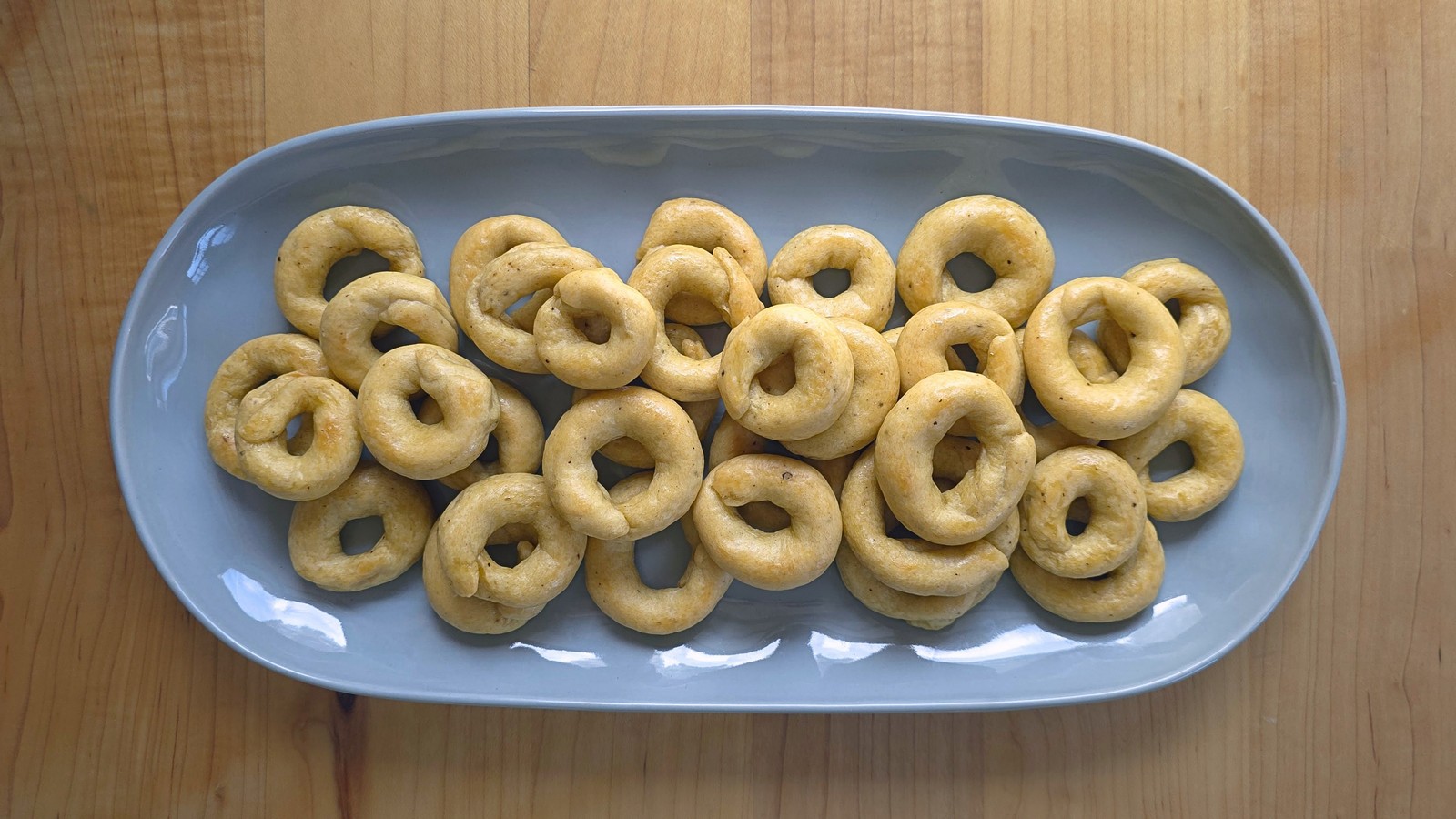
The first time I ate taralli, I was in my mother-in-law’s kitchen and the taralli were from an Italian bakery in Rhode Island. The mouth-tingling black pepper, olive oil, and wine flavor in these crunchy ring-shaped crackers absolutely wow’ed me. Ever since, when I see taralli alongside my mother-in-law’s hors d’oeuvres, I have to restrain myself from eating them all. And like most food I enjoy, I eventually get around to trying to make it myself. I first did this replacing the white wine with water for convenience, and the taralli were…adequate. This time I went all out, using white wine and fancy durum flour instead of all purpose flour, and what a difference this made. The durum flour brings a buttery, nutty note to the crackers, and the white wine adds depth and complexity to the flavor. Fennel seed, red pepper flake, and plain are also popular options for taralli, but black pepper is the best in my opinion. Make sure you use a nice olive oil too. Taralli are originally from Puglia, the “heel” of Italy’s boot and country’s biggest producer of olive oil.
Photo Gallery


Italian taralli crackers have a robust savory flavor and crispy texture that is perfect on a charcuterie board or as a solo snack. The dough is hydrated with dry white wine and olive oil, formed into rings, briefly boiled, and finally baked. Try my favorite, the black pepper variety, or make them with fennel seeds, red pepper flakes, or plain.
Servings
~ 36 taralli crackers
Ingredients
- 290 grams extra fancy durum pasta flour or another flour of your choosing (2 1/4 cups)
- 135 grams dry white wine (1/2 cup + 1 1/2 Tbsp) *
- 80 grams olive oil (6 Tbsp or ~1/3 cup)
- 1 tsp salt (5.5 grams)
- 1 tsp cracked black pepper – or – 1 Tbsp fennel seeds – or – 1 tsp red pepper flakes
- for boiling 1.5 – 2 quarts water + 2 tsp salt
Instructions
- This recipe takes about 2 hours from mixing to cooling rack. Mixing and kneading requires about 10 minutes. The dough rests 20-30 minutes. Rolling, cutting, and forming the little rings takes 20-30 minutes. Boiling is another 10 minutes, and the bake time is 40 minutes.
Mixing and Resting
- Mix together the dough ingredients and knead until the dough is supple and strong. This can also be done in a mixer with the dough hook attachment. The final dough should be soft and a little oily rather than sticky.
- Cover and rest the dough 20-30 minutes.
- Set up a clean workspace for shaping the taralli and line a baking sheet with parchment paper.
- Just before you begin shaping the dough, put water and salt in a pan on the stove to boil.
Shaping, Boiling, and Baking
- See the Photo Gallery for images of this process.
- Cut off a chunk of the dough and roll it into a long tube that is a little less than 1 cm thick. Cut the tube into pieces that are 4-5 inches long.
- Roll the ends of each piece to be a little tapered and join the ends to make a ring shape with some overlap. Set each piece on the parchment lined baking sheet and continue shaping until you’ve used all the dough.
- Begin preheating the oven to 375°F convection or 400°F if there is no convection option on your oven.
- Set up a clean tea towel near the boiling water to drain their excess water after boiling.
- Boil 8-10 taralli at a time in the salted water. Give them a gentle stir so they don’t stick to the bottom of the pan. When the taralli lift off the base of the pan, in 1-2 minutes, they are done.
- Remove the taralli with a slotted spoon and place them on the clean tea towel to drain.
- Load more raw taralli into the boiling water. While the second batch boils, move the just-boiled taralli off the towel and back onto the parchment lined baking sheet. They will stick to the towel if you leave them on it for too long.
- When all the taralli are boiled, drained, and back on the baking sheet, place the sheet in the preheated oven and bake for 40 minutes at 375°F convection bake or 400°F no convection. About 30 minutes into the bake, remove the sheet, flip the taralli, and put the sheet back in the oven. This will allow them to cook and dry out longer without the bottom getting too toasty.
- Cool on a rack.
- Taralli can be stored in an airtight container for a couple of weeks. Depending on the ambient humidity, they may soften up but you can toast them on a baking sheet to re-crisp if desired.
Notes
* Use more or less wine, depending on your flour. If you’re curious about how much alcohol remains in the taralli after baking, this article from Idaho State University, explains that alcohol begins evaporating at 173°F (lower than water’s 212°F) and after 30 minutes at this temperature, about 35% of the alcohol remains, but this also depends on the overall moisture of the item. A baked good that dries out tends to retain less alcohol.