

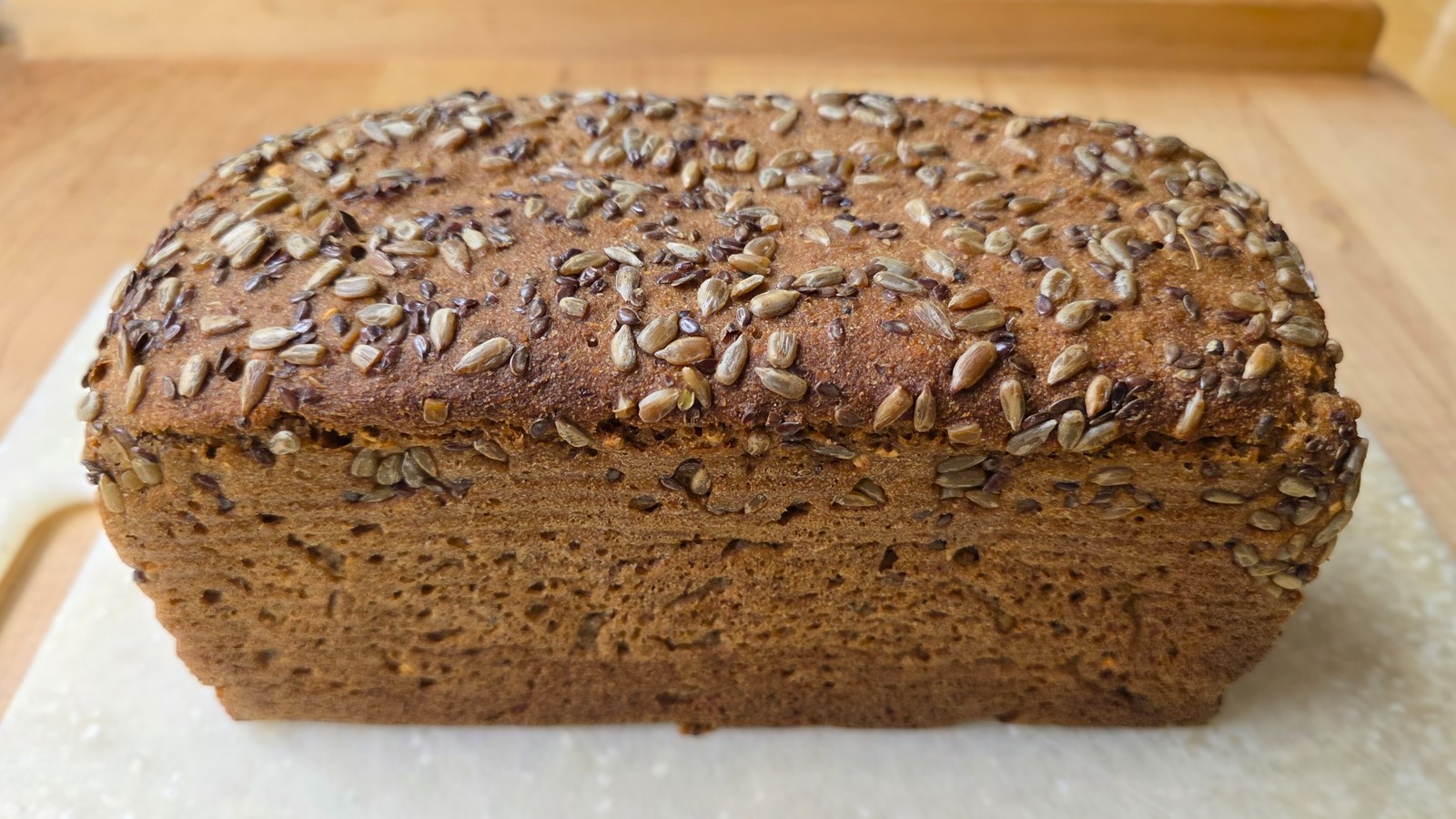
A friend recently send me the link to a bread recipe from Öfferl Bakery in the outskirts of Vienna, Austria. Their website describes the bread as “nutty to spicy, juicy” and the bakery’s instagram recently featured a video of their bakers scooping up the wet dough out of a large vat, rolling it in seeds, and plopping it in loaf pans. This Ulrich Urkorn bread looked and sounded fabulous and I was eager to try it—with my own spin of course. (Ulrich is a name and urkorn means ancient grain.)

The first thing I noticed about the recipe was that the sourdough levain and final dough are both mixed with 42°C water—that’s 107.6°F—a much higher temperature than my water has ever been with sourdough. I actually wondered if this was a translation error but I speak enough German to read the original, and a little research reassured me that the higher temperature ferment is likely intended to favor certain species of lactobacillus that produce dairy-yogurty flavors.
I was still a little worried the heat would damage the desirable microbes in my starter, so after scaling the recipe to fit a single 9x4x4 inch Pullman pan, I built two overnight levains: one fed with 107°F water and the other with 75°F water—just in case the warm one smelled or looked off in the morning. After mixing the levains, they were only about 15°F apart in temp (93°F and 78°F) because of the temp buffering of the flour. By the next morning, they were similarly doubled, but the originally warmer levain was indeed more lacto-sour in aroma and the other levain was nutty and less sour.
I found the easiest way to arrive at approx 107°F water was to tare the scale with the container (Pyrex here) and ThermoPop thermometer in it, and then add hot water and room temp water, alternating until I hit the target.

I joked with the Breadtopia crew that this bread should be called “Hot and Complex Sourdough Bread” because not only does it have a hot levain and dough, it also has a scald, which is where you mix some of the ingredients with boiling hot water. That gelatinizes the flour, allowing the dough to hold more water—perhaps where the descriptor juicy comes from. The heat can also activate some spicy flavor compounds and sweetness, though this is more evident when you do a mash or saccarification (initial higher temp, followed by holding the mixture at 145-149°F for several hours). Our scalding experiment offers a deep dive into the process and outcomes if you want to learn more about scalds.
-

- Scald: khorasan, rye, flaxmeal, buckwheat groats, sunflower seeds

-

- After adding boiling water and mixing

Ingredients
I made various modifications to Georg Öfferl’s original recipe apart from scaling and I really love how the bread turned out. I think it fits the description: nutty, spicy, and juicy aka moist and hearty. The main changes I made were to work with my grain inventory (spelt instead of einkorn, khorasan instead of emmer) and seed preference (ground flax seeds instead of whole in the dough, less caraway more anise). In test bake #1, the buckwheat groats in the dough didn’t hydrate much, so I moved them to the scald. I suggest you work with your inventory and seed preferences as well, modifying the water amount to target a dough that is loose and sticky. In the recipe ingredient list, I give flour options that have similar absorbency.
-

- Final dough after mixing

-

- Pouring dough into pan


The photo above shows slices from test bakes #1 and #2. In that second test, I increased the dough size, let it ferment more, modified the ingredients a bit, and baked at a lower temp and covered the bread for part of the bake.
Equipment
This recipe should be made with a scale to weigh ingredients and a thermometer for taking water temperature.
The ingredients are set for a 9x4x4 inch small Pullman pan. To scale the recipe for a 13x4x4 inch long Pullman pan, multiply each ingredient by 1.45 (rounding is fine). For help with scaling to other pan sizes, take a look at the FAQ How to Scale a Recipe.

See the Photo Gallery after the recipe for more images of the recipe steps.
Austrian Urkorn Sourdough Bread


Modeled after a scrumptious bread from Öfferl Bakery in Austria, this seeded ancient grain sourdough bread offers complex lactic acid and spice flavors, along with a hearty moist texture. Try the neat process with very warm water for the levain and final dough, as well as boiling water for a scald.
Ingredients
Sourdough Levain (the night before)
Scald (one hour before mixing the dough)
Final Dough
- all of the ripe levain
- all of the scald
- 300 grams water at ~ 107°F
- 200 grams rye whole grain flour
- 140 grams spelt or einkorn whole grain flour
- 50 grams khorasan, emmer, or durum whole grain flour
- 30 grams honey
- 16 grams salt
- 1.4 grams ground caraway seeds
- 1 gram ground fennel seeds
Crust Topping
- several handfuls of sunflower seeds and flax seeds to sprinkle on the dough
Instructions
- The overall timing on this recipe is about 24 hours, including the 12+ hours the bread should rest before slicing so the crumb can set. The sourdough levain ripens overnight, 8-14 hours. The scald develops for 1 hour. The dough rises 30-50 minutes before shaping and then rises in the pan another 75-90 minutes.
Sourdough Levain (the night before)
- Mix the ingredients for the levain, measuring the water temp to be about 107°F. Cover and let it ripen overnight. In my test bakes, I used the levain at just double and at already somewhat fallen; both worked well though the latter was more sour.
Scald (one hour before mixing the dough)
- Combine the dry ingredients for the scald in heat resistant bowl. Place on a scale, tare and pour in the boiling water.
- Mix, cover, and let rest/cool for about 1 hour.
Final Dough
- In a large bowl, mix together all the dough ingredients using 107°F water, and including the scald and the ripe levain. Add more water if needed to make the dough somewhat loose (see pics).
- Cover and let rise 30-50 minutes. You shouldn’t see much expansion of the dough.
- Lightly oil a small Pullman pan.
- Scrape the dough directly from the bowl to the pan.
- Wet a spatula and gently smooth down the dough.
- Sprinkle sunflower and flax seeds onto the wet dough surface. Cover and let it rise until the dough just crests over the rim of the pan. This should take 75-90 minutes. (Read the next step now.)
Baking
- Adjust your oven shelves so you can place the pan on the bottom shelf during baking and begin preheating the oven to 425°F before the dough is fully proofed.
- Bake the bread at 425°F uncovered for 20 minutes. Lower the oven temp to 375°F and continue baking another 20 minutes. Cover loosely with aluminum foil and bake a final 20 minutes still at 375°F. Check on the crust browning and cover earlier if desired. The target internal temp is >208°F because of the large amount of rye flour in the dough.
- Remove the pan from the oven and let the bread cool 30 minutes in the pan before transferring it to a cooling rack. To avoid settling of the crumb, you can rest the pan on its sides during that initial cooling. (I didn’t do this but should have.)
- Once completely cool, cover the bread and let it rest at least 12 hours before slicing.
Photo Gallery