

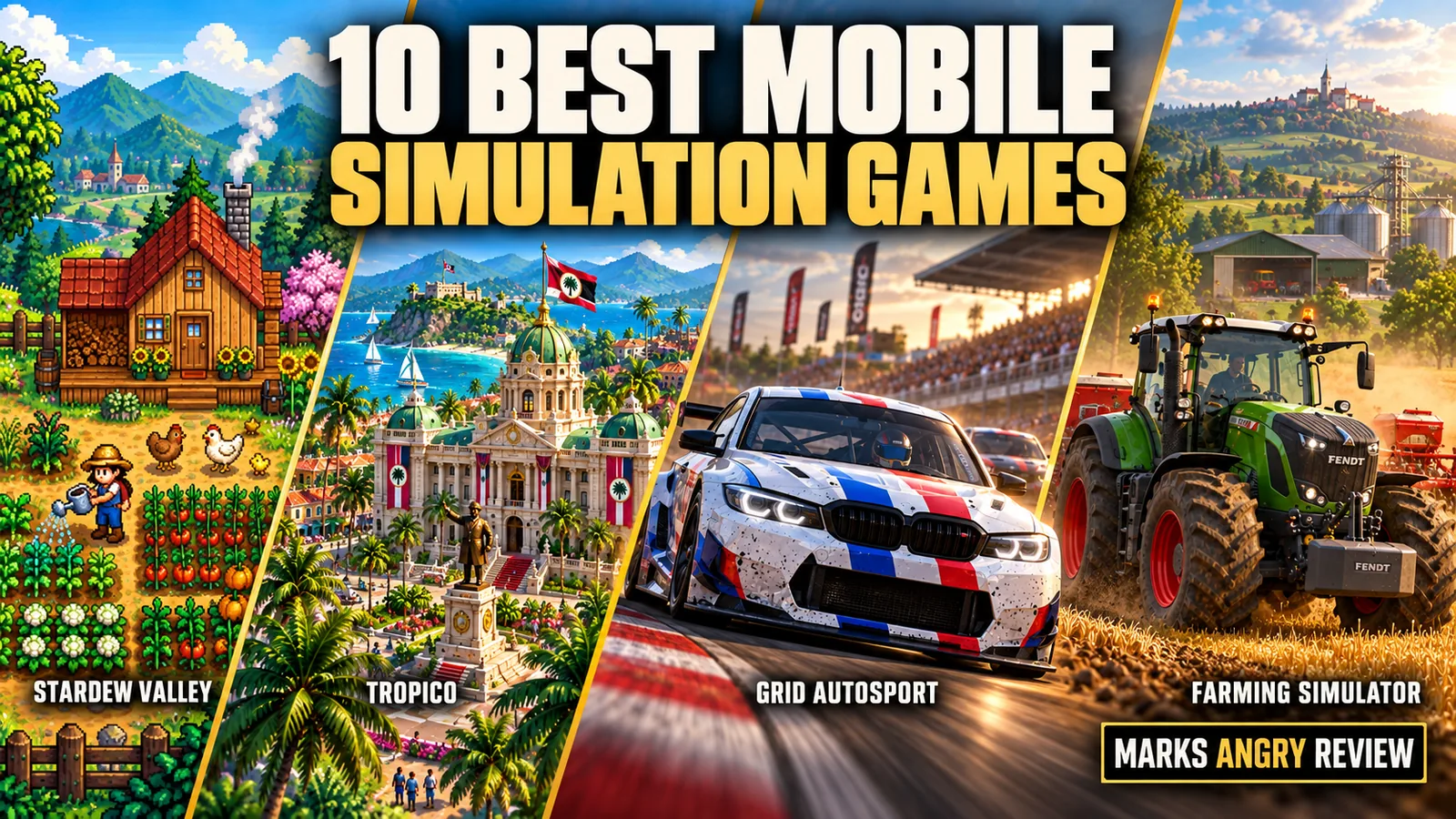
The best mobile simulation games let you build something, understand how it works, and accept responsibility when it falls apart. Naturally, the app stores also contain hundreds of games where your main responsibility is waiting four hours for a carrot. Apparently, agriculture now requires a premium currency and a push notification.
These are my top 10 mobile simulation games, ranked using ten criteria worth ten points each. Farming, city planning, business management, racing, and flying all qualify, provided your decisions actually affect the thing being simulated. A convincing tractor earns its place through machinery and farm management. A convincing town earns its place through the systems keeping its citizens employed, supplied, and slightly less furious than me.
Scores are editorial judgments based on researched mobile features, content, controls, and purchase models, rather than app-store ratings or device benchmarks. The full rules appear below the list, and every game gets a complete score breakdown. If your favorite loses points, you will at least know which numbers to shout at.
| Rank | Game | Score |
|---|---|---|
| 1 | Stardew Valley | 93/100 |
| 2 | Tropico | 89/100 |
| 3 | Pocket City 2 | 88/100 |
| 4 | RollerCoaster Tycoon Classic | 87/100 |
| 5 | Game Dev Tycoon | 86/100 |
| 6 | GRID Autosport | 85/100 |
| 7 | TheoTown | 84/100 |
| 8 | Farming Simulator 26 | 81/100 |
| 9 | RFS – Real Flight Simulator | 79/100 |
| 10 | Fallout Shelter | 77/100 |
1. Stardew Valley – 93/100

Best for: The best overall farming and life sim.
Stardew Valley wins because its farm is attached to an actual life. Crops follow seasons, tools change your workload, animals need attention, and Pelican Town contains people with something more interesting to say than “buy gems.” Farming, fishing, mining, crafting, and relationships feed into a wonderfully satisfying cycle of making plans and immediately finding six distractions. You inherit a neglected farm and somehow acquire a second job you actively want.
The freedom is the important part. You can chase efficient production, decorate your property, pursue community goals, or spend an unreasonable afternoon arguing with the fishing minigame. New equipment and discoveries change what you can accomplish, which earns progression, variety, and replayability 10/10 each. The standard mobile edition also delivers its content without selling you emergency watering tokens. A revolutionary business strategy called selling a game.
It loses points for controls and clarity. Precision tasks are less inviting on a small touchscreen, and the game happily lets beginners discover seasonal mistakes after those mistakes become expensive. Mobile co-op also needs qualification: the developer describes a hidden experimental mode that connects by IP, rather than a simple matchmaking button. Even with those compromises, 93/100 makes this the strongest all-round choice. Your actual houseplants may wish you showed similar commitment.
Purchase model: Paid game; the standard mobile edition has no in-app purchases.
Score breakdown, each out of 10:
Depth 9 · Freedom 10 · Progression 10 · Variety 10 · Controls 8
Clarity 8 · Presentation 9 · Replayability 10 · Pacing 9 · Value 10
Game details and downloads: iPhone and iPad | Android.
Mobile co-op details: ConcernedApe’s mobile multiplayer guide.
2. Tropico – 89/100

Best for: Political and economic management.
Tropico puts an entire Caribbean island under your supervision, which is a worrying appointment given the state of your notifications. Housing, employment, industry, tourism, transport, and politics all compete for attention. A prosperous export business means very little when the workers cannot reach it or the population has decided your presidency should end immediately. This is why the game earns 10/10 for simulation depth: its problems have connections.
The pleasure comes from choosing what kind of leader to become and watching the island respond. Develop a tourist economy, build an industrial machine, or keep powerful groups sufficiently comfortable that they overlook your other decisions. The mobile package includes Absolute Power content, while additional missions expand the selection further. Its replay value comes from changing priorities and governing approaches, rather than collecting slightly shinier versions of the same building.
It finishes behind Stardew because managing a country involves more menus and sustained attention than planting a vegetable. A tablet gives those crowded decisions room to breathe. Presentation also shows the age of the underlying game, and optional paid missions keep value at 9/10. The resulting 89/100 is an excellent score for anyone who wants meaningful economic choices and the opportunity to discover why people keep complaining about their government.
Purchase model: Paid base game with optional paid mission content.
Score breakdown, each out of 10:
Depth 10 · Freedom 10 · Progression 9 · Variety 9 · Controls 8
Clarity 8 · Presentation 8 · Replayability 10 · Pacing 8 · Value 9
Game details and downloads: iPhone and iPad | Android.
3. Pocket City 2 – 88/100

Best for: An approachable city builder.
Pocket City 2 understands that building a city should involve building a city. You lay roads, create zones, provide services, and unlock new possibilities by playing. There are no microtransactions or long construction waits. Your mayor does not need to watch an advert for a suspicious puzzle game before approving a fire station. The fact that this deserves praise is an indictment of the entire app store.
Its best trick is letting you drop an avatar into the place you built. Explore streets, enter buildings, furnish a home, tackle quests, and get distracted by minigames. That connection between the planning view and street level gives the city personality. Sandbox mode, events, disasters, and major projects add variety, while the approachable presentation keeps controls and clarity at 9/10. Value receives a well-earned 10.
The compromise is simulation depth, which scores 7/10. Pocket City 2 favors a busy toy box over the political and economic entanglements of Tropico. The side activities also compete with the management, so dedicated planners may consider some of them unnecessary homework. It takes third with 88/100 because it offers the friendliest complete package for a phone. Build a town, enjoy the town, accidentally unleash a disaster. A respectable afternoon.
Purchase model: Paid game without microtransactions or paid construction timers.
Score breakdown, each out of 10:
Depth 7 · Freedom 9 · Progression 9 · Variety 9 · Controls 9
Clarity 9 · Presentation 8 · Replayability 9 · Pacing 9 · Value 10
Game details and downloads: iPhone and iPad | Android.
4. RollerCoaster Tycoon Classic – 87/100

Best for: Designing and managing theme parks.
RollerCoaster Tycoon Classic lets you design a magnificent coaster and then discover that your guests would prefer a toilet. That is proper simulation. Ride design, path layouts, staffing, maintenance, prices, and visitor needs all influence whether your park becomes a profitable attraction or a beautifully landscaped financial incident. It combines elements of the first two RollerCoaster Tycoon games, including 95 classic scenarios in the base package.
Depth, freedom, and replayability each earn 10/10. You can assemble tracks piece by piece, reshape terrain, rethink a failing park, and work within different scenario restrictions. The charming isometric art also communicates a remarkable amount through tiny guests and busy rides. Optional expansions add content, but the purchase model does not demand a payment every time somebody wants to build a footpath. How wonderfully uncivilized.
The interface is the price of admission. Dense tools and precise construction are easier to appreciate on a tablet than through a thumb covering the exact square you wanted. Controls and clarity therefore receive 7/10, dropping the total to 87. It sits below Pocket City 2 for general mobile convenience, while offering the richer park-management challenge. If designing a profitable coaster sounds better than completing another mayoral minigame, reverse those recommendations immediately.
Purchase model: Paid game; Wacky Worlds, Time Twister, and Toolkit are optional purchases.
Score breakdown, each out of 10:
Depth 10 · Freedom 10 · Progression 9 · Variety 9 · Controls 7
Clarity 7 · Presentation 8 · Replayability 10 · Pacing 8 · Value 9
Game details and downloads: iPhone and iPad | Android.
5. Game Dev Tycoon – 86/100

Best for: Running a game development business.
Game Dev Tycoon begins in a garage and asks you to build a successful studio by choosing game topics, genres, platforms, and development priorities. Research technology, build engines, hire staff, and try to release something the public actually wants. Congratulations, you are now responsible for the games you would normally insult. That should be an educational adjustment.
The progression is excellent. Growing from a lone developer into a larger operation changes the choices available, while game reports encourage you to learn from your latest commercial embarrassment. Its mobile interface suits deliberate decisions, and the illustrated offices make company growth easy to understand. Progression, controls, clarity, and pacing score 9/10. The standard paid edition earns 10 for value because it has no ads or in-app purchases. Your fictional studio may chase money; the real one already sold you the game.
It stops short of the top four because its business model is an approachable abstraction, and repeated campaigns lose some surprise as you learn the successful combinations. Choosing sliders is also a narrower form of creativity than shaping an entire park or farm. That leaves depth, freedom, variety, and replayability at 8/10, for 86 overall. Still an excellent choice for anyone convinced they could run a game company. Please resist announcing a cinematic universe in your first garage.
Purchase model: Paid standard edition with no ads or in-app purchases.
Score breakdown, each out of 10:
Depth 8 · Freedom 8 · Progression 9 · Variety 8 · Controls 9
Clarity 9 · Presentation 8 · Replayability 8 · Pacing 9 · Value 10
Game details and downloads: iPhone and iPad | Android.
6. GRID Autosport – 85/100

Best for: Racing with simulation handling.
GRID Autosport belongs here as a racing hybrid: Feral describes it as a mixture of simulation handling and arcade thrills. Braking, racing lines, throttle control, and your choice of assists matter, but nobody should mistake this for professional driver certification. It gives you a substantial motorsport game on a phone and trusts the cars to provide the entertainment. Apparently, you can make a racing game without turning every menu into a jewelry counter.
The full paid edition includes its DLC, with a broad selection of cars, circuits, and disciplines. Tilt, touch steering, and gamepad options help different players find a sensible setup, while adjustable difficulty gives you room to grow. Controls, variety, presentation, and replayability score 9/10. Value gets 10, specifically for that complete paid edition. Racing your way through the content is preferable to financing each new corner separately.
Its limits are attention and specialization. Races require concentration, the hardware compatibility requirements deserve a check, and its freedom is mostly about how and what you race. You are not managing a team or building a motorsport economy. Pacing scores 7/10 for mobile convenience, with depth at 8 because the handling deliberately blends realism and accessibility. The total is 85/100. A controller is worth considering if your steering thumb has the precision of a falling potato.
Purchase model: The full paid edition includes its DLC; separate trial or custom editions have different purchase arrangements.
Score breakdown, each out of 10:
Depth 8 · Freedom 8 · Progression 8 · Variety 9 · Controls 9
Clarity 8 · Presentation 9 · Replayability 9 · Pacing 7 · Value 10
Game details and downloads: iPhone and iPad | Official mobile details.
7. TheoTown – 84/100

Best for: Detailed city layouts and transport networks.
TheoTown is for people who think a lovely evening involves improving a railway junction. It gives you zoning, services, transport networks, emergencies, and the freedom to keep expanding a pixel city until its traffic becomes a personal insult. Roads, railways, airports, and districts are part of the same planning problem. The visual style may look modest, but the ambitions are considerably larger than the individual pixels.
Its standout strength is customization. Detailed layouts and user-made plugins let committed builders create places with identities beyond “starter city with the expensive tower.” That flexibility earns freedom and replayability 10/10, supported by 9s for depth and variety. If Pocket City 2 makes becoming mayor approachable, TheoTown encourages you to stay late in the planning department arguing about infrastructure. Some people need hobbies. You apparently need a municipal budget.
It falls to seventh because that freedom brings a busier interface and more to learn. Controls and clarity each get 7/10, and its free-to-start model includes purchases rather than the clean transaction offered by several games above it. At 84/100, it remains a strong recommendation for patient builders. Choose it for intricate cities and transport projects, then accept that learning the tools is part of the entertainment. The tiny citizens will still blame you.
Purchase model: Free to start with in-app purchases; the Android listing also includes ads.
Score breakdown, each out of 10:
Depth 9 · Freedom 10 · Progression 8 · Variety 9 · Controls 7
Clarity 7 · Presentation 8 · Replayability 10 · Pacing 8 · Value 8
Game details and downloads: iPhone and iPad | Android.
8. Farming Simulator 26 – 81/100

Best for: Machinery and agricultural management.
Farming Simulator 26 is for anyone who likes Stardew’s agriculture but would prefer fewer birthday presents and substantially more machinery. The mobile release offers two maps, 15 field crops, more than 120 authentic machines, livestock, forestry, and production chains. You decide what kind of operation to run and then perform the work needed to keep it moving. Your reward for escaping work is carefully organized work. Gaming remains a fascinating condition.
The simulation earns its position through the relationships between equipment, fieldwork, output, and expansion. Machinery has a purpose beyond decorating your garage, while processing what you produce adds decisions beyond harvesting the next field. Depth, freedom, and variety each receive 9/10. It is a stronger fit than Stardew for players interested in agricultural operations, even though Stardew wins the broader contest through its richer life simulation and wider appeal.
The deductions come from mobile complexity and value. A touchscreen must handle driving, equipment functions, and management, so controls and clarity score 7/10. This is also a paid app with additional purchases, rather than an entirely self-contained upfront deal. The patient, repetitive nature of fieldwork will delight its audience and bore everybody who expected an explosion before lunch. It earns 81/100: a substantial specialist sim, provided you understand that operating the tractor is the activity.
Purchase model: Paid mobile game with in-app purchases; the Android listing also declares ads.
Score breakdown, each out of 10:
Depth 9 · Freedom 9 · Progression 8 · Variety 9 · Controls 7
Clarity 7 · Presentation 8 · Replayability 8 · Pacing 8 · Value 8
Game details and downloads: Android | Official mobile details.
9. RFS – Real Flight Simulator – 79/100

Best for: Aircraft procedures and flight planning.
RFS makes its intentions clear by expecting you to care about the flight before the aircraft leaves the ground. Cockpit instruments, flight planning, autopilot functions, weather, failures, and airport procedures provide a far more involved experience than dragging a cartoon plane through floating hoops. Simulation depth receives 10/10 for the scope of those systems within a mobile game. That score does not qualify you to land anything containing passengers.
The appeal is learning a process and carrying it out: planning a route, managing the aircraft, and arriving somewhere in one reasonably expensive piece. Different aircraft and routes support strong variety and replayability, while detailed airports and cockpits earn presentation 9/10. Live features and multiplayer add another dimension, but require an internet connection. Your own improvement supplies much of the progression, which earns a more restrained 6 than the expanding careers and businesses above.
Subscription costs are the main brake on the recommendation. Some aircraft and features sit behind recurring payments, so the advertised entry price does not describe the whole experience being scored here. Value gets 6/10, with controls, clarity, and pacing at 7 because complex cockpit work demands patience and screen space. The final 79/100 suits committed aviation enthusiasts. Casual players should establish that they enjoy flying procedures before adding another subscription to their already airborne expenses.
Purchase model: Paid entry app with a subscription for some aircraft and features; this score considers the broader subscription-enabled experience.
Score breakdown, each out of 10:
Depth 10 · Freedom 9 · Progression 6 · Variety 9 · Controls 7
Clarity 7 · Presentation 9 · Replayability 9 · Pacing 7 · Value 6
Game details and downloads: iPhone and iPad | Android.
10. Fallout Shelter – 77/100

Best for: Casual vault management.
Fallout Shelter makes you responsible for an underground community whose survival depends on resources, room planning, and putting the right people in the right jobs. Expand the vault, equip dwellers, send them into the wasteland, and deal with whatever disaster interrupts your carefully arranged domestic misery. It turns Fallout’s setting into a readable management dollhouse. Human resources finally has a reason to discuss actual radiation.
The cutaway presentation is its biggest advantage. You can understand the vault at a glance, move between jobs without learning a giant planning interface, and see how expansion changes the place. Controls and clarity each earn 9/10, while progression gets 8 for the cycle of better rooms, stronger dwellers, and exploration. It works as an accessible introduction to management, especially for someone who considers Tropico’s policy decisions an unreasonable amount of government.
The ceiling is lower. Resource collection, waiting, and recurring incidents can become routine, and optional purchases sit alongside that deliberately paced progression. Depth, freedom, variety, replayability, and pacing each settle at 7/10. The resulting 77 is good enough for tenth because the basic management is approachable and the setting does useful work. Download it for a casual vault to tinker with. Expecting an endlessly evolving society would be optimistic, even before the giant insects arrive.
Purchase model: Free to play with optional in-app purchases and ads.
Score breakdown, each out of 10:
Depth 7 · Freedom 7 · Progression 8 · Variety 7 · Controls 9
Clarity 9 · Presentation 8 · Replayability 7 · Pacing 7 · Value 8
Game details and downloads: iPhone and iPad | Android.
How the Mobile Simulation Scoring System Works
Every game receives an integer score from 0 to 10 in each of ten categories. Add them together and you get the total out of 100. No popularity bonus. No extra points for a publisher whose logo requires an orchestra.
The Rules for Making This List
- A real mobile release is required. These picks have official mobile releases and store or publisher listings checked for this update. Cloud-streaming a PC game does not make it a mobile release.
- The simulation must give you meaningful decisions. Its core should involve managing a system, practicing a process, or shaping a world with consequences. Merely tapping to collect another reward does not impress me.
- Games are judged within their type of simulation. A flight sim earns depth through aircraft systems; a city builder earns it through connected urban systems. Stardew is not penalized for lacking landing gear. GRID is explicitly identified as a simulation-and-arcade hybrid.
- The purchase model counts. A paid game can earn better value marks than a free download. Optional expansions, ads, paid shortcuts, and subscriptions all affect the recommendation. RFS is scored with its broader subscription-enabled offering in mind.
- The total reflects a general mobile recommendation. Specialists may prefer a lower-ranked game. A good finished single-player game also does not need weekly events to justify existing. Leave it alone and let people play.
The Ten Scoring Criteria
- Depth: How well the simulation’s systems interact and produce understandable consequences. Complication alone earns nothing.
- Freedom: How much control you have over your approach, designs, priorities, or methods. Following a tutorial forever is not freedom.
- Progression: Whether learning, expansion, equipment, and new capabilities make continued play rewarding. A larger number is not automatically progress.
- Variety: The range of meaningful activities, tools, scenarios, vehicles, or problems within the game.
- Controls: How well its input options suit the tasks on a phone or tablet, including touch design and supported alternatives.
- Clarity: How clearly the interface, instructions, and feedback explain what is happening and why.
- Presentation: Art direction, animation, sound, atmosphere, and how convincingly they support the simulated world.
- Replayability: The appeal of new runs, different builds, alternative routes, self-directed projects, and continued experimentation.
- Pacing: How well the rhythm of play fits mobile use, including repetitive chores, waiting, session demands, and opportunities to stop.
- Value: How much worthwhile play the purchase model delivers, accounting for paid extras, advertising, and recurring costs.
A 10 means a category-leading strength within this selection, not literal perfection. Scores of 90–100 indicate an exceptional overall recommendation; 80–89 means excellent with clear compromises; 70–79 means good, with more audience-specific limitations. These are researched editorial assessments, not claims of identical hands-on testing across devices.
The scores also explain the order. Tropico beats Pocket City 2 by one point because its deeper systems and stronger replayability narrowly outweigh Pocket City’s easier interface and cleaner value proposition. RFS scores higher for depth than several games above it, then loses ground on progression, mobile convenience, and recurring cost. That is the point of using ten criteria: one impressive feature does not get to carry nine passengers.
Stardew Valley is the first recommendation for most people. Pick Tropico for serious management, Pocket City 2 for approachable city building, and the machinery or aviation entries when that particular obsession is the reason you are here. If you would rather blame teammates than your own planning, try my top mobile MOBA games. Their incompetence is available in multiplayer.
Store availability, compatibility, and purchase options can change. Check the linked listing for your device and region. The custom illustrations accompany the reviews and are not gameplay screenshots.