

Common Retirement Drawdown Orders
If you’ve been fortunate enough to amass some assets for retirement, well, this post is for you – here some common retirement drawdown orders to consider from my perspective and more importantly, why.
Inspired by reader emails and navigating my own early retirement income planning – let’s get right into it.
First, let’s look at some potential or common retirement components:
Retirees might have the following income sources:
- Corporate investments
- Workplace Defined Benefit (DB) pension
- Non-registered accounts
- Registered Retirement Savings Plans (RRSPs) / Locked-In Retirement Accounts (LIRAs)
- Tax-Free Savings Accounts (TFSAs)
- Canada Pension Plan/Quebec Pension Plan (CPP/QPP)
- Old Age Security (OAS).
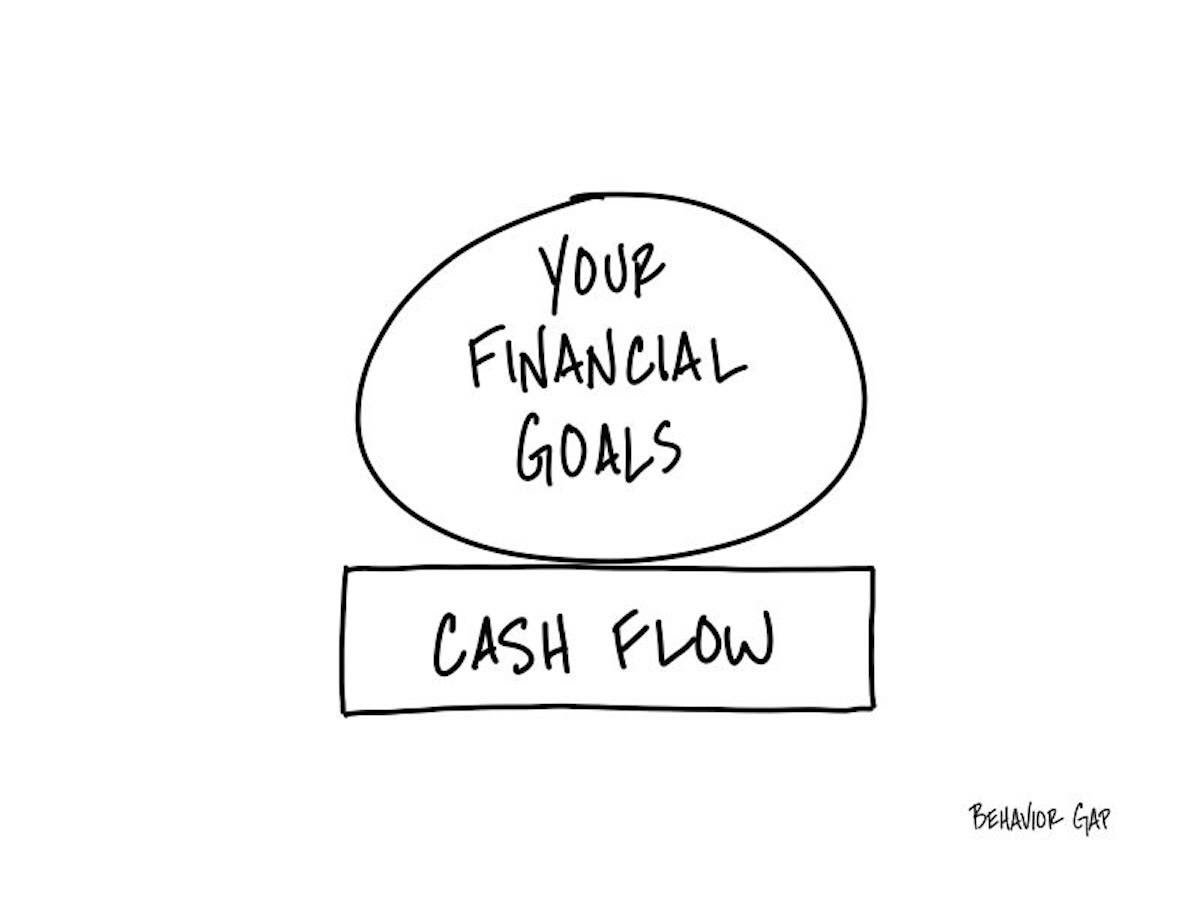
What to spend first? Why?
Image courtesy of The Behavior Gap – Carl Richards:

I believe those answers depend on your primary objectives once retired which may or may always involve taxation.
- Manage risk – you want guaranteed income security as much as possible?
- Minimize tax upfront – pay as little tax as possible in the early years, defer tax into older age?
- Grow the capital – ’nuff said.
- Maximize the estate – do you want to leave a legacy?
Here are some options in more detail!
Manage risk:
| Withdraw first | Corporate portfolio and personal investments | Drawing assets from your corporation first may make sense, including non-registered assets then RRSPs then TFSAs. |
| Withdraw last | CPP/QPP/OAS | Deferring government inflation-protected benefits until age 70 will preserve inflation-fighting power – certainly a good idea if you have a DB pension. |
Minimize tax upfront:
| Withdraw first | Corporate portfolio and non-registered assets | Non-registered investments can be strategically sold for capital gains, with or without any DB pension. |
| Withdraw last | RRSP/RRIF, LIRA to Life Income Fund (LIF) then TFSA | Deferring your RRSP/RRIF will defer taxation. TFSAs can be withdrawn last. |
Grow the capital:
| Withdraw first | CPP/QPP/OAS | Yes, you can can start taking CPP/QPP retirement benefits as early as age 60 (though your lifetime benefit will be smaller) and you can take OAS at age 65 – which is pretty standard. This may allow you to grow the capital inside RRSPs/RRIFs or TFSAs. |
| Withdraw last | TFSA | Needless to say it’s great to maximize tax-free growth via TFSAs.
“The first rule of compounding is to never interrupt it unnecessarily.” |
Maximize the estate:
| Withdraw first | All personal investment assets, except TFSA | Money left in an RRSP/RRIF at death is usually fully taxable in an estate. You should enjoy the money you’ve earned while you are alive and if you want to leave a legacy, leave other assets like your primary home and TFSAs to beneficiaries. |
| Withdraw last | TFSA | Draw this last account last since TFSA assets can continue to grow with no future tax implication to you or your estate! |
What is our drawdown order?
Now that we’re retired, we’re focused on this order for asset decumulation:
“NRT” = Non-Registered (N) with Corporation withdrawals, along with RRSP assets (R), then TFSAs (T).
This is actually the default logic in fact for many professional software programs.
The reasoning behind it is to maintain tax-deferred accounts and tax-free accounts compounding as long as possible. In doing so, we will be able to adjust the timing of CPP and OAS income streams for the bond-like, inflation-protected income I mentioned above.
Here is a summary of my thinking and I will amend this table over time too should anything change.
| Account Type | Details | My Own Advisor Drawdown Order Considerations |
| Taxable Accounts | Non-Registered Accounts |
|
| Tax-Deferred Accounts | RRSP/RRIF, LIRA/LIF |
|
| Tax-Free Accounts | TFSA |
|
What is your potential drawdown order? Have you considered the following in your planning?
- Manage risk?
- Minimize tax upfront?
- Grow the capital?
- Maximize the estate?
Stay tuned to more blogposts on retirement income and planning as my thinking matures.
Mark
Further Reading:
There are also dozens of FREE Retirement stories and essays you can learn from here.
Want some personalized help, well beyond what any free tools could ever offer?
Have you looked into a financial advisor to run some numbers and/or projections for you but you are not willing to pay a few thousand dollars?
I get it.
I don’t blame you.
I wouldn’t pay that money either. 🙂
Instead, my partner and I at Cashflows & Portfolios offer low-cost retirement projections solutions to support your retirement readiness and any retirement cashflow ideas – to any DIY investors supported by DIY investors.

Mark