
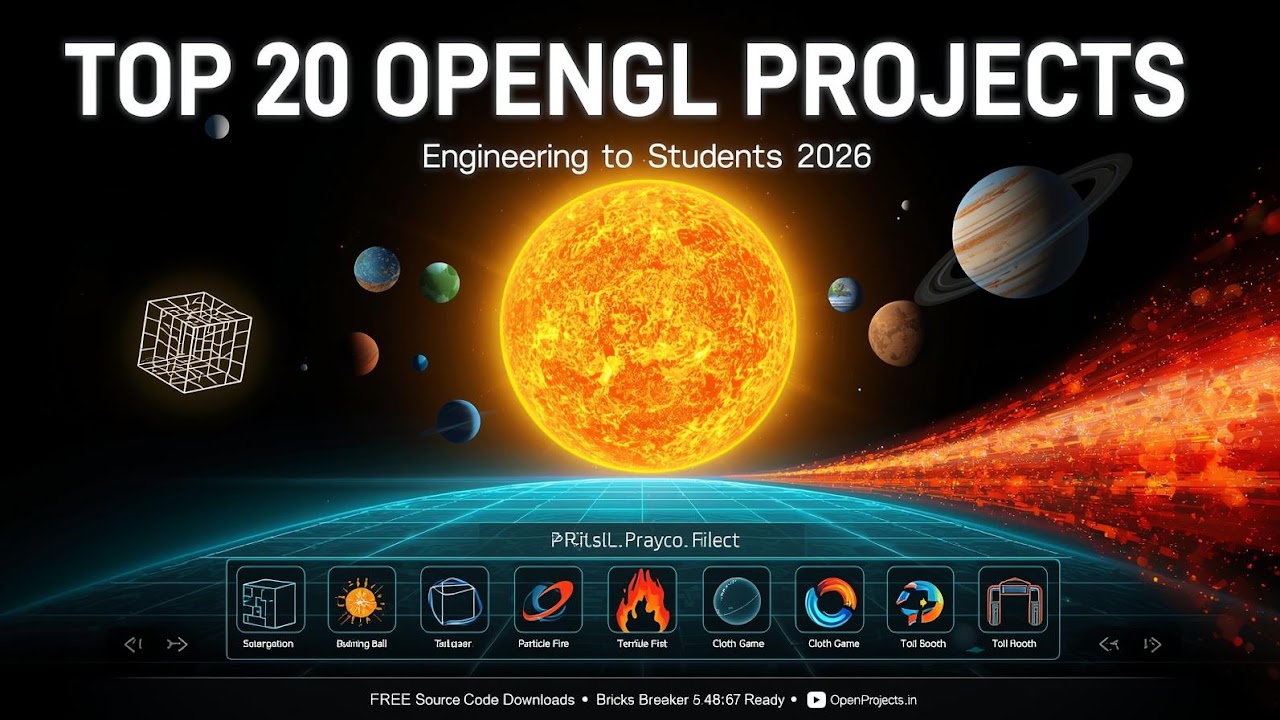
Computer graphics plays an important role in fields such as gaming, simulation, visualization, and scientific computing. OpenGL is one of the most widely used graphics APIs for building cross-platform graphics applications. Through practical projects, engineering students can gain a deeper understanding of rendering pipelines, GPU programming, shaders, and 3D mathematics.
This report presents twenty OpenGL project ideas categorized by difficulty level, including beginner, intermediate, and advanced projects. Each project is designed to strengthen practical skills in modern graphics programming using C++ and OpenGL. The goal of these projects is to help students develop the ability to design and implement real-time graphics applications.
-
Introduction
-
Objectives
-
Development Tools and Technologies
-
Beginner-Level OpenGL Projects
-
Intermediate-Level OpenGL Projects
-
Advanced-Level OpenGL Projects
-
Applications of OpenGL Projects
-
Conclusion
-
References

OpenGL (Open Graphics Library) is an industry-standard graphics API used for developing two-dimensional and three-dimensional graphics applications. It provides developers with the tools needed to control the GPU and implement efficient rendering pipelines.
In modern computer graphics education, practical implementation is essential. Students must understand how rendering works through real projects that demonstrate concepts such as:
The following project list is structured to help engineering students progressively build their skills from fundamental graphics programming to advanced rendering systems.
The objectives of these OpenGL projects are:
-
To understand the fundamentals of computer graphics.
-
To develop practical experience with OpenGL programming.
-
To explore GPU-based rendering techniques.
-
To implement interactive graphics applications.
-
To prepare students for careers in graphics programming, game development, and simulation.
The following tools are commonly used for OpenGL development.
| Tool | Purpose |
|---|---|
| OpenGL | Graphics rendering API |
| C++ | Primary programming language |
| GLFW | Window creation and input handling |
| GLAD / GLEW | OpenGL function loading |
| GLM | Mathematics library |
| stb_image | Texture loading |
| Assimp | 3D model loading |
| Dear ImGui | User interface for debugging |
These libraries simplify the development of modern OpenGL applications.
These projects introduce the fundamental concepts of rendering and graphics programming.
4.1 2D Shape Drawing Application
This project allows users to draw basic geometric shapes such as:
-
Lines
-
Triangles
-
Rectangles
-
Circles
Concepts learned:
-
Vertex buffers
-
Rendering primitives
-
User input handling
4.2 Interactive Solar System Simulation
This project simulates planetary motion where planets revolve around the sun.
Features:
Concepts learned:
4.3 3D Cube Viewer
A simple program displaying a cube that can be rotated, scaled, and translated.
Concepts learned:
4.4 Texture Mapping Demonstration
Render textured objects such as cubes or spheres.
Concepts learned:
-
UV coordinates
-
Texture sampling
-
Texture filtering
4.5 Basic 3D Model Viewer
Load and render a 3D model file.
Features:
-
Model loading
-
Lighting
-
Camera control
Concepts learned:
-
Mesh structures
-
Model rendering pipeline
These projects introduce more advanced graphics techniques.
5.1 Real-Time Terrain Generator
Generate terrain using procedural methods such as noise functions.
Concepts learned:
-
Heightmaps
-
Procedural generation
5.2 3D Maze Navigation Game
A small game where the player navigates through a maze using a first-person camera.
Concepts learned:
-
Collision detection
-
Camera systems
-
Game logic
5.3 Particle System Simulation
Simulate visual effects such as fire, smoke, or rain.
Concepts learned:
-
Particle systems
-
GPU instancing
5.4 Shadow Mapping
Implement dynamic shadows in a scene.
Concepts learned:
-
Depth maps
-
Framebuffer objects
5.5 Physics-Based Bouncing Ball Simulation
Simulate objects bouncing under gravity.
Concepts learned:
-
Motion equations
-
Collision response
5.6 First-Person Camera System
Develop a camera system similar to those used in FPS games.
Features:
-
Mouse look
-
Keyboard movement
-
Perspective projection
5.7 Water Rendering Simulation
Render animated water surfaces.
Concepts learned:
-
Reflection
-
Refraction
-
Wave animation
These projects involve complex rendering algorithms and system design.
6.1 Real-Time Ray Tracing (Hybrid)
Implement basic ray tracing techniques using shaders.
Concepts learned:
6.2 Deferred Rendering Engine
Build a rendering pipeline capable of handling multiple lights efficiently.
Concepts learned:
-
G-buffer rendering
-
Deferred shading
6.3 Procedural City Generator
Automatically generate buildings and urban layouts.
Concepts learned:
-
Procedural modeling
-
Scene generation
6.4 Cloth Simulation
Simulate cloth movement using physics models.
Concepts learned:
-
Mass-spring systems
-
Real-time simulation
6.5 GPU Fluid Simulation
Create a real-time fluid or smoke simulation.
Concepts learned:
-
Numerical simulation
-
Compute shaders
6.6 OpenGL Mini Game Engine
Develop a basic rendering engine supporting:
-
Scene management
-
Lighting systems
-
Model loading
-
Camera control
6.7 Augmented Reality Viewer
Integrate computer vision with OpenGL rendering.
Concepts learned:
-
Camera calibration
-
Marker tracking
-
3D overlay rendering
6.8 Virtual Reality Scene Viewer
Render stereoscopic scenes for VR headsets.
Concepts learned:
OpenGL-based systems are widely used in many industries:
-
Video game development
-
Scientific visualization
-
CAD and engineering software
-
Virtual reality systems
-
Simulation and training environments
-
Medical imaging visualization
Developing OpenGL projects prepares students for careers in these fields.
OpenGL projects provide engineering students with hands-on experience in computer graphics programming. By implementing progressively complex projects, students can develop a deep understanding of rendering pipelines, shader programming, and real-time graphics techniques.
These twenty projects offer a structured pathway from beginner concepts to advanced graphics development, helping students build a strong foundation in modern graphics programming.
-
OpenGL Architecture Review Board. OpenGL Programming Guide.
-
Shreiner, Dave et al. OpenGL SuperBible.
-
Akenine-Möller, Tomas et al. Real-Time Rendering.
-
OpenGL Official Documentation.
-
Graphics programming tutorials and educational resources.