

Queen of Hip-Hop Soul Reflects on Child-Free Decision in Candid Podcast Interview
Mary J. Blige has opened up about occasionally regretting her decision not to have biological children. The 55-year-old singer shared her reflections during an appearance on the IMO podcast hosted by Michelle Obama and Craig Robinson.
In a 38-second clip that has since gone viral, Blige explained that she made the decision while younger after watching family members struggle with the demands of parenthood. Now, with age comes a different perspective — and occasional wistfulness.
The Freedom That Shaped Her Choice
Blige spoke with characteristic candor about the observations that led her to decide against having children. She described watching family members raise kids and the difficulties that came with it: the constant need for babysitters, the loss of personal autonomy, and the sense that those relatives had “no choice” and “no freedom.”
These scenes, she said, led her to conclude early on that she did not want children. Some published transcripts of the fuller conversation include a more emphatic phrasing — “I didn’t want no damn kids” — delivered with a brief chuckle that softened the intensity while underscoring her conviction.
The singer framed the decision as one made with a limited horizon. Younger people make declarations based on what they observe at the time, she noted, without the benefit of decades of hindsight.
Blige has spoken about this calculus before. In a 2022 interview with E! Daily Pop, she emphasized her enjoyment of freedom: “I like being able to get up and go and move and do what I want to do.” She also pointed to her nieces and nephews as ongoing family connections that fulfilled some of her relational needs.
The Perspective That Comes With Age
Then, Mary J. shifted to the present. She stated that aging has altered her perspective. Now, she observes how valuable teenagers and children are to the parents in her family circle — the emotional bonds, the ongoing relationships, the sense of meaning those connections provide.
This recognition produced a moment of wistfulness. Across reliable reports of the remarks, the language ranged from a soft “Oh man…” followed by a dismissive “eh…” to stronger attributions such as “I sometimes regret not having them early too.”
In the broader interview context surrounding the clip, Blige added that she is sometimes lonely yet spends substantial time alone in her home, watching movies, trying on clothes, and deliberately ensuring she has a good time. She accepts the life she has built.
During the interview, she also affirmed the importance of becoming a whole person before or instead of seeking fulfillment through parenthood. She advised against making oneself miserable by chasing what others have.
Stepmother, Aunt, and Artist
Mary J. Blige’s personal history includes a marriage to music producer Kendu Isaacs from 2003 to 2018. During that period she served as stepmother to his three children from a previous relationship and at times spoke positively about that role. She has never had biological children.
Her background includes growing up in challenging circumstances in Yonkers, New York, which informs the emphasis on autonomy once success arrived. Blige rose to prominence in the early 1990s with albums such as What’s the 411? and My Life, blending R&B, hip-hop, and deeply personal lyricism about pain, resilience, love, and self-examination.
Now, she is a nine-time Grammy winner with a long career that includes acting roles, a Las Vegas residency, and continued public reflection on healing and self-knowledge. Her music catalog and prior interviews consistently treat personal pain, growth, and autonomy as central themes.
Earlier comments, including commentary in 2009, indicated reluctance to adopt or foster because she did not believe it would be fair given her lifestyle. So, her current podcast remarks therefore represent an evolution rather than an abrupt reversal: the same freedom-versus-restriction calculus appears, but age and observation of adult children’s value to parents introduce a layer of occasional second thoughts.
The Michelle Obama Connection
The remarks occurred on the IMO podcast, hosted by former First Lady Michelle Obama and her brother Craig Robinson. The episode, released on August 19, covers Mary J. Blige’s discovery of her voice as a child, her navigation of the music industry, the role of music as therapy, self-forgiveness, financial education after early career vulnerabilities, relationships, and personal growth.
The children discussion arises when Robinson raises the topic of her decision not to have biological children. Obama contributes comments emphasizing that a child cannot complete an incomplete person and that individuals should prioritize becoming whole.
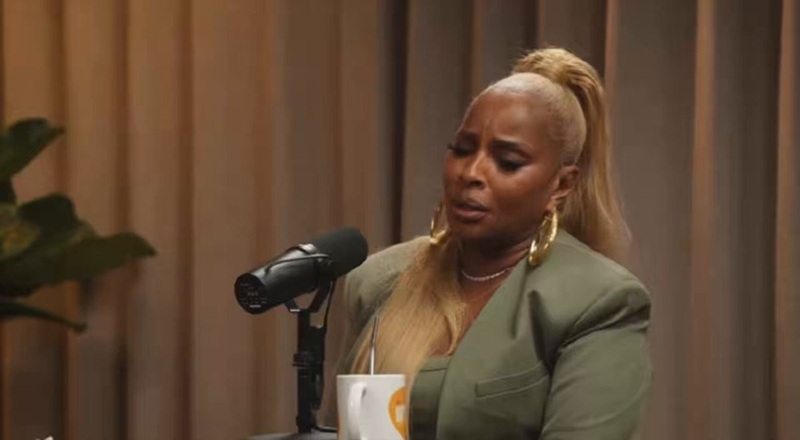
The setting is a studio-style podcast environment with a microphone, a mug, neutral curtains, and a plant — controlled and conversational rather than performative. Blige wears an olive-green blazer, large gold hoop earrings, a high blonde ponytail, and a necklace. Her composed posture and open-handed gestures reinforce the credibility of the reflective speech.
X Splits Over Her Remarks
The original post by @Msriricole on August 19, achieved substantial reach: 1.95 million views, 14,300 likes, 2,500 reposts, 710 quotes, and 615 replies. Overall sentiment across replies and related posts was mixed and polarized along familiar cultural lines.
A significant portion of high-engagement responses treated the remarks as confirmation of the costs of prioritizing freedom or career over motherhood. One widely circulated post, with over 2,000 likes, framed Blige’s comments as the predictable outcome of “feminism crap” that discourages husbands and children, asserting that women are biologically wired for motherhood.
Countervailing replies and quotes pushed back on the caption’s strength. Multiple users noted that Blige did not use the exact phrasing “I regret not having one” in the clip and instead offered softer language of observation — “oh man… eh” — or occasional second thoughts while affirming acceptance of her life.
Some emphasized her success, the presence of nieces and nephews, and the legitimacy of personal choice. Others cautioned against using the moment to pressure women or to equate loneliness solely with the absence of biological children. Empathetic responses acknowledged the “quiet ‘what if’” that can accompany even successful lives.
Debates also surfaced around practical alternatives such as adoption, motives for parenthood such as companionship versus intrinsic desire, and the role of community versus nuclear family. A subset of replies was light or tangential, focusing on Blige’s career achievements or simply circulating the clip for discussion.
Media accounts and aggregator accounts amplified the video with neutral-to-sympathetic headlines, contributing to secondary waves of engagement. The discussion remained active days after the initial post, fueled by the combination of celebrity status, the emotionally resonant topic, and the concise visual clip.
The Evolution of a Public Figure
The remarks contribute to ongoing public conversations about voluntary childlessness, the evolution of personal priorities across the life course, and the tension between individual autonomy and relational or biological expectations. Blige’s status as a prominent Black woman artist whose work has addressed trauma, independence, and emotional honesty gives the comments cultural weight.
In demographic and social terms, the discussion intersects with declining fertility rates in many high-income countries, rising rates of intentional child-free living among women, and debates over whether later-life reflections validate or undermine earlier choices. Blige’s framing — youthful prioritization of freedom based on observed costs, followed by recognition of the emotional value of adult children — illustrates how time horizons and social observation can shift evaluations.
Blige’s simultaneous affirmation of a fulfilling solitary life and the hosts’ emphasis on personal wholeness reinforce messages of self-acceptance alongside acknowledgment of trade-offs. The significance lies less in any single declarative “regret” than in the documented movement from categorical rejection to measured reappraisal, offered without prescription.
Conclusion: A Life Examined, Not Regretted
Mary J. Blige’s reflection on her decision not to have children is not a dramatic about-face. It is a nuanced acknowledgment that the same choice can feel different at different stages of life. The freedom she valued in her youth remains valuable; the bonds she now observes in her family circle are simply more visible to her than they once were.
The singer has built a life of extraordinary achievement, creative output, and personal resilience. She has been a stepmother, an aunt, and a role model for millions. Her occasional wistfulness does not negate her autonomy or her happiness — it simply makes her human.
In the end, Blige’s message is one of acceptance rather than regret. She has what she has, she is who she is, and she continues to grow. That, perhaps, is the most honest reflection of all.