

Top Canadian Dividend ETFs
What makes a great Exchange Traded Fund (ETF)?
What are the top Canadian dividend ETFs to own?
You’ve come to the right site and the right post for these answers and my thoughts. Let’s go in this updated post!
What is an ETF?
An ETF (Exchange Traded Fund) is a diverse collection of assets (like a mutual fund) that trades on an exchange (like a stock does). It is a single investment that holds a basket of many different assets, such as stocks, bonds, or commodities. ETFs trade on public stock exchanges just like regular company stocks do.
This makes an ETF a marketable security = it has trading capability. Since you buy and sell ETFs on an exchange during the day, ETF prices can change throughout the day as they are bought and sold.
ETFs may have lower fees than mutual funds (although not always), which can make them an attractive alternative to mutual funds.
Based on my personal experiences approaching 20 years as My Own Advisor I find ETFs very easy to buy using a discount brokerage and ETFs can provide a low-cost way to diversify your portfolio.
Although you don’t need to buy equity ETFs, it is my personal belief that you’re FAR better off owning more equities than bonds over long investing periods.
Related Reading:
Simply put: learn to live with stocks for ** wealth-building.
** Updates ** That’s what allowed us to realize financial independence in 2024. My wife retired in fall 2025. I retired in spring 2026.
What makes a great ETF? What should you consider?
Before we get into my favourite Canadian dividend ETFs here are some elements to consider.
1. Diversification.
A reminder one of the keys to successful investing, is learning how to balance your personal mix of financial objectives with investing risk against your investing time horizon.
Realizing your goals = risk tolerance + investing behaviour + time invested.
There are risks incurred with investing either too conservatively or aggressively and/or tinkering too much with your portfolio:
- Invest too conservatively for too long before or duing retirement:
- the growth rate of your investments won’t keep pace with inflation (see today!), and
- your investments may not grow to an amount needed/wanted.
- Invest too aggressively as you age in retirement:
- you take on unnecessary risks; you are exposed to stock market volatility, and
- your investments have less time to recover if losses incur.
To help with risk management and your investing behaviour there are three key reasons to diversify your portfolio (using ETFs) in my opinion:
- Not all types of investments perform well at the same time.
- Different types of investments can be affected differently by factors such as interest rates, current exchange rates and inflation rates.
- Diversification can help you build a portfolio whose risk is smaller than the combined risks of the individual securities themselves.
ETFs can help your diversification in that diversification enables you to reduce investment risk across your portfolio without sacrificing potential returns and therefore your goals.
2. Fees.
Hopefully by now you know from my site high money management fees kill portfolio values over time.
This is because fees compound too and fees are forever – it’s money you never see again.
With investing, you usually get what you don’t pay for!
Over the years of managing our DIY portfolio, we’ve tried to keep our management expense ratio (MER) as low as possible for as long as possible. You might want to consider the same.
Dividend ETFs in particular often come with slightly higher fees due to portfolio turnover. Something to think about.
Further Reading: Learn about MERs, TERs and more about ETF fees here.
3. Tax Efficiency.
If you never intend to max out your TFSAs, RRSPs, kids’ RESPs, or other registered accounts then this is a non-issue for you.
For some investors however, who invest outside registered accounts like I/we do, then you need to consider the tax efficiency of your ETFs.
Our Canada Revenue Agency (CRA) lists a LONG list of income sources you and I are taxed on…so I won’t repeat them since that’s a blogpost and then some unto itself. 
A quick Google search will show you that.
Source: Types of personal income.
So….most income is taxable but not all income is taxable. Taxable income includes but is not limited to:
- Employment income: i.e., the money you earn from a job.
- Self-employment income: i.e., the money you earn (or with a business partner) providing a service or selling goods.
- Interest: income earned on savings in a bank account, including any money earned listed on a T5 slip.
- Investments: income earned from selling stocks, bonds, or an investment property beyond your primary home.
- Pension income: e.g., income you receive from from our Canadian Pension Plan (CPP) or Québec Pension Plan (QPP).
- RRSP/RRIF withdrawals: when money is withdrawn.
All this said, depending on how you invest in a taxable account can make a big difference in taxation to you.
You can read more here – including why I/we continue to like some individual Canadian stocks inside our taxable accounts for investing.
And here below. Things to think about.
Further Reading: How to invest for tax efficiency investing in taxable accounts.
There are other considerations beyond these three elements too:
ETF Tracking Error – In short, tracking error is the difference between the performance of the fund (the ETF) and its benchmark (what it tracks). I would advise you to look at the fund’s prospectus before you buy it and strive to own ETFs with low tracking errors.
ETF Style – ETFs can track an index, follow an industry sector, be rules-based like some smart-beta funds are, or be much more. For the most part, I prefer plain-vanilla, broad market equity indexed ETFs. That said, Dividend ETFs can provide income to you as an investor; tangible money to use or reinvest as you please. Broad-market indexed ETFs tend to hold all the stock studs and duds. Dividend ETFs offer a different style or quality tilt.
ETF History – While past performance is never indicative of future results unfortunately ETF/fund history is all we have since nobody can predict the financial future with any accuracy. Consider the track record of the ETF to help you with your investing objectives when it comes to returns.
What are the Top Canadian Dividend ETFs to own?
All data and information was updated in late-July 2026 and is approximate (for total returns) at the time of this post. I will update this post as time goes on.
| ETF Symbol | MER | Inception Date | Total 5-Year Return | Total 10-Year Return |
| VDY | 0.22% | Nov. 2012 | 144% | 300% |
| ZDV | 0.39% | Oct. 2011 | 112% | 217% |
| XEI | 0.22% | April 2011 | 117% | 226% |
| XIU | 0.18% | Sept. 1999 | 97% | 229% |
| Comparison only: XAW (not a Canadian Dividend ETF) | 0.22% | Feb. 2015 with >8,000+ ex-Canada stocks | 85% | 232% |
Disclosure: I/we own global ETF XAW for ex-Canada investing and have done so since 2016. Added only for comparison purposes.
Do I own any of these Dividend ETFs???
Read on. 🙂
We do not own VDY. While the Vanguard Canadian High Dividend Yield Index ETF (VDY) is a very good consideration, I/we own all the top-10 stocks in VDY outright / on my own / on our own at the time of this post and have done so for about 15 years. VDY is very heavy in Canadian banks and energy names so it’s not that diverse into other Canadian sectors mind you the last few years those financial and energy sectors have done very well for us…
We do not own ZDV. BMO Canadian Dividend ETF (ZDV) is another strong consideration but again, I own most of the ZDV top-holdings already and I can skip the modest MER/fee in doing so. The MER is one of the highest in this short list at about 0.39%.
We’ve rotated out of REITs and other companies that iShares Core S&P/TSX Composite High Dividend Index ETF (XEI) holds from time to time so we don’t own this ETF either.
Yet if I had to pick just one ETF to own in this list, for Canadian content, I would own XIU.
And we do – for extra Canadian stock diversification.
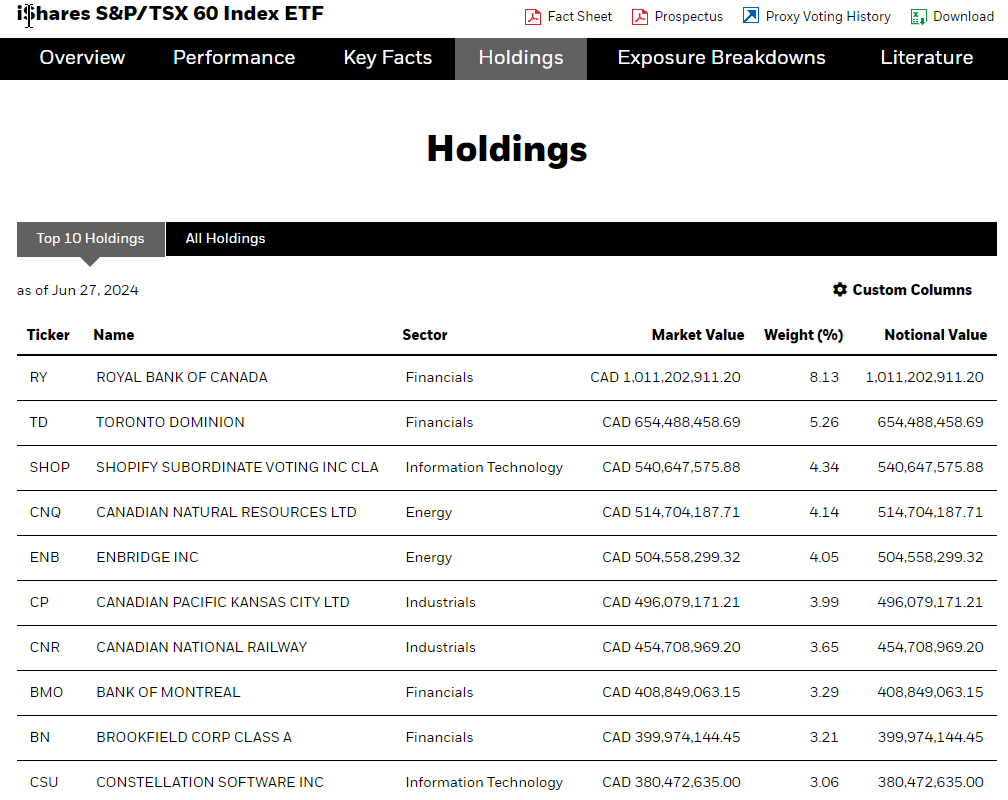
Year after investing year, I consider XIU arguably one of the best products you could own for the Canadian content in your portfolio – it invests beyond Canadian banks, energy, utilities into other important sectors.
XIU delivers income with about 2%-3% yield along with much needed long-term growth to combat inflation.
XIU tracks the TSX 60 so one could argue it’s not so much a dividend ETF (for income) but instead a plain vanilla indexed fund. Given it holds most of the large, established Canadian companies (that pay dividends), I think this is one of the best ETFs in Canada to own.
Top Canadian Dividend ETFs Summary
There are certainly many other Canadian dividend ETFs to consider, including ETF tickers such as PDC from Invesco, XDV from iShares, TQCD from TD Bank and many more however these ones above float to the top of my list.
Whether you decide to own a Canadian dividend ETF or own a few individual Canadian stocks like we do or a mix of both, I believe following the ETF investing principles should apply as a DIY investor:
- Consider diversification as part of your ETF investing approach.
- Keep your investing fees low, as much as you can.
- Be tax efficient where that applies to you. Consider an ETF that delivers *eligible distributions. *See taxation tabs on ETF sites for details. *This way, you can take advantage of tax-efficiency as it relates to our Canadian dividend tax credit when you invest in these low-cost dividend ETFs in a taxable account.
What are your top Canadian dividend ETFs? Do you hold any and if so, which ones and why?
Related Investing Reading:
Thanks for reading and let me know your thoughts!
Mark