TUI Q3 2026 Results: Is the Summer Booking Slowdown Temporary or Real?

TUI’s Q3 2026 results, released on August 12, landed with a familiar mix of headlines: profit down sharply, revenue below forecasts, and a lot of blame pointed at the war in and around Iran. If you only read the top-line numbers, it looks like a bad quarter for Europe’s biggest holiday company. But TUI’s own management pushed back hard on that reading, reaffirming its full-year profit guidance and pointing to a fast-improving booking trend in the weeks right before the results came out.
So which is it? Is TUI’s summer 2026 booking slowdown a temporary hiccup — customers booking later than usual but still going on holiday — or the first sign of a deeper shift in how much Europeans are willing to spend on travel?
This article walks through what TUI actually reported, tests management’s “deferred, not destroyed” narrative against the data, and does the math on whether TUI’s guidance for the rest of the year actually holds up.
TL;DR — Key Takeaways
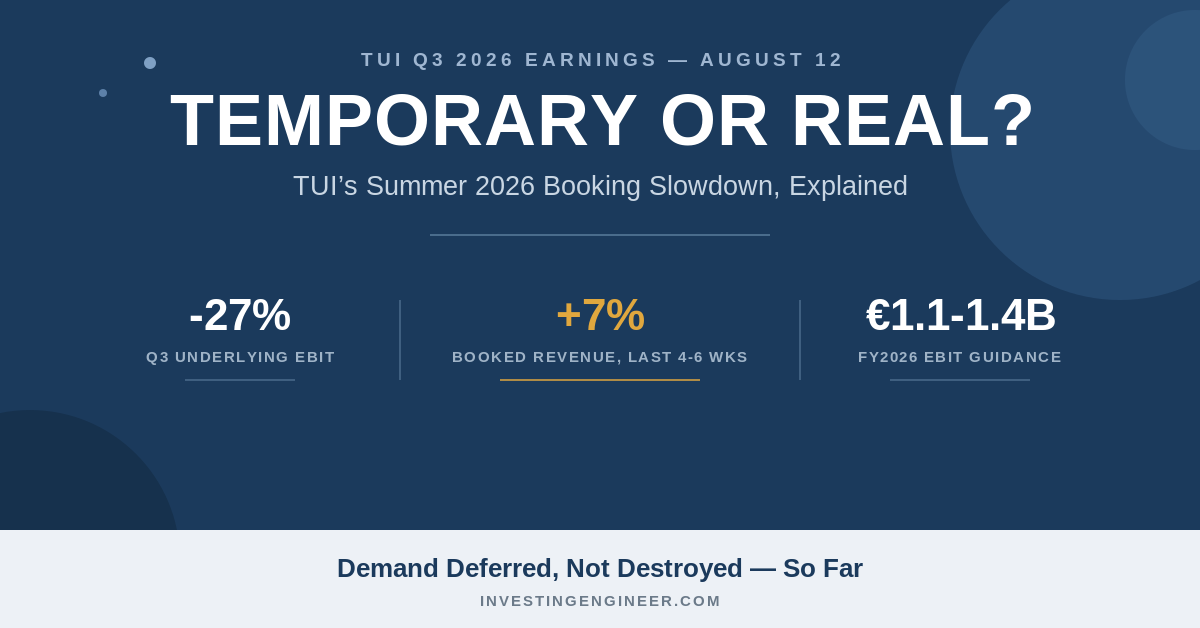
- TUI’s Q3 FY2026 revenue fell about 6% to €5.82 billion, and underlying profit (EBIT) dropped 27% to €233.8 million, missing analyst forecasts of roughly €275 million.
- Around €20 million of that shortfall came directly from the Iran conflict, which disrupted TUI’s cruise ships and pushed up fuel costs.
- TUI reaffirmed its full-year profit guidance of €1.1 billion to €1.4 billion — it did not cut it again after an earlier guidance cut in April.
- Booked revenue for summer 2026 was still running about 6% behind last year, but bookings jumped 7% in the four to six weeks leading up to the results, suggesting the gap is closing.
- TUI’s stock barely moved on the news (down less than 1%), a sign the market had already priced in a weak quarter.
- The evidence currently leans toward “customers are booking later, not skipping holidays” — but hitting the top of TUI’s guidance range will be a genuine stretch.
What TUI Reported in Q3 FY2026
TUI’s fiscal year runs October through September, so its “Q3” covers April through June — the run-up to peak European summer travel. Here’s how the quarter stacked up against the same period a year earlier.
| Metric | Q3 FY2026 | Q3 FY2025 | Change |
|---|---|---|---|
| Revenue | €5.82bn | ~€6.2bn | ≈ -6% |
| Underlying EBIT | €233.8m | €320.6m | -27% |
| Vs. analyst forecast | €233.8m | ~€275m expected | Miss |
| Markets + Airlines EBIT | -€17.4m | +€49.7m | Swung to a loss |
| Hotels & Resorts EBIT | €131m | Roughly flat | ~in line |
| Cruises EBIT | €133m | Lower, but ~€10m better ex-Iran disruption | Iran-related hit |
Underlying EBIT, for anyone new to TUI’s reporting, is the company’s preferred profit measure — earnings before interest and tax, with one-off items like restructuring costs stripped out so quarters and years are easier to compare.
The headline damage is real, but it’s worth being precise about where it came from. Management pointed to roughly €20 million of the shortfall as a direct, quantifiable hit from the Iran conflict: TUI Cruises had to keep ships in Gulf ports for safety, and fuel costs rose across the airline business. That’s not the whole story of the miss, but it’s a meaningful chunk of it, and it’s the kind of cost that doesn’t necessarily recur once the conflict de-escalates.
Segment Breakdown: Not All of TUI Struggled Equally
The quarter’s weakness was concentrated almost entirely in one part of the business. Markets + Airlines — TUI’s tour operator and airline capacity — swung from a €49.7 million profit a year ago to a €17.4 million loss, hit by softer demand, pricing pressure, and higher fuel costs. This is the most commoditized, price-competitive part of TUI’s business, and it’s the segment most exposed to a cautious consumer.
By contrast, Hotels & Resorts delivered €131 million in EBIT, roughly in line with the prior year’s record despite absorbing a roughly €15 million accounting drag from asset revaluations. Cruises posted €133 million in EBIT — lower than last year, but management said the segment would have actually improved by about €10 million year-over-year if not for the direct Iran-related disruption to its ships.
This split matters. TUI has spent the past several years shifting its earnings mix toward higher-margin “Holiday Experiences” — hotels, cruises, and destination activities through TUI Musement — specifically to reduce its dependence on the volatile airline and tour-operator business. Q3 2026 is arguably a live test of that strategy, and on the evidence so far, it held up: the parts of TUI that are supposed to be more resilient were more resilient.
Why the Stock Barely Moved on a Profit Miss
Given a 27% profit decline and a revenue miss, you might expect TUI shares to have sold off hard. Instead, the stock dipped less than half a percent in early trading. The likely explanation: none of this was really a surprise. TUI had already cut its full-year guidance once, back in April, specifically citing the Iran conflict. By the time Q3 results landed, investors had spent months adjusting to the idea that this would be a rough quarter. A miss that’s already been telegraphed tends to do a lot less damage than a miss that comes out of nowhere.
See TUI’s Actual Price Reaction for Yourself
A 27% profit decline that moves the stock less than 1% only makes sense with context — the
market had already priced in a weak quarter after April’s guidance cut. A live chart shows you
exactly how TUI shares behaved around both events, not just the headline number.
The Central Question: Deferred Demand or Disappearing Demand?
Here’s where the article earns its keep. TUI’s argument is that customers are still booking their summer holidays — they’re just doing it later than usual, often to see how the Iran situation develops or to hunt for better prices. If that’s true, TUI’s capacity should eventually fill up and the “slowdown” is really just a change in timing. If it’s false — if consumers are genuinely cutting back — then TUI (and the wider travel industry) has a bigger problem on its hands.
Booked revenue is the metric that lets us test this. It measures how much of TUI’s expected seasonal revenue has already been locked in, compared with the same point a year earlier. As of the Q3 update, summer 2026 booked revenue was running about 6% behind last year — an improvement of roughly 1 percentage point since TUI’s mid-May trading update. More encouragingly, booked revenue over the trailing four to six weeks was up 7% year-over-year, a real and recent acceleration.
Put together, this looks more like a booking curve that’s catching up than one that’s permanently broken. It hasn’t fully closed the gap yet — 6% behind is still 6% behind — but the direction of travel (pun intended) is toward recovery, not further deterioration.
It’s Not Just TUI
If this were purely a TUI problem, you’d expect it to show up only in TUI’s numbers. Instead, the pattern shows up across the sector. Ryanair has reported that summer 2026 booking volumes remained strong, but customers kept reserving closer to departure, with pricing trending modestly below last year. easyJet has leaned further into Mediterranean and North African routes on the assumption that leisure demand, while more price-sensitive, is still there. Lufthansa has been shifting capacity away from weaker routes toward high-demand holiday routes to protect its margins.
None of this proves TUI’s specific numbers are fine — but it does support the idea that “later bookings, more price sensitivity” is a 2026 industry-wide behavior shift, not something unique to TUI’s brand or execution.
The Destination Shift: Spain and Greece Win, Eastern Med Softens
One layer beneath the headline numbers is a clear shift in where Europeans are choosing to go. Spain has reportedly been close to sold out in TUI’s core German source market, and Greece has been closing in on Spain’s level of demand — a genuinely strong signal from two of TUI’s most important Western Mediterranean destinations. Turkey, Egypt, and Cyprus, by contrast, have seen comparatively slower booking growth, tied to their proximity to the broader Middle East conflict and resulting safety concerns, though TUI has noted that late bookings in Turkey have picked up as capacity remained available.
This isn’t necessarily bad news for TUI’s bottom line — a shift toward Spain and Greece, where TUI owns significant hotel capacity, can support pricing power even if the overall mix of destinations looks different than planned. But it does mean the “recovery” in bookings isn’t evenly distributed, and geopolitical risk close to the Eastern Mediterranean remains a real swing factor for the rest of the year.
Bull Case vs. Bear Case
| Temporary Slowdown (Bull Case) | Structural Slowdown (Bear Case) |
|---|---|
| Booked revenue up 7% in the trailing 4-6 weeks | Summer booked revenue still ~6% behind last year |
| Spain and Greece reportedly sold out or near-capacity | Markets + Airlines swung to an outright loss |
| Hotels & Resorts and Cruises held up well | European households show a real, multi-year shift toward shorter, cheaper trips |
| ~5-6% airline capacity cuts show discipline, not panic | Hitting the top of guidance requires Q4 to beat last year’s record quarter |
| Guidance reaffirmed, not cut again | Eastern Mediterranean softness reflects real, not just perceived, safety concerns |
| Net debt trending down, giving TUI more room to absorb a soft patch | “Recovering bookings” hasn’t been proven discount-free yet |
Weighing the Bull and Bear Case Yourself?
Booked revenue up 7% in the trailing weeks, but still 6% behind last year — reasonable people
can read that either way. Pull up TUI’s chart alongside Ryanair and easyJet to see whether the
market is treating this as a sector-wide story or a TUI-specific one.
Can TUI Still Hit FY2026 Guidance? Doing the Math
This is the question that matters most for anyone thinking about TUI as an investment, and it’s one most coverage of these results skips over. TUI has reaffirmed full-year underlying EBIT guidance of €1.1 billion to €1.4 billion. Is that credible?
Step 1: What has TUI already delivered?
Through the first nine months of FY2026 (October 2025–June 2026), TUI’s underlying EBIT totals roughly €123 million — the first half of the year contributed a loss of €111 million (TUI’s winter months are structurally its weakest), and Q3 added €233.8 million. That compares with about €165 million over the same nine months a year earlier.
Step 2: What does the fourth quarter need to deliver?
| Guidance Point | FY2026 Target | Required Q4 EBIT |
|---|---|---|
| Low end | €1,100m | ≈ €977m |
| Midpoint | €1,250m | ≈ €1,127m |
| High end | €1,400m | ≈ €1,277m |
Step 3: How does that compare with history?
TUI’s fiscal fourth quarter (July–September) is by far its most important — it captures the heart of peak summer travel. Last year, TUI’s full FY2025 underlying EBIT came in at €1,413 million, and with roughly €165 million already earned in the first nine months, that means Q4 FY2025 alone contributed around €1,248 million.
What this tells us: Hitting the low end of guidance (€1.1 billion) only requires Q4 2026 to come in about 22% below last year’s record fourth quarter — a bar that looks very achievable given the improving booking trend and deliberate capacity cuts. The midpoint (€1.25 billion) requires Q4 to be roughly 10% below last year’s Q4, which is plausible if the recent booking rebound holds through peak season. But the high end (€1.4 billion) actually requires Q4 2026 to outperform last year’s record quarter — a tall order in a year that’s already absorbed extra fuel costs and geopolitical disruption that FY2025 didn’t have to deal with.
Bottom line: Reaffirming the full range makes sense — the low and mid-points look genuinely reachable on current trends. But treat any talk of hitting the top of that range with healthy skepticism until September’s numbers are in.
Set a Reminder for the Quarter That Decides This
The gap between TUI’s low-end and high-end guidance comes down almost entirely to what happens
in Q4 (July–September). Set a price alert now so you’re watching TUI’s next report in
real time rather than catching the reaction a day late.
Risks to Watch
- A renewed escalation of the Iran conflict, or a new geopolitical shock in another key TUI market.
- Further increases in jet fuel costs squeezing the already-loss-making Markets + Airlines segment.
- A booking recovery that only happens through heavy discounting — protecting revenue on paper while quietly eating into margins.
- Ongoing cost-of-living pressure in Europe’s core outbound markets (Germany, UK) shrinking average trip length and spend even if headline travel intent stays high.
- Currency swings, since TUI reports in euros but earns significant revenue in pounds and dollars.
What This Means for TUI Investors
For existing or prospective TUI shareholders, the Q3 print is best read as “messy but not alarming.” The reaffirmed guidance, the resilience of Hotels & Resorts and Cruises, and the recent booking acceleration all support the case that this is a rough patch rather than the start of a structural decline. TUI has also been steadily reducing net debt and reinstated a small dividend (€0.10 per share for FY2025), both of which give the company more breathing room than it had a few years ago.
That said, the stock isn’t a one-way bet. The gap between what’s needed to hit the low end of guidance and what’s needed to hit the top end is enormous, and investors should treat any “we’re targeting the upper half” commentary from management as an expression of confidence rather than a forecast with the same evidentiary backing as the base case.
If you’re tracking TUI shares through the rest of the fiscal year, tools like TradingView can help you set alerts around TUI’s next reporting dates and watch how the shares react as Q4 booking and occupancy data comes in — useful for separating headline noise from the metrics that actually matter here (booked revenue, occupancy, and whether any late-season recovery comes with discounting).
Trading the Uncertainty, Not Just Watching It?
TUI’s guidance range implies very different outcomes depending on how Q4 plays out —
that’s exactly the kind of uncertainty some traders look to position around rather than wait
out. Pepperstone offers access to TUI shares and related instruments for readers who want to trade
that range directly. As with any trading decision, understand the risks before committing capital.
Frequently Asked Questions
Did TUI cut its profit guidance in Q3 2026?
No. TUI cut its FY2026 guidance once, in April 2026, and reaffirmed that same €1.1–€1.4 billion range after Q3 results in August.
Is TUI’s summer 2026 season a failure?
Not based on the data so far. Summer booked revenue was running about 6% behind last year as of the Q3 update, but the gap has been narrowing, with a 7% booking rebound in the most recent four to six weeks.
Which part of TUI’s business is struggling most?
Markets + Airlines — the tour operator and airline capacity business — swung to a loss. Hotels & Resorts and Cruises were far more resilient.
Why did TUI’s share price barely move after a profit miss?
Because the market had already priced in a weak quarter following TUI’s own guidance cut back in April and months of Iran-related headlines.
Is the travel slowdown affecting all airlines, or just TUI?
It appears to be industry-wide. Ryanair and easyJet have both reported strong booking volumes alongside later booking behavior and price sensitivity in 2026, suggesting this is a broader consumer shift, not a TUI-specific problem.
What would prove the slowdown is structural rather than temporary?
If Q4 booking and occupancy data fail to close the current gap versus last year, or if closing that gap requires heavy discounting that hurts margins, that would support the structural case. A clean recovery without meaningful price cuts would support the “temporary” reading.
Related Reading
Conclusion
TUI’s Q3 2026 results are a genuine miss, driven mostly by a geopolitical shock that hit fuel costs, disrupted cruise operations, and made customers hesitate before booking. But “hesitate” is the operative word so far — not “cancel.” The booking data through early August points toward demand that’s recovering, not collapsing, and the reaffirmed guidance is credible at the low and middle of the range, even if the top end is asking a lot of a single quarter.
Next Steps for the Reader
Keep an eye on TUI’s Q4 FY2026 update (covering July–September, expected around November–December 2026) for the numbers that will actually settle this debate: whether booked revenue and occupancy fully closed the gap with last year, and whether that recovery came with meaningful discounting. Those two data points, more than any single quarter’s headline profit number, will tell you whether 2026’s summer slowdown turns out to have been a blip or the start of something bigger.
Disclosure: The content on this page was produced with AI writing assistance under the editorial direction of a licensed Electrical Engineering practitioner and certified investor in different markets with over a decade of experience. All articles are reviewed and approved by the author before publication.

Post Views: 71