
Anna Mamchur: Symbols That Speak Across Cultures
Mamchur works primarily in acrylic on canvas, creating paintings that remain connected to the observable world while moving beyond direct representation. For her, painting is not an attempt to duplicate reality but an opportunity to organise colour, rhythm, light, scale, texture, silhouette, and form into an expressive visual structure. Landscape, decorative art, figurative imagery, and symbolic composition are not separate categories within her practice but interconnected approaches that investigate recurring ideas. Cultural memory, renewal, belonging, humanity’s relationship with nature, and the continuity of life appear repeatedly, each explored through different visual strategies. Decorative traditions from Ukraine remain particularly influential, not as historical quotations but as living elements capable of carrying contemporary meaning. Her compositions transform familiar motifs into visual narratives that invite reflection while remaining grounded in careful craftsmanship and balanced design.
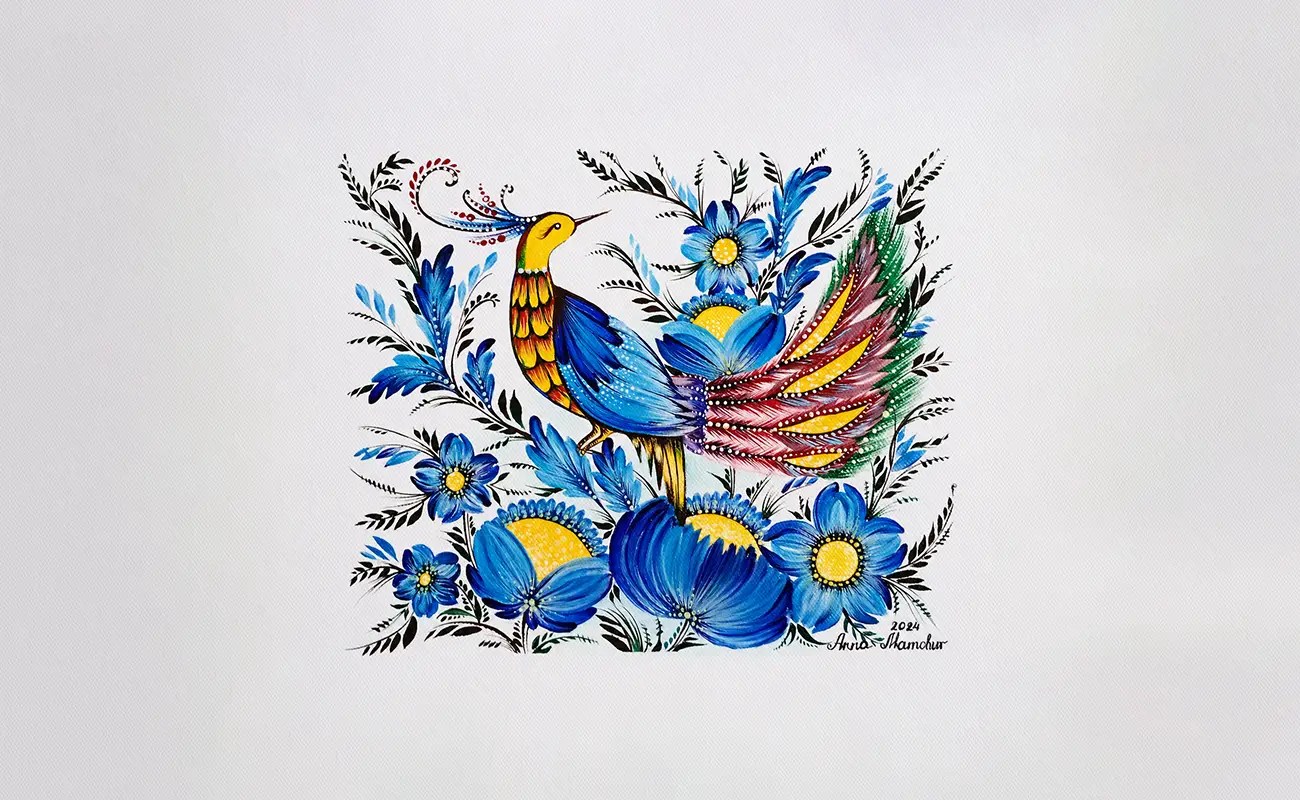
Several works demonstrate this evolving symbolic language with particular clarity. Bird of Renewal presents a fantastical bird surrounded by ornamental botanical forms inspired by Petrykivka painting, creating a vibrant image of vitality, inner freedom, and regeneration. Source of Life shifts toward a more universal visual vocabulary through a central oval form, double spiral, solar signs, and symbols of continuity that address inheritance, transformation, and origin. Berehynia Spirit reinterprets the traditional Ukrainian motanka doll as a contemporary embodiment of feminine strength, cultural protection, and intergenerational connection. Alongside these symbolic works, paintings inspired by French Catalonia, including scenes centred on Mount Canigou and Saint-Laurent-de-Cerdans, reveal how landscape becomes a vehicle for exploring identity rather than merely recording geography. Throughout each series, visual harmony arises from repeated rhythms, measured colour relationships, and carefully considered composition.
Her influences extend well beyond individual artists. Museums, architecture, travel, education, and changing environments all contribute to the development of her artistic thinking. Visits to the Louvre strengthened her appreciation for composition, light, colour, and the physical presence of painting, while Paris itself sharpened her awareness of perspective, architectural rhythm, and spatial organisation. Encounters with the work of Pablo Picasso and Salvador Dalí revealed contrasting possibilities for artistic reinvention and imaginative freedom. Journeys through Rome, Florence, Venice, Pisa, and Milan deepened her interest in the relationship between architecture, sculpture, painting, and urban space. Rather than identifying a single artistic model, Mamchur describes museums, cities, natural landscapes, cultural heritage, and lived experience as her enduring teachers. Together they reinforce an approach in which technical discipline and symbolic expression remain inseparable.