

The Museum’s new special exhibit, Everyday Democracy: Life, Liberty, and the Pursuit of Happiness in Johnson County, explores a powerful idea: democracy isn’t only debated in Congress or written about in founding documents. It is lived in everyday decisions, actions, values, and encounters within our own communities.
From its founding, Johnson County’s residents have valued education and worked to make schools accessible for its citizens. They have worked together – and sometimes against one another – to make education a priority, a part of their definition of what Life, Liberty, and the Pursuit of Happiness truly mean here. Today we highlight five stories about the county’s commitment to education that are featured in the exhibit.

One-Room Schools – Centers of Learning and Community
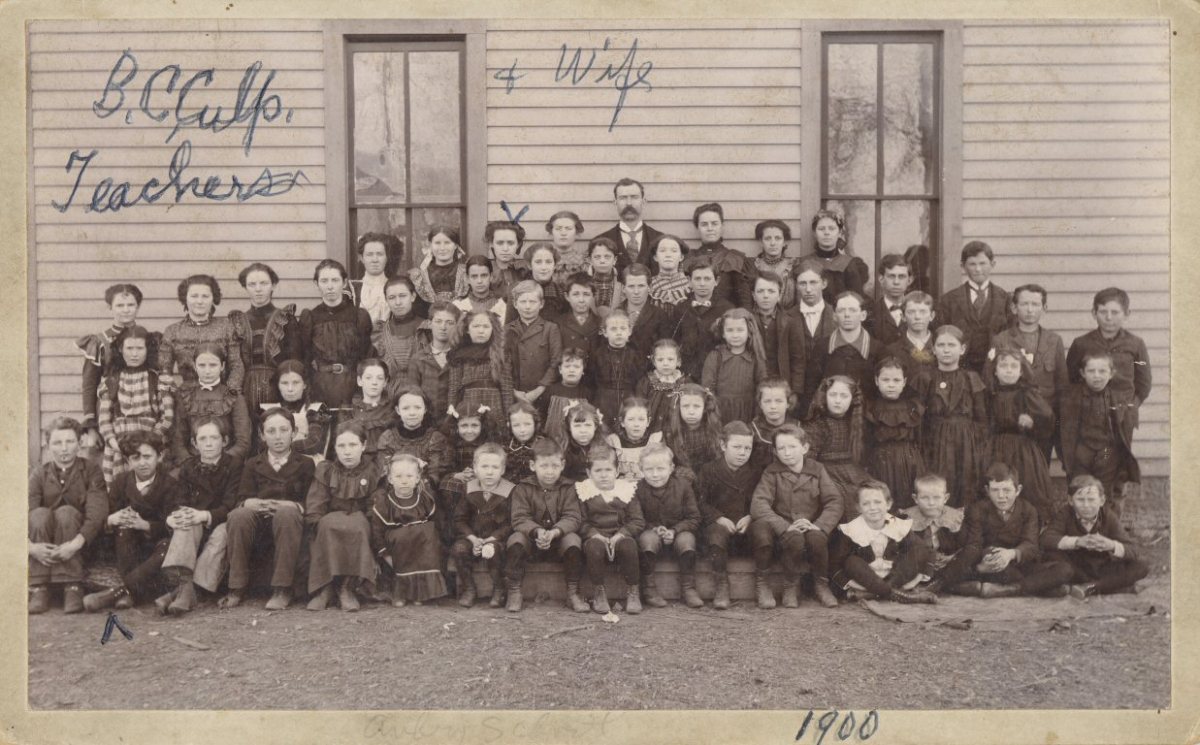
In the late 19th century, Johnson County was a rural, agricultural county. But even in this time of far-flung population, education was an important value to Johnson Countians. One-room schoolhouses were built every few miles so that students could walk to school, leading to 101 across the county’s landscape.
These small wooden or stone buildings served local children, often with just one teacher guiding lessons for up to eight grades. Children learned reading, writing, arithmetic, and history a few miles from home.

Public “common schools” like these reflected early Kansans’ commitment to free education for all, contrasting with fee-based schools established in some neighboring states. Beyond places of learning, these schoolhouses served as community hubs for socials, meetings, and even voting. The one-room schoolhouse made education accessible to local, rural residents at a time when the county’s population was spread out.
Growing Communities, Expanding Education
In the early 20th century, Johnson County’s landscape began to change. Population growth in places like Olathe and Overland Park brought more concentrated town centers, while other areas began early suburban development, as farmland gave way to residential growth.

By the late 1920s, centralized elementary schools began replacing one-room schools in these communities. School buses transported children from more distant areas. Rural high schools were established to better serve these areas, providing education beyond the eighth grade. Shawnee Mission Rural High School (Shawnee Mission North today) opened in 1922, becoming the first high school in northeastern Johnson County. The consolidation of some one-room schools into consolidated districts provided new and better educational opportunities for Johnson County’s growing population.

School for Some, Not for All
Johnson County’s schools were not always equally accessible.
Despite a state statute outlawing the creation of segregated school facilities in towns with less than 15,000 residents (Johnson County’s entire population in 1920 was a little more than 18,300), towns like Shawnee, South Park (Merriam), and Olathe, at times, maintained segregated one-room schools for Black students.

In addition, Black students in parts of the county were often unable to access a local high school education before 1949. For its first 25 years, Shawnee Mission Rural High School did not admit Black students. A 1939-1940 student handbook shows how Black students could continue their education beyond the eighth grade – by private busing to all-Black high schools in neighboring Wyandotte County, such as Sumner High.
The McCallop family operated a private bus line that helped Black students reach these schools, ensuring access to education despite segregation and long travel distances. You can read more about the McCallop family and their community legacy here: JoCoHistory Blog Post.
A 1949 Kansas Supreme Court ruling in the Webb v. School District No. 90 case from South Park required integration of Shawnee Mission schools, five years before the U.S. Supreme Court’s Brown v. Board of Education decision did so nationwide. Even in the face of exclusion, Black families in Johnson County sustained and fought for educational access, and their efforts helped lead to the integration of local schools.

Unifying Johnson County Schools
By 1945, Johnson County’s 101 one-room schoolhouse districts were already beginning to consolidate, often voluntarily, for financial efficiency, convenience, or community preference. The Shawnee Mission School District is one example of this broader trend.
In the 1960s, a new consolidation effort accelerated. A major shift came with House Bill 377 (1963), which mandated the formation of larger “unified districts” to standardize education across Kansas.
These changes were met with considerable local resistance, including concerns about loss of control, job reductions, changes in educational opportunities, and fewer chances for community members to serve on school boards. By 1967, thousands of school districts and one-room schoolhouses across the state had been consolidated into 339 unified districts. Thirteen of the remaining 20 non-unified were in Johnson County, with Shawnee Mission School District unifying last, in 1969.

Despite initial resistance, consolidation ultimately created larger systems that continue to serve the county’s growing population Once it consolidated, the Shawnee Mission School District quickly became one of the state’s most successful systems.
Learning from the Past
These stories highlight the long-standing importance of education in Johnson County and the commitment, conflict, and collaboration that shaped access over time.
Everyday Democracy invites you to explore what Life, Liberty, and the Pursuit of Happiness have meant in this place – and to consider what they mean now, and in the future.
The exhibit is included in regular Museum admission and is open Monday through Saturday, 9am to 4:30pm. To plan your visit, go to JCPRD.com/Museum. You can also view the exhibit’s content online at JCPRD.com/everydaydemocracy.