
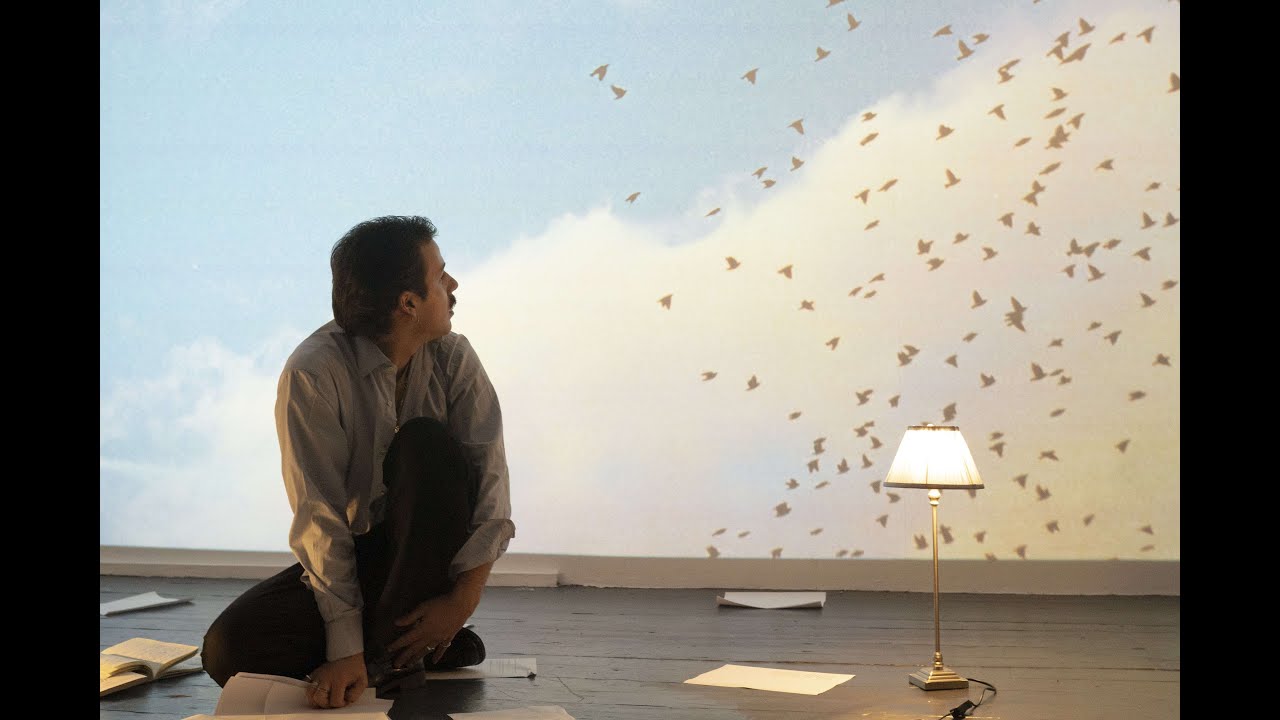
Through film, photography, writing, installation, and performance, London-based French artist Arno Ivaldi turns lived experience into a meditation on memory, distance, desire, and selfhood.
To live, for Arno Ivaldi, is to enjoy life without the need for an audience; to share it, to experience it fully, is the truest expression of freedom. It is a statement that might sound romantic, even declarative, but in Ivaldi’s work it becomes something more rigorous: a method of looking, remembering, withholding, and returning.
The London-based French artist works across photography, writing, moving image, installation, and performance. His practice is multidisciplinary, but not diffuse. Each form appears to belong to a larger inquiry into how experience is shaped, misremembered, performed, and transformed over time. The result is a body of work that moves between intimacy and analysis, personal history and formal experimentation.
Best known for his short cinematic films, Ivaldi, a Royal College of Art graduate, draws closely from lived experience, particularly the intimate terrain of his personal life. His work often turns on desire, memory, family, solitude, and the mutable space where reality and fiction begin to blur. Roland Barthes once wrote that “the Photograph mechanically repeats what could never be repeated existentially,” a thought that resonates with Ivaldi’s treatment of the image as both evidence and failure: a trace of something that once occurred, but also a reminder that the original experience can never be fully recovered.
Describing his practice, Ivaldi sees it as a series of investigations, and the term is precise. His works do not behave like conclusions. They search, circle, interrupt, and return. Personal material becomes less a matter of confession than a form of inquiry: how does one understand oneself through fragments, distances, remembered gestures, and unfinished encounters? In Ivaldi’s hands, autobiography is not presented as a stable narrative but as a shifting field of images, sounds, texts, and silences.
In works such as A Confidential Report of What We Are Looking For, a 13-minute performance, Ivaldi examines connection, family, solitude, and self-knowledge. Developed through long walks across Paris and Europe, the piece brings together writing, photography, sound, and performance. Walking becomes both preparation and structure: a way of thinking through the body, allowing memory and place to shape one another. The work forms a layered meditation on what it means to be alone, to belong, and to understand oneself through movement.
Absence plays a central role in this process. Ivaldi’s works often turn around what is missing, withheld, interrupted, or cut short. In performance, a text may begin and stop before it reaches completion. In photography, a crop may remove the detail the viewer most wants to see. These absences are not decorative gaps; they are active parts of the work. They create tension, inviting the viewer to inhabit the uncertainty between what is offered and what is withheld.
This attention to absence also informs Ivaldi’s understanding of distance. Photography, for him, is not simply a question of proximity or access, but of deciding where to stand in relation to a subject. Drawing on the influence of French photographer Raymond Depardon, Ivaldi treats distance as a form of language. To find one’s voice is also to find one’s distance: the point at which intimacy, restraint, presence, and refusal meet.
That calibration is visible in The Pleasure x2, an early series of black-and-white photographs marked by unease and restraint. Ivaldi lingers on people, places, and gestures, allowing scenes to remain unresolved. The series includes images such as a tiger fish washed ashore and a figure lying face down in a park, dressed in a mac. Some images are blurred, while others are stark and unsettling. In one close-up, a hand holds a kitchen knife in a composition that feels almost cinematic, as though drawn from a horror sequence. Rendered in black and white, the ordinary object becomes charged with ambiguity, its meaning suspended between threat, gesture, and domestic familiarity.

The Pleasure x2
Black and white large
large-format photographs
© Arno Ivaldi
The strength of these photographs lies in their refusal to explain themselves. They hover between document and fiction, observation and staging. A body becomes unreadable. An object becomes symbolic without losing its everyday reality. A scene feels both witnessed and constructed. In this way, Ivaldi’s photographic language echoes the wider concerns of his practice: the instability of memory, the tension between closeness and distance, and the impossibility of fully possessing an image, a person, or a past event.
In many ways, Ivaldi embodies François Truffaut’s idea of the director as author, a figure who gives a work its vision, style, and emotional architecture, even within the collaborative machinery of cinema, and whose 1954 essay in Cahiers du cinéma became foundational for auteur theory. Yet Ivaldi extends this idea beyond film. His authorship is not confined to the screen, but unfolds across a wider field of image, text, sound, body, and installation. Each medium becomes part of the same investigation into how life is remembered, shaped, and made strange through art. For Ivaldi, the investigation itself is the point.

The Pleasure x2
Black and white large
large-format photographs
© Arno Ivaldi
His works suggest that the search is as important as the answer, and that there is pleasure, contentment, and meaning in the act of searching. Rather than offering closure, his practice asks the viewer to remain with uncertainty: with the unfinished sentence, the cropped image, the distant figure, the memory that returns changed.
In this sense, Ivaldi’s work does not simply represent life. It gives form to the fragile, unresolved, and deeply human process of trying to understand it.
© 2026 Arno Ivaldi
Contributing writer at Art Plugged chronicling contemporary art’s beautiful mess, when he can get there. Now edging behind the camera, making insightful documentaries about artists and the work that haunts them. Survives on openings, opinions, one gallery, one artwork at a time. Considers espresso a meal.