

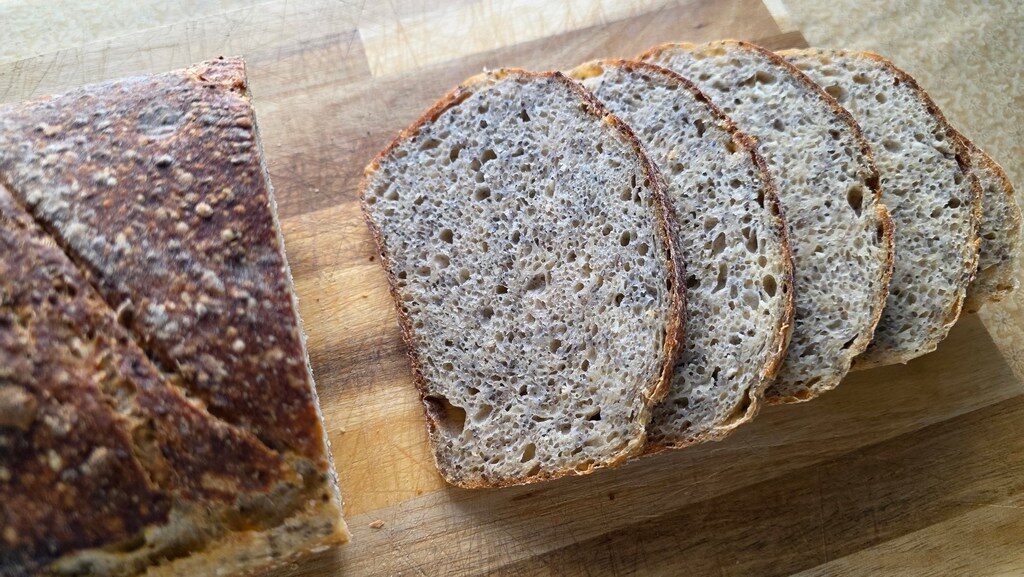
I recently acquired an Emile Henry Pullman/Long Loaf Pan and created this wholesome seeded sourdough bread recipe to fill it. The bread is half whole wheat flour, half strong white bread flour, and full of chia and hemps seeds that add nutty flavor and crackly texture, along with more fiber, protein, vitamins, and minerals.
If you don’t have this pan, you can bake the recipe as-is in a long metal Pullman pan or scale it down for smaller baking vessels. See the recipe notes for more guidance on this. The Emile Henry loaf pan can be preheated like a Dutch oven/clay cloche and used to bake freestanding loaves, or it can be filled with dough for the final proofing stage and then baked from cold or put into a preheated oven. I have always been curious about a “cold start” bake so that’s what I went with here.

5 1/2 cups (720 grams) flour in this bread
See more photos of the steps of this recipe in the Photo Gallery after the recipe.
Seeded Sourdough Everyday Bread


This seeded sourdough everyday bread is packed with flavor, texture, and nutrients from whole wheat flour, chia, and hemp seeds. The crumb is soft and chewy with a little crackle from the seeds and the crust is soft and nutty — perfect for sandwiches or toast.
Total Time
1 hour, 35 minutes
Ingredients
Dough *
Seed Soaker **
- 80 grams chia seeds (1/2 cup)
- 30 grams hemp seeds (3 Tbsp)
- 200 grams water (0.8 cups)
Baker’s Percentages ***
- 100% flour, divided 50:50 between bread flour and whole wheat flour
- 15% seeds (11% chia, 4% hemp)
- 97-106% water, divided
- 20% sourdough starter
- 2.2% salt
Instructions
- My dough had a 7-hour first rise because my starter was a bit sleepy and the dough spent several hours at 67°F before going into my proofing box at 78°F. The final proof at 72°F was a little under 2 hours.
Mixing and First Rise
- Mix the seed soaker, adjusting the water amount if needed. See recipe notes. Cover and set aside.
- In a large bowl or the bowl of a stand mixer, add the dough ingredients, holding back some of the water if you use a less thirsty flour. See recipe notes. Mix until well combined. For stand mixing, use the dough hook attachment and pause to scrape down the sides of the bowl at least once.
- Cover and let the dough rest about 30 minutes.
- Add the seed soaker to the dough and mix for about 5 minutes. For stand mixing, start at a low speed for a couple of minutes, pause to scrape down the sides of the bowl, and resume mixing at med speed.
- Cover and let the dough rise until it has expanded by about 50%. This took about 7 hours for my dough but the timing could range from 4-10 hours depending on the dough temperature and your starter strength.
Shaping and Final Proof
- For a cold start to your bake, prep your baking vessel by lining it with parchment paper. If it is enameled, you can simply grease it.
- Scrape the dough out onto a well-floured work surface and preshape it into a ball. The dough may feel wet-goopy but this is okay as it will bake with side support.
- Let the pre-shaped dough rest about 15 minutes then shape it into a long loaf.
- Transfer the dough to the baker, laying it seam-side down. Cover the dough with the lid and let the dough rise until the center of the loaf almost crests over the rim of the baker.
- Dust the top of the dough with flour, score, and place the lid back on the baker.
Baking
- Put the baking vessel into the cold oven on the middle shelf, set the oven to 450°F, and bake for 40 minutes with the lid on, followed by another 10-20 minutes with the lid off. The internal temperature of the bread should be over 200°F when it is done baking.
- Cool the bread in the base of the baker for about 10 minutes then transfer the bread to a rack to finish cooling.
- Store in a closed container, bag, or beeswax wrap.
Notes
* You can select a different combination of flours based on your preferences and inventory. I chose bread flour and hard white spring wheat to see the seeds better in the crumb. Note that a bread flour with less protein than Breadtopia’s 13.5% will need less water. And on the flip side, some whole wheats e.g. hard red spring wheat could need more water.
The water is given as a range to accomodate different flour choices and seed ratios. At the higher end of the water range, using the given ingredients, the dough is quite wet and challenging to transfer into the baking vessel. At the lower end of the water range, the dough will be more manageable but the crumb may be a bit tighter.
** If you change the seeds in the soaker, you may need more or less water. Start slowly with the water and add more as needed.
*** This recipe is scaled to fill the Emile Henry Pullman/Long Loaf Baker, using 720 grams of flour (about 5 1/2 cups). For a standard batard or boule or to use Breadtopia’s oblong baker, multiply all of the ingredients by 0.7 to scale the recipe down. See more recipe scaling information in our FAQ on how to scale a recipe.